
A construction project can have a solid plan and still struggle if the people and skills it needs aren’t in place. HR solutions for construction companies help coordinate staffing across jobsites, respond to changing labor needs, and organize hiring, time tracking, payroll, and employee support. Labor shortages and turnover can disrupt schedules, strain teams, and make it harder to retain skilled workers.
Construction leaders know these pressures well. Crews shift as projects change, skilled roles can be difficult to fill, and employees need clear communication, practical training, and opportunities to grow. HR is more than paperwork behind the job. It helps companies build consistent workforce practices while giving employees a clearer path to contribute and stay.
This article covers practical ways to manage HR across multiple sites, plan for changing labor demands, strengthen retention, and address skill gaps. Digital tools and consistent processes can support recruiting, time tracking, payroll administration, training records, and workforce planning, helping people operations keep pace with the work.
Key Takeaways
- Connect site-level timekeeping and workforce records with payroll processes to improve visibility across projects.
- Plan hiring around upcoming project needs and set clear staffing triggers before labor demands shift.
- Strengthen retention by pairing competitive practices with skill development, career paths, and regular training follow-ups.
- Use coordinated HR support for hiring, payroll, and workforce administration when managing these demands internally becomes difficult.
1. How can technology help manage a multi-site construction workforce?
For crews spread across jobsites, a shared HR system can bring employee records, time entries, training documents, and payroll information together. Leaders can review workforce details in one place instead of reconciling separate files from each location. Consistent employee classifications and time records, for example, can help teams prepare payroll and certified payroll documentation for applicable projects.
What should construction companies compare when choosing an HR solution? Compare how it handles multi-site records, time-to-payroll workflows, document access, and reporting for certified payroll. Also assess whether it can support consistent processes across locations while accommodating union rules and state-specific requirements. The Fair Labor Standards Act (FLSA) establishes U.S. minimum wage and overtime pay standards and employee classification standards, according to the U.S. Department of Labor. The Davis-Bacon Act sets minimum wage and benefit levels for contractors and subcontractors on federally funded U.S. projects, according to the U.S. Department of Labor.
Compliance tools are most useful when they make routine administration repeatable. Set a standard process for storing employee documents, recording hours, and reviewing payroll details. Keep the employee handbook aligned with workplace policies, then document how revisions are updated and distributed. For a multi-state organization, assign responsibility for reviewing location-specific policies and union requirements, and retain records of which handbook version employees received. Consistent procedures help reduce gaps between expectations and practices at each site.
How can construction companies manage OSHA training, safety records, and incidents with HR software? Record training completion, organize digital training documents by employee, and schedule reviews to flag missing or expiring credentials. Group OSHA-related safety records by site, and use an incident-reporting workflow to capture the event, follow-up steps, and supporting documents. HR software can organize records, but supervisors still need to deliver training, communicate site procedures, and follow up on incidents. A clear audit trail makes relevant records easier to retrieve when reviewing a workplace issue.
2. Construction workforce turnover and fluctuating labor demands
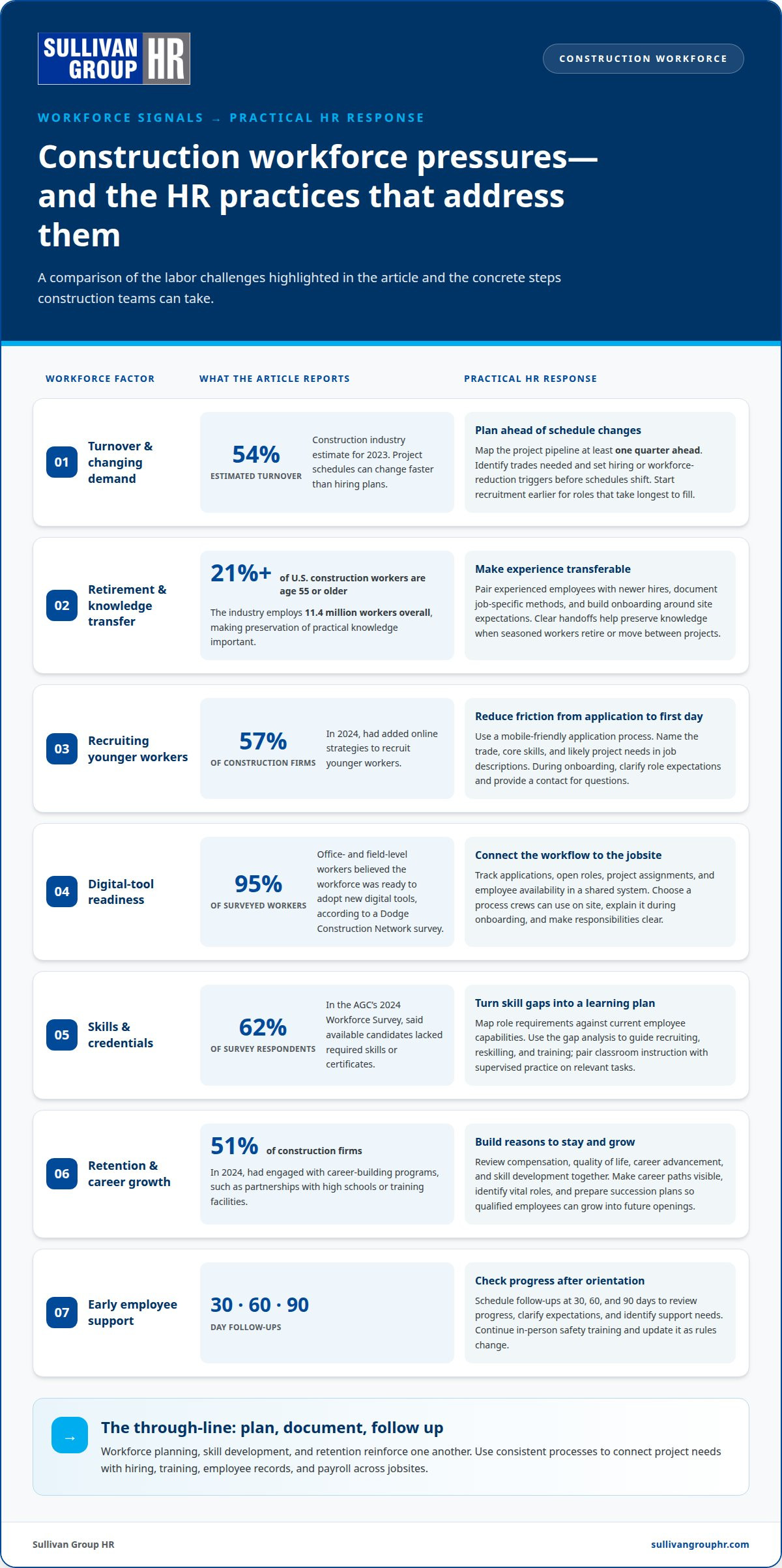
Project schedules can change faster than hiring plans. The construction industry had an estimated turnover rate of 54% in 2023, making workforce continuity a practical challenge. Map the project pipeline at least one quarter ahead, identify the trades each job requires, and set hiring or workforce-reduction triggers before schedules shift. Contractors can also track which roles take longest to fill, then start recruitment earlier for those skills.
Demographics sharpen the challenge. At least 21% of U.S. construction workers are age 55 or older, while the industry employs 11.4 million workers overall. That mix makes knowledge transfer critical: pair experienced employees with newer hires, document job-specific methods, and build onboarding around site expectations. Clear handoffs help preserve practical knowledge when a seasoned worker retires or moves between projects.
Recruitment needs to reach candidates where they look for work. In 2024, 57% of construction firms had added online strategies to recruit younger workers. A mobile-friendly application process can make it easier to apply, while job descriptions should name the trade, core skills, and likely project needs. During onboarding, give each employee clear role expectations and a contact for questions. These steps can help attract applicants and create a steadier start.
Digital tools can connect hiring plans with changing workforce needs. Track applications, open roles, project assignments, and employee availability in a shared system, then review the information when schedules change. A Dodge Construction Network survey found that 95% of office- and field-level construction workers believed the workforce was ready to adopt new digital tools. Yet adoption takes planning: select a process crews can use on site, explain it during onboarding, and make responsibilities clear. To align payroll workflows with changing staffing levels, explore payroll support for construction teams.
Employee retention and skilled labor shortages
Recruiting skilled workers is only part of the challenge. In the AGC’s 2024 Workforce Survey, 62% of respondents said available candidates lacked required skills or certificates. Map the skills each role needs, then compare them with current employee capabilities. Use that gap analysis to guide recruiting, reskilling, and training programs. A learning plan can pair classroom instruction with supervised practice on relevant tasks.
Training should continue after orientation. Schedule follow-ups at 30, 60, and 90 days to review progress, clarify expectations, and identify support needs. Construction HR teams should also provide ongoing, in-person safety training and update it as rules change. These check-ins give supervisors a practical way to catch skill gaps early and help employees build confidence on the job.
Retention depends on more than filling vacancies. Review compensation, quality of life, career advancement, and skill development together. Create visible career paths, identify vital roles, and prepare succession plans so qualified employees can grow into future openings. In 2024, 51% of construction firms had engaged with career-building programs, such as partnerships with high schools or training facilities. Those connections can help develop a future talent pipeline.
Benefits administration also shapes the employee experience. Clear enrollment information, organized records, and timely answers can make benefits easier to understand and use. Pair that administration with regular conversations about workload, development goals, and workplace concerns. Track departure reasons alongside recruiting and training needs. Patterns may reveal whether employees are leaving because of limited advancement, unclear expectations, or another recurring issue. Addressing the causes helps leaders build a more deliberate retention plan and strengthen the workforce.
4. Construction labor shortages and worker retention
Labor shortages affect schedules as well as hiring. In the United States, 54% of contractors experienced project delays because of workforce shortages, while 35% of construction companies experience significant project delays. For an HR team, the practical response is to connect each project’s labor needs with recruiting plans early. Identify roles that could stall critical work, then track open positions, candidate progress, and start dates against project milestones.
Finding qualified talent takes more than posting a vacancy. As many as 80% of construction firms were struggling to find craftworkers. Build a pool of workers from past projects, keep contact details and skills current, and note which candidates are available for upcoming work. This gives HR teams a starting point when project timing shifts. It also helps leaders see whether a shortage reflects a limited candidate pool, a specific skill gap, or hiring timelines.
Give retention as much attention as recruitment. Review why workers leave, where vacancies recur, and which roles are difficult to replace. Then act on the patterns: clarify advancement paths, support skill development, and improve communication between field supervisors and HR. A workforce plan can also include succession planning for vital roles, giving experienced employees a way to pass job knowledge to qualified colleagues before leaving.
Workplace protection is another part of supporting a stable workforce. Keep safety communication and incident follow-up consistent across sites, and make sure employees know how to report concerns. Workers’ compensation insurance is relevant to workforce risk management, but it cannot solve a skills shortage or replace sound retention practices. For help addressing this part of workforce planning, explore workers’ compensation support.
Sullivan Group HR: HCM
Sullivan Group HR helps construction businesses coordinate workforce administration through human capital management (HCM). When hiring needs shift or payroll tasks take time away from managing projects, its services can support essential people processes. The HIRE offering includes applicant tracking, screening, and onboarding. Pay includes payroll, taxes, time tracking, and benefits administration. Together, these services help organize hiring and payroll responsibilities.
Consider this support when growth, multiple sites, or changing crew needs make internal administration harder to coordinate. The right mix depends on where your team needs help, from organizing applications to managing payroll, time tracking, and benefits administration. To discuss HCM support for your workforce, contact Sullivan Group HR or visit sullivangrouphr.com.
Build a workforce plan that can flex
Choose your next improvement by identifying where people operations slow work today. Is it keeping workforce information aligned, preparing for upcoming hiring needs, or giving employees a clearer path to grow? Select one priority, assign an owner, and decide how to review progress. Starting with a focused goal makes it easier to see what needs attention as project demands change.
The right HR solutions for construction companies should fit the way your teams hire, work, and plan across projects. As those needs evolve, revisit your processes and adjust the support around them. Sullivan Group HR can be part of that conversation as you consider your next step. Contact Sullivan Group HR to discuss your workforce needs and move forward with a plan that supports your people and your work.
Frequently Asked Questions
Why is HR important in the construction industry?
HR helps construction leaders connect staffing decisions with active project needs. Before crews begin work at a new site, for example, HR can coordinate onboarding records, clarify reporting contacts, and share workplace policies. This gives supervisors a consistent process for welcoming employees and answering questions. Strong people practices also help employers identify recurring workforce concerns and make informed hiring and retention decisions.
What are the HR challenges specific to construction companies?
Construction HR teams must respond to changing project schedules, hard-to-fill skilled roles, and workforces spread across jobsites. A contractor may need one trade for a new phase while another crew finishes elsewhere. That can complicate hiring, onboarding, time records, and communication. Union arrangements and employees working across state lines can add policy and administrative complexity, so responsibilities and records need clear ownership.
How can technology help manage a multi-site construction workforce?
Technology can give HR and site leaders a shared way to organize workforce information. A supervisor could submit a new-hire update from a jobsite, while HR keeps employee documents and administrative records together. A consistent digital workflow can reduce duplicate entry and make information easier to find by employee or location. Choose processes that crews can reliably follow in the field.
What Are the Responsibilities of HR in Construction?
Construction HR supports the employee lifecycle, from recruiting and onboarding through payroll administration, benefits support, training records, and employee relations. It can help supervisors clarify role expectations, document workplace policies, and direct employee questions to the right person. When a crew member changes roles, for instance, HR can coordinate personnel updates and help ensure administrative records reflect the change.
What are the most critical compliance issues facing construction HR teams?
Key areas include wage and overtime practices, employee classification, project-specific certified payroll, and workplace safety documentation. The U.S. Department of Labor says the Fair Labor Standards Act establishes U.S. minimum wage and overtime pay standards and employee classification standards. For federally funded projects, the Davis-Bacon Act sets minimum wage and benefit levels for contractors and subcontractors, according to the U.S. Department of Labor.
What HR services do construction companies need?
HR solutions for construction companies can bring together services for managing hiring and workforce administration. Applicant tracking, screening, and onboarding can support recruiting, while payroll, taxes, and time tracking help organize related processes. Employee benefits administration and workers’ compensation support may also fit a company’s needs. The right combination depends on which responsibilities are most difficult to manage internally.


