

Employees who believe their pay is fair are 2.8 times more likely to recommend their employer as a place to work. That’s why knowing how to conduct a salary benchmarking study matters: it helps you set pay using relevant market data and clear, consistent criteria. Done well, benchmarking gives you a stronger basis for fair pay decisions and helps you spot when compensation may need a review.
Pay decisions can feel difficult when roles vary, hiring plans shift, and market data comes from different sources. You don’t need to solve everything at once. This guide explains how compensation benchmarking works, how to define and match jobs, and how to choose reliable salary surveys alongside other useful data. You’ll also learn how to set market targets, build practical salary ranges, and revisit benchmarks as your business and the labor market change. The goal is a repeatable process that supports informed decisions, not a one-time spreadsheet that quickly goes stale.
Key Takeaways
- Filter market pay data by location, industry, company size, and stage so comparisons reflect the labor market you actually compete in.
- Choose a target percentile that fits your compensation philosophy, then document why that positioning supports your hiring and retention goals.
- Match jobs by responsibilities and scope, not title alone, and revisit pay ranges as roles and market conditions change.
- Compare multiple reliable sources, including government wage data and current salary surveys, and keep track of the filters used for each role.
Why is salary benchmarking important?
Fair, well-matched pay helps an organization make clearer hiring and retention decisions. Employees who believe their pay is fair are 2.8 times more likely to recommend their employer as a place to work. Salary survey pricing depends on coverage, access terms, and detail; providers give a price after a quote request.
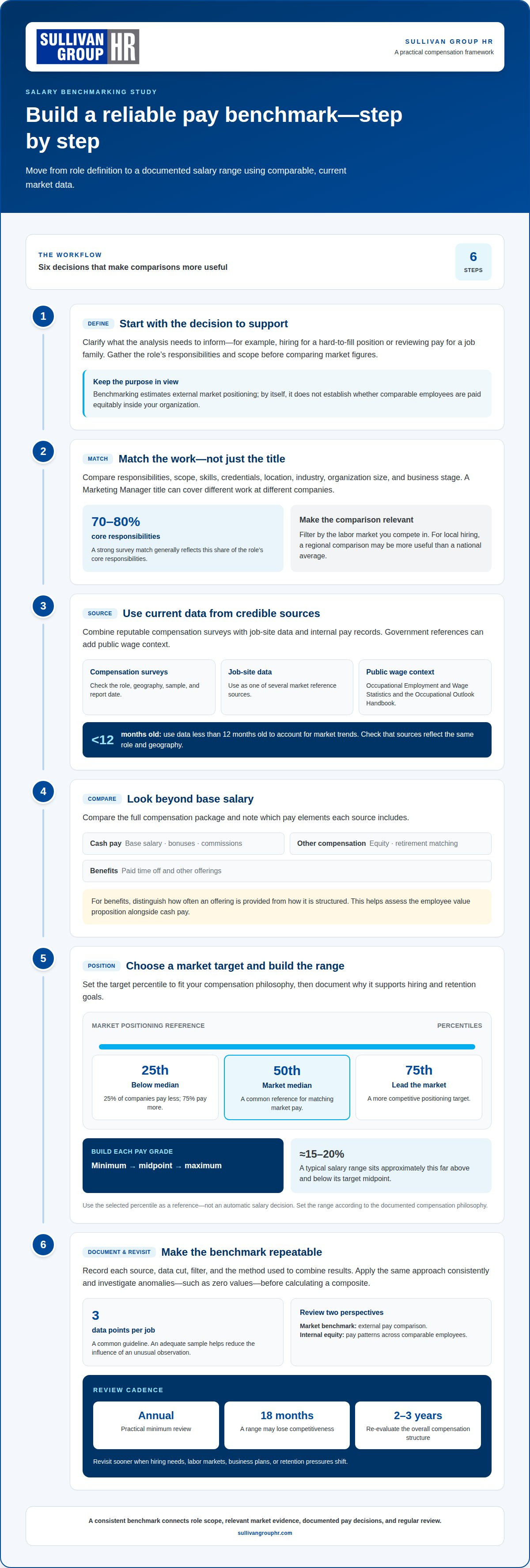
- Filter data to reflect the labor market for each role. Compare location, industry, organization size, and business stage, then consider responsibilities, skills, and credentials. A Marketing Manager’s scope can differ across companies even when the title is the same. A regional comparison may be more useful than a national average when an organization hires locally.
- Use current sources with enough observations for a meaningful comparison. Combine reputable compensation surveys with job-site data and internal pay records. Government references such as Occupational Employment and Wage Statistics and the Occupational Outlook Handbook can add public wage context. Check that each source reflects the same role and geography, and use data less than 12 months old to account for market trends.
- Compare the full compensation package, not base salary alone. Record whether sources include bonuses, commissions, equity, retirement matching, or paid time off. Benefits data can show which offerings are typical among similar employers, while distinguishing how often a benefit is offered from how it is structured. This helps organizations assess their employee value proposition alongside cash pay.
- Combine survey results consistently and document how you handle anomalies, such as zero values. A common guideline is to collect three data points for each job. An adequate sample matters because one unusual observation can skew a market estimate. Record each source, data cut, and filter, and determine whether an outlier is an error or a genuine difference before calculating a composite.
What Is Compensation Benchmarking?
Use compensation benchmarking to compare a position’s pay with market data and guide consistent salary decisions. U.S. pay transparency and equal pay requirements vary by jurisdiction, so account for applicable rules when setting ranges and communicating compensation.
-
Define Benchmarking Purpose
First decide which compensation decisions the analysis should support, such as hiring for a hard-to-fill position or reviewing pay for a job family. Gather role responsibilities and scope before comparing market figures. Benchmarking estimates external market positioning; on its own, it does not show whether employees doing comparable work receive equitable pay within your organization.
-
Set Compensation Philosophy and Target Percentiles
Choose a target percentile that reflects your organization’s compensation philosophy. The 50th percentile represents median market pay, a common reference for matching the market. An employer aiming to lead may choose the 75th percentile, which reflects more competitive positioning. At the 25th percentile, 25% of companies pay less and 75% pay more. Document the rationale and rules for market adjustments or skill premiums.
-
Use Compensation Reports to Set Salaries
Compare reports by matching job responsibilities, location, and pay elements, not titles alone. Check whether each report separates base salary from bonuses or other compensation, and note its data date and sample. Use the selected percentile as a market reference, then set the position’s range according to your documented philosophy. Don’t treat one reported figure as an automatic salary decision.
- Separate market benchmarking from pay equity analysis. Benchmarking compares compensation with external market data; an internal equity review looks for pay patterns across comparable employees, including by job title or location. Review both perspectives before changing salaries, and record the factors behind each decision. For support connecting HR processes with compensation decisions, explore HR support for compensation planning.
Revisiting benchmarks as business needs and markets change
Keep market references connected to current roles, business plans, and internal pay decisions. Review benchmarks regularly and document changes so future comparisons remain consistent.
-
Update Benchmarks as Needs Change
Schedule an annual compensation review as a practical minimum, and revisit sooner when hiring needs or labor markets shift. A pay range may lose competitiveness after 18 months. Re-evaluate the overall compensation structure every two or three years, too. Check whether the organization is expanding, changing its talent strategy, or facing new retention pressures before carrying old benchmarks forward.
- Map market data to internal jobs and levels. Organize roles by job family or department, career track, experience level, and location. Match each position to responsibilities and scope, not title alone. A Marketing Manager at a 20-person company may do different work from one at a 500-person company. A strong survey match generally reflects 70-80% of core responsibilities.
-
Build Salary Bands from Market Reference Points
Set a minimum, midpoint, and maximum for each pay grade using the market reference point and your compensation philosophy. A typical salary range sits approximately 15-20% above and below its target midpoint. Keep the structure consistent across comparable roles, while documenting reasons for different ranges. This gives managers a clear framework for offers, progression, and pay equity reviews.
- Compare internal pay with current market benchmarks. Review employee salaries against the relevant midpoint and range, then flag below-market gaps and patterns across comparable roles. If survey data is effective January 1 but used in September, apply an aging factor based on market trends to estimate current rates. Record the data date, adjustments, and decisions so the next review can build on a clear trail.
Selecting reliable salary surveys
Choose sources that reflect the labor market competing for your roles. Compare their coverage and methods before using the results to guide pay decisions.
-
Select a Relevant Peer Group
Define your peer group by the employers competing for the same talent, not by industry label alone. Consider location, organization size, business type, and hiring market. For example, a regional employer hiring locally may need different comparison data from an organization competing nationally for specialized roles. Confirm that the surveys cover jobs matching a significant share of your positions.
-
Choose Salary Surveys
Use at least two sources, including a government resource such as the U.S. Bureau of Labor Statistics’ Occupational Employment and Wage Statistics and a current salary survey or HR analytics platform. When available, add two to three survey sources to cross-reference market data. Before combining results, compare job coverage, geographic cuts, and reported pay elements. A survey that omits relevant roles may not support sound salary decisions.
-
Assess Survey Reliability
Review each survey’s sample size, participant profile, job descriptions, and data collection approach. Check whether the reported positions match your roles in core responsibilities and scope. Record the survey date, peer group, and filters so later reviews follow the same method. Treat a large sample cautiously if it represents unrelated employers or jobs: volume alone doesn’t make a comparison relevant.
Reliable comparisons help leaders set market-informed ranges and attract or retain top talent. To align workforce processes with compensation planning, explore HCM support.
Sullivan Group HR: HCM
Sullivan Group HR provides HCM to help organizations coordinate essential workforce processes. Once compensation benchmarks are set, payroll records and hiring workflows can support consistent implementation. Payroll Administration and Payroll Outsourcing help manage payroll processes, while the Applicant Tracking System supports applicant management as roles are filled.
Turn to these services when your organization is aligning compensation decisions with payroll administration or recruiting for positions informed by your market review. They support the systems around pay and hiring, while your organization sets its compensation philosophy and salary ranges. For a practical next step, contact Sullivan Group HR or visit sullivangrouphr.com.
Turn Pay Insights Into Consistent Decisions
Knowing how to conduct a salary benchmarking study is only the starting point. Its value grows when leaders use findings consistently, explain the reasoning behind pay decisions, and include compensation in workforce planning. Assign an owner to maintain the study’s records, and give managers a shared process for discussing salary decisions with employees. This creates a clearer path from market evidence to everyday conversations.
Before the next hiring or budget cycle, identify which decisions your benchmark should inform and who needs to act on its findings. Keep the method clear, document the rationale, and ground discussions in the role. This helps teams treat compensation as an intentional business practice rather than a last-minute response to pressure.
For support connecting compensation decisions with your broader HR processes, contact Sullivan Group HR. A thoughtful next step can help your organization move forward with clarity and confidence.
Frequently Asked Questions
How do employers analyze compensation packages?
Compare package components separately before evaluating the overall offer. Review base salary, variable cash such as bonuses or commissions, and benefits such as retirement matching or paid time off. Check eligibility rules and how each item is delivered. For example, a performance-based bonus isn’t equivalent to guaranteed salary, even if both contribute to potential total compensation.
What are the steps to conduct a salary benchmarking study?
To learn how to conduct a salary benchmarking study, first define the roles and decisions the work should support. Gather job details and internal pay records, select relevant market data, and compare like-for-like compensation elements. Review unusual results and examine internal pay patterns separately. Document the methodology, assign responsibility for updates, and prepare guidance so managers can explain decisions consistently.
How do you define roles and match job descriptions to market benchmarks?
Describe the work through key duties, decision authority, expertise, and organizational impact. Match those details to market descriptions, even when titles differ. For example, an “Operations Manager” overseeing one function may not match a role coordinating several departments. Compare actual scope and responsibilities, then record why you selected that market match so another reviewer can follow the decision.
What salary data sources are reliable in the United States?
Combine government wage information with current compensation surveys that offer useful job and geographic detail. The U.S. Chamber of Commerce also recommends government databases, crowdsourced platforms, and industry salary guides as potential sources. Compare what each source measures and whom it represents. Broad occupational estimates provide context, while detailed survey cuts may better fit a specific role or labor market.
How do you compare salaries by job level, location, industry, and company size?
How to conduct a salary benchmarking study well depends on filtering comparisons without losing a meaningful sample. Group roles by level and scope, then apply relevant location, industry, and employer-size filters. Check that each cut represents comparable work and a useful market. Record the filters and job matches so future reviews can reproduce the comparison instead of relying on an unexplained result.
How do you calculate market percentiles and salary ranges?
Sort comparable salary observations from lowest to highest, then identify the market values at the selected percentile points. The 50th percentile is the median; the 25th and 75th show lower and higher positions in the distribution. Use the chosen reference point to inform a range midpoint, then set minimum and maximum boundaries according to the organization’s compensation philosophy and pay structure.


