

A new hire’s first three months need more than a welcome and a stack of training materials. Building an effective 90-day onboarding plan means setting clear priorities across three phases: learning and orientation during days 1-30, applying skills during days 31-60, and taking ownership during days 61-90. The plan gives both the employee and manager a shared path, with goals and check-ins to keep progress on track.
It’s easy to focus on the first day, but confidence and contribution grow through steady guidance over time. A useful plan makes expectations clear while leaving room to adjust support to the person and role. In this guide, you’ll learn how to set role-specific goals, structure early learning, and use manager check-ins, mentoring, and feedback to help a new hire make progress from the start.
Key Takeaways
- Divide the first three months into clear phases so learning, contribution, and ownership build in a sensible sequence.
- Make the first month easier to navigate with focused priorities, essential introductions, and timely access to tools and training.
- Choose role-specific goals that show progress through meaningful work, not just completed onboarding tasks.
- Use regular manager check-ins, a supportive mentor, and candid feedback to spot questions early and keep development moving.
Manager check-ins, mentoring, and feedback
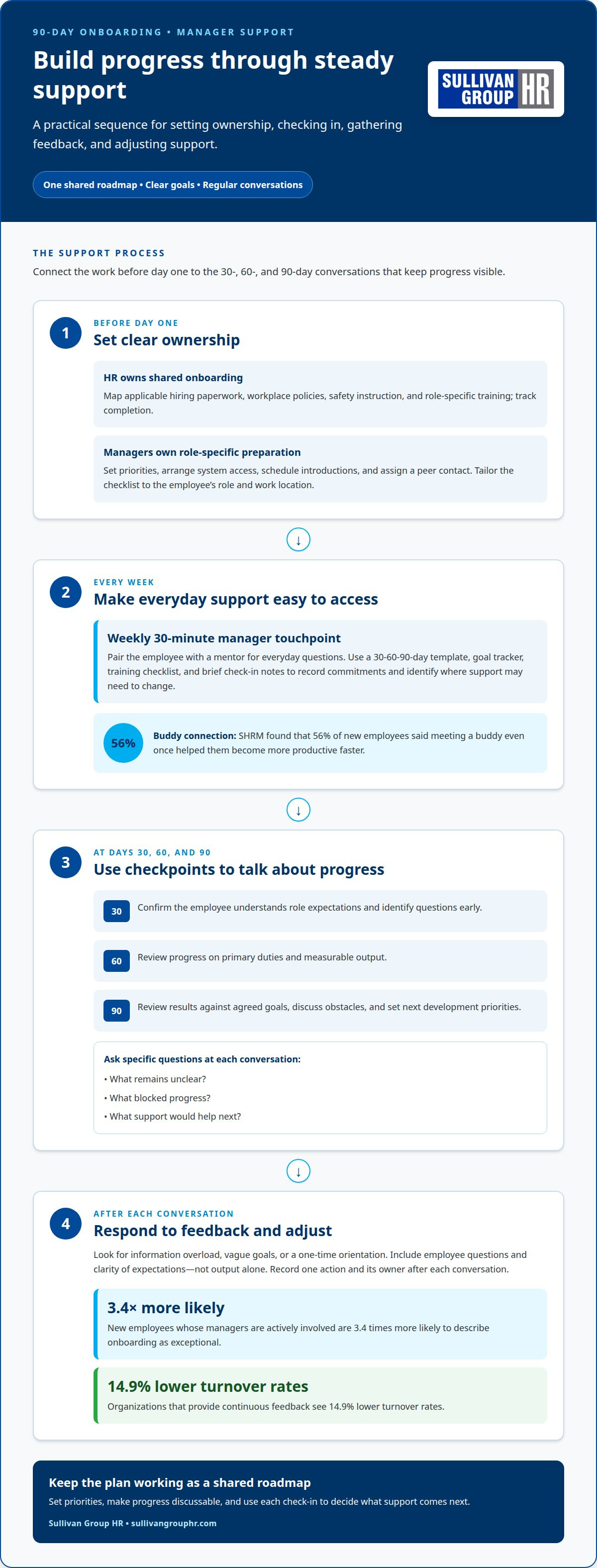
Build manager conversations and practical support into each phase. The 30-, 60-, and 90-day checkpoints make progress easier to discuss.
-
Assign Manager and HR Responsibilities
Give HR ownership of shared onboarding steps and managers ownership of role-specific goals. For U.S. compliance, HR should map applicable hiring paperwork, workplace policies, safety instruction, and role-specific training, then track completion. Before day one, managers should set priorities, arrange system access, schedule introductions, and assign a peer contact. Tailor each checklist to the employee’s role and work location.
-
Set New Manager Onboarding Goals
Set new managers’ first-90-day goals around understanding the team, establishing communication routines, and delegating work. Ask them to meet direct reports, review team priorities, and agree on decision paths with their own leader. Track progress with evidence, such as a completed priorities review and scheduled one-to-ones. Include employee questions and clarity of expectations, not output alone.
-
Schedule Check-Ins and Mentorship
Schedule a weekly 30-minute manager touchpoint and pair the employee with a mentor for everyday questions. SHRM found that 56% of new employees said meeting a buddy even once helped them become more productive faster. Use a 30-60-90-day template, goal tracker, training checklist, and brief check-in notes. These tools record commitments and show managers where to adjust support.
-
Gather Feedback and Avoid Common Mistakes
Ask specific questions during each check-in: what remains unclear, what blocked progress, and what support would help next. New employees whose managers are actively involved are 3.4 times more likely to describe onboarding as exceptional. Use feedback to catch information overload, vague goals, or a one-time orientation. Organizations that provide continuous feedback see 14.9% lower turnover rates. Record one action and owner after each conversation.
Learning and integration during the first 30 days
Use the first 30 days to build understanding before expecting independent performance. Balance structured learning with observation and useful connections.
-
Plan Orientation and Early Learning
Structure the first month around essential knowledge, tools, and role priorities. Start by explaining how the team works, then introduce key systems and required training in manageable blocks. For example, pair a product overview with time to explore its documentation. Avoid loading every policy and process into day one. Use short learning sessions and revisit key information throughout the month.
- Give the employee a practical early win after the initial orientation. A small, low-risk task can help turn new knowledge into action within a couple of days. Explain what success looks like, identify a teammate who can answer questions, and review the work together. This provides a useful measure of understanding without treating the first phase as a test.
-
Support Observation and Relationship Building
Make time for the new hire to observe real work, then discuss what they noticed. Invite them to team meetings, introduce colleagues by role, and pair them with a peer who can explain everyday routines. Build relationships and share company culture through joint projects, informal introductions, and conversations about how the team makes decisions. These activities help new team members understand working norms through real examples.
- Use observation to connect company values with daily actions. For example, after a customer meeting, explain how the team handled a request and why that approach reflects its priorities. Ask the employee to summarize the process in their own words, then clarify gaps without rushing them into solo work. Since 81% of employees report feeling overwhelmed during onboarding, break learning into clear steps and make space for questions.
Role-specific KPIs and measurable goals
Set goals around the work, experience, and decision-making expected in each role. Tailor the roadmap to seniority, then review progress at days 30, 60, and 90.
-
Tailor Goals to Each Role and Level
Start with the role’s core responsibilities, then tailor goals to the employee’s experience and scope. A new sales representative may need product learning and supported client conversations; a senior hire may need to map stakeholders and shape strategic priorities. For a C-suite hire, focus early goals on listening, understanding organizational objectives, and agreeing on priorities with executive peers. Avoid using one generic checklist for every employee.
-
Set Specific and Measurable Goals
Translate each priority into an observable action, a deadline, and evidence of completion. “Learn the sales process” is too broad; shadowing three client calls with a senior team member by day 45 gives the employee a clear target. Pair each goal with the support available and a review point. Check that measures reflect the role’s contribution, rather than activity alone.
-
Choose Role-Specific KPI Examples
For sales, build from learning and practice toward results. For sales, set a realistic target that reflects the employee’s learning and progress. Treat that target as one milestone in a broader progression, including product knowledge and supported calls. For a C-suite transition, choose indicators tied to agreed priorities, such as completing stakeholder discussions and presenting a strategic roadmap.
- Use the 30-, 60-, and 90-day reviews to adjust the plan. At day 30, confirm the employee understands role expectations; by day 60, assess primary duties and measurable output. At day 90, review results against the agreed goals, discuss obstacles, and set the next development priorities. This keeps success measurable while giving managers room to adapt support.
Definition and purpose of a 90-day onboarding plan
Use a 90-day plan as a working roadmap for learning, contribution, and ownership. Its purpose is to turn role expectations, cultural values, and support into clear steps for new team members. A practical part of building an effective 90-day onboarding plan is making those steps useful to both the employee and manager.
- Define the plan’s scope before setting tasks. Map the employee’s first 90 days into three phases: days 1-30 for learning, days 31-60 for applying skills, and days 61-90 for ownership and measurable results. This structure connects early orientation to real work. It also gives managers and employees a shared reference for priorities, questions, and progress.
- Use each phase to answer a different practical question. During days 1-30, what must the employee learn about the role, tools, team, and cultural values? During days 31-60, which skills should they apply with support? During days 61-90, what responsibilities should they own? These prompts keep the roadmap grounded in the actual job and help clarify expectations.
- Make expectations visible in one central plan. Include role responsibilities, learning goals, resources, support contacts, and progress checkpoints. For example, a customer support hire might learn the service workflow, handle cases with guidance, then manage routine cases independently. Building an effective 90-day onboarding plan means connecting each milestone to resources and practical work, so employees can see how learning leads to contribution.
- Use the plan to guide improvement, not to replace ongoing performance management. At each 30-, 60-, and 90-day checkpoint, compare progress with agreed goals, discuss obstacles, and adjust the next steps. By day 90, review how well the employee understands the role and works with the team. Carry longer-term development goals into regular performance conversations.
If your onboarding roadmap needs stronger coordination with broader HR processes, explore HR support.
Sullivan Group HR: HCM
Sullivan Group HR helps organizations coordinate workforce processes through HCM. Its isolved HCM technology brings payroll, HR, time tracking, and benefits administration together, supporting organized workflows as new employees join.
Turn to Sullivan Group HR for support with HCM, payroll outsourcing and administration, and applicant tracking, screening, and onboarding. These services support related workforce processes, while managers continue to set role goals, guide learning, and provide feedback throughout onboarding.
Contact Sullivan Group HR to align workforce administration with your team’s needs.
Make the First Months a Strong Starting Point
An employee’s first months can shape how they approach challenges, build relationships, and contribute over time. Treat the plan as a living agreement, not a document to file away. As work changes and questions emerge, managers can revisit priorities with the employee and refine the next steps together.
That flexibility is central to building an effective 90-day onboarding plan. Keep the employee’s role and development in view, and carry useful lessons from each check-in into ongoing management. The goal is not to make every new hire follow an identical path. It’s to give each person clear direction, practical support, and room to grow into the work.
If you’re ready to strengthen the HR processes around your workforce, contact Sullivan Group HR to discuss a practical next step. A thoughtful plan can help your next hire begin with purpose and build momentum for the work ahead.
Frequently Asked Questions
What is a 30-60-90 Day Plan?
A 30-60-90 Day Plan is a written guide that turns a new employee’s early transition into manageable milestones. For example, a marketing hire might first learn brand tools, then prepare campaign materials with review, and later own a defined project. The plan helps the employee and manager discuss what progress looks like, what support is needed, and which priorities should come next.
What are the key phases of a 90-day employee onboarding plan?
The key phases move from understanding the job, to applying skills, to taking greater ownership. First, help the new hire learn workflows and identify key collaborators. Next, assign work that uses those skills with appropriate guidance. Then increase responsibility and review how the employee handles routine decisions, collaboration, and expected results.
What should a new hire accomplish in the first 30, 60, and 90 days?
By day 30, a new hire should be able to explain core responsibilities and complete basic tasks with guidance. By day 60, they should handle primary duties with less oversight and show work-related progress. By day 90, they should manage regular responsibilities with growing independence. Adjust these milestones for role complexity, prior experience, and the support available to the employee.
How should managers set onboarding goals and measure progress?
Managers should connect each goal to a real responsibility and define what evidence will show progress. For a project coordinator, that might mean maintaining an accurate project tracker and flagging delays promptly. Review work samples, completed assignments, and the employee’s understanding of decisions. If progress stalls, identify whether the barrier is unclear expectations, missing knowledge, or limited access to resources before changing the target.
What check-ins and feedback should managers schedule during the first 90 days?
Use check-ins to resolve current questions and agree on a useful next action. Ask the employee what feels clear, where work is getting stuck, and what input would help. In formal milestone conversations, review examples of completed work and invite the employee to share their perspective first. End each discussion by assigning an owner and follow-up action, so feedback leads to visible progress.


