

Outsourced HR consulting services can pair ongoing HR operations with expert guidance while employees remain under your business’s payroll and brand. Support may include payroll processing, benefits administration, recruitment, training, and employee records and lifecycle tasks.
It’s reasonable to wonder whether outsourcing means giving up control or simply getting advice on a specific challenge. The difference often comes down to scope and duration: consulting typically focuses on guidance for a project, while outsourced support can handle recurring tasks or provide help as needed.
This article explains what HR outsourcing can include, how it differs from consulting, and what to consider when choosing support for your business. You’ll also see how coordinating employee records and lifecycle administration can keep people processes organized as your team evolves.
Key Takeaways
- Map employee records and recurring lifecycle tasks to see which HR operations could be handled with outside support.
- Choose between project-based guidance and ongoing operational help by weighing scope, duration, expertise, budget, and control.
- Identify where external HR support could free up time and bring more consistency to day-to-day people processes.
- Compare service areas such as payroll administration, benefits, recruiting, training, and policy support with your business’s actual needs.
HR records and employee lifecycle administration
An employee record should follow each person from hiring through departure. Create a consistent file for role details, contact information, signed documents, compensation changes, and benefit selections. When an employee changes roles, for example, update the job information and effective date in the same record. Consistent records make current information easier to find without relying on scattered emails or individual spreadsheets.
Build the process around key lifecycle steps: hiring, onboarding, ongoing changes, and departure. During onboarding, collect employee details and record completed forms. When someone changes their address, pay details, or benefits selections, route the update to the right administrator and keep the record current. At departure, document the end of employment and close out relevant administrative tasks. A shared checklist helps track each handoff.
Payroll and benefits administration rely on accurate, timely employee information. A change in hours or compensation needs to reach payroll before it can be reflected in processing. Benefits records should also show current selections and relevant changes. Outsourced support can coordinate these recurring operations, while the business provides employee updates and reviews information for accuracy.
Employee benefits design starts with workforce needs and organizational priorities. Consider which options fit the team, how employees will understand their choices, and how selections will be recorded. Administration covers the practical workflow: communicating available options, collecting elections, and maintaining current records. A clear process connects plan decisions with employee files and payroll administration.
Ongoing HR operations can also include recruitment and employee training. A hiring workflow, for example, may track an application, interview progress, and the onboarding handoff. A training record can show which learning activities an employee has completed. Assign an owner and define how updates move between managers, employees, and administrators.
- Keep employee records current across hiring, changes, and departures.
- Coordinate payroll and benefits updates through clear handoffs.
- Connect benefits choices with accurate administration and employee records.
HR outsourcing versus consulting scope and duration
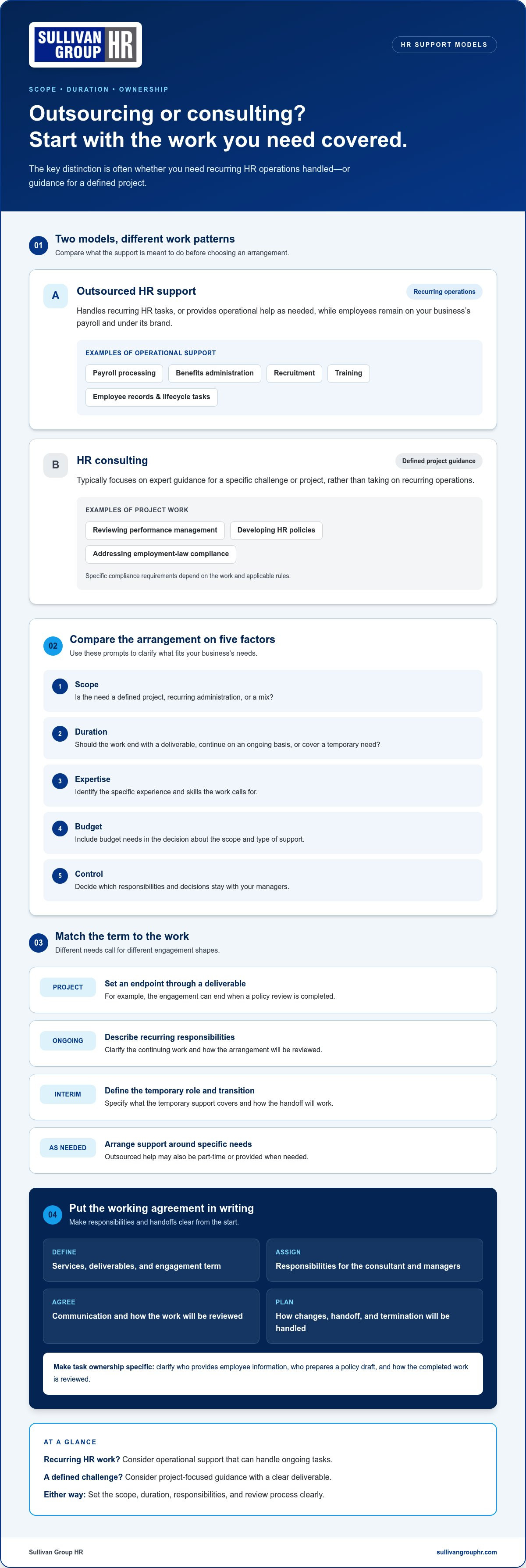
Outsourcing can handle recurring HR operations, while consulting often provides guidance for a defined project. HR consultants can also help businesses address employment-law compliance, though specific requirements depend on the work and applicable rules.
Outsourcing and Consulting Scope
Start by listing the work your business needs covered. Outsourced support may be ongoing, part-time, interim, or arranged as needed. Consulting often focuses on a project, such as reviewing performance management or developing HR policies. Compare the scope, expertise, budget, and control you need. A policy review may call for focused guidance, while recurring administration needs continuing operational support.
Contract Inclusions and Duration
A useful contract spells out services, deliverables, responsibilities, communication, and the engagement term. Clarify which tasks the consultant handles and which remain with your managers. For example, define who provides employee information and who prepares a policy draft. Include how the work will be reviewed, how changes are handled, and what happens during handoff or termination.
Set the duration to match the work. A project contract can define its endpoint through a deliverable, such as completing a policy review. Ongoing support can describe recurring responsibilities and how the arrangement will be reviewed. For interim support, specify the temporary role and transition plan. These details help align expectations as business needs change.
Need help defining a practical HR consulting scope? Human resources consulting can support businesses working through HR projects and complex people-management issues.
Benefits of outsourced HR support
Outsourced support can give a growing business access to HR expertise without assigning every task to one internal role. A manager handling hiring and employee questions, for example, can get help with policy development or performance management. This lets the business focus internal time on decisions that require direct knowledge of its team.
Compared with an in-house HR team, outsourced support can cover selected tasks, ongoing operations, or a defined project. An internal hire provides dedicated capacity within the organization, while outside support can bring specialized expertise when a particular need arises. The right fit depends on workload, desired control, and the skills the business needs.
Another benefit is flexibility as responsibilities change. A company opening a department may need recruitment guidance, while an established team may need help improving employee engagement. Matching the scope of support to the current challenge lets leaders decide what stays internal and what receives outside assistance.
Consistent processes can also strengthen the employee experience. Clear steps for answering policy questions, for example, give employees a reliable point of reference. A structured performance management process can help managers set expectations, document feedback, and plan follow-up. HR support can help shape these steps around the organization’s working practices.
- Protect leadership time. Assign recurring HR tasks externally when managers need more room for hiring, operations, or team development.
- Target expertise. Use consulting support for a defined need, such as revising policies or improving recruitment and retention.
- Keep ownership clear. Identify which decisions stay with leaders and which administrative or advisory tasks receive support.
Before choosing an arrangement, list the HR work that takes the most time. Mark each task as recurring, project-based, or dependent on internal judgment. Then compare the skills, access, and control each approach provides. This review helps a business choose support that fits its actual workload rather than taking on a broader arrangement than it needs.
What services do outsourced HR consulting firms provide?
Services can span advice and practical support. A firm may help revise HR policies, strengthen recruitment and retention, or shape employee training. A business struggling to retain new hires, for example, could review hiring steps, onboarding feedback, and retention practices with an HR consultant. The right scope depends on the problem to solve.
Some work focuses on people strategy. A consultant can help leaders create performance management systems, improve employee engagement, and clarify procedures for managers. A performance process might set expectations, guide feedback conversations, and establish follow-up steps. With outsourced HR consulting services, businesses can seek support for a defined project or complex issue.
- Policies and procedures: Review how managers handle common employee questions and document consistent steps.
- Recruitment and retention: Examine hiring workflows and identify where candidates or new employees need clearer support.
- Employee engagement: Use staff feedback to identify concerns and shape practical follow-up actions.
- Training: Develop learning plans around job responsibilities, manager needs, or a specific workplace process.
- Compliance and performance: Get help reviewing employment-law practices or structuring performance management processes.
To define a useful project, describe the business issue and the outcome you need. Identify who will provide internal information, who will review recommendations, and which deliverables mark completion. A policy project, for example, might produce revised procedures and manager guidance. Clear responsibilities help turn advice into steps the organization can put into practice.
Choose support based on the gap, not a broad service label. A business with inconsistent hiring may prioritize recruitment and retention; a team with unclear reviews may focus on performance management. Define the scope, decision-makers, and deliverables before work begins.
Explore human resources consulting support for help addressing HR projects and complex people-management needs.
Sullivan Group HR: HCM
Sullivan Group HR brings core people operations together through HCM and practical administrative support. If payroll tasks take time away from managing employees, Payroll Outsourcing or Payroll Administration can support that workflow. An Applicant Tracking System can help organize recruitment as hiring needs evolve.
The right starting point depends on where work is becoming harder to manage. A business reviewing its HR processes may benefit from an HCM approach, while a team focused on payroll or hiring can explore the corresponding support. This connects your operational needs with services suited to your priorities.
To discuss which approach fits your business, visit Sullivan Group HR.
Build HR support around your next stage
As your business grows, the next HR challenge may not be obvious at first. Look for recurring work that pulls managers away from leadership, or a people-process decision that needs focused expertise. Define the outcome you want, the responsibilities to keep in-house, and the support that would make progress easier. That clarity makes outsourced HR consulting services part of a deliberate growth plan, not a broad fix for every workplace concern.
Sullivan Group HR offers HCM, Payroll Outsourcing, and Payroll Administration. These options can help organize human capital management or address payroll operations. Start with the task creating the most friction, then discuss how the available support aligns with your needs.
Contact Sullivan Group HR to discuss a practical next step. Your people processes can grow with your business, one clear decision at a time.
Frequently Asked Questions
What is HR outsourcing?
HR outsourcing means assigning selected human resources work to an outside provider while the business remains the employer. Employees stay under the company’s name and payroll, rather than entering a co-employment arrangement. For example, a business might outsource payroll processing but keep hiring decisions and manager conversations in-house. The arrangement can cover specific functions or a wider set of recurring HR operations.
What is the Difference Between HR Consulting and HR Outsourcing?
HR consulting generally provides expert advice for a defined issue or project, while outsourcing can take responsibility for recurring HR tasks. A consultant might help redesign a performance review process, while an outsourced arrangement could also manage ongoing administrative work. Some businesses combine both approaches, using consulting for a specific challenge and operational support for recurring tasks.
How does pricing work?
Pricing depends on the case and is provided after a quote request. The main factors are the services included, how long support is needed, the expertise required, and how much control your team wants to retain. A policy guidance project differs in scope from ongoing payroll operations, so defining responsibilities helps clarify what the quote covers.
How quickly can you get started?
The start date depends on the work’s scope, the information needed, and the handoffs involved. A project may begin once goals and decision-makers are defined; ongoing payroll support also needs a transition plan that accounts for current processes and payroll timing. Prepare existing workflows, relevant records, and internal contacts to establish responsibilities and organize the setup.
What is HR consulting?
HR consulting provides expert guidance to help a business address people-related challenges and improve its HR practices. A consultant might review a hiring process, help shape employee policies, or recommend ways to strengthen engagement. The work usually starts by identifying the business problem, then agreeing on recommendations or project deliverables. Company leaders remain responsible for deciding how to apply that advice.
How much do outsourced HR consulting services cost in the United States?
There’s no single cost that applies to every business. Pricing depends on the case and is provided after a quote request, with scope, duration, expertise, and desired control shaping the work. For a useful estimate, define the problem, the tasks you want handled, and the outcome you need. Those details help distinguish a focused consulting project from ongoing support.


