

83% of surveyed employers used background checks to protect employee and customer safety, according to the Professional Background Screening Association. But a screening result is useful only when it’s relevant to the role and handled fairly. Strong background check compliance for employers connects those responsibilities: informed hiring decisions and a process that respects applicants’ rights.
You may already know that checks can surface criminal-history information. But a standard search doesn’t reveal every record, and a result doesn’t automatically tell you whether it matters for a particular job. The Fair Credit Reporting Act (FCRA) also sets requirements for disclosure and written authorization when employers use a third-party report.
This guide explains what employment checks may reveal, what they may leave out, and why employers screen. You’ll learn how FCRA disclosure and authorization work, along with the steps to take when a report could affect a hiring decision. The aim is a process that supports sound decisions and treats applicants fairly.
Key Takeaways
- Assess criminal records individually by weighing the offense, the time that has passed, and its relevance to the role.
- Understand how separate disclosure and written authorization support compliant use of third-party background reports.
- Account for federal, state, and local rules, since they can affect what employers may ask and when screening can occur.
- Connect screening decisions to job responsibilities and hiring goals, then see how HR systems can support a more organized hiring process.
What do standard background checks not reveal?
A standard background check may not reveal expunged convictions, sealed records, juvenile records, military records, or minor infractions. Military records require a specific request, and a national search should not be treated as a complete picture of every record. Results depend on which records are searched, so don’t treat an incomplete report as a definitive account of someone’s history.
EEOC guidance recommends assessing criminal records individually. Consider the nature of the offense, how much time has passed, and how closely the conduct relates to the job. These factors help distinguish a relevant concern from a record with little connection to the work. For example, a past theft conviction may be relevant to a cashier role involving payments, but may carry different weight in a job with different responsibilities.
Job-relatedness matters. Link each screening criterion to the specific role’s duties and risks instead of applying one rule to every applicant. A criminal record alone doesn’t show how someone will perform now. Review the offense and how long ago it occurred, then consider the position’s responsibilities. Consent to screening allows a search, but doesn’t make every result relevant to hiring.
Fair treatment matters alongside relevance. Title VII, enforced by the U.S. Equal Employment Opportunity Commission, prohibits employment discrimination based on race, color, religion, sex, and national origin. A consistent, role-based review helps employers avoid relying on broad assumptions about people with criminal records. Keep the reasons for a decision tied to the job and the individual assessment.
Keep records of the screening process and decision. The U.S. Equal Employment Opportunity Commission says employers generally must retain background-check records for at least one year after the records were made or after a personnel action was taken, whichever is later. Clear documentation shows what information was considered and why it mattered.
FCRA disclosure and written authorization
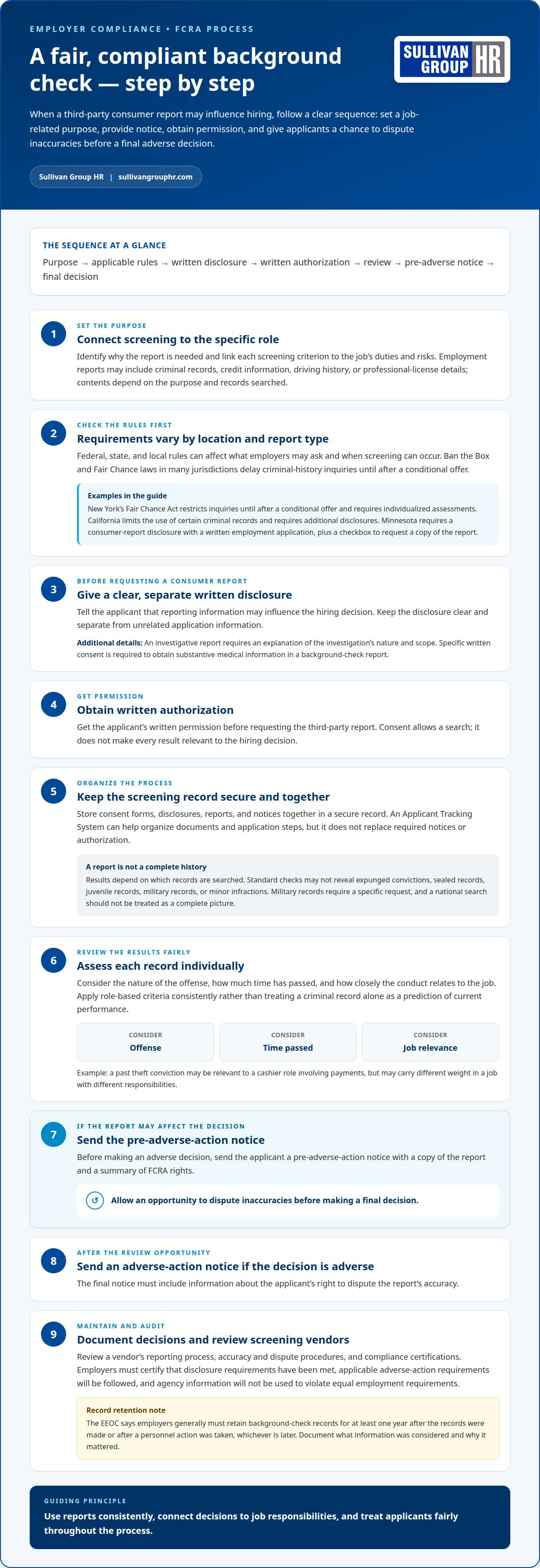
A sound approach to background check compliance for employers starts with clear notice and written permission. The Fair Credit Reporting Act (FCRA) also requires procedures for notices and disputes when a third-party report may affect hiring.
Disclosure and Candidate Authorization
Before requesting a consumer report, give the applicant written notice that reporting information may influence the hiring decision, then obtain written permission. Keep the disclosure clear and separate from unrelated application information. This confirms the candidate was informed and authorized the screening. Employers need specific written consent to obtain substantive medical information in a background-check report. For an investigative report, the applicant also has the right to an explanation of the investigation’s nature and scope.
State and Local Disclosure Requirements
State and local rules may require disclosures beyond federal law. California, New Jersey, Massachusetts, New York, Washington, and certain U.S. cities may require additional applicant disclosures. In Minnesota, employers using a written employment application must provide the consumer report disclosure with it. They must also include a checkbox allowing applicants to request a copy of the report, then obtain and share that copy if requested. Review applicable local requirements before collecting data.
Compliant Background Check Steps
For background check compliance for employers, identify the report’s purpose, provide the required disclosure, obtain written authorization, and follow applicable state and local procedures. Store consent forms, disclosures, reports, and notices together in a secure record. An Applicant Tracking System can help organize hiring documents and application steps, but it doesn’t replace required notices or authorization.
Before making an adverse decision based on a report, send a pre-adverse-action notice with a copy of the report and a summary of FCRA rights. Give the applicant an opportunity to dispute inaccuracies before making a final decision. Then send the adverse-action notice, including information about the right to dispute the report’s accuracy.
To audit a screening vendor, review its reporting process, accuracy and dispute procedures, and compliance certifications. Working with an experienced screening provider such as Elevated Background Checks can help streamline these investigations while ensuring compliance standards are met. Employers must certify to a third-party agency that disclosure requirements have been met, applicable adverse-action requirements will be followed, and agency information won’t be used to violate equal employment requirements. Documenting these checks supports consistency and helps track claims about inaccurate information.
What types of records show up in the employment background check?
Employment reports may include criminal records, credit information, driving history, or professional-license details. Their contents depend on the screening purpose and records searched. The federal Fair Credit Reporting Act governs permissible use and adverse action involving consumer reports; state and local rules can further shape hiring decisions.
State and local restrictions can affect what employers may ask and when. Ban the Box and Fair Chance laws in many jurisdictions delay criminal-history inquiries until after a conditional offer. New York’s Fair Chance Act restricts inquiries until after a conditional offer and requires individualized assessments. California limits the use of certain criminal records and requires additional disclosures; Illinois also protects candidates with criminal records and regulates consumer-data use. These rules can change how employers conduct screening.
Credit-report requirements vary by location. Several states and certain cities prohibit employers from using credit checks in employment decisions. Where credit reports are allowed, the Fair Credit Reporting Act still governs permissible use and adverse-action procedures. Account for applicable restrictions before requesting or relying on credit information.
Driving records and professional licenses are particularly relevant in regulated roles. The Department of Transportation requires driving-history checks, drug and alcohol screenings, and physical examinations for certain transportation jobs. Healthcare screening may include professional-license verification and compliance with Department of Health and Human Services regulations. Match these checks to the role’s actual requirements to support sound hiring decisions.
Federal contractors and regulated employers should align screening with the contract, role, and applicable industry rules. A standard package may not address requirements tied to a particular job. Noncompliance also carries legal risk: Fair Credit Reporting Act violations can result in penalties of up to $1,000 per violation, attorney’s fees, punitive damages, and potential federal enforcement actions. Consistent screening criteria and careful review of report accuracy help reduce avoidable errors.
Reasons employers conduct background checks
Screening can help employers make informed decisions about hiring, retention, promotion, and reassignment. Tie the purpose to a real responsibility of the position, not curiosity about an applicant’s past. For example, driving-history information may matter for a role involving vehicle operation. Education verification can help confirm a qualification the job requires. A focused check gathers information connected to the work.
Safety is one reason employers screen. In a Professional Background Screening Association survey, 83% of surveyed employers said they used background checks to protect employee and customer safety. The same survey found that 51% used checks to improve the quality of hires, while 40% cited a legal requirement. These results point to distinct aims: reduce workplace risk, assess job-related qualifications, and meet applicable obligations.
Different positions call for different information. A healthcare employer may verify a professional license, while a transportation employer may need driving-history information for certain roles. Credit information has a narrower fit because several states and certain cities restrict or prohibit its use in employment decisions. Connect each search to the position and account for state and local rules before screening.
Background checks can support consistent hiring decisions when employers apply the same role-based criteria to applicants. A documented purpose clarifies why a search is included, what information matters, and how it relates to the position. Disclosure and authorization remain essential when using a third-party report. A check alone cannot establish job performance, so weigh relevant findings alongside qualifications and other evidence. The practical takeaway: screen for a defined reason, match the search to the job, and use results within applicable rules.
Sullivan Group HR
Sullivan Group HR helps employers organize hiring and workforce processes through HCM and an Applicant Tracking System. If screening policies, applicant records, and hiring steps are difficult to coordinate, an organized recruiting workflow can help bring them together. Sullivan Group HR also provides Payroll Outsourcing and Payroll Administration to support workforce operations after hiring.
Background screening still requires role-relevant criteria and careful attention to disclosure and authorization rules. Sullivan Group HR supports the broader HR and hiring workflow, while employers remain responsible for fair, compliant screening decisions. It’s a practical next step when you want recruiting and workforce administration to work together more smoothly.
Contact Sullivan Group HR to discuss your HR and hiring needs.
Build a Hiring Process You Can Sustain
Make screening part of a thoughtful hiring process that can adapt as your organization and roles change. A clear internal owner, consistent decisions, and organized HR operations help keep responsibilities visible instead of scattered across teams. This foundation lets leaders focus more on people and business priorities.
Strong background check compliance for employers isn’t a one-time task. Treat it as part of ongoing workforce planning, and revisit how hiring practices fit your organization’s needs as they evolve. When you’re ready to strengthen the connection between HR operations and hiring, contact Sullivan Group HR.
Steady, practical improvements can make complex people processes easier to manage. Choose a clear next step, involve the right team members, and keep building a workplace where confident decisions and people-first practices go hand in hand.
Frequently Asked Questions
Are background checks a one-and-done process?
No. Some industries routinely screen current employees, and another check may be needed when role requirements or applicable rules call for it. A role change, for example, may bring different screening needs. Employers conducting periodic checks on existing employees must obtain written permission. A clear policy can define which roles are covered and what changes trigger a new review.
Is background screening mandatory?
Generally, federal law doesn’t require employers to run background checks for every job. A requirement may apply to a regulated role, industry, contract, or state or local rule. For example, the Department of Transportation requires drug and alcohol screening and driving-history checks for certain transportation roles. Identify the requirements tied to the position rather than assuming every hire needs the same screening.
Do all jobs require the same background check?
No. Appropriate screening depends on the position’s duties, relevant industry requirements, and applicable laws. A job involving vehicle operation may call for a driving-history review, while a role requiring a professional license may need license verification. Credit checks are restricted in several states and certain cities. Keep searches tied to the role to avoid collecting information unrelated to the work.
What disqualifies a candidate?
No single record automatically disqualifies every candidate. Consider the specific offense, the time that has passed, and its connection to the job’s responsibilities. A concern may matter for one role but have little relevance to another. Apply consistent criteria, consider the full application, and give candidates a chance to address inaccurate report information before deciding.
What federal FCRA requirements apply to employer background checks?
The Fair Credit Reporting Act (FCRA) applies when employers use a consumer reporting agency for employment reports. Employers must provide written disclosure and obtain written authorization before requesting a report. If information may lead to an adverse decision, the process includes pre-adverse notice and an opportunity to dispute inaccuracies, followed by final adverse-action notice. State and local laws may add requirements.
What disclosures and written authorization must employers obtain before a background check?
Before requesting a third-party report, give the applicant written notice that the information may influence hiring and obtain written consent. Keep the disclosure and authorization with the hiring documentation. Local rules may add steps. In Minnesota, for example, employers using a written application must include the consumer report disclosure and provide a checkbox for applicants who want a report copy.


