
A remote employee’s work location can change which labor laws your business must follow. Navigating different state labor laws starts with a key rule: employers generally follow the employment laws of the state where an employee works, not where they live. This can make compliance more complex than applying one set of rules across the team.
Federal requirements provide a consistent foundation, but state and local rules can add obligations for pay, leave, and other aspects of employment. Tracking those differences and changes manually can make it harder to keep requirements aligned with each employee’s location.
This article explains what labor law compliance involves and why remote work brings location-specific responsibilities. You’ll learn how state requirements can differ, where manual processes create risk, and how mapping employee work locations helps clarify which rules apply. A clearer view of these obligations can help you build a more reliable approach to supporting your team across state lines.
Key Takeaways
- Understand how federal, state, and local requirements combine to shape labor law compliance.
- See where manual HR tracking can leave gaps as requirements change across jurisdictions.
- Map remote employees by work location to identify which rules may apply to each person.
- Learn how state-specific requirements can affect pay, leave, and job postings.
What is labor law compliance?
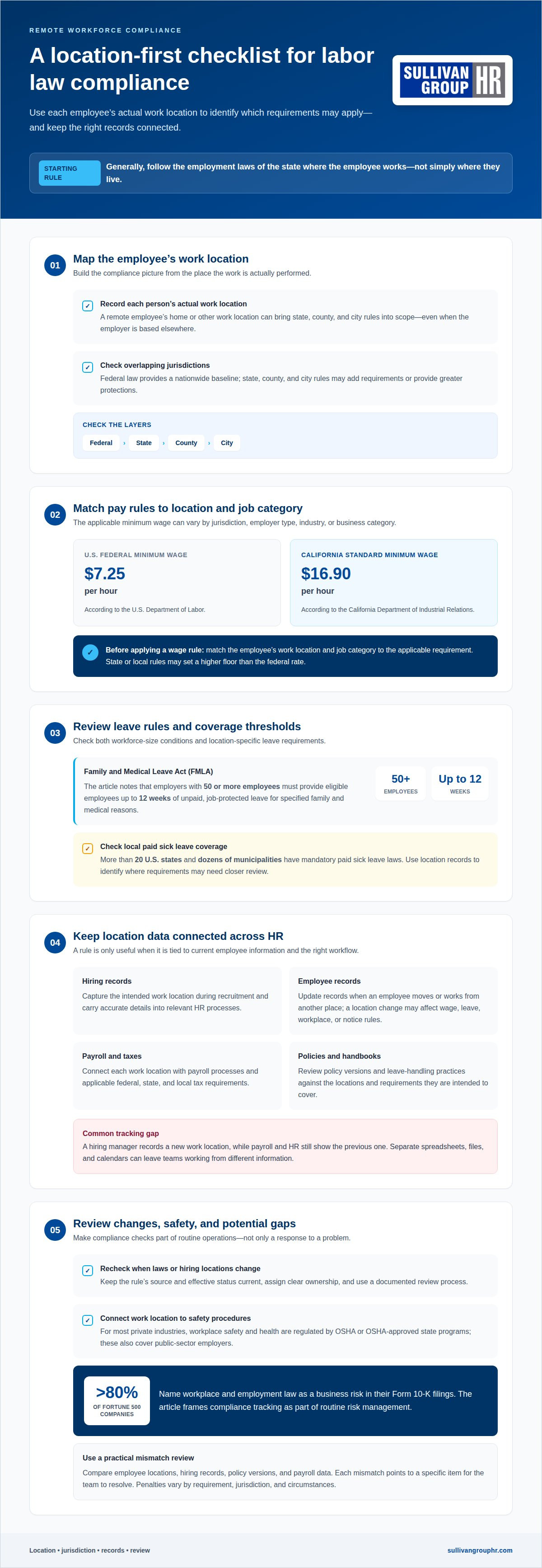
Labor law compliance means applying the employment rules that govern each worker, from federal requirements to state and local standards. For remote teams, an employee’s work location helps determine which rules apply.
Employment Rules Across Jurisdictions
Employment rules overlap across federal, state, county, and city jurisdictions, shaping the employer-employee relationship. Federal law establishes a nationwide baseline, while state and local rules can add requirements or provide greater protections. For example, a remote employee’s city may have a different workplace standard from another employee’s city, even within the same state. Identify the rules that apply instead of assuming one policy fits everyone.
Federal laws also use employer-size thresholds. According to the U.S. Department of Labor, the Family and Medical Leave Act requires employers of 50 or more employees to provide eligible employees up to 12 weeks of unpaid, job-protected leave for specified family and medical reasons. Thresholds matter because coverage can depend on workforce size, while state rules may have different conditions. Employment taxes also have federal, state, and local dimensions, so payroll processes must account for the worker’s employment location and applicable tax requirements.
Minimum Wage by Jurisdiction and Employer Type
Minimum wage requirements set the lowest hourly pay an employer may provide to covered workers, and the applicable rate can depend on location and employer type. According to the U.S. Department of Labor, the federal minimum wage in the United States is $7.25 per hour. A state or local requirement may set a higher floor. California’s standard minimum wage is $16.90 per hour, according to the California Department of Industrial Relations.
Employer and job categories can matter too: requirements may differ by industry or business type within one state. To navigate different state labor laws, match each worker’s location and job category to the applicable wage rule. This review supports accurate pay decisions across a distributed team.
Multi-State Tracking and Violation Penalties
Multi-state compliance tracking means keeping employee work locations and applicable requirements current as teams and laws change. A practical system maps each employee to a work location, records the relevant jurisdiction, and connects that location to payroll and employment policies. This helps employers spot when a move or hire may require different wage, leave, tax, or handbook treatment.
What are the penalties for violating state labor laws? There is no single penalty for every violation. Consequences depend on the requirement, jurisdiction, and circumstances. Tracking applicable rules helps employers identify potential gaps before they become compliance issues.
Manual HR compliance tracking and operational risk
Manual HR compliance tracking relies on people to collect, update, and apply employment requirements across records, spreadsheets, and calendars. Every handoff creates an opportunity to miss an update. For example, a hiring manager may record an employee’s new work location while payroll and HR records still show the previous one. Teams can end up working from different information.
Risk grows when regulations change or hiring expands into another state. Employers need to identify the areas where they hire and track applicable employment laws over time. A spreadsheet can capture a rule, but someone must keep its source, effective status, and connection to the right employee current. Without a clear owner and review process, outdated guidance may remain in use.
The consequences can reach beyond one document. A delayed update to a policy may affect how managers handle leave requests, while an incorrect employee record may disrupt payroll or benefits administration. Medical leave is one example where accurate records and consistent handling matter. The underlying risk is operational: separate files and disconnected workflows make it harder to spot inconsistencies before they affect employees.
More than 80% of Fortune 500 companies name workplace and employment law as a business risk in their Form 10-K filings. That figure underscores why compliance tracking belongs in routine risk management, not only in a response to a problem. A practical review can compare employee locations, hiring records, policy versions, and payroll data. Each mismatch gives the team a specific item to resolve.
Hiring records are an important starting point because location information often begins during recruitment. A structured process can capture the employee’s intended work location and pass that information into relevant HR workflows. An Applicant Tracking System can support organized hiring records; accurate location details still need to carry through the employer’s processes. Clear ownership, documented updates, and regular reviews help reduce the risks created by manual tracking.
Remote workers and location-based legal obligations
A remote worker’s physical work location can determine which employment requirements apply. Their home address may fall under state, county, and city rules that differ from those at the employer’s headquarters. Mapping each employee to their actual work location helps identify the relevant jurisdictions. For example, two employees reporting to one office may work remotely in different states and face different local requirements.
Location records need to stay current as employees move or work from another place. A change can affect which wage, leave, workplace, or notice rules the employer should consider. More than 20 U.S. states and dozens of municipalities have mandatory paid sick leave laws. That makes a location map useful for identifying where leave requirements may need closer review.
Remote work also raises practical questions about workplace safety and workers’ compensation. In most private industries, workplace safety and health are regulated by OSHA or OSHA-approved state programs, which also cover public-sector employers. Connecting a worker’s location with relevant safety procedures and workers’ compensation insurance records helps tie workplace planning and compensation administration to where the work happens.
Location mapping works best as an ongoing record, not a one-time hiring task. A clear process captures a worker’s work address at hiring, updates it after a move, and notifies the teams responsible for payroll, leave, and policies. Each record should identify the worker, their work location, and the date the information changed. These details help teams trace which jurisdictional review may be needed.
Remote arrangements can cross city boundaries without crossing state lines. A worker’s new municipality may have requirements that differ from the previous one, so state-only tracking can miss local obligations. Keep city and county information alongside state details, then connect changes to the relevant HR records. This gives employers a practical basis for reviewing employment policies and compensation processes as teams change locations.
State-specific labor laws
State rules can add workplace requirements beyond the national baseline, so both location and employee status matter. Examples include salary transparency, paid sick leave, safety, and pay practices.
According to the Massachusetts Attorney General, employers with 25 or more employees must include salary ranges in job postings, including for promotions and transfers. More than a dozen states have some form of salary transparency requirement, and more than 20 states and dozens of municipalities have mandatory paid sick leave laws. These examples show why one national policy may need state-specific supplements.
In most private industries, workplace safety is regulated by OSHA or OSHA-approved state programs. Manage workers’ compensation obligations with the employee’s work location in view, so relevant coverage and claims processes align with that state’s framework.
Employee Classification and Contractor Rules
Employee classification determines whether a worker is treated as an employee or an independent contractor under applicable state rules. This distinction matters because status affects which employment protections and employer responsibilities apply. For a remote role, review the worker’s actual duties and working arrangement against the rules relevant to their work location. Don’t assume a classification used for the same role elsewhere automatically applies. For independent professionals and creators establishing their own home-based ventures, platforms like Bunnymama.biz offer digital resources to help launch and market an online business.
Final Paychecks and Wage Deductions
State rules govern final paycheck timing and which wage deductions an employer may make. Requirements can depend on the employee’s state and the circumstances of separation. A sound process identifies the work state, records the separation date, and routes final-pay calculations through the relevant rules. Clear records of pay, authorized deductions, and changes help teams explain how they calculated the final amount.
These differences call for a location-aware review of policies, worker status, and pay processes. If state-specific insurance administration is part of that review, explore workers’ compensation insurance support.
Sullivan Group HR
Sullivan Group HR helps employers coordinate the people and payroll processes that support a distributed workforce. When employee locations, hiring activity, or payroll needs span states, organized HR operations can help keep relevant information connected.
Sullivan Group HR’s HCM, Payroll Outsourcing, and Payroll Administration offerings support workforce and payroll management. Its Applicant Tracking System can help organize hiring information, while Workers’ Compensation Insurance supports a separate part of employee coverage. Together, these offerings help employers manage the operational work behind a multi-state team.
Consider reaching out when manual processes are becoming difficult to manage or your workforce is expanding across state lines. Contact Sullivan Group HR to discuss your HR and payroll needs.
Build compliance into your next stage of growth
As your workforce changes, compliance can become part of how your organization plans and operates, not a task reserved for moments of uncertainty. Make ownership clear, connect employee information to everyday decisions, and build processes that can adapt as your team grows. This steady approach can help leaders focus on people and business priorities while keeping HR responsibilities visible.
Navigating different state labor laws takes coordination across policies, workforce information, and payroll operations. Sullivan Group HR offers HCM, Payroll Outsourcing, and Payroll Administration to support those connected needs. If you’re ready to discuss a practical approach for your organization, start a conversation with Sullivan Group HR.
With the right structure in place, your team can move forward with greater clarity and confidence.
Frequently Asked Questions
How can businesses stay updated with changing labor laws?
Build a recurring review into HR operations rather than relying on occasional reminders. Assign responsibility for monitoring employment rules in each jurisdiction where employees work, then record updates alongside the affected policy, employee group, and implementation date. For example, a change to a city’s leave policy should prompt a review of the relevant handbook language and payroll processes. Keep a record of decisions and revisions.
What state labor laws apply to employees working remotely across state lines?
Generally, the employment laws of the state where an employee works apply, rather than those of the employee’s residence. If a worker moves across a state line, update the work-location record and review the policies and payroll settings tied to that location. Account for applicable county or city rules as well. A remote-work agreement should clearly record the employee’s approved work location.
How do state minimum wage and overtime laws differ?
Minimum wage requirements can differ by state, locality, and employer or industry category. Overtime treatment also depends on the applicable rules and whether the employee is covered and nonexempt. The Fair Labor Standards Act requires covered, nonexempt employees to receive overtime at one-and-one-half-times their regular rate of pay. If a worker’s schedule crosses jurisdictions, confirm the correct work location and applicable pay rules before processing hours.
Which state labor laws govern meal breaks and rest periods?
The rules to consider depend on the employee’s work location, so don’t assume one national break policy covers every state’s requirements. For a remote worker, identify the state where the work is performed, then apply the relevant break requirements to that employee’s role and schedule. Keep policy instructions clear for managers and workers, especially when teams follow different schedules or operate in multiple states.
How do states differ in paid sick leave and family leave requirements?
State and local paid sick leave rules can differ, and more than 20 states and dozens of municipalities have mandatory paid sick leave laws. Family leave requirements can also vary by jurisdiction and eligibility conditions. Keep leave policies tied to employee work locations, and ensure managers know which process applies when someone requests time off. A worker’s situation and the relevant jurisdiction determine which leave rules to apply.
What state-specific requirements apply to hiring, pay transparency, and background checks?
Hiring requirements can depend on the job location and the type of employment information involved. More than a dozen states have some form of salary transparency requirement, so employers may need location-aware job posting practices. Background-check requirements also call for jurisdiction-specific review before a hiring decision. Connect job descriptions, postings, screening steps, and decision records to the role’s location instead of relying on one process for every opening.


