

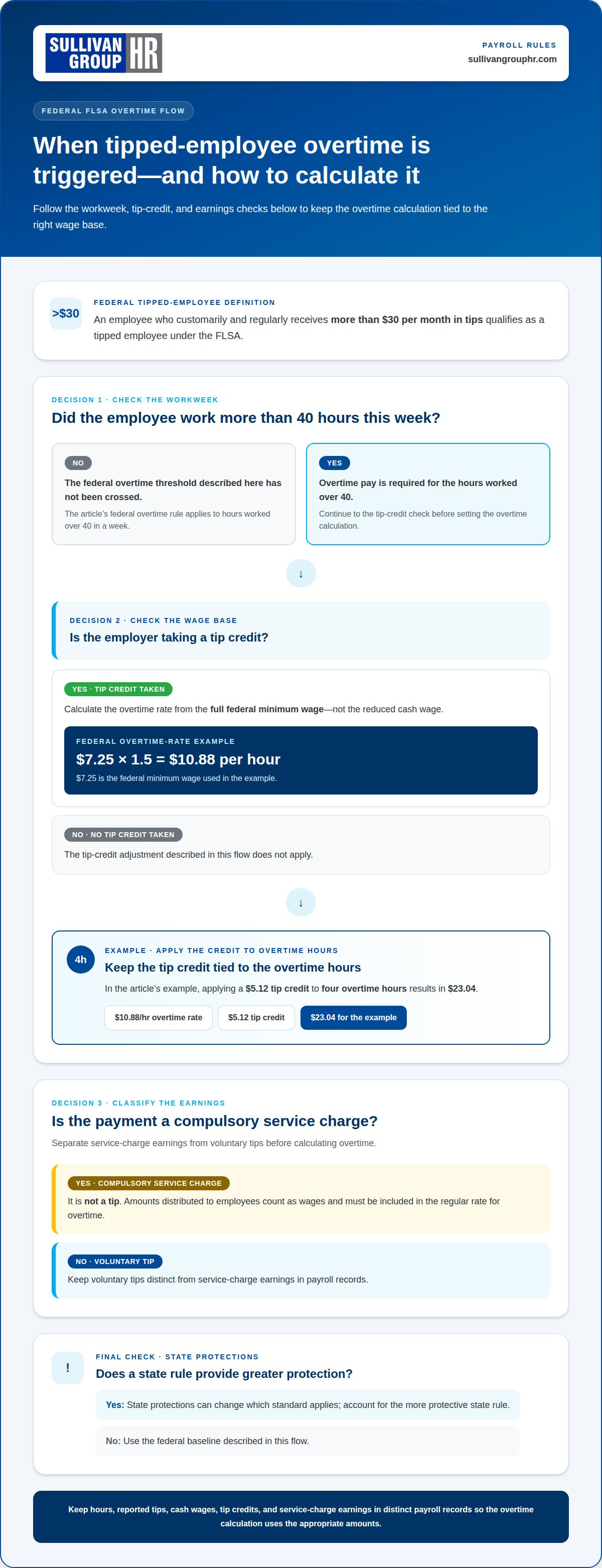
A tip credit doesn’t lower the overtime standard. Under the FLSA, an employee who customarily and regularly receives more than $30 per month in tips qualifies as a tipped employee, according to the U.S. Department of Labor. Employees must receive overtime pay for hours worked over 40 in a week, also according to the U.S. Department of Labor. That makes accurate payroll processing for tipped employees about more than recording tips: the overtime calculation must also account for any tip credit correctly.
It’s understandable to start by asking who qualifies as a tipped employee. But accurate pay calculations matter just as much, especially when cash wages, tips, and overtime hours fall in the same workweek. This article explains how federal law treats tipped employees, how reported tips affect payroll, when employers must make up a tip-credit shortfall, and how to calculate federal overtime.
State protections can change which standard applies. Understanding the key rules makes it easier to see what payroll processing for tipped employees must account for.
Key Takeaways
- Understand which employees meet the federal definition of tipped employees and how that affects payroll treatment.
- Learn what payroll reviews when matching reported tips to wages and identifying a tip-credit shortfall.
- See why overtime calculations must account for the tip credit and any more protective state rules.
- Recognize how payroll administration and HCM support consistent handling of tipped employees’ pay.
How a payroll provider reviews reported tips and tip credit make-up amounts
Payroll brings reported tips, cash wages, and hours worked together. Reviewing them shows whether a tip credit is supported and whether wages need an adjustment.
Reported Tips and Make-Up Amounts
Reported tips help determine whether an employee’s cash wages and tips reach the applicable minimum wage. A tip credit reduces the employer’s direct wage obligation, subject to federal requirements. For each workweek, payroll compares reported tips and cash wages with hours worked to identify any shortfall the employer must make up.
According to the Internal Revenue Service, employees must report tips over $20 per month for tax purposes. If no daily reporting system is used, the Internal Revenue Service requires employees to report tips to their employer by the 10th of the following month. Payroll records can then reflect reported tips alongside wages for the relevant pay period.
For example, if an employee receives a $2.13 hourly cash wage and tips do not bring total pay to the $7.25 federal minimum wage, the employer must cover the difference for that workweek when claiming the federal tip credit. Employees must report tips over $20 per month for tax purposes; underreporting may lead to a penalty equal to 50% of Social Security and Medicare tax on unreported tips, plus an additional 20% IRS penalty.
Credit-card tips also require accurate handling. An employer may deduct only an amount equal to the card company’s transaction fee. The employee’s remaining tip is due by the regular payday, not when the employer receives reimbursement from the card company.
Reporting tips after tip pooling through a payroll provider
Tip pooling redistributes tips among participating employees, so payroll records should show each worker’s share, not just the pool total. Each employee’s share matters for individual tip reporting and wage calculations.
For example, an employee who receives $400 in monthly tips and gives one-fourth to another employee reports $300, while the recipient reports $100. A payroll provider can reconcile the pool distribution with employee reports, then carry those individual amounts into payroll and tax records. Clear records help distinguish tips received from tips contributed.
Who qualifies as a tipped employee under federal law?
Under the FLSA, a tipped employee customarily and regularly receives more than $30 per month in tips, according to the U.S. Department of Labor. The Fair Labor Standards Act also sets the federal baseline for tipped workers’ wages and overtime. Payroll software can organize reported tips, tip allocation, tip credits, and hours worked so payroll calculations use consistent records.
That classification matters when calculating overtime. According to the U.S. Department of Labor, employees must receive overtime pay when they work more than 40 hours in a week. A payroll provider totals each employee’s hours and earnings, then calculates overtime using the full federal minimum wage as the base when an employer takes a tip credit, not the reduced cash wage.
For example, the federal overtime rate in the provided calculation is $10.88 per hour, based on 1.5 times the $7.25 federal minimum wage. After applying a $5.12 tip credit to four overtime hours, the resulting amount is $23.04. This calculation keeps the credit tied to overtime hours instead of treating the employee’s regular cash wage as the overtime-rate base.
Service charges require separate treatment. A compulsory service charge is not a tip, even if the business distributes part of it to workers. Amounts paid to employees count as wages and must be included in the regular rate for overtime. Payroll should therefore distinguish voluntary tips from service-charge earnings before calculating overtime.
Tip allocation also requires distinct records. The provided allocation benchmark is 8% of gross receipts, excluding service charges and carryout fees. A payroll provider can compare tip records with that benchmark and account for any allocated amount separately from tips employees reported. This keeps tip-credit and overtime calculations tied to the right earnings categories.
For coordinated records across hours, tips, and wages, payroll support can help keep these calculations together.
How a payroll provider sets up a global tip credit make-up pay code
A consistent make-up pay code can apply the same shortfall calculation across tipped employees. Payroll compares wages and tips with the applicable minimum wage for each workweek.
Minimum Cash Wage and Tip Credit Amounts
The cash wage is the direct amount an employer pays, while the tip credit counts eligible tips toward minimum-wage obligations. According to the U.S. Department of Labor, an employer taking the federal FLSA tip credit must pay a tipped employee a direct cash wage of at least $2.13 per hour.
The federal tip credit can cover up to $5.12 per hour, bringing that cash wage to the $7.25 federal minimum wage. A payroll provider uses separate earning codes for cash wages, reported tips, and make-up pay. This separation shows how each amount contributes to the minimum and helps prevent a shortfall from being obscured.
Federal Minimum Wage and Tip Credit
According to the U.S. Department of Labor, the federal minimum wage used to calculate the FLSA tip credit is $7.25 per hour. Employers can count tips toward that minimum only through the tip-credit system, rather than treating tips as direct cash wages.
The make-up pay calculation compares cash wages and eligible tips with the minimum owed for each workweek. If the total falls short, payroll adds the difference as wages. A surplus in one workweek does not offset a shortfall in another.
Tip Credit Rules and Employer Notice
The FLSA tip credit allows an employer to count eligible tips toward minimum-wage obligations, subject to required employee notice. Employers must provide the required information about the credit; otherwise, they cannot take it.
Payroll must account for the tip-credit notice requirement and add make-up pay if an employee’s cash wages and tips fall below the federal minimum wage in a workweek. State law may set a more protective standard, which takes precedence. Apply the relevant wage floor rather than assuming one federal setting works for every location.
How a payroll provider sets up FLSA overtime rules for tipped employees
Start with the Fair Labor Standards Act workweek and the employee’s recorded hours. When hours exceed the federal overtime threshold, payroll separates regular and overtime earnings. Before finalizing the calculation, review time records, job duties, tip-credit settings, and applicable state rules.
When an employer takes a tip credit, the overtime calculation uses the full federal minimum wage as its base, not the reduced direct cash wage. Keep the tip credit separate from the overtime-rate calculation. If state law provides greater protection, apply that standard rather than relying only on the federal rule.
Job duties matter, too. For an employee with a dual job, an employer cannot take a tip credit for hours spent in a non-tipped occupation. Record those hours separately so the credit applies only to eligible tipped work. A manager’s title alone does not determine tip eligibility, and federal rules restrict certain managers or supervisors from keeping employees’ tips.
Tip pools need their own controls. When an employer takes a tip credit, pooled tips may be shared only with workers who customarily and regularly receive tips. Document the distribution and each worker’s hours, job classification, and earnings. These records help show how the overtime rate was determined and which hours qualified for a tip credit.
Record service-charge distributions under a separate earning category. Because these amounts count as wages, they are included in the regular rate for overtime calculations. Reviewing earning codes, time records, tip-credit treatment, and state rules together helps identify and document adjustments before payroll is finalized. It also keeps one employee’s classification from being applied automatically to every role.
Get support with tipped-employee payroll calculations when overtime rules and tip-credit records need coordinated administration.
Sullivan Group HR: Employee Benefits Management
Sullivan Group HR connects payroll administration with Employee Benefits and HCM. When tipped wages, overtime calculations, and benefits administration all need attention, coordinated support can help employers manage these responsibilities.
Sullivan Group HR provides Payroll Outsourcing and Payroll Administration to support employee pay processing, including the records and calculations involved in tipped payroll. Employee Benefits supports another part of workforce administration, while isolved HCM technology brings workforce functions together. These services can help businesses coordinate payroll and benefits within their broader operations.
For employers who need help coordinating these responsibilities, contact Sullivan Group HR to discuss your needs.
Build a steadier payroll process
Make tipped payroll part of a consistent operating routine. Sullivan Group HR combines payroll, HR, and employee-benefits solutions, with a dedicated specialist for each client. This support helps connect compensation records with the processes behind workforce administration as staffing or pay practices change.
Sullivan Group HR offers HCM, Payroll Outsourcing, and Payroll Administration, supported by isolved HCM technology. For help coordinating payroll and broader workforce management, contact Sullivan Group HR to discuss your needs. A sound approach to payroll processing for tipped employees helps keep pay calculations and records organized.
Take the next step at a pace that works for your business. Discuss payroll support with Sullivan Group HR and explore a practical path forward with a supportive partner.
Frequently Asked Questions
Tax Requirements: Are Tips Taxed?
Yes. Tips are taxable income, and the Internal Revenue Service says employees must report tips over $20 per month for tax purposes. Cash and credit-card tips belong in employee tip records. Noncash tips aren’t reported to the employer, but their value is taxable on the employee’s income tax return. Keeping these categories distinct supports accurate payroll and tax reporting; for broader financial governance and bookkeeping compliance, chartered accountancy firms such as Fair View Accounting Services help business owners maintain structured payroll and accounting records.
What Is Considered a Tip?
A tip is a voluntary customer payment in an amount the customer chooses, rather than an amount set by the employer or negotiated with them. A customer-selected cash amount or card addition can qualify. A compulsory service charge is different: it is a fixed charge, not a tip. If distributed to employees, it counts as wages and is included in the regular rate for overtime calculations.
What Is a Tip Credit?
A tip credit is the portion of eligible tips an employer may count toward federal minimum-wage obligations. According to the U.S. Department of Labor, an employer taking the federal FLSA credit must pay a direct cash wage of at least $2.13 per hour; the maximum federal credit is $5.12 per hour. Employers can’t keep employees’ tips, whether directly or through a tip pool.
What Payments Are Tips?
A payment is a tip when the customer chooses to give it and decides the amount. For example, a customer may leave cash or add a chosen amount to a card payment. A business-imposed service charge does not meet that test, even if employees later receive part of it. Payroll records should distinguish the two because tips and service-charge distributions receive different wage and overtime treatment.
How Does a Payroll Provider Calculate Payroll for Tipped Employees?
Payroll processing for tipped employees brings each worker’s hours, cash wages, reported tips, and tip-pool share into the pay calculation. Payroll checks whether wages and tips meet the applicable minimum, adds make-up pay for any shortfall, and calculates overtime using the correct rate. Job coding matters, too: a tip credit cannot apply to hours worked in a non-tipped occupation.
What Is the Federal Minimum Cash Wage for Tipped Employees in 2026?
The federal FLSA direct cash wage stated by the U.S. Department of Labor is at least $2.13 per hour for an employer taking a tip credit; the fact is dated as of May 2021. State or local law may require a higher wage, so this federal figure doesn’t establish the required cash wage in every location in 2026.


