

Understanding payroll tax reciprocity agreements starts with a simple rule: when a qualifying agreement applies, an employee who lives in one state and works in another generally has state income tax withheld for their resident state, not their work state. There are 30 state reciprocity agreements, but the rules depend on the states involved and the required exemption form. Reciprocity affects state income tax withholding; it doesn’t change federal income tax withholding or FICA obligations.
Remote and hybrid work can make payroll tax reciprocity agreements harder to understand because an employee’s actual work location matters. This article explains which state pairs have agreements, how employees document eligibility, and what withholding may involve when no agreement applies. It also clarifies why working from home in your resident state differs from crossing state lines for work, and which payroll details employers need to track across jurisdictions.
Key Takeaways
- Find the state pairs covered by reciprocity and the employee forms used to claim an exemption.
- Understand how withholding and tax-return requirements can differ when an agreement doesn’t apply.
- See what makes bilateral agreements distinct and why state rules may not work the same way across every border.
- Account for remote and hybrid work by connecting payroll withholding to where employees actually perform their work.
Which states have reciprocity agreements?
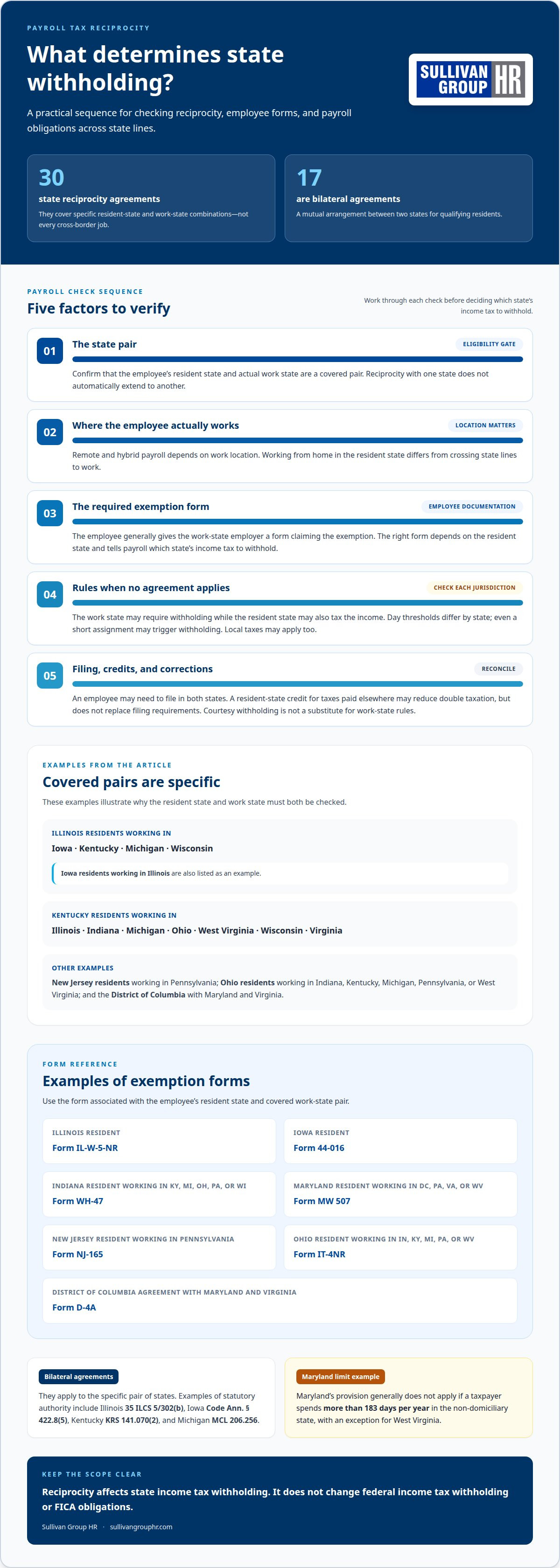
Understanding payroll tax reciprocity agreements starts with the state pair: 30 agreements cover specific combinations of resident and work states, not every cross-border job. Examples include Illinois residents working in Iowa, Kentucky, Michigan, or Wisconsin, and Iowa residents working in Illinois. Kentucky residents working in Illinois, Indiana, Michigan, Ohio, West Virginia, Wisconsin, or Virginia also qualify under listed agreements.
Employees generally provide the work-state employer with a form claiming the exemption. The required form depends on the resident state: Illinois residents use Form IL-W-5-NR, while Iowa residents use Form 44-016. Indiana residents working in Kentucky, Michigan, Ohio, Pennsylvania, or Wisconsin use Form WH-47. Maryland residents working in the District of Columbia, Pennsylvania, Virginia, or West Virginia use Form MW 507. These forms tell payroll which state’s income tax to withhold.
Other examples include New Jersey residents working in Pennsylvania, who use Form NJ-165, and Ohio residents working in Indiana, Kentucky, Michigan, Pennsylvania, or West Virginia, who use Form IT-4NR. The District of Columbia has agreements with Maryland and Virginia, and employees use Form D-4A for exemption. Wisconsin, Minnesota, and Indiana also extend reciprocity to states offering similar treatment to their residents.
Without an agreement, the work state may require income tax withholding, while the resident state may tax the same income. Understanding payroll tax reciprocity agreements also means knowing that a resident may claim a home-state credit for taxes paid elsewhere, although filing in both states may be necessary. Some employers offer courtesy withholding for the resident state, but that does not replace work-state filing or withholding rules. A qualifying employee generally files a resident-state return; if work-state tax was withheld in error, filing there may be necessary to seek a refund.
Withholding when no reciprocity agreement applies
Without an agreement, the work state may require income tax withholding, while the employee’s resident state may also tax that income. Employers and employees need to consider the withholding method, exemption paperwork, and filing duties together.
Multistate Withholding Compliance
Multistate withholding compliance means applying each state’s rules to wages earned within its jurisdiction. States set different thresholds for how many days a nonresident employee may work before withholding is required. As a result, even a short assignment across state lines may trigger withholding duties. Local taxes may also apply, adding another jurisdiction to payroll calculations.
Employer Withholding Responsibilities
Employers must determine which state’s income tax applies to an employee’s work and whether local taxes apply. Employees may need to ask their employer about home-state withholding and submit a state tax exemption form. A nonresident certificate can document nonresident status for state tax purposes. Accurate work-location records help employers apply the relevant rules.
Multistate Filing and Withholding
Multistate filing and withholding means accounting for tax obligations in each relevant state and reconciling withholding on tax returns. An employee may need to file in both the work state and the resident state, rather than relying on a single return. A resident-state credit for taxes paid to another state may reduce double taxation, but it does not remove the need to follow each state’s filing rules.
Some employers use courtesy withholding, withholding for an employee’s home state when the work and resident states lack reciprocity. This is a payroll practice, not a substitute for determining work-state withholding or filing requirements. For example, employees working across state lines between Kentucky and New Jersey still need payroll rules applied to their specific state pair. Reciprocity with one neighboring state does not automatically extend to another.
Incorrect withholding can leave an employee with an unexpected tax balance or require payroll corrections and additional returns. State-specific penalties may also apply, so employers need to address errors under the rules governing the wages. Payroll administration can support the ongoing work of managing state withholding details.
Bilateral reciprocity agreements
A bilateral agreement is a mutual arrangement between two states that exempts qualifying residents from income tax withholding in the other state. Of the 30 reciprocity agreements described, 17 are bilateral. The agreement applies to its specific state pair, so a worker’s eligibility depends on residence, work location, and the relevant state rules.
Several state statutes authorize these mutual arrangements. Illinois’s statute authorizes bilateral state income tax reciprocity under 35 ILCS 5/302(b), while Iowa’s statute does so under Iowa Code Ann. § 422.8(5). Kentucky’s authority appears under KRS 141.070(2), and Michigan’s under MCL 206.256. These provisions establish legal authority for reciprocal treatment; they don’t mean every neighboring state pair qualifies.
For payroll, bilateral reciprocity means the participating states coordinate which state receives income tax withholding for an eligible worker. The employee generally provides an exemption certificate to the employer, identifying the applicable resident-state treatment. For example, New Jersey residents working in Pennsylvania use Form NJ-165 to report state tax reciprocity. A form supports the withholding exemption, but it doesn’t turn an unrelated state pair into a reciprocal one.
Maryland illustrates why bilateral rules can include limits. Its reciprocity provision generally doesn’t apply when a taxpayer spends more than 183 days per year in the non-domiciliary state, with an exception for West Virginia. Maryland and Virginia also have commuter provisions that reciprocally exempt nonresident commuters from income tax. The worker’s residence and time in the other state can therefore affect whether the provision applies.
Don’t confuse a bilateral agreement with a unilateral offer. Minnesota’s statute authorizes a unilateral reciprocity offer under Minn. Stat. § 290.081, while Wisconsin’s does so under Wis. Stat. § 71.05. Indiana’s unilateral authority is Ind. Code Ann. § 6-3-5-1. This distinction matters for state payroll setup: bilateral treatment depends on the agreement between both states, while unilateral treatment follows the offering state’s rules. If an agreement ends, employers must begin work-state withholding from the termination’s effective date.
Reciprocity for remote and hybrid workers
For remote work, the employee’s actual work location still matters. Reciprocity depends on the states involved; the convenience-of-the-employer rule concerns how a state sources remote-work income.
Remote and Hybrid Worker Withholding
A fully remote employee who performs duties in their home state usually does not need reciprocity because work-state income tax is generally not at issue. Hybrid employees may work both in their home state and in an employer’s state, so payroll needs accurate work-location records. For example, an Illinois resident working in Wisconsin may fall under that state pair’s agreement for qualifying wages.
Reciprocity and Convenience Rules
Reciprocity is an agreement between states that directs eligible withholding to the employee’s resident state. A convenience-of-the-employer rule is different: it concerns whether a state treats remote work performed outside the employer’s location as income sourced to the employer’s state. The distinction matters because a state agreement does not, by itself, settle how every remote-work day is sourced.
Hybrid schedules make this distinction practical. A Pennsylvania resident commuting to Maryland may qualify under those states’ reciprocity arrangement, while remote days worked from Pennsylvania raise a work-location question. The District of Columbia also has agreements with Maryland and Virginia, but the employee’s actual residence and work pattern still shape payroll treatment.
Remote work can cross state borders without a daily commute. As of 2021, 4.5 million people in the United States worked outside their state of residence, while 27.6 million primarily worked from home. For payroll, the useful distinction is where the employee performs duties, not simply where the employer is based.
For a workforce spanning multiple states, payroll processes should record work locations and confirm applicable agreements and forms. Employers should also verify that reciprocal withholding forms are properly filed. These steps help distinguish wages covered by an agreement from workdays subject to other state sourcing rules, reducing confusion about withholding and potential double taxation.
Explore employee benefits management as part of supporting employees across remote and hybrid arrangements.
Sullivan Group HR
Sullivan Group HR helps employers manage payroll when employees work across state lines or remotely. Its Payroll Administration and Payroll Outsourcing services support the ongoing work of applying state withholding information and handling payroll across jurisdictions.
For businesses coordinating employee records, compensation, and related HR processes, HCM offers a broader way to manage workforce information. This support can be especially useful when work locations change or employees live and work in different states. Payroll rules still depend on each employee’s circumstances and the states involved, but organized administration helps keep the details connected.
If cross-state payroll is creating extra work for your team, contact Sullivan Group HR to discuss your needs.
Make cross-state payroll part of a stronger process
As your team’s work locations evolve, build state withholding into how you manage payroll and workforce information. Understanding payroll tax reciprocity agreements is one part of that process. Keeping employee details and payroll administration aligned helps your team respond as work arrangements change.
Sullivan Group HR offers HCM, Payroll Outsourcing, and Payroll Administration to support businesses managing these responsibilities. The right next step is to consider how cross-state employees fit into your existing payroll process and where additional support would help. Contact Sullivan Group HR to discuss your payroll needs and the support that fits your business. A clear process can help your team move forward with confidence.
Frequently Asked Questions
How To Report Tax Reciprocity?
Report eligibility by submitting the exemption certificate required for the employee’s resident-state and work-state combination. Forms vary: an Indiana resident working in Ohio uses Form WH-47, while an Ohio resident working in Indiana uses Form IT-4NR. The employee gives the applicable completed form to the employer so payroll can apply the correct state income tax withholding treatment.
What should an employer do when an employee submits a reciprocity exemption certificate?
After receiving a completed certificate, the employer updates payroll to withhold for the employee’s resident state starting with the next payroll run. The form should be associated with the employee’s payroll record and the relevant state pairing. For example, a certificate for a Kentucky resident working in Ohio supports the withholding treatment for that agreement, not a blanket exemption across other work states.
What is a payroll tax reciprocity agreement?
A payroll tax reciprocity agreement is a state arrangement that changes which state receives an eligible employee’s state income tax withholding. It applies to qualifying residents who earn wages in another participating state. The agreement does not change federal income tax withholding or FICA obligations, and it does not cover unemployment tax. The state pair and the employee’s eligibility determine whether the arrangement applies.
Which states have reciprocal income tax agreements?
Listed agreements involve Arizona, California, the District of Columbia, Illinois, Indiana, Iowa, Kentucky, Maryland, Michigan, Minnesota, Montana, New Jersey, North Dakota, Ohio, Oregon, Pennsylvania, Virginia, West Virginia, and Wisconsin. Not every pair among these jurisdictions has an agreement. For example, New Jersey’s listed agreement is with Pennsylvania, while Arizona residents have listed agreements with California, Indiana, Oregon, and Virginia.
Which states and local taxes are covered by reciprocity agreements?
Reciprocity applies to state income tax withholding for eligible workers in the covered state pair. It does not change federal income tax withholding or FICA, and it does not apply to unemployment tax, which usually depends on where the employee works. Local taxes are a separate consideration: employers handling multistate payroll must determine whether they apply to the employee’s work location.
How do reciprocity agreements affect state income tax withholding?
For an eligible employee, reciprocity directs state income tax withholding to the employee’s resident state rather than the work state. The employee’s exemption certificate tells payroll which treatment to apply. If the employee works in a state outside the agreement, reciprocity does not automatically exempt those wages. The relevant state pair and the employee’s work locations guide withholding and filing decisions.


