

An off-cycle payroll run should address an exception, not become a second payroll calendar. It is a payment processed outside the regular schedule, often to correct underpaid wages or pay a new employee for days worked before the next payday. Learning how to manage off-cycle payroll runs starts with distinguishing legitimate requests from process failures.
When an employee needs payment outside the normal cycle, a clear process helps you respond while tracking approvals, deductions, and records. Repeated requests, however, may point to a deeper issue, such as delayed timesheet approvals or commission reports.
This guide explains what qualifies as an off-cycle run, how to assess requests, and how to set submission and approval rules. It also covers investigating recurring runs, addressing their causes, and keeping payment records organized.
Key Takeaways
- Distinguish genuine exceptions, such as correcting underpaid wages, from routine payments that belong in the regular payroll cycle.
- Set clear qualifying criteria, request deadlines, and approval steps so employees and managers know how exceptions are handled.
- Communicate payment corrections clearly, including what changed and when the employee can expect the payment.
- Track the reason, amount, and processing date for each exception to spot recurring issues and address their root causes.
What is an off-cycle payroll run?
An off-cycle payroll run pays an employee outside the business’s regular schedule. Reserve it for a genuine exception, then document the payment and explain the correction.
- Start by identifying why the payment falls outside the regular cycle. An off-cycle run can correct underpaid wages before the next payday, pay a new employee for days already worked, or handle a departing employee’s unused vacation pay. Common payroll schedules are weekly, every other week, or twice monthly.
- Give your payroll provider the employee’s identifying details, affected pay period, corrected hours or wages, and reason for the adjustment. Include relevant approvals and supporting records. These details help the provider calculate the payment, apply applicable withholding, and record the transaction separately from regular payroll.
- Tell the employee what changed, why a separate payment is being issued, and when it is expected. For example, identify the pay period with the underpayment and explain how the correction will appear on the pay stub. Direct deposit timing depends on processing cutoffs and the payment method, so state the scheduled payday rather than implying funds will arrive immediately.
- Check the employee’s state rules before paying final wages. California requires an employee’s final paycheck at termination, according to the California Labor Commissioner’s Office. In Arizona, a terminated employee must receive final pay within seven working days or by the end of the next regular pay period, whichever is earlier, according to the Industrial Commission of Arizona. The timing for correcting underpayments also depends on applicable state wage-payment rules.
- Ask the provider to confirm how the run will appear in payroll reporting and employee records. Off-cycle wages belong on Form 941 for the quarter in which they’re paid and on the employee’s Form W-2, according to the Internal Revenue Service. Provider charges and processing times depend on the service agreement, payroll cutoff, and payment method. Incorrect wages, withholding, or records can create reporting errors and wage-payment compliance risks.
How a payroll provider helps establish policies for qualifying off-cycle requests
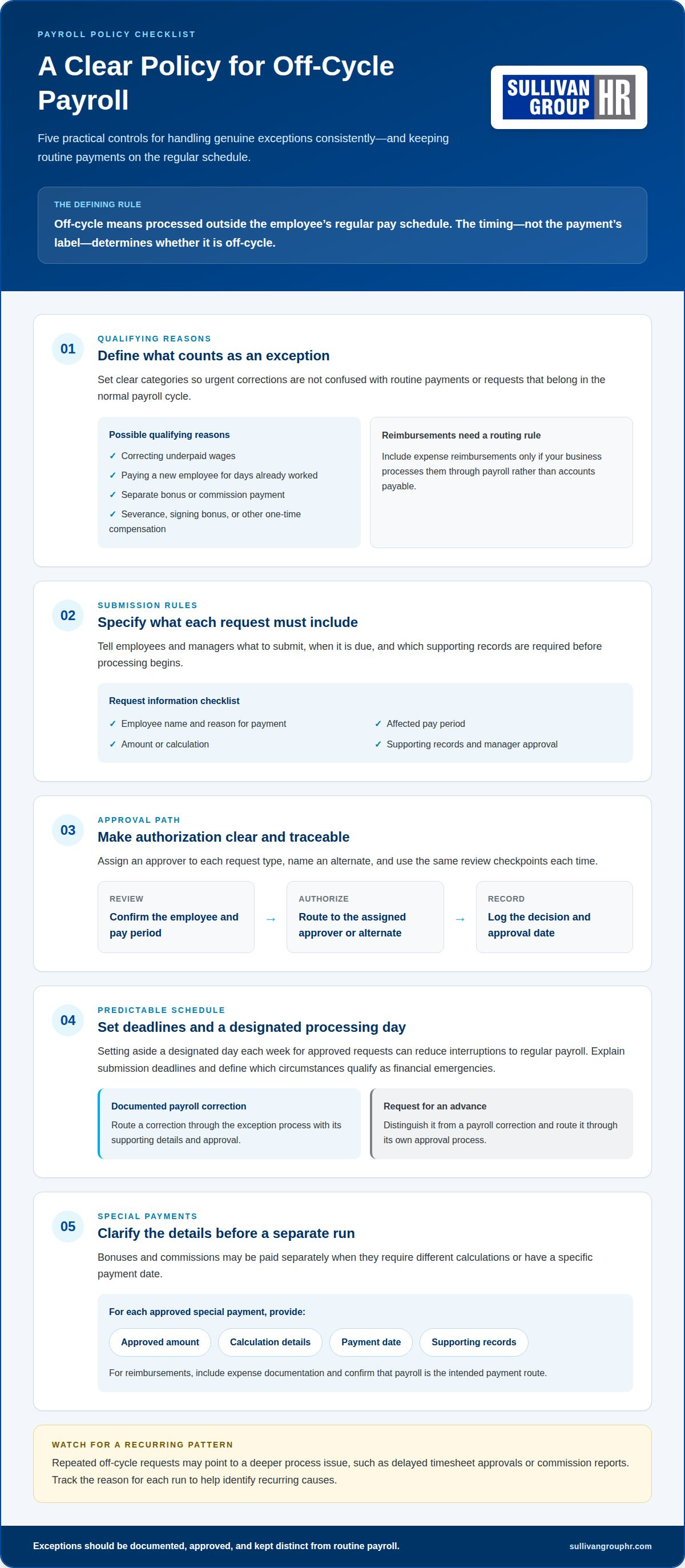
- Define qualifying reasons. A payroll provider can help group requests by purpose, such as correcting underpaid wages, paying a bonus, or issuing a separate commission payment. Include expense reimbursements only if your business processes them through payroll rather than accounts payable. Clear categories support consistent decisions and help distinguish urgent exceptions from routine payments.
- Set submission rules. Specify what employees or managers must submit, when requests are due, and who approves each type. For example, a request might include the employee’s name, reason for payment, affected pay period, amount or calculation, supporting records, and manager approval. A provider can help map these details into the payroll workflow before processing begins.
- Build an approval path. Assign an approver to each request type and name an alternate who can authorize payment when the primary approver is unavailable. Define review checkpoints, such as confirming the employee and pay period before running payroll. Record the decision and approval date so payroll staff can follow the same process each time.
- Set a predictable schedule. Setting aside a designated day each week for approved requests can reduce interruptions to regular payroll. Explain submission deadlines and define which circumstances qualify as financial emergencies. For example, distinguish a documented payroll correction from a request for an advance, then route each through its own approval process.
- Clarify special payments. Bonuses and commissions may be paid separately when they require different calculations or have a specific payment date. Provide the approved amount, calculation details, payment date, and supporting records. For reimbursements, include expense documentation and confirm that payroll is the intended payment route.
Consistent payroll administration support can help connect request rules with day-to-day processing.
Employers should set clear rules for off-cycle use, employee requests, submission deadlines, and manager approvals. Severance pay, signing bonuses, other one-time compensation, and payment during leave may qualify.
Definition of off-cycle payroll
- Classify a payment as off-cycle when it is processed outside the employee’s regular pay schedule. The timing, not the payment’s label, determines whether it is an off-cycle run. A correction, bonus, or new-hire payment can qualify if processed separately. For example, paying a new employee for days worked before the next scheduled payday is an off-cycle payment. A payment included in regular payroll remains regular pay, even if it covers an unusual item.
- Distinguish a payroll correction from a planned separate payment. An unscheduled run may follow an error in regular payroll, such as wages calculated too low. Other off-cycle runs are intentional: a commission may be calculated separately, or a signing bonus may have a specific payment date. Severance and one-time compensation can also be processed outside regular pay. This distinction helps finance teams document why each run occurred and assess whether it reflects an error or a planned exception. For small business owners managing these entries, Skyplex Management provides dedicated bookkeeping support to ensure every adjustment is accurately recorded.
- Recognize that off-cycle payroll can cover different payment types, not only base wages. Some employers process expense reimbursements through payroll rather than accounts payable. Others use a separate run for bonuses, commissions, or eligible leave-related payments. Under 26 CFR 31.3402(g)-1, supplemental wages include wages paid outside an employee’s regular payroll period. That definition helps distinguish supplemental wages from ordinary scheduled pay when classifying a payment.
- Keep each run connected to the employee’s payroll record. Off-cycle wages are still payroll payments, so applicable federal withholding and employer taxes matter. Court-ordered garnishments and benefit deductions may also need to be handled consistently with regular payroll. Most payroll software supports a separate off-cycle workflow, so an exception can be processed without merging it into the regular run. Record the reason, amount, and processing date to explain the transaction and maintain accurate payroll records—an approach modern business advisory firms like popbusiness.com.au recommend to ensure payroll exceptions align seamlessly with overarching accounting ledgers.
How a payroll provider can investigate recurring off-cycle payroll runs
- Map where exceptions enter the workflow. A provider can trace each request from its origin through review, calculation, and release. This sequence can show whether disruption starts with an unclear policy, a handoff, or a late decision. It helps focus the investigation on a specific stage instead of treating every separate payment as an isolated event.
- Compare patterns across teams and payment types. Look for clusters by department, manager, or compensation type. If exceptions build up around one approval path, examine how it works. If they involve different payment types but share a processing stage, investigate that stage. Reviewing patterns can reveal a common bottleneck without assuming every exception has the same cause.
- Test whether policy and practice match. Compare written rules with the decisions employees and managers actually make. For example, a policy may allow separately timed bonuses, while managers submit them through inconsistent channels. Clarify who decides, which process applies, and how exceptions are escalated. This helps distinguish a legitimate payment choice from a recurring process failure.
- Review tax treatment and deposit timing. Off-cycle payments remain subject to applicable withholding, and the federal tax deposit deadline follows the payday. A provider can review whether payments were classified and processed consistently, then flag discrepancies for correction. This keeps the investigation focused on payroll accuracy and makes clear that separate runs still carry normal tax responsibilities.
- Check whether workflow changes resolve the pattern. After clarifying an approval route or policy, review whether similar disruptions continue. If they do, revisit the changed stage and test another possible cause. This evidence-led approach helps refine how to manage off-cycle payroll runs without adding approval layers to every request. It also keeps exception handling practical as teams and compensation practices change.
Use a structured review to make recurring exceptions easier to understand. Get payroll administration support to examine the workflow and strengthen payroll processing.
Sullivan Group HR
Sullivan Group HR helps businesses organize payroll processes and people operations. Its Payroll Outsourcing and Payroll Administration services can help when exceptions disrupt regular payroll, approval responsibilities are unclear, or recurring off-cycle runs point to process gaps.
A defined process for payment requests, approvals, and payroll records helps your team see which exceptions need attention and where workflows may need improvement. HCM can also support a broader view of workforce administration alongside payroll.
If off-cycle requests are becoming difficult to manage, contact Sullivan Group HR to discuss your payroll needs.
Build a payroll process that keeps moving
A reliable payroll process should support growth without turning every exception into a disruption. As your team changes, review how requests move from submission to approval and how payroll information reaches the people who need it. Regular review helps turn lessons from individual off-cycle runs into stronger day-to-day practices.
For businesses seeking support with these processes, Sullivan Group HR offers HCM, Payroll Outsourcing, and Payroll Administration. These services can connect payroll work with broader workforce administration as your needs evolve.
Learning how to manage off-cycle payroll runs is one step toward a more organized payroll operation. Contact Sullivan Group HR to discuss support for your business, and keep building a process your team can rely on.
Frequently Asked Questions
What is an off-cycle payroll run and when should employers use one?
An off-cycle payroll run issues payment separately from the employee’s normal payday. Use one for an exception that should not wait for the next scheduled payroll, such as a wage correction or time-sensitive bonus. For example, if an approved commission calculation arrives after payroll closes, a separate run may address it without changing the regular payroll calendar.
What information and approvals are needed for an off-cycle payroll run?
Provide the employee’s name, the reason for payment, the relevant pay period, and the approved amount or calculation. Include records supporting the request, such as corrected hours or a commission report. The manager responsible for the payment should approve it, along with any additional review required by company policy. Clear documentation helps distinguish an authorized exception from a duplicate or incomplete request.
How can employers reduce the need for off-cycle payroll runs?
Look for recurring causes and fix the handoffs behind them. If late timesheets lead to corrections, clarify submission and manager approval deadlines. If commission data regularly misses the payroll cutoff, set a dependable reporting schedule with the team that supplies it. Review exception records over time, then improve the process causing repeat runs instead of treating each payment as an isolated event.
What common mistakes, compliance risks, and penalties can result from off-cycle payroll?
Errors in wages, withholding, or records can create reporting mistakes and wage-payment compliance risks. Apply applicable withholding and employer taxes, handle garnishments and benefit deductions consistently, meet tax deposit deadlines based on payday, and follow applicable final-pay timing rules.


