

In the United States, the Fair Labor Standards Act doesn’t set a single payroll frequency; state rules vary, and some depend on the work employees perform. When choosing a payroll frequency, an employer can move from biweekly to semimonthly pay with help from a payroll provider, but the transition must preserve required payday timing and may require an extra payment to bridge schedules.
Changing schedules is more than a calendar adjustment: pay periods, overtime calculations, employee notice and cash flow all need to align. A careful transition also keeps pay periods and paydays clear for employees. The right schedule balances legal requirements with hourly and salaried work, employee preferences and industry practices. This guide compares weekly, biweekly, semimonthly and monthly payroll, explains rules employers need to consider, including notice and transition timing, and shows how worker type and industry can inform the decision. The goal is a compliant, workable schedule that employees can understand, without avoidable confusion.
Key Takeaways
- Understand how state payday rules can shape the schedules available to your business.
- See why hourly and salaried employees may call for different payroll timing considerations.
- Compare weekly, biweekly, semimonthly, and monthly schedules by pay periods and practical trade-offs.
- Use industry patterns as context, then choose a schedule that fits your workforce and operations.
1. How often are employers legally required to pay employees?
Federal law does not set one payroll frequency for every U.S. employer. The Fair Labor Standards Act (FLSA) does not specify how often employees must be paid, but it defines the workweek used for wage standards. According to the U.S. Department of Labor, a workweek is a fixed and regularly recurring period of 168 hours. That definition matters because overtime calculations follow the workweek, not the employer’s chosen payday.
State laws supply much of the detail. Most states set pay-frequency and payday timing requirements, and some base them on the type of work employees perform. Arizona requires employers to pay employees at least twice monthly, with no more than 16 days between paydays, according to the Industrial Commission of Arizona. Some states also require advance written notice when employers change payroll frequency, so the schedule and any transition need to meet applicable state standards.
New York illustrates how worker type can affect pay frequency rules. According to the New York State Department of Labor, manual workers must be paid weekly, no later than seven calendar days after the pay period ends. Other New York employees not covered by listed exceptions must be paid at least semimonthly. Employers should consider both location and job classification before setting a regular payday.
Pay frequency affects employees’ budgets and an employer’s cash flow. More frequent pay gives employees access to wages sooner and can make routine expenses easier to plan. Less frequent pay may mean fewer payroll runs, but employees must manage expenses across longer gaps between paydays. A reliable schedule makes payday predictable. When changing frequency, employers must continue meeting applicable timing laws, and the transition may require extra payments to bridge schedules. In addition, consulting an experienced accounting firm like Tax Partners can help ensure that new pay schedules align seamlessly with cash flow forecasting and tax reporting requirements.
Choosing a payroll schedule for hourly or salaried workers with professional support
A payroll provider can review employee classifications, work patterns, payday rules and payroll capacity to help choose a schedule. For a small business, this can align the calendar with hourly time records and salaried pay cycles. A provider can also map the transition between schedules, including the pay period that bridges the change. For companies managing international offices or regional staff, specialized firms like Payroll Services Singapore offer dedicated outsourced payroll administration to navigate local pay requirements seamlessly.
Hourly, nonexempt workers often fit weekly or biweekly payroll because overtime is calculated by workweek. Biweekly payroll can make overtime easier to organize. Semimonthly schedules require closer tracking: a workweek can span two pay periods, so hours from both periods must be accounted for before pay is finalized. The pay-period boundary does not change the workweek used for overtime.
Salaried employees are typically paid monthly or semimonthly. Where permitted, a workforce with hourly and salaried employees may use different frequencies, keeping hourly calculations tied to workweeks while providing salaried workers with consistent calendar paydays. A provider can review employee classifications, timekeeping records and applicable rules together, so a convenient payday pattern does not obscure overtime or compliance requirements.
Changing frequency carries practical risks. Employees may face a longer gap between checks during the transition, while payroll teams must avoid missed wages, duplicate payments and inaccurate overtime calculations. A change should have a legitimate business reason, be intended as permanent, and not delay wages unreasonably or avoid payment. Employers are advised to give workers 30 days’ written notice, even where law doesn’t require it.
A provider can prepare a clear employee communication showing the new calendar, first payday and any transition payment. It can also explain that changing frequency doesn’t change an employee’s total pay over a year. For coordinated payroll schedule support, align the change plan, calculations and employee notice before the first new payday.
3. Weekly, biweekly, semi-monthly, and monthly schedules
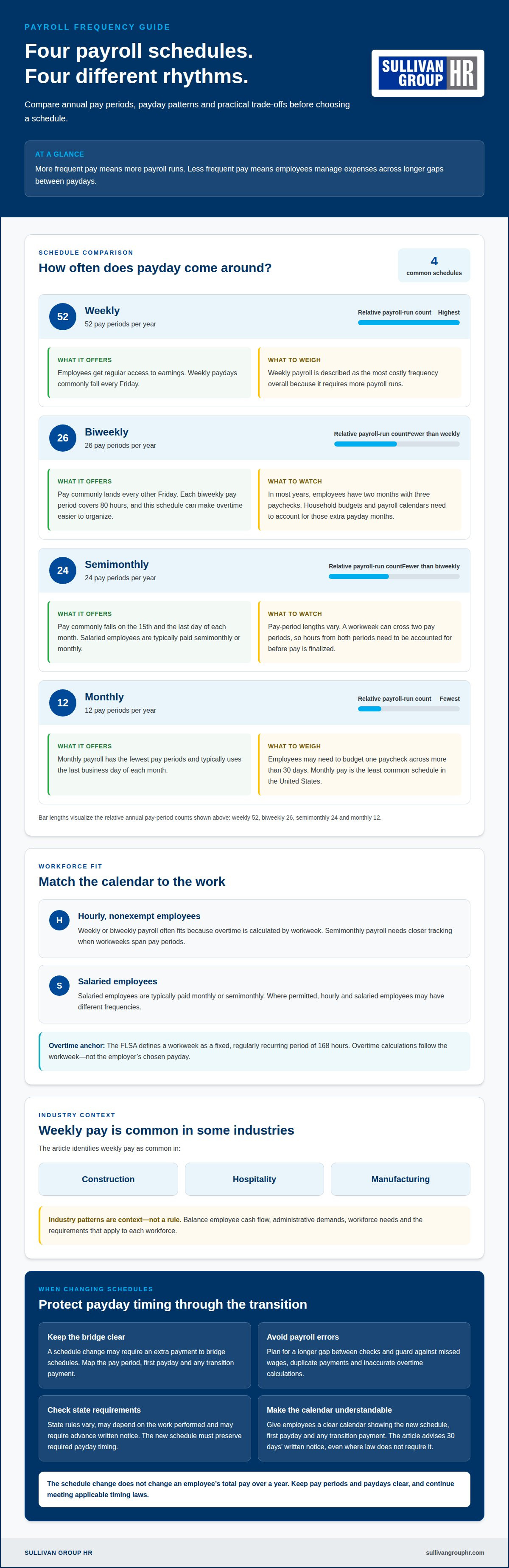
The four common schedules differ in payday rhythm, annual pay periods and administrative workload. Weekly payroll provides 52 pay periods per year, while biweekly provides 26. Semi-monthly payroll provides 24, and monthly payroll provides 12. The frequency affects how often employees receive checks, and employers may need to account for applicable pay requirements.
Weekly paydays commonly fall every Friday. Employees get regular access to earnings, but weekly payroll is described as the most costly frequency overall because it requires more payroll runs. Biweekly pay commonly lands every other Friday. In most years, employees paid biweekly have two months with three paychecks, so household budgets and payroll calendars need to account for those extra payday months.
Biweekly and semi-monthly schedules aren’t interchangeable. A biweekly pay period covers 80 hours and shifts through the calendar, while semi-monthly pay commonly falls on the 15th and last day of each month. Its pay periods vary in length, and a workweek can cross two semi-monthly periods. That difference matters when payroll administration tracks hours and overtime.
Monthly payroll typically uses the last business day of each month. It has the fewest pay periods, but employees may need to budget one paycheck across more than 30 days. Salaried employees are typically paid monthly or semi-monthly, while hourly schedules also need to accommodate time records and applicable state rules. Monthly pay is the least common schedule in the United States.
For a practical comparison, weigh predictable payday timing against payroll workload and workforce needs. Industry practices differ: weekly pay is common in construction, hospitality and manufacturing. A schedule that suits one employer may not suit another, so choosing a payroll frequency means balancing employee cash flow, administrative demands and the rules that apply to each workforce.
4. Industry payroll-frequency benchmarks
Industry patterns offer a useful starting point, not a schedule every employer must copy. In cited Bureau of Labor Statistics industry data, 70.6% of construction workers are paid weekly. Frequent paychecks can suit workforces with changing hours, where employees may value quicker access to earned wages. But the best fit still depends on the employer’s operations and applicable state rules.
Other industries show different common pay schedules. The cited data reports that 52.9% of workers in education and healthcare are paid biweekly. In information services, 35.9% receive semimonthly pay, while 17.6% of workers in finance are paid monthly. These benchmarks can help employers compare their current calendar with common pay in their field, then assess whether that pattern fits their workforce.
Each payday creates a cycle of collecting hours, reviewing changes, calculating pay and issuing paychecks. Weekly schedules require more frequent payroll runs; monthly schedules require fewer runs but leave longer gaps between paydays. Workload and cash flow may be affected, while employees may weigh payday timing against their budgeting needs. Industry benchmarks do not replace the practical needs of hourly workers or state requirements.
Use industry practices as context, then weigh three factors: employee work patterns, payroll capacity and predictable paydays. For example, a construction employer with variable hours can consider whether weekly processing fits its time records and cash flow. A finance employer considering monthly pay still needs to account for employee budgeting and applicable requirements. If the schedule changes, clear notice and a calendar showing the new payday can help employees plan.
Want support assessing payroll frequency against your workforce and processing needs? Discuss payroll administration support.
Sullivan Group HR
Sullivan Group HR helps employers connect payroll frequency decisions with wider workforce and payroll processes. Its HCM, Payroll Outsourcing and Payroll Administration services support coordinated payroll operations, while its Applicant Tracking System supports hiring workflows. This support can help when a business is weighing a schedule change, managing different worker classifications or aligning payroll administration with its needs.
A sound review considers the workforce, pay calendar and applicable requirements together. This context helps clarify which schedule is workable and what to address during a transition. Employers seeking professional support to connect payroll decisions with broader human capital management can turn to Sullivan Group HR. Contact Sullivan Group HR to discuss your payroll frequency needs.
Build a pay schedule that can grow with your business
A payroll calendar should support the business you are building, not just its current workforce. Hiring, changing work patterns and new operational demands can affect whether your schedule remains practical. Treat the decision as part of workforce planning, and revisit it when business changes affect payroll administration.
Choosing a payroll frequency is easier when the schedule, employee needs and payroll process are considered together. Sullivan Group HR offers HCM, Payroll Outsourcing and Payroll Administration to help businesses manage connected workforce and payroll needs. If you’re preparing to change schedules or want professional input on a payroll approach, contact Sullivan Group HR to discuss the next step.
A clear plan can turn a complex decision into a workable routine. Build a payroll process that supports your people and gives your business room to move forward.
Frequently Asked Questions
Can a payroll provider help an employer switch from biweekly to semimonthly pay?
Yes. A payroll provider can help plan the new calendar, account for the transition between schedules and prepare employee communications. Biweekly paydays, for example, move through the calendar, while semimonthly paydays fall on set dates. Mapping the final biweekly period against the first semimonthly period helps identify timing gaps and payroll adjustments before the new schedule begins.
How often are employers legally required to pay employees?
There is no single federal pay frequency for all employees. State requirements vary, and some also depend on job type. Separate rules may govern final wages after employment ends, so employers with workers in multiple states can face different payday obligations. The applicable location and employee classification shape the schedule, not simply the organization’s preferred payroll calendar.
What Does Your State Require?
State rules determine which pay schedules are allowed, how quickly wages must be paid and whether a schedule change requires notice. Requirements can also differ by occupation. For example, rules for hourly workers may differ from those for exempt employees. Employers with workers in several states need a schedule that accounts for each location’s requirements.
What Is Pay Frequency, Exactly?
Pay frequency is how often an employer issues wages, such as weekly, biweekly, semimonthly or monthly. It differs from a pay period, the span of work being paid, and payday, the date wages are issued. Keeping these terms distinct helps employers explain calendars clearly and understand why pay-period boundaries do not always match workweeks.
What is the most common pay frequency in the United States?
Biweekly pay is the most common frequency in the United States. It offers a regular rhythm without requiring a payroll run every week, and payday moves through the calendar rather than falling on fixed dates each month. For employers, this pattern is a useful comparison point, but workforce needs and applicable rules matter more than popularity alone.
Why is overtime harder to calculate on a semimonthly pay schedule?
Semimonthly pay periods follow calendar dates, while overtime calculations follow the workweek. As a result, a workweek can cross two pay periods. Payroll staff must combine hours from both periods before completing the overtime calculation for that workweek. For example, hours recorded near a semimonthly cutoff may need to be considered alongside later hours from the same workweek.


