

A policy on paper cannot protect a workplace unless employees understand it and supervisors know how to apply it. Effective drug-free workplace policy implementation gives your team clear expectations, consistent procedures, and a path to support when someone needs help.
It is reasonable to want a policy that supports safety without treating every concern as a disciplinary issue. A workable program balances clear rules with education, confidentiality, and access to assistance.
This article explains why employers implement drug-free workplace programs, what a comprehensive policy should cover, and how to prepare supervisors to recognize and respond to concerns. It also outlines the federal Drug-Free Workplace Act requirements, including what covered employers must communicate to employees.
Key Takeaways
- See how a clear workplace policy can support safety, consistency, and access to help.
- Learn which policy elements shape fair testing, privacy safeguards, and responses to violations.
- Understand how supervisor training helps managers recognize concerns and respond appropriately.
- Find out which employers are covered by federal requirements and what their awareness programs must communicate.
Why Should I Implement A Drug Free Workplace?
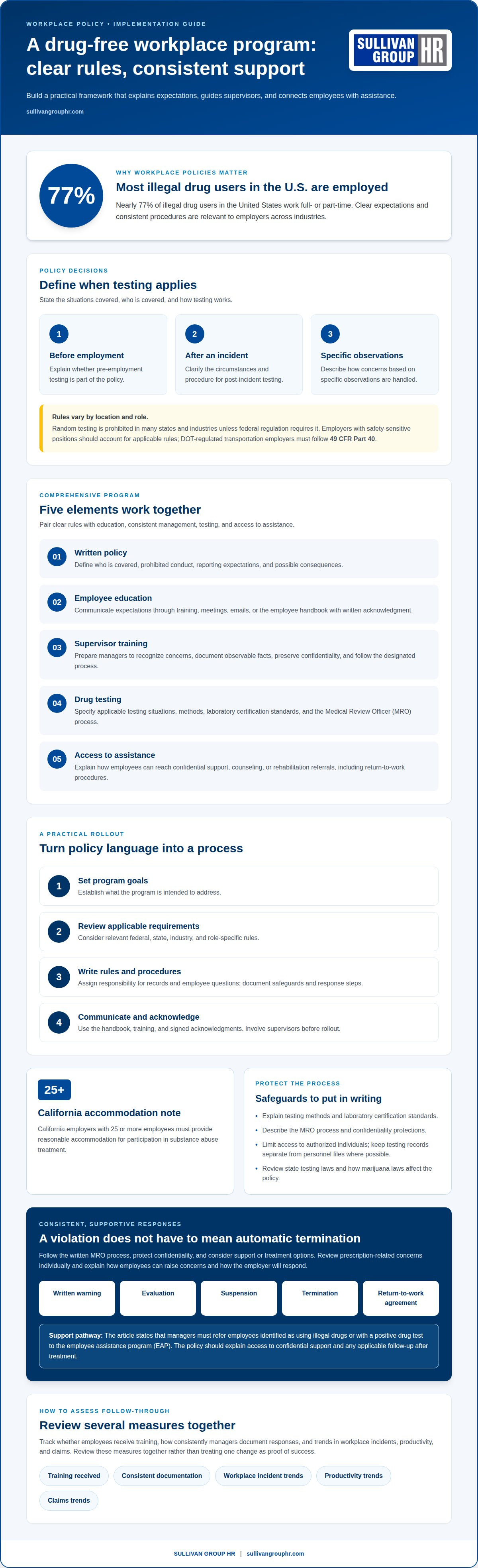
A written program helps employees understand workplace expectations and gives supervisors a consistent way to respond to safety concerns. Effective drug-free workplace policy implementation also connects clear rules with employee support. Nearly 77% of illegal drug users in the United States are employed full- or part-time. That makes workplace policies relevant to employers across industries.
Workplace drug testing can occur at different points, such as before employment, after an incident, or when specific observations raise a concern. The policy should state which situations apply, who is covered, and how testing works. Random testing is prohibited in many states and industries unless federal regulation requires it, so don’t assume one approach applies everywhere. Employers with safety-sensitive positions should account for Department of Transportation rules; DOT-regulated transportation employers must follow 49 CFR Part 40, and companies overseeing commercial drivers often coordinate with specialized facilities like Miami CDL/DOT Physical Exam Center to keep driver health evaluations aligned with federal standards.
Before testing begins, put safeguards in writing. Explain the testing method, laboratory certification standards, the Medical Review Officer (MRO) process, and confidentiality protections. Keep testing records separate from personnel files where possible, and limit access to authorized individuals. Review state drug-testing laws and how marijuana laws affect the policy. These steps help employees understand the process and support consistent drug-free workplace policy implementation.
What are the costs of drug testing programs and workplace drug-free initiatives? Costs depend on the program’s design, including testing methods and frequency, laboratory procedures, supervisor training, and support resources. A clear budget should account for the whole process, not just the test itself.
How should employers handle positive tests, prescriptions, and reasonable accommodations? Follow the written MRO process, protect confidentiality, and consider support or treatment options instead of relying on automatic termination. Review prescription-related concerns individually; California employers with 25 or more employees must provide reasonable accommodation for participation in substance abuse treatment. A policy should explain how employees can raise these concerns and how the employer will respond.
What Are the Components of a Comprehensive Drug Free Work Place Program?
A strong program pairs clear rules with education, testing, and access to support. Its effectiveness depends on consistent communication and follow-through.
Program Reasons and Core Components
A comprehensive program combines a written policy, employee education, supervisor training, drug testing, and access to assistance. These elements help employees understand expectations and give managers a consistent framework for responding to substance-related concerns. To evaluate effectiveness, track whether employees receive training, how consistently managers document responses, and trends in workplace incidents, productivity, and claims. Review these measures together rather than treating one change as proof of success.
Policy Components and Progressive Discipline
A policy defines who is covered, prohibited conduct, reporting expectations, and possible consequences. Explain whether the rules apply to employees, contractors, or safety-sensitive roles, and clarify expectations around substances at work. Possible responses include written warnings, an evaluation, suspension, termination, or a return-to-work agreement. The American Public Health Association recommends considering alternatives to discipline. A clear response framework helps managers act consistently while leaving room for support.
Step-by-Step Policy Implementation
How do employers implement a drug-free workplace policy step by step? Set program goals, review applicable requirements, write the rules and procedures, then communicate them through the handbook, training, and signed acknowledgments. Assign responsibility for records and employee questions. This sequence turns policy language into a process employees can understand. Involve supervisors before rollout so they can explain expectations and follow the same procedures across teams.
Treatment Referrals
Treatment referrals connect employees with help after a concern, positive test, or policy violation. According to the Internal Revenue Service, managers must refer employees identified as using illegal drugs or with a positive drug test to the employee assistance program (EAP). The written policy should explain how employees can access confidential support, counseling, or rehabilitation referrals. Define return-to-work procedures after treatment, including any applicable follow-up steps.
Supervisor training
Supervisor training prepares managers to recognize concerns and respond without diagnosing employees. Daemen University provides training to help supervisors recognize and manage employees with alcohol and other drug problems. Training can clarify the difference between observing a work-related concern and assuming its cause. For example, managers should document specific conduct or performance issues, then follow the written policy rather than confront someone based on rumor.
Practice the response process with realistic scenarios. A supervisor might notice an employee struggling to complete an assigned task or behaving in a way that raises an immediate safety concern. Training should cover how to document observable facts, preserve confidentiality, and refer the matter through the designated HR process. Clear boundaries help managers avoid sharing private information or promising a particular outcome before the process is complete.
How should employers communicate and train employees about the policy? HR and management should coordinate a clear rollout, using training sessions or workshops, emails and meetings, or an updated handbook with written acknowledgment. Daemen University requires all employees to complete Drug Free Workplace Training upon hire and periodically afterward. These examples show how employers can pair initial communication with recurring education.
A supportive culture can make it easier for individuals to seek help. The American Public Health Association recommends workplace peer support to help workers access treatment and reduce the risk of returning to substance use disorder. Supervisors can explain available support resources and refer employees through established channels. Training should also distinguish a supportive conversation from a disciplinary decision, so managers do not confuse offering help with overlooking safety or policy concerns.
Reinforce training when the policy changes and give supervisors a consistent place to raise process questions. A short scenario review can test whether managers know whom to notify, what facts to record, and how to protect privacy. When every supervisor follows the same steps, employees receive clearer communication and workplace responses become more consistent.
Federal Drug-Free Workplace Act requirements
The Drug-Free Workplace Act of 1988 sets requirements for certain federal contractors and grant recipients. Coverage depends on the funding relationship, so identify whether your organization holds a qualifying federal contract or grant before defining its obligations.
For a non-federal workplace, a federal contract of $100,000 or more triggers a Drug-Free Workplace Program requirement. A federal grant in any amount also triggers the requirement. Separately, federal contractors with contracts exceeding $25,000 must certify that they maintain a drug-free workplace. These thresholds describe different requirements, so don’t treat the certification rule as a replacement for the program requirement.
A covered program needs more than a signed certification. According to the U.S. Government Publishing Office, a covered federal contractor’s drug-free awareness program must inform employees about workplace drug-abuse dangers, the policy, available support programs, and penalties. Use employee education to explain what the rules mean in practice, where staff can find assistance, and how the organization responds to violations.
Build federal requirements into everyday procedures. Keep the written policy consistent with the certification, explain it to employees, and make support resources accessible. Assign responsibility for communicating the policy and recording required actions. Handle sensitive employee matters confidentially and limit policy communications to clear, work-related information. These steps help prevent a gap between what the organization certifies and what employees experience.
The key takeaway: confirm the federal funding relationship, apply the correct threshold, and maintain an awareness program that covers each required topic. For help coordinating employee benefits within your broader workplace program, connect with Sullivan Group HR.
Sullivan Group HR
Sullivan Group HR helps employers coordinate workforce administration through HCM, Payroll Outsourcing, Payroll Administration, and Applicant Tracking System services. Its isolved HCM technology brings together payroll, taxes, time tracking, benefits administration, applicant tracking, screening, and onboarding. These services support the workforce processes around a workplace policy, but do not replace the employer’s responsibility to establish policy terms, meet federal requirements, or handle legal questions.
Consider Sullivan Group HR when HR administration competes with the time needed to communicate workplace expectations and support employees. A dedicated Sullivan Group HR specialist and integrated workforce services can help keep processes organized while your organization puts its policy into practice.
Contact Sullivan Group HR to discuss your workforce administration needs.
Build a Workplace Practice That Lasts
A durable approach to drug-free workplace policy implementation extends beyond the launch. Connect the policy to everyday decisions: how managers respond to concerns, how employees find support, and how leadership reinforces expectations. When responsibilities are clear, the program can become part of how your organization works rather than a document employees rarely revisit.
Consider what will help your team sustain that effort. Make policy communication part of onboarding, give supervisors a consistent process to follow, and revisit procedures as workplace needs evolve. Small, deliberate actions can keep the program understandable and practical for employees and managers alike.
Workforce administration can also take attention away from building and maintaining sound people practices. If you’re ready to discuss how your HR operations can support your organization’s priorities, contact Sullivan Group HR. A clear next step can help you move forward with confidence.
Frequently Asked Questions
Why Should An Employer Establish a Comprehensive Drug-Free Workplace Program?
A comprehensive program helps employers set safety expectations and respond to concerns consistently. It can also make support easier to access, rather than leaving employees unsure where to turn. For example, a written process can guide a supervisor who notices a safety concern toward appropriate documentation and an established referral path. The goal is a safer, more supportive workplace, not simply testing or punishment.
What Should a Drug-Free Workplace Policy Include?
A policy should make its scope and expectations clear. For example, it can identify whether it covers employees, contractors, or safety-sensitive roles; define prohibited conduct; and explain reporting and response procedures. It should also describe how employees acknowledge receipt and where they can find support information. Specific examples help distinguish prohibited conduct at work from concerns that require individual, consistent review.
What Federal Laws Apply to Drug-Free Workplace Policies in the United States?
The Drug-Free Workplace Act of 1988 applies to qualifying federal contractors and grant recipients, with program requirements tied to the contract or grant relationship. Federal transportation employers also follow drug-testing requirements under 49 CFR Part 40. These federal rules address different situations, so identify whether your organization has federal funding or operates in a DOT-regulated role before deciding which requirements shape its policy.
What State Laws Restrict Workplace Drug Testing and Cannabis Testing?
State laws can limit testing methods and when employers may test, while marijuana laws can affect how workplace policies address cannabis. Random testing is prohibited in many states and industries unless federal regulation requires it. For example, an employer operating across states may need different procedures for employees in different locations. The policy should account for applicable state rules rather than assume one testing standard works everywhere.
What Are the Rules for Pre-Employment, Random, and Post-Incident Drug Testing?
There is no single testing rule that automatically applies to every employer or testing situation. A written policy should explain whether testing occurs before employment, randomly, or after an incident, and describe the procedures for each. Random testing has additional restrictions in many states and industries unless federal regulation requires it. For DOT-regulated transportation employers, 49 CFR Part 40 governs testing requirements.
What Are the Legal Risks and Penalties for Improperly Implementing a Drug-Free Workplace Policy?
Improper implementation can expose an employer to disputes over inconsistent enforcement, privacy protections, or testing procedures. For example, applying different consequences to employees in similar circumstances can undermine fair administration. Missing documentation or using testing procedures that do not meet applicable requirements can create additional compliance concerns. Specific penalties depend on the law and circumstances involved, so avoid treating one general consequence as universal across states and industries.


