

A polished hypothetical answer can sound convincing without showing how someone actually works. Behavioral interview questions for key roles ask candidates to describe real past experiences, giving you evidence of how they handled challenges, made decisions, and worked with others. Hypothetical questions, by contrast, explore what they say they would do in a situation.
When hiring for a role with real responsibility, you want answers that show sound judgment, not just polished speaking. A strong interview connects a candidate’s specific examples to the actual demands of the job.
Learn why behavioral questions matter, which skills to explore in roles involving adaptability, leadership, and organization, and how to distinguish past experience from hypothetical reasoning. Sample prompts and practical follow-ups can help you make interviews more consistent and informative.
Key Takeaways
- Use past examples to explore how candidates adapt, learn from setbacks, and respond when plans change.
- Assess managers for ownership, clear communication, and how they guide people through challenges.
- Look for practical prioritization: strong candidates explain how they organize work and set expectations when delegating.
- Separate real examples from imagined responses: past-experience prompts reveal what candidates have done, while hypothetical prompts explore what they might do.
1. Adaptability and resilience
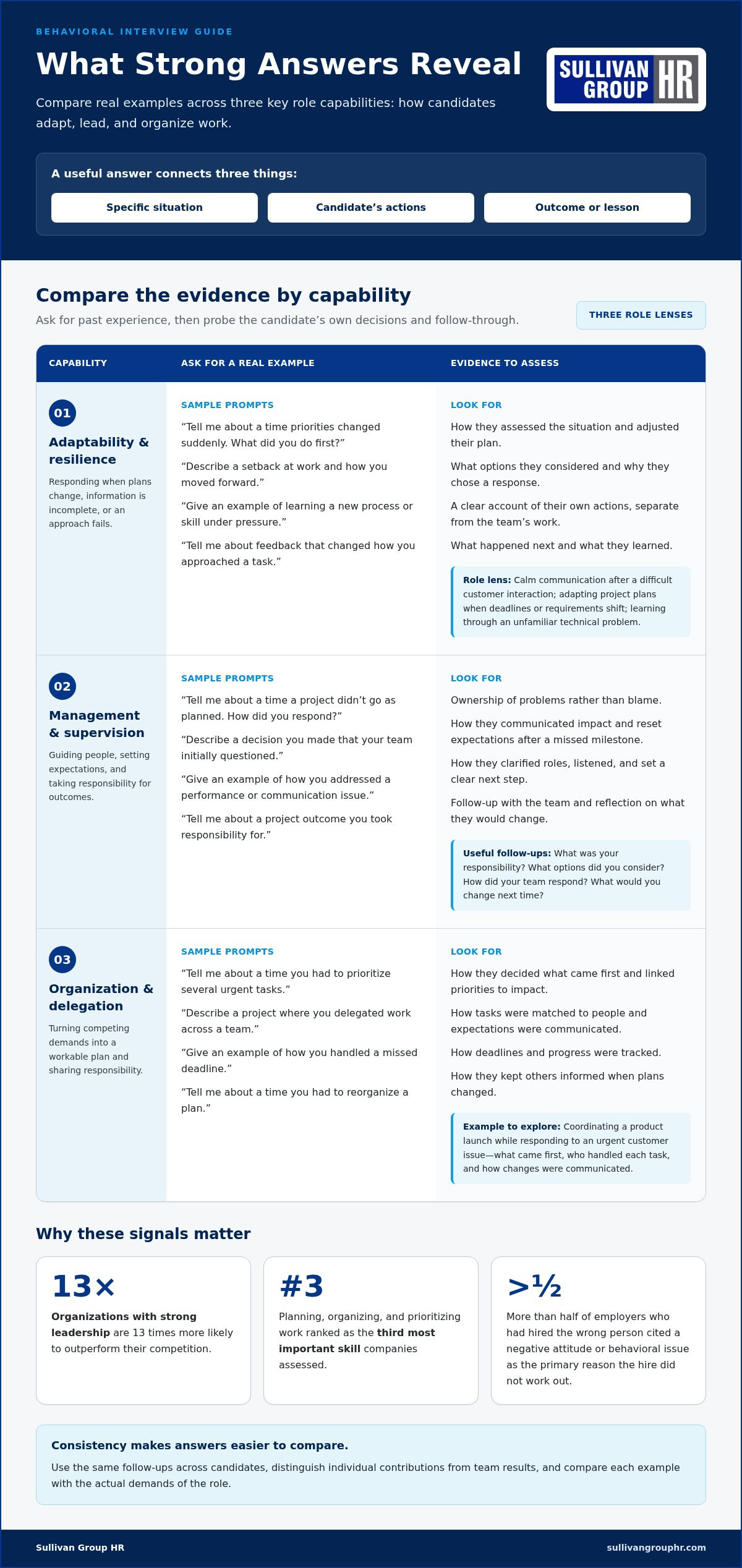
Adaptability shows in how a candidate responds when plans change, information is incomplete, or a familiar approach fails. Use behavioral interview questions for key roles to ask for a specific example, then listen for how they assessed the situation, adjusted their plan, and learned from the outcome. Resilience means recovering constructively and applying those lessons to the next challenge.
Ask candidates to describe an unexpected challenge, a setback, or a time they had to learn quickly. You can also ask about a mistake, shifting priorities, or difficult feedback. These prompts encourage concrete examples instead of general claims such as “I’m flexible.”
- “Tell me about a time priorities changed suddenly. What did you do first?”
- “Describe a setback at work and how you moved forward.”
- “Give an example of learning a new process or skill under pressure.”
- “Tell me about feedback that changed how you approached a task.”
The competencies to assess depend on the role. For customer service, explore how the candidate communicated calmly after a difficult interaction. For project work, ask how they adjusted plans when deadlines or requirements shifted. For technical roles, ask how they approached an unfamiliar problem and identified what they needed to learn. Across positions, look for curiosity, judgment, and practical problem-solving.
Effective behavioral interview questions for key roles leave room for follow-ups. Ask what options the candidate considered, why they chose a particular response, and what happened next. If they describe a delayed project, ask how they reprioritized tasks and kept colleagues informed. A clear account distinguishes their actions from the team’s work.
Compare responses with the role’s actual demands, rather than looking for one ideal personality. A strong answer describes the situation, the candidate’s actions, and an outcome or lesson. That structure helps you assess how thoughtfully they might respond to another unfamiliar challenge.
Look for candidates who are willing to tackle unfamiliar challenges and learn from them, rather than disengaging when faced with uncertainty. Behavioral questions give candidates an opportunity to show adaptability and problem-solving through specific examples of what they did and learned.
Attitude matters alongside skill: more than half of employers who had hired the wrong person cited a negative attitude or behavioral issue as the primary reason the hire did not work out. Consider whether the candidate’s account shows constructive engagement when circumstances become difficult.
2. Management and supervision
Management interviews should show how candidates guide people, set expectations, and take responsibility for outcomes. Organizations with strong leadership are 13 times more likely to outperform their competition. Ask for examples that reveal the candidate’s actions, not just the team’s results.
For project management roles, ask how candidates handled a missed deadline, competing priorities, or a stakeholder disagreement. Useful prompts include, “Tell me about a project that fell behind schedule,” and “Describe a time you aligned a team around a difficult decision.”
- “Tell me about a time a project didn’t go as planned. How did you respond?”
- “Describe a decision you made that your team initially questioned.”
- “Give an example of how you addressed a performance or communication issue.”
- “Tell me about a project outcome you took responsibility for.”
Listen for ownership. A capable manager explains what they did when problems emerged, rather than blaming a colleague or circumstance. If a project missed a milestone, for example, ask how they communicated the impact, reset expectations, and helped the team move forward. The details show whether they lead through action.
Assess how the candidate balances direction with support. Ask how they clarified roles, resolved conflicting requests, or helped a struggling team member improve. Strong answers explain how the manager listened, set a clear next step, and followed up. A project lead might describe resetting task owners and sharing revised deadlines with stakeholders.
Use consistent follow-ups across candidates: What was your responsibility? What options did you consider? How did your team respond? What would you change next time? These questions help distinguish individual leadership from team effort and show whether a candidate can reflect honestly on a decision and its trade-offs.
When management decisions connect to broader workforce processes, human capital management support can help organizations coordinate people-focused work.
3. Organizational skills and delegation
Planning, organizing, and prioritizing work ranked as the third most important skill companies assessed. Behavioral questions can show how candidates turn competing demands into a workable plan. Ask for a specific example involving deadlines, changing priorities, or a project with several contributors. Listen for clear choices, not just a claim to “stay organized.”
Delegation is another useful area to explore. A strong example explains how the candidate matched tasks to people, communicated expectations, and tracked progress. Ask what they delegated, how they set deadlines, and what they did when work fell behind. These details show whether they share responsibility while remaining accountable for the outcome.
- “Tell me about a time you had to prioritize several urgent tasks.”
- “Describe a project where you delegated work across a team.”
- “Give an example of how you handled a missed deadline.”
- “Tell me about a time you had to reorganize a plan.”
A candidate might describe coordinating a product launch while responding to an urgent customer issue. Follow up by asking how they decided what came first, who handled each task, and how they communicated changes. A clear answer links priorities to impact, explains responsibilities, and describes a specific outcome.
Assess the candidate’s approach, not whether they use a particular app or planning system. One person may use a shared calendar; another may organize work through team check-ins. Focus on whether they make deadlines visible, identify dependencies, and revisit priorities when new information arrives. Ask what they would improve next time to gauge their capacity for reflection.
Delegation answers should also show how candidates support others without taking every task back. If a team member struggled, what guidance did the candidate provide? If instructions were unclear, how did they reset expectations? These follow-ups reveal communication and judgment as well as organization.
Use the same core prompts for candidates applying to similar roles. Then compare evidence of how they set priorities, communicate instructions, track progress, and respond to disruptions. This keeps the discussion focused on the role’s actual workload and helps distinguish a considered process from a polished but general answer.
4. Behavioral versus hypothetical interview questions
Behavioral questions ask what a candidate did in a real situation; hypothetical questions ask what they would do in a possible one. Use both to compare demonstrated experience with their reasoning about new challenges. Behavioral interview questions for key roles work best when each prompt relates to a responsibility the person would actually handle.
For sales and customer service roles, ask, “Tell me about a time you handled a frustrated customer,” or “Describe how you re-engaged a hesitant buyer.” For software engineering and other technical roles, ask about diagnosing a difficult bug, weighing technical trade-offs, or responding to a production issue.
Candidates can structure answers with STAR: Situation, Task, Action, and Result. They should briefly set the scene, explain their responsibility, describe their actions, and share the outcome. For example, they might explain a release delay, the task they owned, how they coordinated a fix, and what the team learned.
Create fair, job-related prompts by linking each question to a role skill and asking candidates for comparable examples. Keep core questions and follow-ups consistent. For example, assess customer-facing roles on handling service problems, while technical interviews can explore debugging and decision-making.
A strong answer gives a specific example, clarifies the candidate’s contribution, and explains the result. A weak answer offers only a broad claim, such as “I’m great under pressure.” Follow up by asking what the person did first and what they would change next time. These details make behavioral interview questions for key roles more useful for comparing relevant evidence.
Candidates can prepare by reviewing the job description and choosing stories that demonstrate relevant skills, including teamwork, problem-solving, and learning from a setback. Practice explaining each story aloud with STAR, while keeping details accurate and focused. Discuss your hiring priorities and the people processes that support your organization.
Behavioral questions are described as 55% predictive of future on-the-job behavior; they assess how candidates handled situations likely to arise again.
Sullivan Group HR: HCM
Sullivan Group HR can help connect hiring workflows with broader human capital management. If your organization wants a more coordinated process from applicant tracking through employee administration, its isolved HCM technology brings workforce management into a broader operational framework.
As your team grows, recruiting is only one part of workforce management. Sullivan Group HR provides Payroll, taxes, time tracking, and benefits administration, as well as applicant tracking, screening, and onboarding. These services support hiring and employee administration alongside the interview practices described above.
Turn to Sullivan Group HR when you want to coordinate hiring with broader workforce processes. Contact Sullivan Group HR to discuss your workforce needs and next steps.
Build a Hiring Process That Grows With Your Team
A strong interview is a starting point, not a complete hiring system. Make your chosen prompts part of a consistent process: connect each question to a role requirement, record evidence against shared criteria, and revisit those criteria as responsibilities change. This gives interviewers a practical framework while leaving room for each candidate’s distinct strengths.
Use behavioral interview questions for key roles alongside clear hiring workflows, then consider how new hires fit into wider people operations. Sullivan Group HR offers isolved HCM technology, Payroll Outsourcing, and Payroll Administration to support workforce and payroll processes. These services can help coordinate hiring with the work that follows an offer.
Choose a next step that fits your organization’s priorities. Contact Sullivan Group HR today to discuss how its HCM and payroll offerings align with your needs. With a thoughtful interview process and dependable operational support, you can make hiring decisions with greater clarity and help your team move forward with confidence.
Frequently Asked Questions
Why Ask Behavioral Interview Questions?
Ask behavioral questions to understand how a candidate makes decisions and works through situations relevant to the role. A focused example can reveal practical judgment that a broad question about strengths may not uncover. For instance, ask someone applying to manage client accounts how they handled conflicting customer needs. Their explanation can help you assess whether their approach fits the work and expectations.
What behavioral interview questions are asked for leadership and manager roles?
Leadership prompts can explore how candidates coach people, handle disagreement, and build trust during change. Ask, “Tell me about a time you helped an employee develop a skill,” or “Describe how you earned support for a decision your team opposed.” Follow up by asking what they learned about their leadership approach. Their response can show how they balance direction with listening and staff development.


