

Talent acquisition consultants help small businesses plan hiring, find and assess candidates, improve recruitment processes, and support employees after they join. Talent acquisition consulting for a small business can bring structure to hiring without making it impersonal or overly complicated.
When you’re balancing daily operations with an open role, recruiting can become rushed and reactive. A clear hiring plan helps define what the role requires, reach suitable candidates, and make consistent decisions. This article explains how consultants can support each stage of hiring and how small businesses can strengthen onboarding, development, and retention. You’ll also learn how to assess your current process and identify the support that fits your needs.
Key Takeaways
- Build candidate connections through employee referrals, community relationships, and a clear picture of your workplace culture.
- Make hiring more consistent by defining role needs, setting timelines, and communicating clearly with candidates.
- Review each step of your recruiting process to spot gaps and choose practical improvements.
- Connect hiring plans to business goals, then support new employees with thoughtful onboarding, feedback, and growth opportunities.
- Use HCM and applicant tracking tools to organize hiring and employee information as your business grows.
Local employment-market knowledge and candidate networks
Yes, talent acquisition consultants work with small businesses in local employment markets, and some support can happen remotely. A consultant who understands your area can help identify where suitable candidates connect, from workforce development agencies to community organizations.
Local knowledge starts with the role, not a generic job description. A consultant can clarify which skills are essential, what your organization offers, and what might make a candidate choose your opening. For example, a small business competing for experienced customer-service staff could highlight close team collaboration, varied responsibilities, and opportunities to learn new tasks. These details shape an employee value proposition: the practical reasons someone might join and stay.
Employer branding makes that proposition visible before an interview. Share team successes on social media, publish employee testimonials, and offer a candid view of workplace culture. Respond thoughtfully to reviews and community feedback. These steps help candidates understand the organization, while consistent messages make it easier for employees to describe what working there is really like.
Candidate networks grow through more than job advertisements. Invite trusted people to share openings and stay in touch with promising applicants, including candidates you didn’t hire for an earlier role. Useful ways to build connections include:
- Current and former employees who understand the work firsthand.
- Alumni, business partners, and local nonprofits with community ties.
- Workforce development agencies that connect people with employment opportunities.
- Past candidates whose skills may fit a different opening later.
Give advocates a credible story to share: a concise description of the role, its core skills, and the work environment. A consultant can help identify team members who communicate well with candidates and clarify where the business needs new perspectives. This keeps referrals focused on role fit rather than simply hiring people who resemble the existing team.
Assess employee strengths and development needs, too. An employee might excel at customer conversations but need support with scheduling. Matching strengths to responsibilities can improve role design, while coaching can address skills that are still developing. Mentors can help new hires learn team routines, ask questions, and build confidence through practical guidance.
Growth also supports retention. Set clear learning opportunities, celebrate early wins, and ask employees about their experience. After a new hire completes a customer handoff, for example, a manager can recognize the contribution and discuss the next skill to build. Talent acquisition consulting for a small business can connect these practices, so candidate outreach reflects the real workplace and employees have reasons to grow within it.
Yes, talent acquisition consultants serve small businesses in local employment markets, and some offer remote support. An area-savvy consultant can help connect your business with suitable candidates through local organizations and networks.
Recruitment planning, sourcing, selection, and hiring
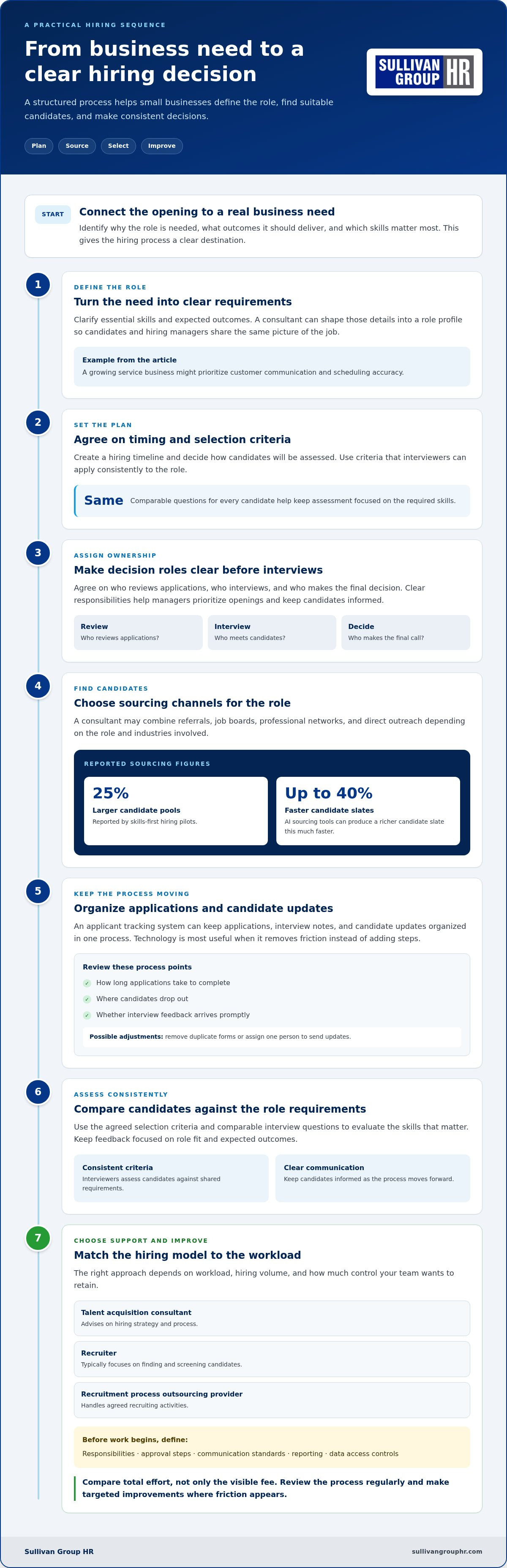
A clear hiring process connects a business need with a candidate who can meet it. Small businesses can plan each step, from defining the role to communicating the decision.
Recruitment Planning and Hiring
Start by identifying the business need, essential skills, and expected outcomes. A consultant can turn those details into a role profile, hiring timeline, and selection criteria that interviewers apply consistently. For example, a growing service business might prioritize customer communication and scheduling accuracy, then ask every candidate comparable questions about those skills.
A consultant can help when hiring competes with daily work, roles are difficult to fill, or repeated searches produce poor matches. They can help managers prioritize openings, clarify decisions, and keep candidates informed. Before interviews begin, agree on who reviews applications, who interviews, and who makes the final decision.
Sourcing and Process Optimization
Sourcing means finding candidates through suitable channels, then giving them a clear path to apply. A consultant may combine referrals, job boards, professional networks, and direct outreach, depending on the role and industries involved. Skills-first hiring pilots report candidate pools that are 25% larger, while AI sourcing tools can produce a richer candidate slate up to 40% faster. For teams looking to accelerate recruiting through modern technology, working with BlueBridge Group Placement Corp offers access to specialized AI-driven employment services that streamline the hiring process.
Technology helps when it removes friction rather than adding steps. An applicant tracking system can organize applications, interview notes, and candidate updates in one process. Review how long applications take, where candidates drop out, and whether interview feedback arrives promptly. Then make targeted adjustments, such as removing duplicate forms or assigning one person to send updates.
Recruitment Challenges and Costs
Small businesses often have limited recruiting capacity, while mid-market organizations may face higher hiring volume and more complex coordination. A consultant advises on strategy and process; a recruiter typically focuses on finding and screening candidates; a recruitment process outsourcing provider handles agreed recruiting activities. The right model depends on workload, hiring volume, and how much control your team wants to retain.
Compare the total effort, not just the visible fee. A recruiting firm may focus on filling a specific vacancy, while consulting can address planning, sourcing practices, and process improvement. Outsourcing also requires clear ownership: unclear responsibilities can slow decisions, inconsistent communication can harm candidate experience, and shared data needs careful access controls. Define responsibilities, approval steps, communication standards, and reporting before work begins.
When a candidate accepts, connect the hiring handoff to onboarding and payroll administration. Payroll outsourcing support can help manage payroll tasks as an employee joins, while managers focus on role expectations and the first weeks of work.
Recruiting and Hiring Requirements
In the United States, recruiting and hiring must comply with applicable federal, state, and local employment requirements, including rules related to discrimination, candidate screening, and employment records. Requirements can vary by location and hiring practice, so build a consistent process around job-related criteria, documented decisions, and secure handling of applicant information.
For each opening, write selection criteria before reviewing applications, ask candidates consistent questions, and record how their answers relate to the role. Avoid screening practices unrelated to job requirements. If an outside recruiter or RPO provider participates, specify who handles candidate information, communicates decisions, and escalates concerns. Clear ownership keeps the process organized from application to offer.
Hiring-process diagnostics and maturity assessments
Track time-to-fill, source of hire, interview-to-offer rate, offer acceptance, candidate withdrawals, and new-hire retention. Review each metric by role and recruiting source to identify slow stages or underperforming channels.
A hiring-process assessment examines how an organization moves from an approved vacancy to a new employee who can contribute effectively. A consultant can review job descriptions, application steps, screening criteria, interview practices, decision ownership, and candidate communication. The aim is to find friction and connect recruiting activity with business needs, not to collect metrics without acting on them.
Diagnostics typically take 6-8 weeks. During that period, a consultant can gather hiring records, speak with managers and candidates, and map the existing process. For example, an organization might discover that candidates wait several days between interviews because no one owns feedback collection. Assigning a decision owner and setting a response routine gives the team a specific improvement to test.
Use a consistent review sequence to make the assessment actionable:
- Map each stage, from role approval to the accepted offer.
- Record who owns the task and what information moves forward.
- Compare candidate experience across roles and recruiting sources.
- Identify repeated delays, unclear criteria, and duplicated work.
- Choose a manageable change, then monitor the relevant metric.
Metrics become useful when paired with context. A long time-to-fill may reflect a narrow candidate pool, slow interview scheduling, or changing role requirements. A low offer acceptance rate may point to unclear expectations or a mismatch between the role and candidate priorities. Compare similar roles and review the underlying steps before changing the process.
New-hire retention can help show whether selection and onboarding are aligned. If employees leave soon after joining, compare interview expectations with the actual work and manager support. Candidate feedback can also reveal experience gaps, such as confusing instructions or delayed updates. Together, these measures help businesses assess both recruiting efficiency and the quality of the match.
End an assessment with clear priorities, owners, and follow-up measures. A small team, for example, could standardize interview questions first, then review candidate withdrawals and hiring-manager feedback. Consultants can use manageable steps to help changes take hold. A useful maturity review turns findings into a practical sequence, links each action to a measure of success, and gives the team a way to see whether the adjustment helps.
Strategic planning and candidate attraction
A strategic recruiting plan connects workforce needs with business goals. Small businesses can build an effective approach on a limited budget by prioritizing critical roles and using focused outreach.
Strategic Recruiting Plans
Start with the work the organization must deliver, then identify the roles and skills needed to deliver it. Organizational design aligns structure with objectives and helps owners decide whether to hire, redistribute tasks, or develop current employees. For example, a service business preparing to expand could compare customer demand with available team capacity before opening a role.
Next, define the hiring need in practical terms: essential skills, expected outcomes, and how the role supports the business plan. A strategic workforce plan can distinguish immediate vacancies from future skills gaps, helping managers prioritize recruiting instead of treating every request as equally urgent.
Connect those decisions to a people strategy. Top-performing companies are twice as likely to have a cohesive people strategy as companies that do not. For a small organization, cohesion can mean aligning role expectations, onboarding, manager responsibilities, and development opportunities with the same business priorities.
A consultant can help turn that plan into clear hiring priorities and recruiting practices. Look for recommendations that explain which roles matter most, what success looks like, and how progress will be reviewed. A plan should guide action, not sit unused.
Budget-Conscious Candidate Attraction
Attract candidates on a limited budget by making existing strengths easy to understand. Describe the role honestly, show how the work contributes to the organization, and share employee perspectives through channels the business already uses. A team member’s account of solving a customer problem can make the workplace more tangible than broad claims.
Choose outreach based on the role and likely candidate community. A small business hiring for a hands-on position might share the opening through local workforce connections and employee referrals. For a specialized role, managers can ask professional contacts to circulate a concise description of the required skills and responsibilities.
Keep the application process focused. Remove steps that don’t help assess the work, assign interview responsibilities in advance, and provide consistent updates. These practices require coordination rather than a large campaign budget, and they reduce avoidable friction for candidates.
Targeted outreach can also improve timing: consulting outreach strategies can reduce time-to-accept by 30 percent or more. To apply that insight, clarify the role’s value, respond promptly to candidate questions, and prepare decision-makers before interviews begin. Track which channels produce relevant applicants, then direct future effort toward the sources that fit the workforce plan.
For a practical starting point, choose one hard-to-fill role, define its essential skills, and test a focused outreach message. Review the response and refine the message before using it for other openings.
Small-business talent management
Hiring is only the start. Talent management connects recruiting with onboarding, employee development, and the day-to-day relationship between employees and employers. For a small business, the practical test is whether people understand their roles, get useful support, and see how their work contributes to the organization.
Start by defining what success in each role looks like during the first 90 days. A customer-service employee, for example, might need to learn product details, handle customer questions, and follow the team’s handoff process. Clear expectations help managers coach against the work itself, rather than relying on vague impressions of whether a new hire is a “good fit.”
Build onboarding around the tasks and relationships that help someone do the work. Pair a new employee with a mentor who can explain team routines, answer everyday questions, and share practical feedback. A manager can also make sure the employee has the tools, training, and access needed for assigned responsibilities. These steps make the first weeks a planned transition rather than leaving a new hire to figure everything out alone.
Retention grows through regular, specific attention. Managers can recognize early wins, ask employees what is getting in the way, and discuss opportunities to learn new skills. After an employee completes a challenging customer handoff, for instance, a manager can acknowledge the contribution and agree on a skill to develop next. That conversation connects appreciation with progress.
Small businesses can make these practices manageable with a repeatable routine:
- Set role expectations and first-90-day goals before a new hire starts.
- Choose a mentor and clarify what support that person will provide.
- Schedule regular check-ins to discuss progress, obstacles, and feedback.
- Identify a practical learning opportunity tied to the employee’s role.
- Review whether onboarding and development support the business’s needs.
Culture is shaped by everyday actions, not just written values. If collaboration matters, managers can invite employee input before changing a team process. If growth is a priority, they can offer opportunities to build skills through current work. Consistency between words and actions helps employees understand what the organization values.
Talent acquisition consultants can help small-business leaders connect hiring plans with employee development and retention practices. Their role may include identifying gaps, helping managers introduce manageable changes, and reviewing whether new routines are working. Make progress visible through employee feedback, clearer role expectations, and follow-through on agreed development steps. Connect with an HR partner to discuss how employee support can fit your business’s needs.
Sullivan Group HR: HCM
Sullivan Group HR helps small businesses connect hiring administration with broader workforce management through HCM and isolved HCM technology. Its Applicant tracking, screening, and onboarding tools support the recruiting process. Payroll, taxes, time tracking, and benefits administration help manage payroll responsibilities as employees join.
This support can fit when hiring growth adds administrative work or recruiting and payroll tasks feel disconnected. Consider which process needs attention first, such as organizing candidate information or managing payroll tasks during onboarding. Starting with a clear priority helps align workforce support with your business needs.
Contact Sullivan Group HR to discuss HCM and the workforce processes you want to manage.
Make Your Next Hiring Move Count
Choose one hiring challenge that’s affecting the business now. Is it unclear role requirements, scattered applicant information, or too much time spent on payroll tasks? Defining that priority helps you decide what to improve first and what support could help.
Talent acquisition consulting for a small business works best when it connects hiring decisions with the practical work of managing employees. Sullivan Group HR offers HCM, Payroll Outsourcing, and Payroll Administration to help businesses coordinate workforce processes as they grow. Consider which administrative tasks are taking focus away from building a strong team, then make that the starting point for a conversation.
Contact Sullivan Group HR to discuss the workforce processes you want to strengthen. A clear next step can help you make room for thoughtful hiring and a team ready to move forward.
Frequently Asked Questions
What do talent consultants do?
Talent consultants help employers make hiring and workforce decisions more deliberate. They may review a hiring challenge, recommend an approach, and help leaders put agreed changes into practice. For example, if a business struggles to hire for a technical role, a consultant can clarify which skills are essential and how candidates will demonstrate them. The work may focus on strategy, process design, or hands-on recruiting support.
What does talent acquisition consulting include for small businesses?
Talent acquisition consulting can include planning roles, shaping candidate outreach, reviewing selection methods, and assessing how hiring decisions are made. The scope should match the business’s specific need. A company preparing to open a new department, for instance, might need role priorities and a hiring sequence, while another may need a clearer way to compare applicants. An applicant tracking system can also organize candidate information and recruiting steps.
How much do talent acquisition consultants charge small businesses?
Fees depend on the case and are provided after a quote request. The estimate can reflect the engagement’s scope, structure, hiring volume, project duration, and how much recruiting work the consultant handles. A strategy review differs from ongoing support across several openings. Define the problem you want solved and the expected deliverables first, so the proposed work and its cost factors are clear.
What is the difference between a talent acquisition consultant, recruiter, and staffing agency?
A talent acquisition consultant advises on hiring strategy and processes, while a recruiter generally focuses on finding and assessing candidates for roles. A staffing agency typically supplies candidates for temporary, contract, or permanent positions, depending on its services. The distinction matters when deciding whether you need process guidance, candidate sourcing, or help filling a specific vacancy. Some providers combine functions, so compare the actual scope of work.
How can small businesses choose a talent acquisition consultant?
Choose a consultant whose proposed work matches your hiring problem. Set out the roles involved, the decisions you need help with, and the deliverables you expect. Then assess their approach to communication, candidate experience, and progress reporting. If hiring managers need consistent interview feedback, for example, look for a plan that clarifies responsibilities and creates a usable review process, rather than relying on general recommendations alone.
What steps do talent acquisition consultants use to improve hiring?
Consultants commonly begin by clarifying the business need, examining the existing hiring workflow, and identifying obstacles. They recommend targeted changes, assign responsibilities, and review results to guide further adjustments. If candidates abandon an application, for example, a consultant can map its steps and identify unnecessary friction. The business can then simplify the process and monitor candidate completion and feedback to assess the change.
What employment laws must small businesses follow when recruiting and hiring in the United States?
Small businesses must follow applicable federal, state, and local requirements related to discrimination, candidate screening, and employment records. Use job-related criteria, document decisions, and handle applicant information securely.


