

Consistency, not conversational chemistry, is the foundation of a fair interview. Creating a structured interview process means asking every candidate the same predetermined, job-related questions in the same order and assessing their responses with the same scoring standards. That gives each person a comparable opportunity to show what they can do.
Interviews need room for human connection. Structure does not remove that; it prevents first impressions and improvised questions from outweighing job-related evidence. The goal is not to make every conversation feel scripted, but to make decisions more consistent, clear, and grounded in the role’s requirements.
This guide explains how to define role competencies, create interview questions and scorecards, prepare candidates, and align interviewers on evaluating answers. You’ll also learn how to keep the process practical, understand its benefits, and separate common myths from what structured interviews can actually do. A clear plan helps your team make thoughtful hiring decisions and give candidates a more consistent experience.
Key Takeaways
- Choose role-related competencies first, then build behavioral, situational, and skills-based questions that help reveal how candidates would perform.
- Give candidates clear expectations about the interview and use the same structure to make each conversation more consistent.
- Define what weak, solid, and strong responses look like before interviews so evaluators can score evidence against shared standards.
- Understand where structure can improve consistency and reduce bias, while recognizing that it supports sound judgment rather than replacing it.
What are Structured Interviews?
A structured interview gives every candidate the same predetermined, job-related questions in the same order, then evaluates answers against shared standards. For question count, use 5-8 prepared questions; another guide recommends 8-12 questions covering 4-6 core competencies. Train interviewers with a shared guide and a 30-minute calibration session before interviews begin.
-
Standardize Interview Questions
Ask every candidate the same questions to assess the same skills, and keep the question order consistent. For a customer service role, you might ask, “How would you respond to a customer whose order is delayed?” This situational question assesses problem-solving. A skill-based prompt could ask candidates to explain how they would prioritize a sample task list. Use a rating scale with clear descriptions so interviewers assess the answer, not just how polished it sounds.
-
Write Behavioral Questions and Follow-Ups
Draft two or three behavioral questions for each competency. Ask candidates for a real example, such as, “Tell me about a time you resolved a disagreement with a coworker.” Use consistent follow-up prompts, such as “What action did you take?” and “What happened next?” These questions focus on past behavior and the candidate’s specific contribution. Avoid giving one candidate extra opportunities to demonstrate a skill by changing the follow-ups.
- Identify 4-6 core competencies before writing the interview guide. Choose qualities tied to actual role duties, such as collaboration, accuracy, or troubleshooting. Map each question to a competency, then remove questions that test the same thing without adding useful evidence. This keeps the hiring team focused on the skills needed for successful performance, not personal similarity or unrelated credentials.
- Put the questions, evaluation criteria, and rating scorecard in one interview guide. For example, define a strong response as one that includes a clear action, relevant reasoning, and an outcome connected to the prompt. Give each interviewer the same guide and practice scoring sample responses together before interviews. This calibration helps recruiters and hiring managers apply the same standards.
Interview logistics and candidate communication
Plan logistics and candidate communications before interviews begin. Clear expectations, comparable conditions, and shared criteria help the hiring team assess candidates fairly.
In the United States, follow relevant federal, state, and local employment requirements, alongside EEOC guidance. Keep questions focused on job-related criteria and evaluate each candidate consistently against the role’s requirements.
- Before scheduling interviews, define the ideal candidate with the hiring manager. List the role’s required skills, qualifications, and competencies, then connect each one to a work responsibility. For example, a role involving frequent customer issues may require clear communication and problem-solving. Leave out preferences that are unrelated to the job.
- Map the interview process from invitation to decision. Tell candidates whom they’ll meet, what each stage involves, how much time to set aside, and whether they should prepare anything. Share the same core information with every candidate. If a stage changes, communicate the update promptly and consistently.
- Set up comparable interview conditions by sharing the same format, question sequence, and time allocation with each candidate. Make practical arrangements that let candidates participate and demonstrate their abilities. A recruiter can coordinate scheduling and explain the process, leaving interviewers to gather evidence against the agreed criteria.
- Explain what strong answers should demonstrate without giving away a preferred response. Tell candidates that interviewers will look for relevant examples, clear reasoning, and actions connected to the role. For a project management position, for example, a strong answer might describe how the candidate set priorities, communicated a change, and assessed the outcome.
- Keep candidate communications consistent after each stage. Confirm next steps and expected timing, then update everyone who remains in the process. Before making a decision, ask interviewers to record their evaluations independently. This helps the team compare evidence instead of letting one person’s first impression shape the discussion.
Anchored rating scales and response scoring rubrics
A shared rubric turns interview notes into comparable evidence. Define the scoring format before interviews start, then use it consistently for every candidate.
-
Create a Shared Scoring Rubric
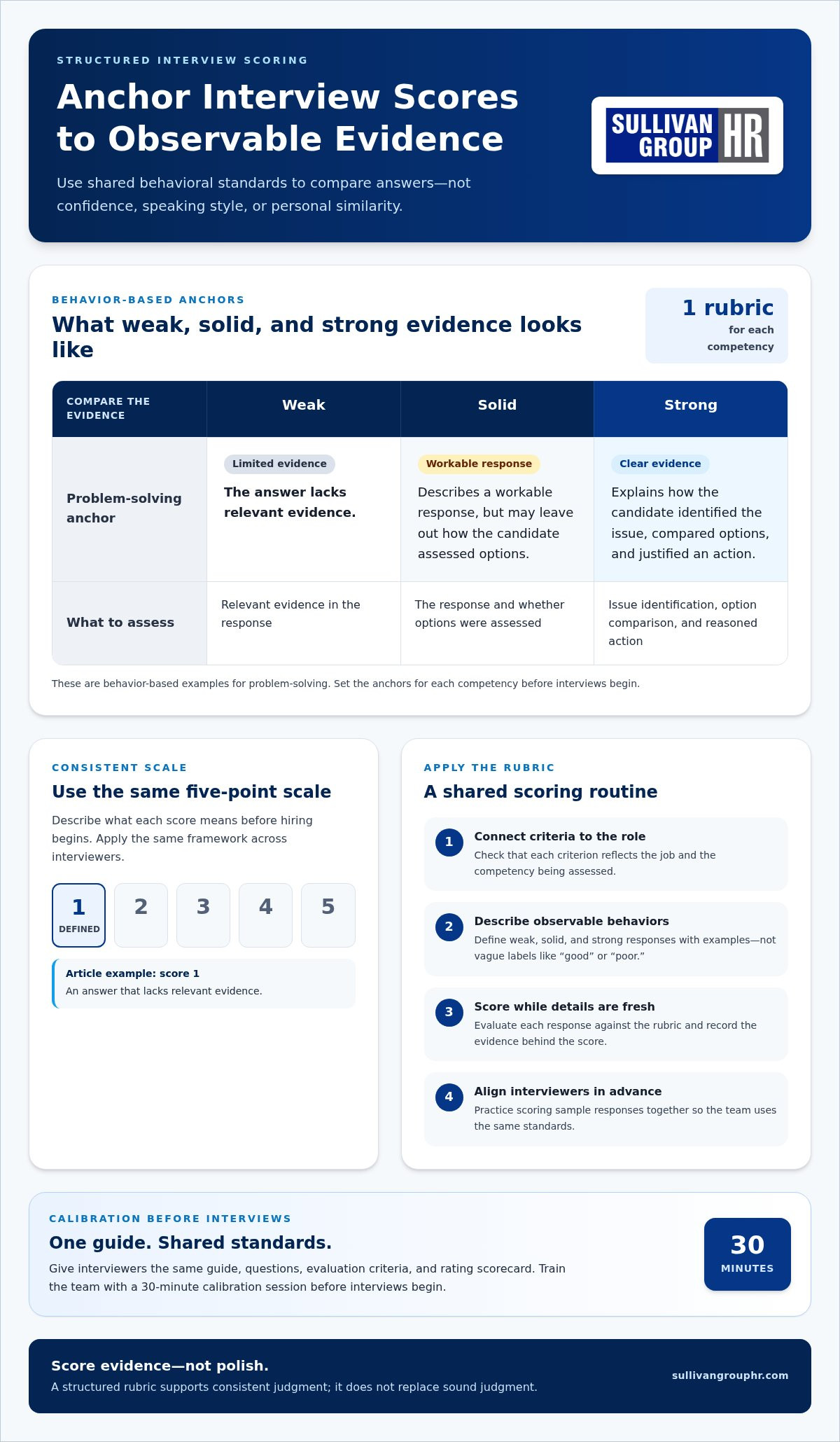
Build one rubric for each competency, using the same five-point scale across interviewers. Describe what each score means before hiring begins, rather than relying on labels like “good” or “poor.” For example, a score of 1 can represent an answer that lacks relevant evidence. Check that every criterion connects to the role and that interviewers use the same framework.
-
Anchor Scores to Behaviors
For each competency, describe observable examples of weak, solid, and strong answers. For problem-solving, a strong answer might explain how the candidate identified the issue, compared options, and justified an action. A solid answer might describe a workable response but leave out how the candidate assessed options. These behavior-based anchors help interviewers score evidence rather than confidence, speaking style, or personal similarity.
-
Score Candidate Responses
Evaluate each response against the rubric while details are fresh, and record the evidence behind the score. If a candidate earns a 4 for collaboration, note the specific action they described and how it relates to the competency. Avoid changing standards between candidates or scoring from memory after the interview. This format supports consistent comparisons and a more objective candidate experience.
- Calibrate the hiring team before using the rubric. In a 30-minute session, have interviewers score the same sample answer, compare their reasoning, and clarify any unclear anchors. After interviews, review agreement rates; investigate results below 70%, since they may signal that behavioral descriptors need more detail. Use those findings to develop a clearer rubric and improve later hiring outcomes.
Benefits and myths of structured interviews
Structure can make hiring decisions more consistent, but it isn’t a shortcut to perfect judgment. Use these steps to understand what structured interviews improve, what they can’t promise, and where implementation can go wrong.
Common risks include questions that do not measure the role, vague scoring criteria, and interviewers who ignore the shared format. These weaknesses can undermine the assessment and lead to inconsistent evaluations.
- Use job-related evidence to ground decisions. A 2022 meta-analysis reported predictive validity of .42 for structured interviews and .19 for unstructured interviews. That difference supports structure as a stronger assessment method, not as a guarantee that every hiring decision will be right. Hiring managers still need to define competencies that matter to the actual work.
- Challenge the myth that structure makes interviews cold or robotic. Everyone can ask planned questions while still listening carefully and responding with the same prepared follow-ups. Lighthouse Research & Advisory found that 7 in 10 candidates prefer interviews where questions don’t vary from candidate to candidate. Consistency can support a fairer candidate experience without removing human interaction.
- Don’t assume a rubric removes bias automatically. Questions can still reflect irrelevant assumptions, and interviewers can interpret anchors differently. Greenhouse’s 2025 Workforce Hiring Report found that 53% of US job seekers say they have faced illegal or discriminatory interview questions. Keep prompts focused on job-related criteria, train interviewers, and review scoring patterns for unexplained differences.
- Keep the process practical, then measure its results. Google re:Work reports that pre-made interview guides save an average of 40 minutes per interview session. Pilot the guide, gather interviewer feedback, and revise unclear questions. Track pass-or-fail rates by competency and compare interviewer agreement to see whether the assessment framework is working as intended.
Ready to strengthen hiring practices alongside your broader people operations? Explore human resources support for your organization.
Sullivan Group HR: HCM
Sullivan Group HR helps organizations connect hiring administration with broader workforce processes through HCM and its Applicant Tracking System. If your team is creating a structured interview process, an ATS can support the hiring workflow, while your questions and scoring criteria guide candidate assessment.
After employees move from hiring into ongoing operations, Payroll Outsourcing and Payroll Administration can support payroll processes. HCM brings workforce functions into a broader management framework, helping business owners coordinate people-related administration as their needs evolve.
If you’re looking to align hiring systems with workforce administration, contact Sullivan Group HR to discuss your organization’s needs.
Put a Fairer Hiring Framework Into Practice
Turn your interview plan into a repeatable part of how your organization hires. Assign an owner to the interview guide, decide when the team will review it, and update it when role responsibilities change. Creating a structured interview process is ongoing work: each hiring cycle can reveal where questions, scoring criteria, or candidate communications need refinement.
Hiring also connects to the work that follows a candidate’s selection. Sullivan Group HR offers HCM, Payroll Outsourcing, and Payroll Administration to support workforce administration beyond the interview stage. Consider how these services fit your organization’s broader people operations as you put a consistent hiring approach into practice.
Contact Sullivan Group HR to discuss your organization’s needs and next steps. A thoughtful process starts with clear standards, and your team can build on them with confidence.
Frequently Asked Questions
How Do You Measure Whether Your Interview Process Is Working?
Compare interview evidence with later job performance, not just hiring speed. Review new-hire performance ratings at 90 days and annually, then look for patterns between interview scores and outcomes. Also track pass-or-fail rates by competency, interviewer agreement, and changes in time-to-hire. If one question consistently separates candidates without relating to later performance, revisit its relevance and scoring criteria.
What Is An Interview Guide?
An interview guide is a working document that helps the hiring team conduct and evaluate interviews consistently. Alongside prompts and scoring, it can identify who owns each stage, where evaluators record evidence, and how decisions are documented. For example, a guide might include a version date for the role, helping interviewers distinguish current questions from an outdated copy.
What Is a Structured Interview Process?
A structured interview process is a planned way to gather and compare candidate evidence against the needs of a particular role. It brings preparation, candidate conversations, evaluation, and the hiring decision together in a consistent framework. For example, a team hiring a support specialist can assess how candidates handle customer concerns and consider that evidence alongside other job-related information when deciding.
What Steps Are Involved in Creating a Structured Interview Process?
Creating a structured interview process starts with role analysis, followed by question design, interviewer preparation, candidate scheduling, scoring, and review. Assign someone to maintain the interview materials and a hiring lead to address gaps in evaluator feedback. After each hiring round, gather interviewer observations and candidate feedback, then use them to improve the next version of the process.
How Do You Define Job-Related Competencies for Interview Questions?
Start with the work itself: review key responsibilities, recurring decisions, and problems the role must handle. Ask the hiring manager and people familiar with the work to identify the abilities needed for those tasks. In a scheduling role, for example, coordinating competing requests may matter more than general confidence. Separate essential capabilities from preferences, then link each interview question to a specific responsibility.
How Do You Write Consistent Behavioral and Situational Interview Questions?
Build each prompt around one competency and use clear, neutral wording. Behavioral questions ask for an example from past work; situational questions present a realistic job challenge. For instance, ask every candidate how they handled a missed deadline or what steps they would take if two urgent requests arrived at once. Keep the purpose of each prompt consistent, and avoid hints that steer candidates toward a preferred answer.


