

What if a bonus plan could motivate strong performance without rewarding results employees can’t control? That’s the challenge at the heart of designing an employee bonus plan. You want bonuses to support business goals, but unclear targets or inconsistent decisions can quickly undermine trust. A sound plan makes the link between effort, outcomes, and rewards clear.
This guide will help you build a bonus plan that’s measurable, fair, and practical to manage. You’ll learn how to choose business and role-specific goals, define eligibility, set targets, and calculate payouts employees can understand. We’ll also cover how to track results, approve awards, and coordinate payments through a repeatable process. Clear rules and connected HR and payroll support can help you recognize meaningful contributions while keeping the plan aligned with business performance and affordability.
Key Takeaways
- Start with business outcomes, then choose measures employees can influence and understand.
- When designing an employee bonus plan, set clear eligibility rules, targets, payout calculations, and communication expectations.
- Compare individual, team, company-wide, and profit-sharing plans by fairness, collaboration, measurement effort, and cost predictability.
- Make administration repeatable by assigning owners for data, calculations, approvals, employee questions, and payroll processing.
- Connected HR and payroll support can help coordinate compensation policies, workforce information, and recurring bonus payments.
Why design an employee bonus plan around clear business outcomes?
An employee bonus plan is variable compensation awarded when employees or the business meet conditions set in advance. Unlike base pay, which provides a regular wage, a bonus is conditional. Commissions typically reward sales against defined targets; profit sharing distributes a portion of business profits under stated rules; and employee benefits provide non-wage support such as health or retirement benefits. For a broader overview of incentive programs, consider how different approaches can encourage particular actions or results.
A bonus can recognize results, reinforce priorities, or support retention. It can’t guarantee better performance or replace fair base pay and effective management. If employees lack the tools, clarity, or support to reach a target, adding a payout alone may not solve the underlying problem.
What should a bonus plan accomplish?
Start with a specific business need: improving quality, increasing productivity, retaining employees, or rewarding shared financial performance. Connect that need to a measure employees can understand and influence. For example, a quality-focused plan might track error rates, while a retention goal might reward eligible employees for remaining through a clearly defined period.
Keep the link between action and reward credible. Employees should know what counts, how results are measured, and why the outcome matters to the business. If a measure depends mostly on factors outside their control, it may feel arbitrary rather than motivating.
Which bonus-plan structure fits the goal?
The right structure depends on the result you want and who can influence it. Individual awards can recognize personal contributions. Team bonuses can encourage collaboration around a shared target. Company-wide bonuses connect rewards to overall results, while profit-sharing ties payouts to business profits. Each approach involves trade-offs in employee influence, shared accountability, measurement, and cost predictability.
Short-term incentives suit defined performance periods, such as quarterly quality or productivity goals. Longer-term aims, such as sustained growth or retention, need measures and time frames designed for those outcomes. As you work on designing an employee bonus plan, consider how it fits your broader human capital management strategy, including compensation priorities and workforce needs.
Choose a structure that reflects the work, not just the payout method. A clear purpose gives you a stronger foundation for setting targets, explaining the plan, and assessing whether it remains useful as business needs change.
How to design an employee bonus plan in clear, manageable steps
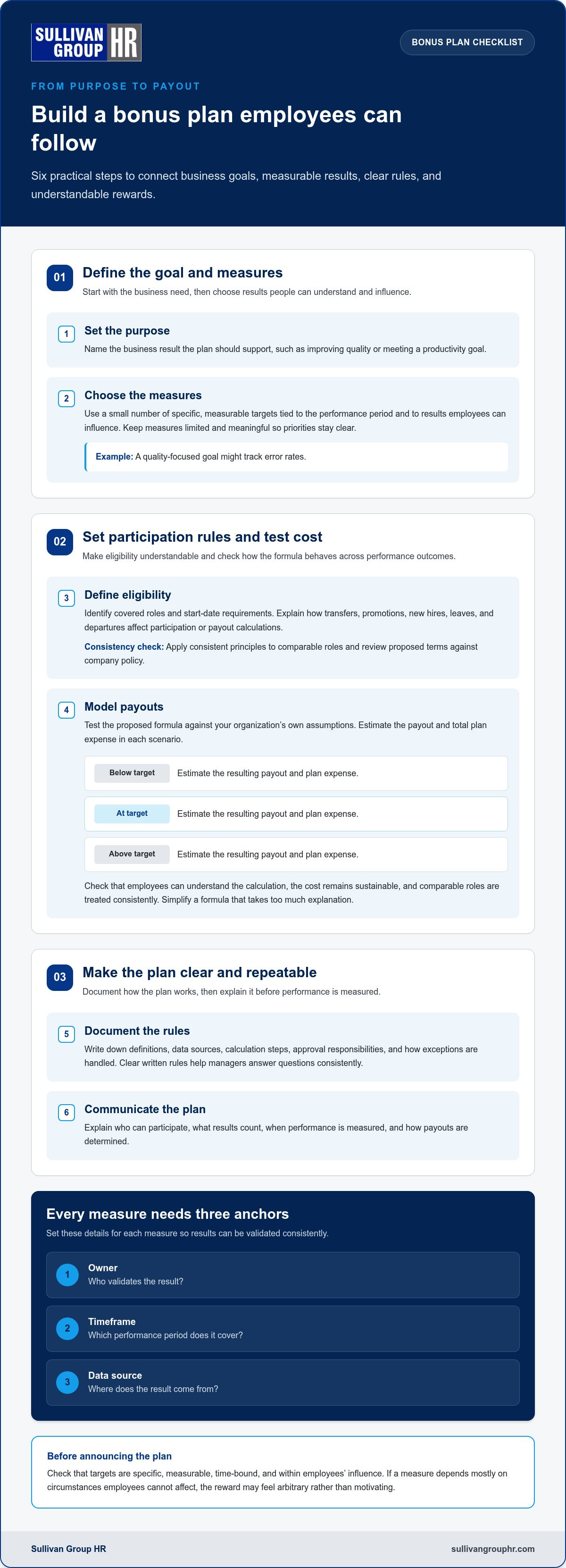
Once the plan’s purpose is clear, turn it into rules employees can follow and administrators can apply consistently. Use this sequence to build and test the framework before announcing it.
- Set the purpose. State the business result the plan is meant to support, such as improving quality or meeting a productivity goal.
- Choose the measures. Select a small number of specific, measurable targets tied to the performance period and results employees can influence.
- Define eligibility. Identify covered roles, start-date requirements, and how role or employment-status changes affect participation.
- Model payouts. Test the proposed formula against different performance outcomes and assess the potential cost.
- Document the rules. Write down definitions, data sources, calculation steps, approval responsibilities, and how exceptions are handled.
- Communicate the plan. Explain who can participate, what results count, when performance is measured, and how payouts are determined.
Every bonus measure should have a defined owner, timeframe, and data source. This makes it clear who validates a result, which period it covers, and where the number comes from. Keep measures limited and meaningful. Too many competing targets can make priorities harder to understand.
How do you set targets and eligibility rules?
Specify the performance period, eligible roles, and any start-date requirements. Describe how transfers, promotions, new hires, leaves, and departures affect eligibility or payout calculations. Apply consistent principles to comparable roles, and have the proposed terms reviewed against company policy before launch. Clear written rules help managers answer questions consistently instead of making exceptions on the fly.
Choose targets that are specific, measurable, time-bound, and within employees’ influence. For example, a team might have a defined quarterly quality target and a consistent method for measuring completed work. Avoid measures that depend heavily on circumstances employees can’t affect.
How should you test the bonus formula?
Model below-target, target, and above-target outcomes using your organization’s own assumptions. For each scenario, estimate the resulting payout and total plan expense. Then assess whether employees can understand the calculation, the cost remains sustainable, and comparable roles are treated consistently. If the formula takes too much explanation, simplify it before communicating the plan.
A clear process also depends on reliable records and payroll coordination. Employers refining their HR and payroll administration can use payroll administration outsourcing to support recurring processes.
How to compare bonus-plan options for fairness and affordability
A plan can feel unfair if employees don’t see how their work affects the payout, or if similar contributions lead to different treatment. Clear rules and measures employees can influence help address both concerns. Perceived fairness depends on transparent rules, consistent application, and meaningful employee influence.
Compare structures against the work employees do and the results you want to recognize. No structure is best for every organization. Each balances influence, collaboration, measurement effort, and cost predictability differently.
Which bonus structure fits different business goals?
Use individual rewards when results can be clearly attributed to a person. Team awards suit interdependent work, while company-wide bonuses connect payouts to broader organizational outcomes. Profit sharing links rewards to business profits, which can make payouts less predictable when profits fluctuate.
| Structure | Employee influence | Collaboration | Measurement complexity | Cost predictability |
|---|---|---|---|---|
| Individual | Often high for role-specific results | May be limited if goals compete | Depends on reliable individual measures | Can be modeled per eligible employee |
| Team | Shared within the team’s scope | Directly supports shared effort | Requires clear team-level measures | Can be modeled by team size and formula |
| Company-wide | May be indirect for individual employees | Creates a shared organizational goal | Depends on business-level data | Varies with the selected outcome |
| Profit-sharing | Usually indirect | Connects rewards to shared financial results | Requires an agreed profit measure | Can fluctuate with profits |
Role-based plans can adapt measures or targets to different jobs while keeping common rules, such as the performance period and calculation approach. As you continue designing an employee bonus plan, choose measures that reflect genuine contributions instead of rewarding what is easiest to count.
How can employers reduce bias and unintended incentives?
Apply eligibility rules consistently, document calculations, and establish a review process for exceptions. Check whether a target could encourage unsafe shortcuts, lower-quality work, or decisions that favor immediate results over lasting performance. Pairing measures, such as productivity with quality, can help keep priorities balanced.
Managers can explain the plan’s measures, an employee’s results, and the calculation process without disclosing another person’s compensation. Consistent, privacy-conscious communication helps employees understand decisions while protecting individual pay information.
How to administer and review an employee bonus plan
A well-designed plan needs a repeatable process after the performance period ends. Assign an owner to each handoff so results are checked, awards are approved, and payroll receives complete information. A typical workflow moves from data collection to validation, payout calculation, approval, employee communication, and payroll processing.
- Performance data owner: gathers results from the agreed source and confirms the measurement period.
- Calculation reviewer: checks eligibility, inputs, and formula application.
- Approver: reviews the final award file against the plan and authorizes payment.
- Employee contact: answers questions and routes disputed results for review.
- Records owner: maintains plan documents, decisions, and communications.
Wage-hour, tax, and plan-specific requirements can vary. Verify current guidance with authoritative sources before setting or changing procedures. Include these checks in your broader HR risk management practices, and coordinate with payroll early so approved awards reach the payroll team in the required format and within its processing schedule.
What should employers track and document?
Keep a clear record of the written plan terms, eligibility decisions, source data, calculations, approvals, and employee communications. Organize access according to company policy and applicable requirements, so responsible people can review records without exposing them broadly.
Define how payroll receives approved awards, including the information needed to process them. If an employee or reviewer spots a discrepancy, document the issue, who will investigate it, and how a correction will be communicated and processed. A consistent path helps resolve questions without relying on informal decisions.
When should a bonus plan be adjusted?
Review the plan after each performance period. Compare results with the original business objective, then look for unintended behavior, uneven effects across roles, and calculations employees found difficult to understand or disputed. For example, a productivity measure may need a quality check if results suggest employees are prioritizing speed at the expense of accuracy.
Don’t change the rules midway through a measurement period without careful review. Explain adjustments prospectively, document the revised terms, and communicate them before the next period begins. This gives employees a clear basis for understanding what counts and gives administrators a stable framework to follow.
Need support coordinating HR records, compensation policies, and recurring payroll processes? Explore Sullivan Group HR’s HR and payroll support.
How Sullivan Group HR can support the people and payroll behind your plan
Once the plan’s purpose, measures, and rules are set, the next task is coordinating the people and processes that bring it to life. That means keeping compensation policies clear, workforce information organized, and approved awards connected to recurring payroll workflows. Sullivan Group HR supports employers with HR outsourcing, HR consulting, payroll administration, and access to the isolved HCM platform.
Where can HR and payroll support fit?
HR consulting can help employers organize plan policies, clarify who is responsible for each step, and prepare consistent communication for employees and managers. HR outsourcing can support broader people processes that sit alongside compensation administration.
Payroll administration helps carry approved awards through established payroll workflows. Clear handoffs matter: the plan owner validates results, an authorized person approves awards, and payroll receives the information needed to process them. Workforce records and HR processes also need to stay coordinated as roles or employee information change. Sullivan Group HR provides access to isolved HCM as part of its broader HR support.
What are sensible next steps before launch?
Before announcing the plan, bring its essential details together in one review:
- Purpose: What business outcome should the plan support?
- Measures: What results count, and how will they be measured?
- Eligibility and formula: Who can participate, and how are awards determined?
- Owners and timeline: Who validates data, reviews calculations, approves awards, answers questions, and coordinates payroll, and when does each step happen?
- Review process: When will you assess results and decide whether to revise the plan for a future period?
This final check connects the design work with the records, communication, and payroll steps needed to administer the plan. Sullivan Group HR provides HR and payroll support to help coordinate these responsibilities. Explore HR and payroll support.
Put a clear, workable bonus plan into motion
Effective bonus plans start with a business outcome, reward results employees can influence, and spell out how eligibility and payouts work. As you continue designing an employee bonus plan, keep the measures focused, check the formula against different performance scenarios, and assign clear owners for tracking, review, approval, and payroll processing.
Fairness depends on more than the formula. Consistent rules, clear communication, and regular reviews help employees understand how the plan works and give you a chance to adjust it as business needs change. The right administrative support can also help connect compensation policies, workforce information, and recurring payroll tasks.
Sullivan Group HR provides HR outsourcing, payroll administration, HR consulting, employee benefits management, and access to the isolved HCM platform. Explore how Sullivan Group HR can support your HR and payroll operations.
With a clear framework and dependable processes behind it, you can build a plan that recognizes meaningful contributions while keeping business priorities in view. Start with one measurable goal, then build from there.
Frequently Asked Questions
What should an employee bonus plan include?
A written bonus plan should explain its purpose, eligibility rules, performance period, measures, calculation method, approval process, payment timing, and how changes or exceptions are handled. Use plain language and a practical example to show how results affect an award. Before launch, have the appropriate HR and payroll stakeholders review the plan. Verify relevant legal and tax details against current authoritative guidance, since requirements can depend on the plan and circumstances.
How do you set a fair bonus target?
Start with a business outcome, then choose a target employees can understand and meaningfully influence. Define the measurement period, data source, target level, and rules for unusual situations before performance begins. Compare how the target applies across roles, and consider whether it could encourage unsafe or low-quality shortcuts. Fairness also depends on documented rules being applied consistently, with a clear explanation of how results are measured and calculations are reviewed.
Should employee bonuses be based on individual or company performance?
Choose the basis that best supports the result you want to encourage. Individual measures can make personal contributions clearer, while team or company measures can reinforce shared outcomes. Each structure has trade-offs in employee influence, collaboration, and measurement. Some employers combine approaches, such as pairing a role-specific target with a company result. If you do, keep the formula understandable and avoid measures that pull employees toward conflicting priorities.
Are employee bonuses subject to taxes and payroll rules?
Generally, bonuses are treated as compensation, but withholding and wage-hour treatment can depend on how a payment is structured and the employee’s circumstances. Don’t assume every bonus receives identical treatment. Before launching a plan, verify current IRS, Department of Labor, and applicable guidance for your situation. Coordinate the written terms with payroll administration so approved awards are handled through a consistent process and relevant requirements are considered.
How often should a company pay employee bonuses?
Set the payout cadence to match the goal and the time needed to measure results reliably. A short performance period may suit a near-term operational target, while broader company outcomes may need a longer measurement cycle. State the measurement period and expected payment timing in advance. Then review whether the schedule keeps the plan understandable, affordable, and connected to business planning, and whether administrators can apply it consistently.
Can a small business create an employee bonus plan?
Yes. A small business can start with a focused plan, a limited number of measurable goals, clear eligibility rules, and a formula it can afford across different performance scenarios. Keep the process proportional to the organization’s capacity, document decisions, and coordinate approved awards through payroll. Before communicating final terms, verify applicable employment, tax, and wage-hour requirements. A simple plan with clear ownership can be easier to explain and administer.
How can employers prevent bonus plans from feeling unfair?
Publish clear eligibility and calculation rules before the performance period, use reliable data, and apply the same standards to comparable situations. Choose measures employees can influence and explain how exceptional circumstances will be handled. Review outcomes for unintended disparities or incentives that could undermine quality or safety. Give employees a consistent way to ask questions or flag calculation errors, and document how concerns are reviewed and resolved.


