

What if you could manage workers compensation costs without compromising employee safety or the care injured workers need? The answer isn’t cutting corners. It’s managing workplace risks, claims, payroll accuracy, and recovery as connected parts of one process.
It’s understandable if premiums and claim expenses feel difficult to predict. An injury can disrupt operations, while missing payroll details or inaccurate job classifications can complicate a policy review. These pressures are real, but a consistent process can help your business identify risks earlier and handle its responsibilities more reliably.
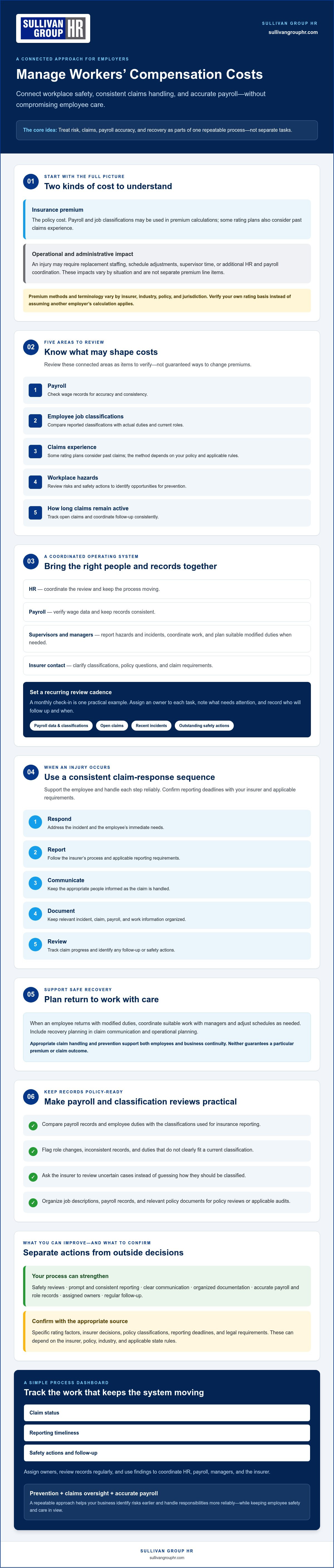
This guide explains the main factors that influence workers’ compensation costs and where employers can take practical action. You’ll learn how to strengthen injury prevention, report and manage claims consistently, support safe return-to-work planning, and keep payroll classifications and records in order. You’ll also see how HR, payroll, managers, and your insurer can coordinate around a repeatable process, so cost management supports both your business and your employees.
Key Takeaways
- Separate insurance premiums from the operational and administrative effects of injuries, then confirm which policy and state factors shape your costs.
- To manage workers compensation costs, coordinate safety reviews, claims oversight, and payroll classification checks instead of treating them as separate tasks.
- Use a consistent claim response sequence: respond, report, communicate, document, and review. Confirm reporting deadlines with your insurer and applicable requirements.
- Distinguish practices your business can improve from rating factors, insurer decisions, and legal requirements that need outside confirmation.
- Build a repeatable HR process with assigned owners, regular record reviews, and a simple dashboard to track claim status, reporting timeliness, and safety actions.
How to Manage Workers' Compensation Costs: Start with the Main Cost Drivers
Before you can manage workers compensation costs, separate what appears on the insurance bill from the wider impact an injury can have on your business. A workers' compensation policy helps provide benefits for covered workplace injuries. The full business impact may also include time spent coordinating the claim, adjusting schedules, and maintaining operations.
Workers’ compensation costs include the insurance premium and the operational and administrative impact of workplace injuries. The Workers' compensation system provides benefits for work-related injuries within a legal framework, but the details employers encounter depend on the policy and applicable state requirements. Rating methods and cost components can vary by insurer, industry, policy, and jurisdiction, so don’t assume another employer’s calculation applies to your business.
Start by reviewing five areas: payroll, employee job classifications, claims experience, workplace hazards, and how long claims remain active. These factors can interact. For example, payroll records that don’t reflect actual wages or work duties may complicate a premium review. An injury can affect both claim handling and day-to-day staffing. Treat each area as something to verify, not as a guaranteed way to change premiums.
Which factors can influence workers' compensation premiums?
Insurers may use payroll and job classifications in premium calculations. Classifications generally reflect the work employees perform and its associated risk, so accurate job descriptions and wage records matter. Some rating plans also consider an employer’s past claims experience. The method and terminology, including whether an experience-rating adjustment applies, depend on the policy, insurer, industry, and state rules. Ask your insurer or a qualified adviser to explain your specific rating basis before drawing conclusions.
For a practical review, compare payroll records with employees’ current roles. Flag changes in duties, work locations, or operations that may need clarification. Connected HR and payroll administration can help keep records consistent, but your insurer should confirm how the information affects your policy.
Why do workplace injuries create costs beyond the insurance bill?
An injury can leave a role temporarily unfilled, require replacement staffing, redirect a supervisor’s time, or add administrative work for HR and payroll. If an employee returns with modified duties, managers may also need to plan suitable work and adjust schedules. These are operational impacts, not separate premium line items, and they vary by situation.
That’s why prevention and appropriate claim handling belong in one cost strategy. Safer work practices can help prevent avoidable injuries. Prompt reporting and clear communication can help the claim move through the proper process. Neither guarantees a particular premium or claim outcome. Together, they give your team a consistent way to support employees, maintain records, and understand where costs and disruptions arise.
Build a Cost-Control System Around Safety, Claims, and Accurate Payroll
To manage workers compensation costs consistently, connect the people and records that shape your workplace risk picture. HR can coordinate the review, payroll can verify wage data, supervisors can report hazards and incidents, and an insurer contact can clarify policy classifications and claim questions.
Cost oversight works best as a recurring, cross-functional process. Set a practical review schedule, such as a monthly check-in, and assign a clear owner to each task. Review payroll data and classifications, open claims, recent incidents, and outstanding safety actions. Record what needs attention, who will handle it, and when the team will follow up.
How can employers improve workers' compensation payroll and classification reviews?
Compare payroll records and employee duties with the classifications used for insurance reporting. Flag role changes, inconsistent records, and duties that don’t clearly fit a current classification. Ask your insurer to review uncertain cases instead of guessing. Keep job descriptions, payroll records, and relevant policy documents organized so your team can answer questions during policy reviews or applicable audits.
Connected HR and payroll administration can support consistent records, but verify how your insurer wants information reported. Make this check part of regular payroll and HR workflows, rather than waiting until renewal preparation.
How should a workplace safety program support cost management?
Use incident reviews to look for recurring hazards and practical ways to address them. Include employees who do the work, ask supervisors to confirm that agreed changes are in place, and record safety discussions and follow-up dates. An action isn’t complete until someone checks that it was carried out.
The linked state government guidance on ways to reduce workers' compensation costs discusses prevention and steps to take after an injury. Treat it as a useful reference, not a substitute for checking requirements that apply to your own policy and workplace.
- HR: Coordinate records, review dates, and action tracking.
- Payroll: Check wage data and flag discrepancies.
- Supervisors: Report incidents, identify hazards, and confirm corrective actions.
- Insurer contact: Clarify policy classifications and reporting questions.
After an incident, record what happened, what conditions may have contributed, and what change could help prevent a similar event. Assign an owner and follow-up date to each corrective action. Prevention and claims oversight work better together when the same review process checks injury patterns alongside unresolved claims and documentation issues.
If your team needs help coordinating HR and payroll responsibilities, explore HR and payroll administration support as one part of a consistent oversight process.
Manage Claims and Return-to-Work Decisions Without Cutting Corners
After an injury, a clear response helps protect the employee and gives your team a consistent way to handle the claim. Cost management should never mean discouraging injury reports or challenging legitimate claims. Delayed reporting can complicate communication and follow-up. Respectful, accurate handling keeps attention on the employee’s needs and the appropriate process.
What should employers do after a workplace injury?
Use a simple sequence, and make sure employees and supervisors know whom to contact:
- Respond: Address immediate safety concerns and help the employee access appropriate medical attention.
- Report: Notify the insurer or claims contact through the channels required by your policy. Follow applicable requirements and verify deadlines with the insurer or a qualified adviser, since rules can vary by state.
- Communicate: Keep contact respectful and consistent. Explain the next steps without making promises about claim decisions or outcomes.
- Document: Record relevant facts, such as when and where the incident occurred, reported conditions, and actions taken. Limit access to confidential employee information to people who need it for their role.
- Review: Check that required information has been submitted, identify open questions, and agree on who will follow up and when.
Timely reporting matters, but the correct timing and procedure depend on the policy and applicable requirements. Confirm them in advance, then include them in supervisor guidance so a stressful moment doesn’t become a scramble. The linked state government guidance on ways to reduce workers' compensation costs also discusses workplace safety and return-to-work planning.
How can transitional work support a safe return to work?
Transitional work may help an employee return while recovering, but the plan must fit documented medical restrictions. Don’t assume a task is suitable just because it seems light. Review the proposed duties, hours, equipment, and work location with the employee, supervisor, and appropriate insurer or claims contact. If the restrictions rule out a task, consider another option or wait for updated guidance.
Check in as circumstances change. Restrictions may be updated, or a task may prove uncomfortable or impractical. Reassess the work and coordinate any changes with the appropriate parties. Never pressure someone to return before they’re ready or assign duties that conflict with medical guidance.
Keep the process steady: respond, report, communicate, document, and review. This helps your team support recovery and manage workers compensation costs responsibly, without putting short-term savings ahead of employee safety or proper claim handling.
Are Workers' Compensation Costs Truly Outside Your Control?
Not entirely, and not completely within your control either. Employers can strengthen safety practices, keep payroll and job records accurate, and handle claims consistently. But a business can’t control every injury, insurer decision, policy-rating factor, or state requirement. The practical goal is to manage workers compensation costs responsibly, without promising a particular premium or limiting an employee’s right to report an injury or pursue a legitimate claim.
Separate your review into two groups: actions your team can take and details that need confirmation. This keeps attention on practical steps and helps prevent assumptions about policy terms or legal duties.
Actions employers can take
- Identify workplace hazards and follow through on appropriate prevention measures.
- Keep payroll, job duties, and employee records current when staffing or roles change.
- Report injuries through the proper channels and follow up on open claims consistently.
- Review incident patterns and claims over time, rather than judging results by a single claim or premium cycle.
Factors to verify
- Policy terms, premium calculations, and the reporting process with the insurer or a qualified insurance adviser.
- Job classifications and how specific work duties should be reported.
- Applicable state requirements, especially if employees work in multiple locations.
- Legal questions with qualified legal counsel.
Which workers' compensation cost factors can employers influence?
Start with the day-to-day practices your team can maintain. If an employee’s duties change, update the relevant records and ask the insurer whether the classification needs review. If an incident occurs, follow established reporting procedures and track the claim’s next steps. Review injuries and safety actions periodically to spot patterns. These habits can improve oversight, but they don’t guarantee lower premiums or a particular claim outcome.
Which costs and decisions require insurer or state-specific guidance?
Rating methods, classifications, policy conditions, and reporting deadlines may depend on the insurer, policy, and jurisdiction. Don’t apply one location’s process across every worksite without checking. Ask your insurer or a qualified adviser to explain policy-specific questions, and verify state obligations with an appropriate authority or professional. For legal matters, consult qualified legal counsel rather than relying on general HR or insurance guidance.
Clear boundaries make cost management more useful: act on prevention, records, and follow-through, and verify what depends on coverage or local rules. If you’re reviewing how HR responsibilities and workers’ compensation insurance fit into your process, explore Sullivan Group HR’s HR and workers’ compensation support.
Turn Workers' Compensation Cost Management into a Repeatable HR Process
A repeatable process turns separate records and responsibilities into useful oversight. Start with a baseline: gather current policy and payroll records, employee classifications, open claims, incident trends, and prevention actions. Note what’s complete, what’s unclear, and what needs follow-up. This gives your team a starting point, not a promise that costs will change.
Next, assign owners across HR, payroll, supervisors, and the insurer contact. Set a regular review date that fits your operations, then use each meeting to resolve questions and track commitments. Keep the process simple enough to maintain.
What should an employer include in a workers' compensation review?
Use a short dashboard to show verified information, not assumptions. Useful measures include open claim status, whether incidents were reported according to established procedures, and which planned safety actions are complete. Add a named owner and follow-up date for each unresolved item.
- HR: Coordinate review dates, claim-status follow-up, and action tracking.
- Payroll: Check payroll records and flag changes that may need classification review.
- Supervisors: Share incident patterns and confirm completed prevention actions.
- Insurer contact: Answer policy, classification, and reporting questions.
At each review, compare current records with the previous check. Record questions for the insurer instead of making assumptions about policy terms or state requirements. If multiple locations are involved, confirm which procedures apply to each. Broader HR risk management can also help place workers’ compensation tasks within the organization’s wider responsibilities.
When can HR and payroll support make cost oversight easier?
Consistent payroll administration can help keep wage and employee records organized for review. Coordinating payroll workflows with HR responsibilities may also make it easier to identify job changes, maintain documentation, and assign follow-up. The value is clearer oversight, not a guarantee of premium savings or a particular claim outcome.
Sullivan Group HR provides HR outsourcing, payroll administration, workers’ compensation insurance, and HR consulting. These services can support coordinated administrative workflows, while policy questions and state-specific requirements should still be confirmed with the appropriate insurer or qualified adviser.
If you’re ready to coordinate these responsibilities, explore Sullivan Group HR's HR and payroll support.
Make Cost Management a Consistent Part of Your HR Process
You can’t control every claim, insurer decision, or state requirement. But you can strengthen oversight of the factors your team can influence: workplace safety, accurate payroll and job records, timely reporting, and consistent claim follow-up. Regular reviews help HR, payroll, supervisors, and insurer contacts keep responsibilities clear and identify questions before they get lost in day-to-day work.
That’s how employers can manage workers compensation costs responsibly: protect employee well-being, maintain dependable records, and verify policy-specific details with the right professionals. No process can guarantee a particular premium or claim outcome, but a repeatable approach can help your organization respond with greater clarity and consistency.
Sullivan Group HR provides payroll administration, workers’ compensation insurance, and HR consulting. If you’re looking to coordinate these responsibilities, explore HR and payroll support for your business.
Start with one review, assign clear owners, and build from there. Steady steps can make a complex responsibility more manageable.
Frequently Asked Questions
Can employers control workers' compensation costs?
Employers can influence some cost drivers, but they can’t control every injury, insurer decision, rating factor, or state requirement. To manage workers compensation costs responsibly, focus on workplace safety, accurate payroll and job records, timely injury reporting, and consistent claim follow-up. Review results over time, and confirm policy-specific questions with your insurer or a qualified adviser. These steps support better oversight, but they don’t guarantee lower premiums or particular claim outcomes.
How do payroll and job classifications affect workers' compensation premiums?
Payroll figures and job classifications may be factors in calculating workers’ compensation premiums. Insurers generally need accurate wage information and descriptions of the work employees perform. If someone’s duties change, or records don’t match the work being done, ask your insurer whether the classification or reporting needs review. Rating methods vary by policy, insurer, industry, and state, so confirm how your specific premium is calculated rather than relying on a general formula.
What should an employer do after a workplace injury?
First, address immediate safety concerns and help the employee access appropriate medical attention. Then follow your policy’s reporting procedures and applicable requirements, since deadlines and processes can vary. Record relevant facts consistently, protect confidential employee information, and communicate respectfully. Coordinate next steps with your insurer or claims contact, and track open questions and follow-up responsibilities. Avoid discouraging reports or making assumptions about whether an injury should qualify for benefits.
Can an employee return to work while recovering from an injury?
An employee may be able to return with temporary or modified duties if the work fits documented medical restrictions and the appropriate parties agree on the plan. Review the proposed tasks, hours, equipment, and work location with the employee, supervisor, and insurer or claims contact as appropriate. Reassess duties when restrictions change. Don’t pressure an employee to return prematurely or assign work that conflicts with medical guidance.
How often should employers review workers' compensation claims and records?
Set a recurring review schedule that fits your operations, and check open claims and related records consistently rather than waiting for renewal or an audit. A monthly or quarterly check-in may help your team track claim status, reporting timeliness, payroll records, classifications, incident patterns, and outstanding safety actions. Assign owners and follow-up dates for unresolved items. Review the cadence if staffing, locations, or workplace risks change.
Does a safety program guarantee lower workers' compensation premiums?
No. A safety program can help identify hazards, document prevention steps, and strengthen employee and supervisor awareness, but it can’t guarantee lower premiums or a specific claim result. Premiums may also depend on policy terms, insurer rating methods, payroll, classifications, claims experience, and applicable state requirements. Build safety into regular operations because protecting employees matters, then ask your insurer how prevention practices relate to your policy and rating.
What information should employers prepare for a workers' compensation audit?
Start by organizing the records requested by your insurer, which may include payroll reports, employee job descriptions, classifications, policy documents, and documentation of staffing or duty changes. Keep relevant claim and incident records available while protecting confidential employee information. Requirements vary by insurer, policy, and applicable rules, so ask for the audit’s scope and document list in advance. Compare records for consistency and flag unclear classifications for review.
To coordinate payroll administration, HR responsibilities, and workers’ compensation support, contact Sullivan Group HR.


