

Employee development works best as shared ownership, not an HR task handed off and forgotten. Creating an employee development plan means agreeing on growth goals, useful learning activities, and who will support each step. The employee, manager, and organization each have a role.
Creating an employee development plan can feel challenging when goals need to balance an employee’s interests with the business’s needs. A practical plan makes expectations clear and turns development into shared, actionable steps.
Learn how to assign responsibilities, set measurable goals, and choose relevant learning activities. You’ll also find what to include, when to revisit the plan, and how it differs from a performance improvement plan. The result is a clear process for turning development conversations into next steps.
Key Takeaways
- Make development a shared responsibility: employees identify their aspirations, managers guide and support progress, and the organization provides the resources.
- Keep growth-focused development plans distinct from performance improvement plans, which address specific performance concerns.
- Use skills evaluations, feedback, and career conversations to identify strengths and choose meaningful development goals.
- Match learning activities to each goal by combining practical experience, learning from others, and formal training.
- Record the goal, actions, timeline, support, and measures of progress, then revisit the plan as roles and priorities change.
Whose Responsibility is Employee Development?
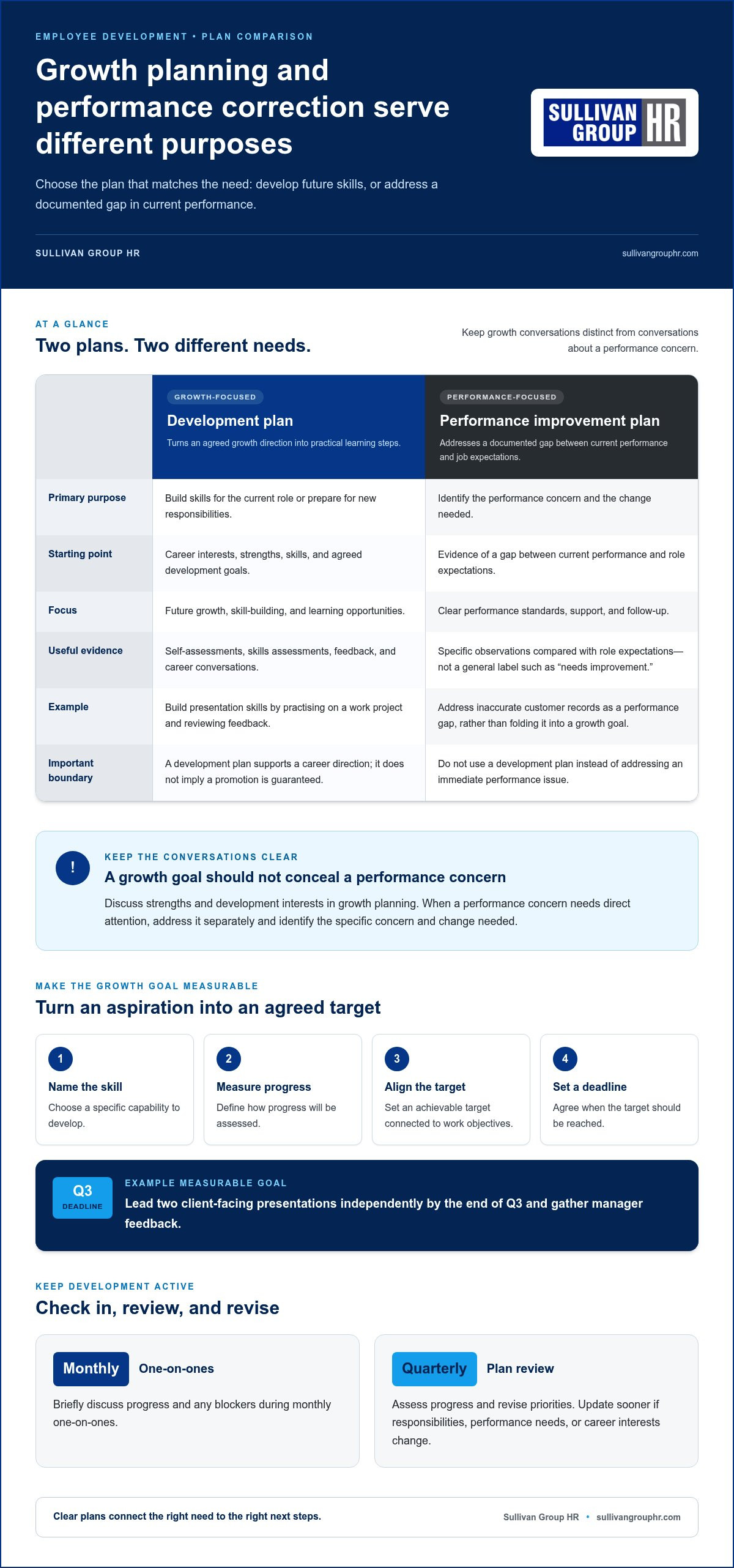
Employee development is shared: employees identify their interests, managers guide progress, and the organization makes learning possible. Set SMART goals by naming a specific skill, defining how progress will be measured, choosing an achievable target aligned with work objectives, and setting a deadline. For example, an employee could lead two client-facing presentations independently by the end of Q3 and gather manager feedback.
- Define the plan’s purpose. An employee development plan turns a growth objective into actions, learning experiences, and ways to review progress. It can help employees build skills for their current roles or prepare for new responsibilities. The organization benefits when learning addresses real skill gaps and supports its priorities. Development matters to retention, too: 94% of employees say they would stay longer at a company that invested in their learning.
- Share ownership between three partners. Employees bring their career interests, self-knowledge, and commitment to practice. Managers identify opportunities, provide feedback, and make time for learning. The organization supports development with resources and objectives that connect individual growth to business needs. For example, if an employee wants to improve presentation skills, a manager can identify a project where they can practise.
- Separate development planning from career planning. Career planning explores a person’s broader direction, such as moving into leadership or building technical expertise. A development plan turns an agreed direction into practical steps. An employee interested in becoming a team lead might practise delegating, observe a manager leading team discussions, and review feedback after leading a project. This supports the career goal without implying that a promotion is guaranteed.
- Choose the right planning scope. An individual plan addresses one employee’s skills and objectives; a paired plan can help two colleagues learn together. For example, a new supervisor and an experienced manager might schedule shared coaching sessions while setting separate goals. A staff development plan addresses a team’s shared needs, such as improving handoffs between departments. Make individual responsibilities clear so each person knows their next step.
- Turn objectives into action and learning. For each goal, record the action, who is responsible, the support needed, and how progress will be reviewed. Match learning activities to the skill: a stretch assignment offers practice, a mentor provides guidance, and a course can teach specific concepts. For example, an employee developing analytical skills could take a relevant course, apply what they learn to a work project, and discuss the results with their manager.
Separating development plans from performance improvement plans
Review employee development plans quarterly and discuss progress briefly during monthly one-on-ones. Update a plan sooner if responsibilities, performance needs, or career interests change.
- Set the purpose before choosing a plan. A development plan supports future growth, such as improving presentation skills or preparing for broader responsibilities. A performance improvement plan addresses a documented gap between current performance and job expectations. Keep the distinction clear: growth discussions look ahead, while performance discussions identify the concern and the change needed. Don’t use a development plan instead of addressing an immediate performance issue.
- Assess skills with more than one perspective. Compare role expectations with evidence from performance reviews, self-assessments, 360-degree feedback, or skills assessments. For example, a manager may see strong project delivery, while peer feedback points to unclear handoffs. Discuss both observations with the employee, then identify whether the priority is skill-building, clearer expectations, or a performance correction. A specific assessment makes the next conversation more useful than a general label such as “needs improvement.”
- Choose the plan type that matches the need. A skill-based plan targets a capability, such as data analysis, and combines practice with feedback. An objective-based plan focuses on an outcome, such as completing a project milestone, and identifies supporting actions. A performance-based plan responds to a gap against role expectations, with clear standards, support, and follow-up. One employee might have a development plan for presentation skills and a separate performance discussion about missed deadlines.
- Connect development conversations to performance reviews. Use reviews to discuss strengths, results, and areas the employee wants to develop. Hold a separate conversation when a performance concern needs direct attention. For example, a review might highlight strong customer knowledge and a goal to build coaching skills. If customer records are also inaccurate, address that performance gap directly instead of folding it into the development goal.
- Integrate plans into the performance management process. Record agreed goals, actions, progress measures, and check-in notes in the organization’s performance management platform. A shared process helps managers follow through and lets employees see how learning connects to role objectives. During monthly one-on-ones, discuss progress and blockers; during quarterly reviews, assess results and revise priorities. If development discussions need a more connected workforce process, explore human capital management support.
Development plans should be integrated with performance management systems to support accountability and a continuous learning culture. Reviews and one-on-ones can explore strengths, growth potential, and career goals; engagement surveys can gauge sentiment. Regular feedback and goal setting facilitate continuous performance improvement.
What should be included in a development plan?
Build the plan around assessed strengths, a clear learning goal, and a way to review progress. The following steps connect feedback to practical development activities.
-
Select goals and activities
Start by assessing skills through performance reviews, self-assessments, or 360-degree feedback. Ask the employee which strengths they want to use more and what career skill they want to build. Examples of goals include strengthening data storytelling or learning to lead project discussions. Match each objective with an activity, such as a course, mentoring, shadowing, or a stretch assignment.
Make each goal clear, measurable, achievable, and relevant to both the employee’s interests and organizational priorities. For example, an employee who wants to improve data storytelling could take a relevant course, present findings to colleagues, and ask for feedback. Check that the employee can apply the skill in their role. Don’t choose training just because it’s available; select an activity that addresses an identified need.
-
Track progress and give feedback
Set a progress measure and schedule monthly check-ins during existing one-on-ones. Compare completed actions with the plan, discuss obstacles, and agree on a next step. A manager might ask whether the employee has practised a new reporting method and what guidance would help. Briefly record actions and feedback so everyone shares the same understanding of progress.
Give specific, timely feedback tied to observable work. Instead of saying “good job,” describe what was clear in a recent team briefing and how it helped colleagues. If progress stalls, ask what’s getting in the way and adjust the activity or support. Raise barriers during the next one-on-one rather than waiting for a quarterly review.
-
Recognize employee progress
Recognize effort and the use of new skills as the employee works toward a goal. For example, acknowledge someone who applies a newly learned technique to improve a project handoff, even before completing the full objective. Recognition can be verbal, written, or shared with the team, depending on what suits the employee. Make it specific, timely, and linked to the behaviour being developed.
Use recognition to reinforce learning, not to replace feedback about next steps. Eighty-three percent of employees feel motivated by workplace recognition, so make acknowledgment a deliberate part of check-ins. A leader can note progress, invite the employee to reflect on what worked, and agree on a next opportunity to practice. Keep recognition fair by linking it to clear actions and agreed objectives.
Choosing experiential, social, and formal learning activities
Choose learning activities that suit the skill, the employee’s role, and available support. A useful plan combines instruction with practice and application at work.
- Start with hands-on experience. The 70-20-10 model allocates 70% of development to experiential learning, 20% to social learning, and 10% to formal training. Treat it as a planning guide, not a fixed formula for every employee. For a project-management goal, assign ownership of a defined project task, then review decisions and results with the employee. Practice turns concepts into skills employees can use at work.
- Add learning through people. The model assigns 20% to social learning, including mentoring, peer observation, and collaborative work. Pair an employee learning to give feedback with an experienced colleague who can model a coaching conversation. Build time for preparation and reflection into the arrangement. Learning from coworkers can make unfamiliar processes easier to discuss, while shared initiatives help teams exchange practical knowledge.
- Use formal instruction to fill specific gaps. Formal training accounts for 10% in the 70-20-10 model. Select courses, workshops, or online lessons that teach the knowledge required for a clear objective. A short course on spreadsheet analysis may help an employee prepare for reporting tasks. Follow instruction with a work assignment, so the employee can apply new ideas instead of treating course completion as the only measure of success.
- Match the format to the learner and the task. Ask how the employee prefers to learn, then choose a suitable format or mix of formats. Someone who learns by doing may benefit from guided practice; another employee may prefer a written reference before trying a new process. Microlearning can divide a larger topic into brief lessons that fit around work responsibilities. Avoid assuming one format suits everyone or every role.
- Protect the resources and conditions for learning. Record the time, budget, materials, and mentoring support each activity needs. A course takes time to attend and practise; a stretch assignment may need manager guidance and access to learning materials. Set the expectation that questions and mistakes during practice are part of building skills. If a new customer-service script feels unfamiliar, let employees rehearse before using it with customers. This helps create a workplace where employees can learn, apply, and refine skills.
Definition and components of an employee development plan
An employee development plan is a structured, personalized record of skills to build, actions to take, and support to provide. Common mistakes include vague objectives, activities unrelated to the employee’s role, and unclear ownership. These gaps can leave employees and managers unsure what progress should look like.
- Write the growth objective and its organizational purpose. Start with the capability the employee wants to strengthen, then connect it to a role need or business priority. For example, an employee who wants to improve cross-team coordination could build skills for leading project handoffs. State the objective plainly and explain how it relates to the employee’s work. Without a clear purpose, a goal can become a task list with no useful direction.
- Record the starting point and desired outcome. Describe the employee’s current experience, relevant strengths, and the skill or knowledge they want to develop. Then define what successful application looks like. For a handoff goal, the employee might document key project decisions and ask colleagues receiving the work for feedback. This gives the employee and manager a shared reference instead of relying on broad labels such as “communicate better.”
- Turn the objective into specific actions. List the learning activities, who is responsible for each, and the support needed. A plan might combine guided practice with observing an experienced colleague and a follow-up discussion. Specify who arranges each opportunity, who provides coaching, and what the employee will complete. Without clear ownership, relevant activities can remain ideas rather than actions.
- Include timing, resources, and progress measures. Note the intended duration of each activity, its status, and who oversees it. Identify practical needs such as protected work time, learning materials, or mentoring. For example, a manager could schedule practice during an existing team project, then review the work and colleague feedback. Avoid a timeline that conflicts with core responsibilities, and don’t measure only course completion when the goal requires applying skills at work.
- Set a review point and revise the structure as needed. Agree when the employee and manager will discuss progress, what evidence they’ll review, and how they’ll decide on next steps. A role change or new career interest may call for different opportunities or a revised objective. Treat the plan as a working document, not a promise of promotion or a fixed template. For support with employee benefits management, discuss employee benefits management.
Sullivan Group HR: HCM
Sullivan Group HR offers HCM to help organizations manage workforce operations alongside employee development. Its isolved HCM technology brings together payroll, taxes, time tracking, and benefits administration. Sullivan Group HR also provides Payroll Outsourcing and Payroll Administration for organizations seeking support with payroll operations.
Applicant tracking, screening, and onboarding tools support hiring workflows as a business considers the skills it needs. These services address operational needs; they don’t replace conversations between employees and managers or shared ownership of development goals. Consider Sullivan Group HR when your workforce processes need coordinated support alongside your people strategy. Contact Sullivan Group HR to discuss your organization’s needs.
Build a workplace where growth keeps moving
Development lasts when learning is part of how work gets done, not an extra task employees must fit around it. Give managers room to coach, encourage employees to share what they learn, and include skill-building in project conversations. Small, consistent steps can make growth part of your workplace culture.
Creating an employee development plan can also prompt a broader review of the systems that support your people. Sullivan Group HR offers HCM, Payroll Outsourcing, and Payroll Administration to support workforce and payroll operations while your organization focuses on employee growth.
Contact Sullivan Group HR for support to discuss your organization’s workforce needs. Take the next step with confidence, and keep making room for people to learn and contribute.
Frequently Asked Questions
What is an employee development plan and what should it include?
An employee development plan is a working agreement to build skills relevant to an employee’s role or career direction. Include the target skill, its purpose at work, learning activities, responsibilities, resources, and a way to assess application. For example, a customer-support employee improving case analysis could review anonymized cases with a peer, then apply the approach to new work. Clarify that development supports growth, not a guaranteed promotion.
How do you create an employee development plan step by step?
Start by discussing the employee’s interests and the role’s upcoming needs. Review evidence of current skills, agree on a priority, and define what successful application looks like. Then choose an activity, assign who will arrange and complete it, and set a review point. When creating an employee development plan, make sure the employee can use what they learn in their work. If workload prevents practice, adjust the activity before progress stalls.
How do you assess an employee’s skills, strengths, and development needs?
Compare role expectations with work samples, completed projects, the employee’s self-reflection, and feedback from people who see the work firsthand. For example, review a recent client presentation for accuracy, structure, and audience response. Ask which tasks energize the employee and where they need support. Look for patterns across the evidence rather than treating one mistake or strong result as the whole picture.
How should managers and employees collaborate on a development plan?
Ask the employee to suggest a growth direction and examples of work they want to take on. The manager can connect that interest to team priorities, explain opportunities, and identify support or constraints. If their priorities differ, agree on a small work-based trial, such as leading a project update, then discuss what each person learned. Record shared decisions so everyone knows who owns each task.
How do you measure the success of an employee development plan?
Measure whether the employee can apply the target skill in relevant work, not just whether they completed training. Choose evidence before activities begin, such as clearer project updates, fewer corrections to a defined task, or greater independence with a process. Compare it with the employee’s starting point, then discuss what helped or hindered application. If the skill hasn’t transferred to work, revise the practice opportunity or support.
What is the difference between an employee development plan and a performance improvement plan?
An employee development plan builds capability for growth; a performance improvement plan addresses a gap against current job expectations. For example, an employee might develop presentation skills for future responsibilities while separately addressing repeatedly incomplete reports. Keep each conversation and document focused on its purpose. Combining the plans can make learning feel corrective or leave an urgent performance concern without clear expectations.


