

What would happen to your business if the person who holds its most important knowledge stepped away tomorrow? Succession planning for small business helps you prepare before that possibility becomes urgent. When key decisions, relationships, or daily tasks depend on one owner or employee, even a planned transition can feel uncertain.
You may know a change is coming but still be unsure who could step into key roles, which ownership path fits, or how much time a handoff will take. Those are practical concerns, not signs that you’re behind. A clear plan can help protect your people, business knowledge, and day-to-day operations while you work toward your goals.
This guide explains what succession planning includes, when to begin, and how to compare transition options with your priorities and business needs. It also offers practical steps for identifying successors, documenting responsibilities, and keeping essential processes running. Reliable payroll, time, benefits, and compliance practices can support continuity, too. Sullivan Group HR brings 40 years of experience in payroll, HR, and employee-benefits management, with isolved HCM technology and a dedicated specialist for each client.
Key Takeaways
- Succession planning for small business can address one critical role or prepare the entire company for a leadership or ownership change.
- Map essential responsibilities, not just job titles, to identify where an unexpected absence could disrupt decisions or daily operations.
- Compare family transitions, employee ownership, external sales, partial handoffs, and closure against your goals and the business’s readiness.
- Separate immediate continuity steps from longer-term transition decisions, then document and revisit the plan as circumstances change.
- Consistent payroll, time tracking, benefits, and compliance processes help keep workforce operations organized during a transition.
What Succession Planning for a Small Business Actually Covers
Succession planning is the process of preparing people and business operations for a change in who leads or owns a company. In plain terms, it’s deciding how important work and decision-making can continue when the people responsible for them change. Succession planning for small business may focus on one key role, such as a founder who manages customer relationships, or cover a business-wide leadership and ownership transition.
Preparing for a transition is not the same as deciding to sell tomorrow or setting a retirement date. A continuity plan identifies what needs to keep working, who could take on essential responsibilities, and what knowledge should be recorded. An owner can begin these steps while still running the business, then make larger transition decisions as personal goals and business circumstances become clearer.
Leadership continuity versus ownership transition
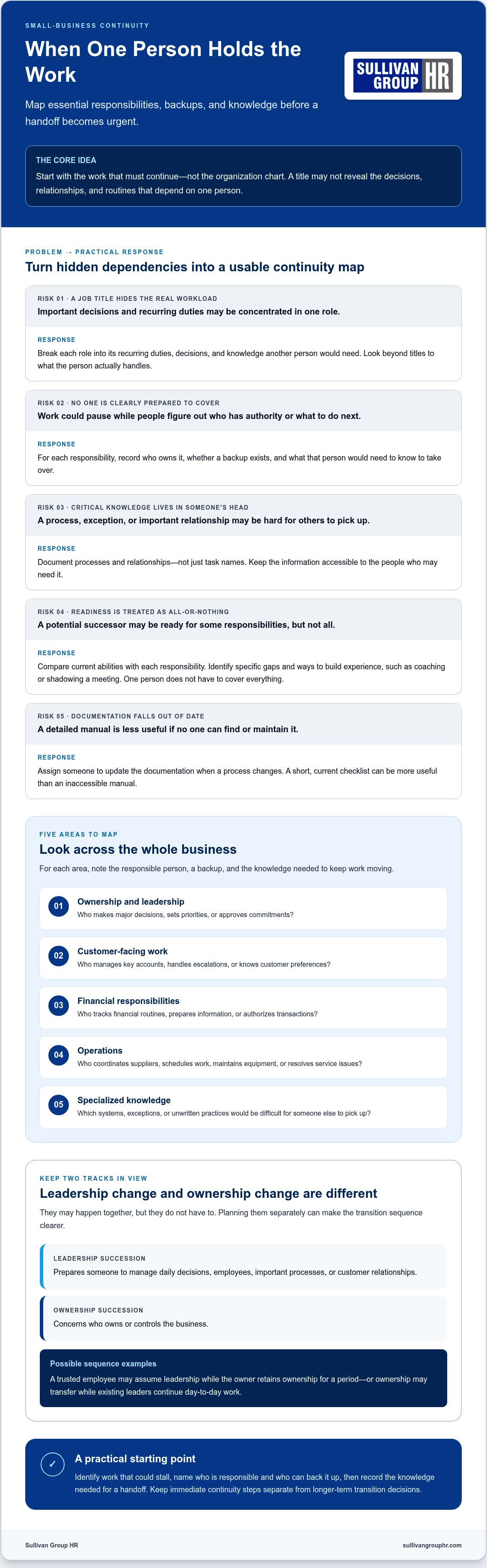
Leadership succession prepares someone to take on responsibilities such as making daily decisions, managing employees, overseeing important processes, or maintaining customer relationships. Ownership succession concerns who owns or controls the business. The changes may happen together, but they don’t have to. A trusted employee might assume leadership while the owner retains ownership for a period, or ownership might transfer while existing leaders continue managing day-to-day work. The right sequence depends on the business and the owner’s goals.
Considering these as separate tracks makes a plan more useful. Foundational succession planning principles also emphasize preparing people for key roles. For a small business, that means looking beyond titles to the decisions, relationships, and tasks each person handles.
Why small-business succession planning matters
In a small team, one person may hold several responsibilities that aren’t obvious until they’re unavailable. The owner might approve payments, resolve customer issues, and know how a recurring process works. An employee might be the only person familiar with a critical system. If either steps away unexpectedly, work can stall while others look for information or determine who has authority to act.
Documenting key processes and assigning clear responsibility can make everyday operations less dependent on any one person. Start by identifying:
- Decisions that only one person currently makes.
- Recurring tasks with no documented steps or backup owner.
- Important relationships or knowledge that need a planned handoff.
These are practical continuity measures, not a commitment to transfer ownership or leave the business. They can strengthen operations now and give the owner more room to consider future options. You can start before there’s an exit date: first make essential work easier to understand and cover, then develop leadership and ownership choices as the business’s needs and the owner’s intentions take shape.
Identify Critical Roles and Prepare People for a Small-Business Transition
A useful succession map starts with the work that must continue, not an organization chart. For succession planning for small business, list the responsibilities tied to ownership, leadership, customer relationships, finances, and daily operations. Then ask: if the person responsible were unavailable, which decisions or tasks would pause, and who could keep them moving?
Map critical positions and responsibilities
Look across the business, including work that happens behind the scenes. A person’s title may not show how much depends on them. Break each role into recurring duties, decisions, and knowledge another person would need to do the work. A practical mapping approach resembles a workforce succession planning framework, which connects critical positions with the capabilities needed to fill them.
For each area, record who is responsible, whether a backup exists, and what someone would need to know to take over. Include processes and relationships, not just task names.
- Ownership and leadership: Who makes major decisions, sets priorities, or approves commitments?
- Customer-facing work: Who manages key accounts, handles escalations, or knows customer preferences?
- Financial responsibilities: Who tracks financial routines, prepares information, or authorizes transactions?
- Operations: Who coordinates suppliers, schedules work, maintains equipment, or resolves service issues?
- Specialized knowledge: What systems, exceptions, or unwritten practices would be hard for another person to pick up?
Keep documentation accessible to people who may need it, and assign someone to update it when a process changes. A short, current checklist can be more useful than a detailed manual that no one can find.
Assess successor readiness and development needs
Compare each potential successor’s current abilities with the responsibilities you mapped. Consider experience, judgment, relationships, and comfort making decisions. Someone may be ready to manage a routine process but need coaching before handling a sensitive customer issue or broader business decisions. Readiness isn’t all-or-nothing, and one person doesn’t have to cover every responsibility.
Identify specific gaps and ways to build experience. A candidate might shadow a meeting, prepare a report, lead a project, or take responsibility for a process with appropriate support. Set a clear scope, discuss which decisions they can make, and review what they learn. These gradual steps help both the owner and candidate identify where more guidance is needed.
A successor needs practice, context, and clear authority, not just a new title. Development should make expectations visible and give the person a chance to build confidence before a larger handoff.
Clear role records also depend on dependable workforce administration. Sullivan Group HR supports workforce management through payroll, time tracking, benefits administration, compliance support, and HR guidance. Learn about workforce management support that can help keep essential employee processes organized while you prepare people for changing responsibilities.
Compare Small-Business Succession Options Before Choosing a Path
Succession planning for small business doesn’t require choosing a successor today or putting the company up for sale. It gives you space to consider how a transition could work, what matters most to you, and what the business can realistically support. The best path depends on personal priorities, available successors, operational readiness, and the continuity you want.
Use the options below to begin a comparison, not to rank one route above another. Preserving the company’s current leadership may suit one owner, while another may prioritize a clear transfer or an orderly closure.
| Path | Owner goals | Continuity | Successor readiness | Operational change |
|---|---|---|---|---|
| Family transition | Keep ownership or leadership within the family. | May retain relationships and familiar practices. | A family member needs interest and capability for the role. | Responsibilities and family roles may shift. |
| Employee or leader transition | Pass leadership or ownership to people already in the business. | Existing knowledge and working relationships may support continuity. | Readiness depends on the person’s experience and authority. | Leadership, decision-making, or ownership may change. |
| External sale | Transfer the business to an outside party. | Continuity depends on the new owner’s plans. | The buyer must be prepared to take over the business. | Processes, priorities, and leadership may change. |
| Partial transition | Make staged changes to leadership or ownership. | The current owner may remain involved during a handoff. | Readiness can develop as responsibilities shift. | Changes happen in stages rather than all at once. |
| Closure | End operations when transfer or continued ownership isn’t the goal. | Business operations don’t continue under a successor. | No successor is needed to keep the business operating. | Work winds down rather than transferring to a new owner. |
Internal and family succession
A family member, existing leader, or employee may be a potential successor, but familiarity alone doesn’t establish readiness. Clarify the role, expectations, and decision-making authority, then give the person opportunities to build relevant experience. Open communication can help align plans and responsibilities. Family relationships may shape discussions, but disagreement isn’t inevitable. Clear expectations can help keep personal and business considerations distinct.
External, partial, and closure options
An external transition transfers the business to an outside party, while a partial transition can stage changes in ownership or leadership. Closure is also a valid path if continued operation or transfer isn’t the owner’s aim. Consider what each route could mean for employees, customers, and day-to-day work. You don’t need to settle every detail at once. Compare each option with your priorities and the business’s ability to support the change, or turn to exit strategy and leadership advisors such as Significant Business Results to assess business readiness across different transition scenarios.
Build a Practical Succession Plan in Manageable Steps
A useful plan doesn’t have to answer every ownership question upfront. Start with what needs to keep running, then work toward longer-term leadership and ownership decisions. For succession planning for small business, the goal is a practical document people can use and update, not a binder that sits untouched.
- Set your goals. Decide what you want to preserve, change, or eventually transfer. Consider your preferred level of future involvement, the continuity you want for employees and customers, and what matters most to you about the business’s future.
- Separate immediate coverage from future transition choices. Identify who can handle essential decisions if you’re unexpectedly unavailable. Keep this continuity guidance distinct from longer-term choices about leadership, ownership, a sale, or closure.
- Assign responsibilities. Name who maintains the plan, keeps key records current, and tracks successor readiness. Make sure that person knows where the latest version is stored and who should be able to access it.
- Record practical details. Document decision authority, key contacts, recurring responsibilities, and essential process steps. Note who handles each task, what information they need, and where related records can be found. Include communication needs, such as who should be informed if a key leader becomes unavailable.
- Set adaptable milestones. Choose checkpoints that reflect business needs and the potential successor’s development. A milestone might be completing a knowledge handoff or having a successor take responsibility for a defined process. Revisit the timing if readiness or business priorities change.
- Review and revise the plan. Schedule a regular review and update the document after a significant change in roles, operations, ownership goals, or key contacts. Confirm that responsibilities still have clear owners and that the instructions remain usable.
Prepare for planned and unexpected transitions
For an unexpected absence, keep the first instructions direct: who can make time-sensitive decisions, who handles essential operations, and who should be notified. For a planned transition, match communication to the change. Employees, customers, and other stakeholders may need different information at different stages, so decide who will communicate, what they’ll share, and when updates are appropriate.
Keep the plan focused on continuity and decisions. Ownership changes can raise legal, tax, valuation, or financing questions, and the relevant details depend on the situation. For business owners aligning succession with personal estate planning and trusts, resources like lawbob.com outline typical legal considerations and setup costs. Note which issues need attention as the transition takes shape rather than treating a general plan as professional advice on those matters.
Clear workforce processes can help keep responsibilities organized as a plan evolves. Learn about workforce management support for payroll, time tracking, benefits administration, and compliance processes that help maintain orderly workforce records.
Support Succession Planning with Reliable Workforce Operations
A thoughtful succession plan sets direction for leadership and ownership changes. Reliable HR administration helps keep workforce operations organized while those changes take shape. It doesn’t choose a successor, assign leadership authority, or replace the plan. Consistent processes for payroll, time, benefits, and employee administration can give owners and incoming leaders a clearer view of workforce operations during a handoff.
Keep essential HR processes organized during change
Transitions can affect everyday responsibilities: who tracks time, how payroll and taxes are administered, where benefits information is maintained, and who handles routine employee matters. Consistent processes make those responsibilities easier to follow as people’s roles evolve. Clear workforce practices can also help an incoming leader understand how work is handled instead of having to piece it together while managing other demands.
Compliance support is another part of organized workforce administration. Sullivan Group HR provides compliance support covering Federal, State, and Local employment regulations, along with workers’ compensation assistance and HR guidance. These services support employment processes; they don’t replace a business-specific succession plan or resolve ownership decisions.
Planning for future workforce needs also includes bringing people on board. Applicant tracking, screening, and onboarding tools can help organize hiring as roles or staffing needs change. A new hire may eventually take on important responsibilities, but recruiting and onboarding alone don’t prepare someone for leadership. That development still depends on the role, the person’s capabilities, and a clear handoff.
Bring technology and personal HR support together
Sullivan Group HR combines workforce management services with enterprise-grade isolved HCM technology. The platform supports payroll, taxes, time tracking, and benefits administration, and each client is assigned a dedicated Sullivan Group HR specialist. Technology and a consistent point of contact bring structured processes and personal support together as a business manages change.
Sullivan Group HR brings 40 years of experience in payroll, HR, and employee-benefits management. Its services include applicant tracking, screening, and onboarding, as well as payroll, taxes, time tracking, benefits administration, compliance support, workers’ compensation, and HR guidance. For an owner preparing for a transition, dependable administration can help keep essential people processes in view while the business works through its separate succession decisions.
Succession planning for small business is ultimately about preparing people and operations for change. Workforce administration can support that work, but the transition plan remains yours to shape. Explore workforce management support to keep essential HR processes organized as your business prepares for what’s next.
Take the First Step Toward a More Resilient Future
You don’t need every transition decision settled before you begin. Choose one practical step: identify a responsibility that depends on you, write down how it gets done, or decide who should be able to access the information. Small actions can make the future easier to plan for and the present less dependent on any one person.
Succession planning for small business is an ongoing process, not a one-time document. Revisit your priorities as the business and the people in it change. Keep the plan clear enough to use and flexible enough to grow with your goals.
Workforce administration is one part of keeping operations organized through change. Sullivan Group HR brings 40 years of experience in payroll, HR, and employee-benefits management, uses enterprise-grade isolved HCM technology, and assigns a dedicated specialist to each client.
Take the next step toward complete workforce management with Sullivan Group HR.
Frequently Asked Questions
What is succession planning for a small business?
Succession planning for a small business is a practical way to prepare for changes in who leads, owns, or makes key decisions. It helps the owner identify which responsibilities need coverage and consider how a handoff could work. For example, if one person manages supplier relationships, the plan might identify the information and introductions someone else would need. It can guide preparation without requiring an immediate sale or retirement.
When should a small business start succession planning?
Start when a key responsibility would be difficult to reassign quickly, even if a transition feels years away. Note where a delay could affect customers, employees, or routine decisions. Then choose a manageable action, such as recording a process or arranging a backup for a recurring task. Revisit the plan as responsibilities shift so it stays connected to how the business operates.
What if a small business has no obvious successor?
You can begin without naming one. First, identify the decisions that need coverage and whether they could be shared among more than one person. A business might assign customer issues to one employee and routine approvals to another, rather than expecting one candidate to take on everything. You can also use the planning process to identify capabilities to develop or compare an outside transition with the owner’s goals.
Is succession planning only for retirement or selling a business?
No. It can help address a leadership departure, an ownership change, or a temporary absence that affects decision-making. For instance, an owner who plans to remain in the business may still want another person prepared to handle a specific function during leave or an unexpected interruption. Planning for that coverage can be useful independently of any decision to retire, sell, or transfer ownership.
How often should a small business update its succession plan?
Review it on a regular schedule and after changes that affect how work gets done. A new manager, a changed customer process, or a shift in the owner’s priorities may make parts of the plan outdated. During each review, check whether someone unfamiliar with a task could follow the instructions, verify contact details, and assign an owner to outstanding actions. That keeps the document useful, not merely current on paper.
Should a succession plan include an emergency leadership backup?
Yes. A simple backup plan can prevent uncertainty about who has authority to act if a key leader is suddenly unavailable. For example, record who can approve urgent operational decisions, who can respond to time-sensitive employee matters, and how the backup can reach essential information. Keep this short-term coverage distinct from a permanent leadership or ownership change, which may need a separate decision process.
Can a small business succession plan include transferring only part of the business?
Yes. A plan can explore transferring some ownership or leadership responsibilities while the owner retains other roles. This may allow a gradual handoff instead of an all-at-once change. Be specific about what would shift, who would make which decisions, and how the arrangement could affect daily work. The right structure depends on the business and may raise legal or financial questions that require separate consideration.


