

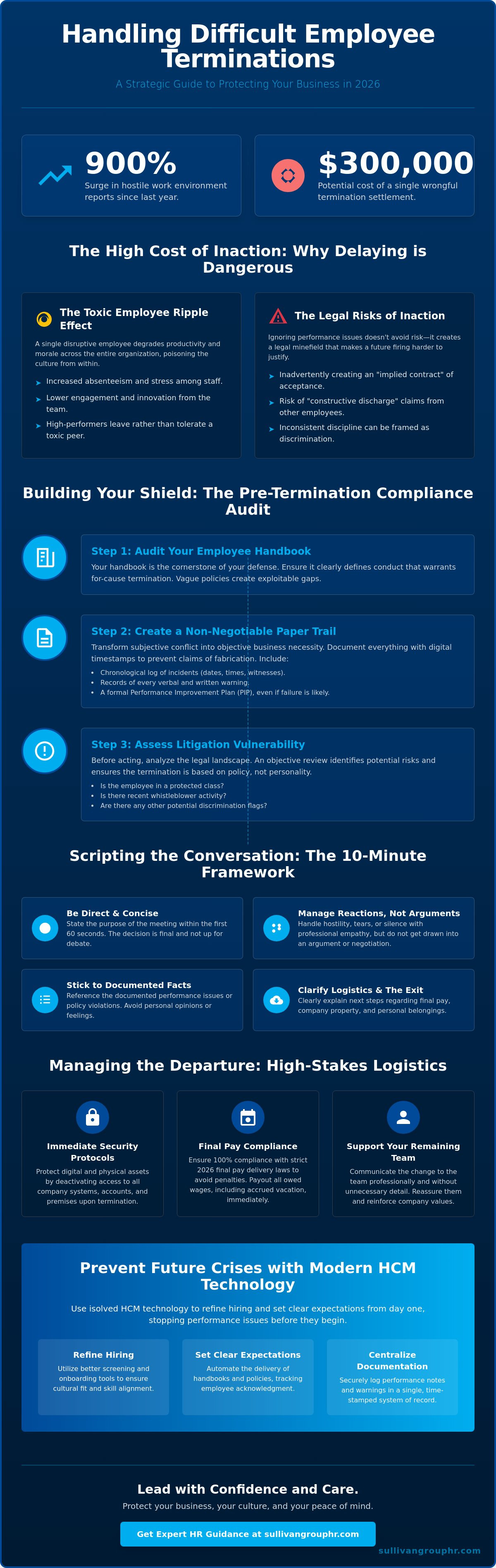
Did you know that reports of hostile work environments have surged by 900 percent since last year? When a single team member disrupts your culture, the weight of leadership feels heavier than ever. You aren't just letting someone go; you're protecting everything you've built. Learning how to handle a difficult employee termination is no longer just an HR task. It is a vital survival skill for your business in 2026.
We understand the late-night anxiety that comes with a volatile exit. You might worry about a potential $300,000 wrongful termination settlement or a confrontation that shakes your remaining staff. It's a heavy burden for any business owner to carry alone. We're here to help you master this complex process while protecting your business, your culture, and your professional peace of mind. This guide provides a clear roadmap to a clean break and minimized legal exposure.
We will examine the latest California AI transparency requirements, explore communication strategies that prevent escalation, and show you how to support your team after the exit. You can lead through this challenge with confidence and care.
Key Takeaways
- Understand why delaying a necessary exit costs you more than just productivity; it risks your top-tier talent.
- Establish a non-negotiable paper trail that turns your employee handbook into a shield against wrongful termination claims.
- Master how to handle a difficult employee termination with a concise, ten-minute framework designed to manage hostility and silence.
- Protect your business with immediate security protocols and ensure compliance with strict 2026 final pay delivery laws.
- Use isolved HCM technology to refine your hiring process and set clear expectations that stop performance issues before they begin.
The High Cost of Avoiding a Difficult Employee Termination
Have you ever felt the atmosphere in your office shift the moment a specific person walks in? A difficult termination encompasses more than just a missed deadline; it involves behavioral toxicity, persistent negativity, or the potential for open hostility. While it’s tempting to hope the problem fixes itself, silence is a strategy that always fails. Knowing how to handle a difficult employee termination is about more than just paperwork. It's about protecting the health of your entire organization.
At Sullivan Group HR, we don't view these exits as failures. We see them as a vital, protective function of strategic human capital management. Pruning a garden isn't an act of destruction; it’s an act of cultivation. When you remove a disruptive element, you create the space necessary for your remaining team to grow, innovate, and feel secure in their roles.
The Toxic Employee Ripple Effect
A single toxic individual acts like a drop of ink in a glass of water. They degrade productivity across the entire department. You’ll see the evidence in increased absenteeism, lower engagement, and higher stress levels among your most reliable staff. Your high-performers won't stick around to watch a manager tolerate mediocrity or malice. They’ll simply find a workplace that values their peace of mind. When your best people leave because you refused to address one difficult peer, the cost of your inaction becomes astronomical.
The Legal Risks of Inaction
Is "waiting it out" actually a safer legal strategy? Many leaders fear a lawsuit if they act, but keeping a difficult employee creates its own legal minefield. If you ignore performance issues for months, you might inadvertently create an "implied contract" that suggests the behavior is acceptable. This makes a future firing much harder to justify.
There is also the risk of constructive discharge. This occurs when a workplace becomes so intolerable that a reasonable person feels forced to resign. If your top talent quits because of a toxic environment you failed to manage, you could still face legal claims. Furthermore, inconsistent discipline can be framed as discriminatory in future disputes. Learning how to handle a difficult employee termination correctly and promptly is the only way to minimize these mounting liabilities.
We believe in a "no-nonsense" approach to organizational security. By addressing behavioral issues early, you demonstrate a commitment to your company’s values and its long-term stability. You aren't just letting someone go; you are standing up for the people who actually want to be there.
The Pre-Termination Compliance Audit: Documentation and Risk Mitigation
Are you truly ready for the fallout? Learning how to handle a difficult employee termination begins long before the actual meeting. Before you step into the meeting room, you need an airtight defense. A difficult termination is rarely a surprise, yet many leaders lack the documentation to back their decision. Building a paper trail is your most effective form of HR risk management. It transforms a subjective conflict into an objective business necessity.
Your Employee Handbook is the cornerstone of this defense. Does it clearly define the conduct that warrants for-cause termination? If your policies are vague, a hostile employee will find the gaps. Before moving forward, conduct a final review of the personnel file. You are looking for consistency, clarity, and compliance. This audit ensures that your actions are rooted in policy rather than personality. It provides the security business owners need when facing administrative burdens.
Documentation: Beyond the Performance Review
Standard annual reviews aren't enough when you're dealing with behavioral toxicity. You need a chronological log of every verbal warning and incident. Include specific dates, times, and any witnesses present. Even if you're certain a Performance Improvement Plan (PIP) won't be successful, you must offer it. It demonstrates that you gave the employee every opportunity to succeed. We recommend using isolved HCM tools to secure this data. Digital timestamps and centralized records prevent claims that documentation was manufactured after the fact.
Assessing Litigation Vulnerability
Objective reality often differs from legal perception. You must identify if the employee belongs to a protected class or has a recent history of whistleblower activity. Did they recently return from medical leave? Have they filed a recent internal complaint? These factors don't make termination impossible, but they do increase your risk. Ensuring your decision is purely performance-based is vital to shielding your assets.
If the situation feels high-stakes, consulting with termination compliance services provides the external perspective you need. They help you verify that I-9 records and labor law requirements are fully met before the exit. Taking these steps creates an environment of reliable advocacy for your business. If you want to ensure your internal processes are bulletproof, our team at Sullivan Group HR can audit your current documentation strategy. By the time you sit down for the conversation, the outcome should already be decided by the facts on the page.
Scripting the Conversation: How to Handle Hostility, Tears, and Silence
The moment has arrived. You've audited your documentation and assessed the risks. Now, you must sit across from a person whose presence has likely caused you months of stress. Knowing how to handle a difficult employee termination requires a shift in mindset. You aren't there to debate, negotiate, or justify. You are there to deliver a final business decision. Speed and clarity are your best allies in this room.
We recommend the "Short and Direct" framework. A termination meeting should never exceed ten minutes. Why? Because the longer the meeting lasts, the higher the chance for emotional escalation or legal missteps. Deliver the news in the first thirty seconds. Once the news is out, the rest of the time is for logistics. Be firm. Be clear. Be finished.
One critical rule we advocate for is the "No Apology" rule. Never say "I'm sorry." While it feels like a polite gesture, those two words can be interpreted as an admission of fault or guilt in a courtroom. It suggests the termination might be unfair or unjustified. Instead, use neutral, factual language that focuses on the business necessity of the separation.
Scenario-Based Scripts for Difficult Exits
Preparation prevents panic. Having a script ready allows you to maintain control when the employee reacts. For the Hostile Exit, use a shut-down phrase: "This is not a discussion; this is a final decision." If they attempt to argue, repeat the phrase without variation. For the Emotional Exit, provide a tissue and a moment of silence, but don't get drawn into the grief. Say, "I understand this is difficult, but the decision is final." For the Blaming Exit, redirect immediately. Say, "We aren't here to discuss others. We're here because your performance did not meet the standards outlined in our previous meetings."
The Logistics of the Meeting Room
Where and when you hold this meeting matters as much as what you say. Aim for a mid-week morning, such as Tuesday or Wednesday. This gives the employee time to contact unemployment offices and avoids letting them stew over the weekend. Choose a neutral location near an exit so they don't have to walk past the entire team after the meeting.
Always have a witness present. Their role is to take notes and observe, not to participate in the conversation. If you anticipate physical hostility, have a professional security presence nearby but out of direct sight. This ensures safety without unnecessarily escalating the tension. By controlling the environment, you protect your peace of mind and the safety of your workplace.
Managing the Logistics of a High-Stakes Departure
The meeting is over, but your work isn't finished. Are you prepared for the digital and financial loose ends that follow? Logistics are the safety net of your organization. When you're learning how to handle a difficult employee termination, the details of the exit are just as critical as the conversation itself. A single oversight in IT access or a delayed final check can turn a clean break into a messy legal dispute. You need a process that is swift, secure, and legally compliant.
Execution requires a coordinated effort between your leadership, IT, and payroll teams. In California, as of January 1, 2026, your termination notices must now include specific disclosures. You're required to state whether you're coordinating with local workforce development boards and provide information regarding the CalFresh food assistance program. Missing these small regulatory details can leave your business vulnerable. Utilizing professional payroll administration outsourcing ensures that every final payout meets these evolving state-specific standards without delay.
The IT and Physical Security Handshake
Digital security must be instantaneous. Coordinate with your IT department to disable email, building keycards, and isolved HCM access the exact moment the meeting begins. This prevents a disgruntled individual from deleting files or sending "parting shots" to the entire staff. When it comes to company property, be firm but professional. If the exit is volatile, don't ask them to pack their desk while the team watches. Instead, offer to courier their personal items to their home address later that afternoon. This protects their dignity and your office's productivity.
Post-Termination Communication Strategy
How you talk to your remaining team defines your culture. Your employees will be watching to see how the situation was handled. Avoid gossip or detailed explanations of why the person was let go. A neutral announcement is best: "They are no longer with the company, and we wish them well." Shift the focus immediately to the future. Reassure the team about workload distribution and remind them that their safety and success are your primary concerns.
Strategic workforce management solutions can help you re-optimize the team during the transition. By focusing on organizational stability, you turn a moment of tension into a demonstration of strong leadership. If you need help navigating these high-stakes logistics, our team at Sullivan Group HR can provide the expert guidance you need to protect your business. We believe in providing a localized "handshake" that national firms can't match, ensuring your compliance is as airtight as your culture.
Leveraging HCM Technology to Prevent Future Performance Crises
How do you stop the cycle of toxic exits? While mastering how to handle a difficult employee termination is a necessary skill for any leader, the ultimate goal is to make these events a rare exception. The best defense is a proactive offense. By leveraging the right technology and expert partnership, you can filter for cultural fit before a candidate ever sets foot in your office. You aren't just filling a seat; you are protecting your legacy.
The isolved platform transforms your hiring process from a guessing game into a data-driven strategy. It allows you to utilize robust applicant tracking and onboarding to set crystal-clear expectations from day one. When a new hire understands exactly what is required of them, the ambiguity that often leads to performance crises disappears. This structure minimizes the cognitive load on your leadership team, allowing you to focus on growth rather than damage control.
Better Hiring Through Data
If your business experiences recurring issues with behavioral toxicity, it is time to look at the patterns. HCM analytics can help you identify if specific departments or job descriptions are attracting the wrong candidates. By refining your job postings to deter toxic traits and implementing behavioral interview techniques, you create a natural filter. This ensures you only bring in people who align with your mission. We believe that talent acquisition, compensation, and organizational security form the three pillars of a healthy business. When the first pillar is strong, the others are much easier to maintain.
The Power of Professional HR Consulting
The 90 days following a difficult exit are critical for team morale and legal safety. Having a fractional HR partner reduces the emotional burden on you as a business owner. You don't have to navigate the expiration of enhanced ACA marketplace subsidies or the complexities of COBRA alone. Our benefits management solutions ensure that your former employees receive the required notices while your business remains compliant with the latest 2026 regulations.
A partnership with Sullivan Group HR provides a protective shield for your growing business. We offer the hard-earned wisdom of regional experts who understand the nuances of your local territory. You deserve a "no-nonsense" authority that values people over systems. Are you ready to move from reactive firing to proactive leadership? Let us help you master how to handle a difficult employee termination by building a workforce that never requires one. Contact us today to secure your organizational future.
Secure Your Culture and Your Future
Are you ready to reclaim your workplace culture? Mastering how to handle a difficult employee termination is the final step in protecting the team you've worked so hard to build. By prioritizing airtight documentation and executing a direct, ten-minute exit strategy, you transform a potential crisis into a controlled transition. You aren't just managing a departure; you're setting a standard for professionalism and safety that your high-performers will respect.
You don't have to carry the weight of these high-stakes decisions alone. Since 1998, we've provided business owners with expert HR consulting and integrated payroll management to ensure every move is compliant and secure. With access to the industry-leading isolved HCM platform, you can streamline your entire people-process from talent acquisition to final payout. This combination of local expertise and advanced technology creates a protective shield for your organization.
It's time to move forward with confidence. Protect your business with Sullivan Group HR consulting and gain the reliable advocacy you deserve. Your best days are ahead, and we're here to help you reach them.
Frequently Asked Questions
What is the best day of the week to fire a difficult employee?
Tuesday or Wednesday is generally the best time to conduct a termination. This timing allows the individual to access unemployment offices or job search resources immediately. It also prevents them from dwelling on the situation over a weekend without support. A mid-morning meeting ensures you have time to finalize logistics and secure your facility before the business day ends.
Do I have to give a reason for the termination in an "at-will" state?
While at-will employment means you can legally fire someone without cause, you should always have a documented business reason. Providing a brief, factual reason prevents the employee from filling the silence with assumptions of discrimination or retaliation. Clear, objective communication is your best defense against future litigation and helps maintain a professional atmosphere during the exit.
Should I offer a severance package to a difficult employee to avoid a lawsuit?
Offering severance in exchange for a signed release of claims is often a strategic and protective move. It is usually much cheaper than defending even a single wrongful termination lawsuit. This "peace of mind" payment ensures a clean break and protects your organization from long-term legal headaches. It allows both parties to move forward without the threat of future disputes.
How do I handle a termination if I fear the employee might become violent?
Safety is your primary priority if you anticipate a physical confrontation. Arrange for professional security to be present or nearby during the meeting. If the threat is significant, conducting the exit via a secure video call may be the most responsible way to master how to handle a difficult employee termination. Always notify local law enforcement if specific threats have been made.
Can I fire an employee immediately for a toxic attitude, or must I follow a PIP?
You can fire for gross misconduct immediately, but a toxic attitude usually requires a paper trail to be legally defensible. Following a Performance Improvement Plan (PIP) demonstrates that you provided the employee a genuine chance to change. This objective process makes it much harder for them to claim the firing was arbitrary. It protects your culture while shielding you from claims of unfair treatment.
What should I do if a terminated employee refuses to return company property?
Send a formal written demand via certified mail specifying a clear deadline for the return of all company assets. Never withhold a final paycheck as a bargaining chip; this violates labor laws in many jurisdictions and can lead to heavy fines. If the property is not returned after the deadline, you may need to involve local law enforcement or file a claim in small claims court.
How much documentation is enough to fire a difficult employee safely?
You need enough documentation to prove a consistent pattern of behavior or performance failure. This includes specific dates, detailed descriptions of incidents, and names of any witnesses present. A single annual review is rarely enough for a high-risk exit. You need a chronological record of verbal warnings, written notices, and failed improvements to ensure the termination is viewed as objective and fair.
Is it better to fire someone in person or over a video call for remote roles?
For remote roles, a video call is the professional standard. It allows for a face-to-face conversation that maintains human dignity while ensuring you can coordinate an immediate digital lockout with IT. This method balances the need for a personal touch with the technical necessity of securing your company data the moment the meeting concludes. Avoid using phone calls or email for these sensitive conversations.


