
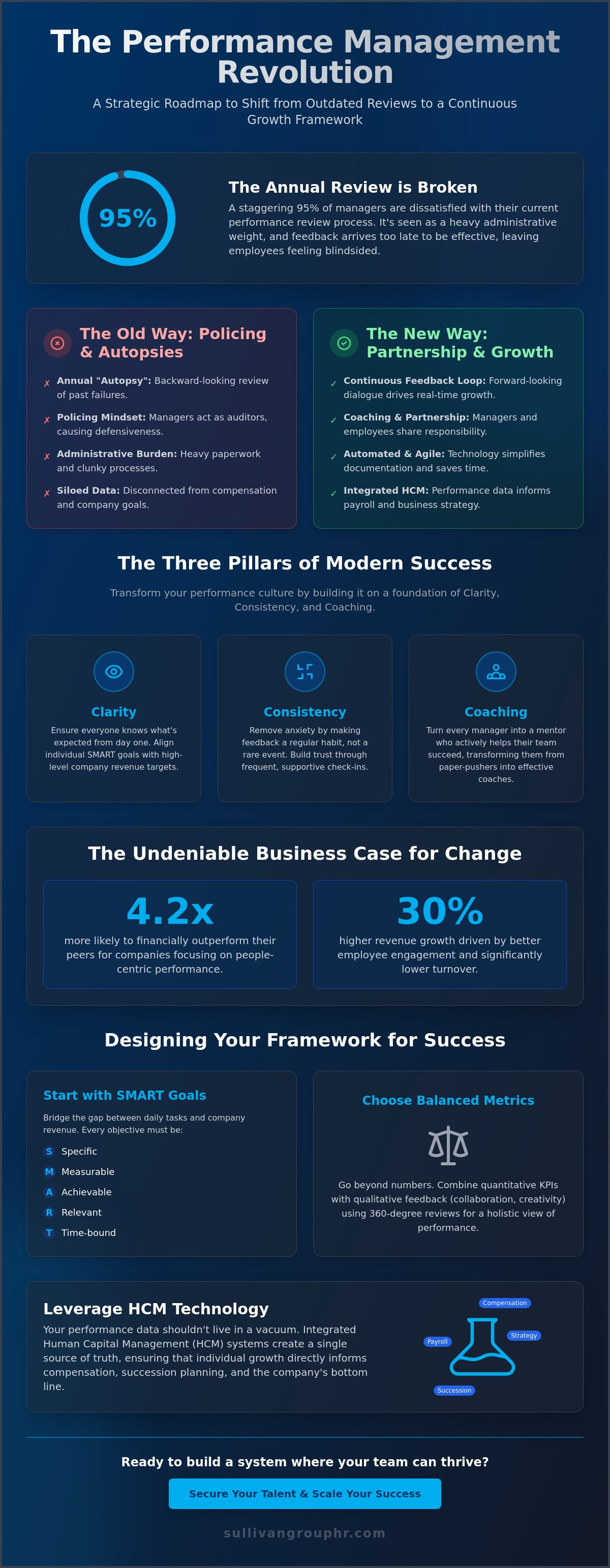
Did you know that 95% of managers are dissatisfied with their current performance review process? It's a staggering figure that highlights a painful reality: the traditional annual review is broken. You've likely felt the frustration yourself. Managers see these reviews as a heavy administrative weight, while employees feel blindsided by feedback that arrives months too late. If you're wondering how to implement a performance management system that actually works, you aren't alone. It's time to move away from a system that feels like a policing exercise and toward one that acts as a true partnership.
You deserve a process that simplifies your day, secures your talent, and scales your success. As a long-term partner in your growth, we believe managing your team shouldn't feel like an uphill battle against clunky software and disconnected goals. This guide provides a 2026 strategic roadmap to help you transition to a modern, growth-oriented framework. You'll discover how to automate the administrative burden, foster continuous feedback, and align individual output directly with your company's revenue. Let's build a system where your team can truly thrive.
Key Takeaways
- Stop looking in the rearview mirror with annual reviews; learn to build a continuous feedback loop that drives real-time growth.
- Follow a strategic roadmap on how to implement a performance management system that aligns individual milestones with your business revenue.
- Transform your managers from administrative paper-pushers into effective coaches who deliver supportive, impactful feedback.
- Simplify your operations by leveraging integrated HCM technology to automate documentation and keep your team focused on high-value work.
- Secure leadership buy-in and employee engagement by replacing outdated "autopsies" with clear, consistent, and coaching-focused pillars.
Understanding the Shift: Why Modern Performance Management Matters
Why do we still treat performance reviews like a forensic investigation of past failures? For too long, businesses have relied on annual "autopsies" that look backward instead of forward. If you want to know how to implement a performance management system that actually drives results, you have to start by changing your perspective. It isn't about documenting mistakes. It's about fueling real-time development. In 2026, the goal is to transform a static administrative chore into a dynamic engine for growth.
Modern success rests on three specific pillars: Clarity, Consistency, and Coaching. Clarity ensures everyone knows exactly what's expected from day one. Consistency removes the anxiety of the unknown by making feedback a regular habit. Coaching turns every manager into a mentor who actively helps their team succeed. When these three elements work together, you create a culture where people feel safe to excel and empowered to take risks.
Traditional systems often fail because they feel cold and disconnected from daily work. There's a deep emotional gap when feedback only happens once a year. By studying the broader history of Business Performance Management, it becomes clear that the most effective frameworks prioritize ongoing dialogue over rigid scoring. When employees feel blindsided by a yearly review, you don't just lose productivity; you lose trust.
The 2026 business case for this shift is undeniable. Companies focusing on people-centric performance are 4.2 times more likely to outperform their peers. It's a simple equation. Better engagement leads to 30% higher revenue growth and significantly lower turnover. You aren't just managing tasks. You're protecting your most valuable investment and securing the future of your company.
From Policing to Partnership
We need to move away from the "policing" mindset that has haunted HR departments for decades. When a manager acts like an auditor, employees naturally go into a defensive crouch. True growth happens when both parties view performance as a collaborative journey rather than an audit. A "Performance Partnership" is the 2026 industry standard where managers and employees share equal responsibility for professional growth and business outcomes.
The Role of Human Capital Management (HCM)
Your performance data shouldn't live in a vacuum. It must inform every other part of your business, from compensation to succession planning. This is the core of what is human capital management. When HR data is siloed, you lose the "big picture" of your organization's health. Integrated systems ensure that a win for the employee is a win for the payroll and the bottom line. It's about creating a single source of truth that helps you lead with confidence.
Designing Your Framework: The Core Components of Success
How do you build a structure that supports growth without adding clutter? When you're deciding how to implement a performance management system, the design phase is your foundation. It's the blueprint that ensures your managers and employees are moving in the same direction. A well-designed framework should be clear, flexible, and results-oriented. It shouldn't just track work; it should fuel it.
Start with SMART goals. Every role needs objectives that are specific, measurable, achievable, relevant, and time-bound. These goals act as a bridge between an individual's daily tasks and your company's high-level revenue targets. When employees see exactly how their output contributes to the bigger picture, engagement naturally rises. If you're looking for structured templates to guide this process, the performance management toolkit from the U.S. Office of Personnel Management offers excellent foundational resources for setting these standards.
Next, you must choose the right metrics. Relying solely on quantitative KPIs (like sales numbers or tickets closed) only tells half the story. You also need qualitative feedback to capture "how" the work is being done. Are they collaborating? Are they solving problems creatively? Integrating 360-degree feedback allows peers and direct reports to provide a holistic view of a person's impact. This well-rounded approach ensures that your top performers are recognized for their leadership, not just their spreadsheets.
Establishing Clear Performance Milestones
A timeline is essential for keeping everyone on track. You need to decide if monthly check-ins or quarterly milestones work best for your specific culture. Monthly meetings are great for agility, while quarterly reviews allow for deeper strategic reflection. Define what "success" looks like for every role before the first review occurs. This prevents confusion and ensures that short-term tasks don't overshadow long-term career development. If you need help refining these roles, our team at Sullivan Group HR can help you align your job descriptions with your performance goals.
The Feedback Loop: Making it Continuous
The most effective systems rely on "micro-feedback." These are small, immediate coaching moments that happen in the flow of work. Don't wait for a formal meeting to celebrate a win or correct a course. Document these informal moments so they can be referenced later. Most importantly, ensure the loop is two-way. Give your employees a voice by asking them what they need from leadership to succeed. This transparency builds trust and turns the process into a conversation rather than a lecture.
Empowering Your People: Training Managers as Coaches
"My managers don't have time for this." It's the most common objection we hear from busy business owners. If your leadership team views reviews as a burden, your system is already at risk. Understanding how to implement a performance management system requires more than just buying software; it requires a cultural shift in how your leaders communicate. We need to move away from the "Manager vs. Employee" dynamic and embrace a "Coach vs. Talent" relationship. This shift protects your culture and ensures your team feels supported rather than scrutinized.
Training your managers to be effective coaches is the secret to long-term retention. This involves teaching a "Supportive Professional" tone, where hard truths are delivered with kindness and clarity. When a manager acts as a coach, they focus on removing obstacles rather than just pointing them out. By aligning with modern performance management best practices, you empower your leaders to drive development through daily interactions. Providing them with templates and scripts reduces their cognitive load, making these vital conversations feel natural instead of forced.
The Anatomy of a Coaching Conversation
Great coaching starts with the "Ask, Don't Tell" method. Instead of barked instructions, coaches use questions to help employees find their own solutions. This builds confidence and autonomy. When handling poor performance, the goal is to address the behavior without damaging the individual's morale. Focus on the future, not just the mistake. Effective feedback should be limited to three actionable points to ensure clarity, focus, and retention.
Reducing Administrative Friction
Manager buy-in sky-rockets when the "paperwork" disappears. Automation is your best friend here. By using integrated systems to handle reminders and documentation, you allow your managers to focus on the human element of their roles. Sometimes, the transition to a coaching culture feels overwhelming for a small internal team. This is often when business owners explore what is HR outsourcing to gain access to expert HR consulting. Having a professional partner to guide difficult reviews or provide training ensures your new system stays on track and remains a source of organizational security.
Leveraging HCM Technology for Seamless Execution
Why do so many businesses struggle with disconnected tools? You might have a great goal-setting app, but if it doesn't talk to your payroll system, you're creating more work for yourself. When you're exploring how to implement a performance management system, the technology you choose shouldn't just be a digital version of a paper form. It should be a unified ecosystem that connects every part of the employee lifecycle. In 2026, the most successful organizations use integrated Human Capital Management (HCM) platforms to turn raw data into strategic action.
To ensure your enterprise technology stack is fully optimized for these goals, you can learn more about Kagool and their expertise in managing global IT solutions for SAP and Microsoft environments.
An integrated platform like the isolved People Cloud acts as your single source of truth. It bridges the gap between performance, payroll, and benefits. This connectivity allows you to identify trends that a standalone app would miss. For instance, modern analytics can now predict potential turnover by flagging drops in engagement or productivity long before an employee hands in their notice. By centralizing your data, you gain the clarity needed to lead with confidence and the agility to respond to challenges in real-time. We help you streamline, secure, and scale your operations through technology that values people over processes.
The isolved Advantage: Performance Meets Payroll
Automation is the key to reducing administrative fatigue for your managers. With isolved, you can automate merit increases based directly on performance scores. This ensures that your compensation strategy is fair, transparent, and data-driven. By integrating Time and Attendance data, you add a layer of objectivity to your reviews that removes bias and guesswork. This approach doesn't just save time; it reduces your legal risk through compliant, timestamped documentation of every coaching moment and performance milestone. It's about creating a reliable history of growth that protects both the business and the individual.
Self-Service Portals: Empowering the Employee
Transparency is the foundation of trust in any professional partnership. Self-service tools give your employees the power to track their own goals and view their progress in real-time. This visibility makes the promotion and bonus process feel earned rather than arbitrary. When people see a clear path to advancement, they're more likely to stay and grow with your company. To learn more about balancing these digital tools with human talent, explore our guide on workforce management solutions.
Ready to move beyond disconnected systems? Our team can help you implement a unified HCM strategy that simplifies your administration and empowers your team to reach their full potential.
Launching and Refining: Your Implementation Roadmap
How do you move from a grand vision to a functional reality? Learning how to implement a performance management system is only half the battle. The other half is the execution. You need an agile roadmap that prioritizes clarity over complexity. In 2026, we don't have time for multi-year rollouts that lose steam before they are finished. You need a plan that delivers value quickly while protecting your most important asset: your people.
The first step is a thorough audit of your "shadow" processes. These are the hidden spreadsheets and side-notes your managers use because your current system failed them. Once you have identified these pain points, you must secure leadership buy-in. The best way to do this is by tying performance directly to revenue. Show your executives how higher engagement leads to higher growth. From there, pilot the system with a single department. This allows you to gather feedback and fix bugs before a full-scale rollout. Finally, use real-time sentiment data and AI-assisted insights to review and refine your approach every six months.
Managing the Transition
Change can be daunting. You will likely encounter employees who are resistant to new tracking systems. The key is communicating the "WIIFM" (What’s In It For Me) to your entire staff. Explain how this system provides clearer career paths, fairer bonuses, and more consistent support. While you are building this culture of transparency, you must also ensure 100% compliance with labor laws. A botched rollout isn't just a morale killer; it's a legal risk. We help you simplify your rollout, secure your compliance, and scale your results.
The Role of a Strategic HR Partner
You don't have to navigate this transition alone. Sullivan Group HR acts as a coach for your implementation, providing the professional rigor and local expertise you need to succeed. We help you move away from a transactional vendor relationship toward a long-term professional partnership. By integrating our expertise, you also strengthen your HR risk management strategy. Continuous improvement is our hallmark. We recommend auditing your system every six months to ensure it stays aligned with your evolving business goals and the needs of your growing team.
Secure Your Future with a Growth-Oriented Team
Are you ready to stop looking backward and start leading your team into the future? We've explored how the shift toward continuous feedback and integrated technology can transform your workplace. By aligning individual goals with company revenue and empowering your managers as coaches, you create a culture that values people over paperwork. Knowing how to implement a performance management system is the first step toward building a resilient, high-performing culture that lasts.
At Sullivan Group HR, we help you simplify your process, secure your talent, and scale your results. We provide access to the industry-leading isolved HCM platform, backed by decades of professional human resources consulting expertise. Our human-first approach ensures you balance powerful technology with personal advocacy. It's about more than just software; it's about a long-term partnership in your success.
Ready to transform your team? See how our HCM solutions can streamline your performance management.
Your team has the potential to achieve incredible things. Let's build the framework that makes it possible.
Frequently Asked Questions
What is the first step in implementing a performance management system?
The first step is auditing your current "shadow" processes and identifying specific pain points. You need to understand where your current system is failing before you can build a new one. This ensures you address the administrative burdens managers face daily. By uncovering these hidden spreadsheets and manual notes, you can design a framework that actually meets the needs of your leadership team.
How much time does it typically take to roll out a new HR system?
A full rollout typically takes three to six months, depending on the size and complexity of your organization. While some consultants suggest multi-year plans, an agile approach focused on high-impact departments allows for faster results. This timeframe includes auditing, piloting with a specific team, and conducting full-scale training. It's about moving quickly enough to maintain momentum while ensuring everyone feels supported during the transition.
Can I implement performance management without specialized software?
Yes, you can use manual tools like spreadsheets or word documents, but it often leads to administrative fatigue. Manual systems lack the "single source of truth" that integrated platforms provide. If you want to know how to implement a performance management system that scales, automation is the most reliable choice. Technology ensures that feedback is documented, timestamped, and easily accessible for future growth conversations.
How do I get my managers to actually use the new system?
Secure manager buy-in by reducing their administrative friction and automating the paperwork. When leaders see the system as a tool that saves time rather than a chore, adoption rates skyrocket. Providing pre-built templates and coaching scripts also helps lower the cognitive load of these conversations. We believe that when you simplify the process, you empower your managers to focus on the human side of leadership.
What is the difference between a performance appraisal and performance management?
A performance appraisal is a one-time event focused on past behavior, while performance management is an ongoing strategic cycle. Appraisals are often "autopsies" of the previous year that leave employees feeling blindsided. Performance management focuses on real-time development, consistent coaching, and future growth. It turns a static administrative task into a dynamic partnership between the manager and the employee.
How does an integrated HCM platform like isolved help with performance reviews?
An integrated platform like isolved connects performance data directly to payroll, benefits, and time tracking. This eliminates the need for manual data entry and ensures merit increases are based on objective, verified scores. It creates a seamless flow of information that protects both the business and the employee. When you learn how to implement a performance management system using isolved, you gain a unified ecosystem for your entire workforce.
Is performance management compliant with federal labor laws?
Yes, provided your system uses consistent, objective criteria and maintains thorough documentation. A modern system reduces your legal risk by creating a clear, timestamped paper trail of coaching and performance milestones. This transparency is a critical component of risk management for any growing business. It ensures that every promotion or disciplinary action is backed by reliable data, protecting your organization from potential disputes.
How do we measure the ROI of a new performance management system?
Measure ROI by tracking improvements in employee retention, productivity metrics, and overall revenue growth. Companies that focus on people-centric performance are documented to be 4.2 times more likely to outperform their peers. You can also calculate the administrative hours saved through automation and the reduced costs associated with turnover. Better alignment between individual output and company goals always leads to a stronger bottom line.


