
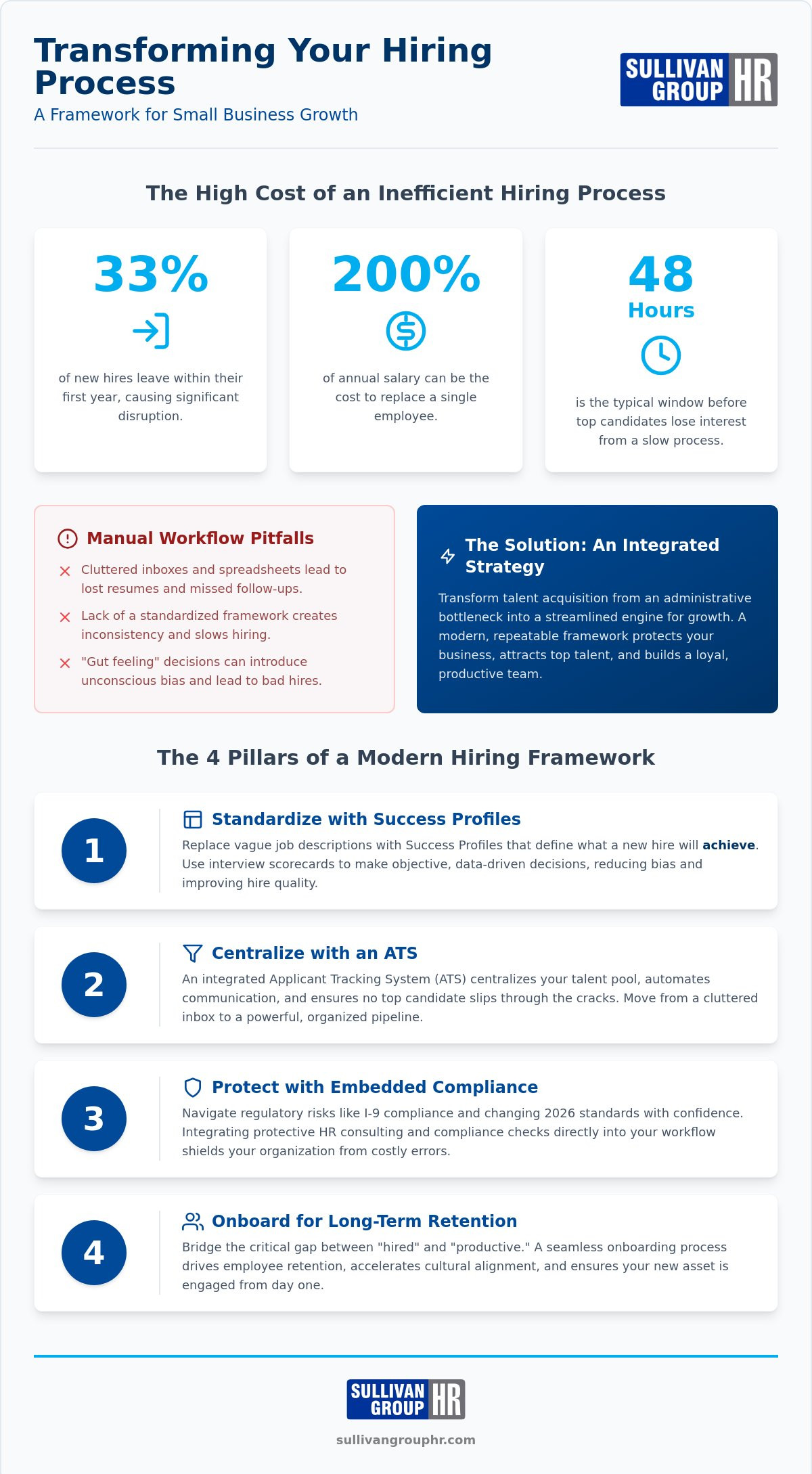
Did you know that one in three new hires leaves within their first year, often costing your business up to 200% of their annual salary to replace? For a growing company, these aren't just numbers; they represent lost momentum, drained resources, and missed opportunities. You've likely felt the frustration of losing a great candidate to a faster firm or the anxiety of wondering if your latest hire meets the newest 2026 compliance standards.
We understand that your people are your greatest asset, but finding them shouldn't feel like a second full-time job. You deserve a recruitment strategy that is efficient, protective, and results-oriented. This guide focuses on improving hiring process for small business by transforming your talent acquisition into a streamlined engine for growth using integrated HCM strategies.
We'll show you how to build a repeatable hiring framework, leverage the isolved platform to automate the heavy lifting, and create an onboarding experience that secures long-term loyalty. It's time to move past the administrative bottleneck and start building the team your professional vision deserves.
Key Takeaways
- Identify why manual workflows like spreadsheets stall your growth and learn to replace them with standardized Success Profiles and interview scorecards.
- Discover how an integrated Applicant Tracking System (ATS) centralizes your talent pool, effectively improving hiring process for small business by ensuring no top candidate slips through the cracks.
- Protect your organization from 2026 regulatory risks by embedding I-9 compliance and protective HR consulting directly into your recruitment workflow.
- Bridge the gap between "hired" and "productive" with a seamless onboarding process that drives employee retention and cultural alignment from day one.
Why Your Current Hiring Process is a Bottleneck
Every day a critical position sits empty, your business pays a hidden tax. We call this the "ghost role" effect. It is not just about the missing output. It is about the heavy strain placed on your existing team. According to 2026 data from C&C Search, the cost of replacing a single employee can reach 200% of their annual salary. When a role remains vacant too long, productivity drops and your top performers begin to burn out from carrying the extra weight.
If you are still managing applicants through a cluttered inbox or an old spreadsheet, you are fighting an uphill battle. These manual methods are the true enemies of talent acquisition. They lead to lost resumes, missed follow-ups, and a total lack of a standardized hiring framework. This disorganized approach directly slows your "speed to lead." In the competitive 2026 market, top-tier candidates frequently withdraw their interest within 48 hours if they do not see clear momentum. A slow process does more than lose you talent; it signals to the market that your business is stuck in the past.
The Emotional Toll on Small Business Owners
Are you a CEO or a full-time resume screener? Many small business owners find themselves trapped in the administrative weeds, sifting through dozens of unqualified applications. This reactive firefighting creates constant anxiety. The fear of a "bad hire" often leads to a paralyzed decision-making process. However, a bad fit can damage your company culture faster than almost any other mistake. Improving hiring process for small business requires moving away from this defensive posture toward proactive talent planning. You need a system that allows you to focus on people, not paperwork.
Identifying Your Specific Friction Points
To fix your hiring engine, you must first identify where the oil is leaking. Audit your current time-to-hire. Is the process stalling during the initial screening, or does it get stuck at the final decision stage? Communication gaps are usually the primary culprit. Candidates feel ignored when they do not receive timely updates, which quickly damages your brand's reputation. Additionally, keep an eye on your interview count. Dragging a candidate through four or five rounds of meetings does not just exhaust the applicant; it pulls your internal team away from their core responsibilities. Your goal should be a process that is lean, professional, and protective of your time. By focusing on how to acquire, compensate, and protect your staff, you can turn hiring from a bottleneck into a competitive advantage.
Auditing Your Workflow: 3 Steps to a Standardized Hiring Framework
How do you turn a chaotic search for talent into a predictable, repeatable outcome? Many entrepreneurs rely on intuition, but intuition doesn't scale. If you want to build a legacy, you need a system that works even when you aren't the one conducting the interview. Standardization is the foundation for improving hiring process for small business. It provides a protective shield against bad hires while ensuring every candidate receives a professional, high-quality experience that reflects your brand's values.
A standardized framework relies on three critical pillars: defining the role with precision, measuring talent objectively, and maintaining a brisk communication rhythm. By following these steps, you move away from reactive "firefighting" and toward a proactive growth strategy. This level of organization also aids in Navigating Risk During the Hiring Phase by ensuring every candidate is treated with identical rigor and fairness. If building these systems feels overwhelming, partner with professional HR consulting to design a framework tailored to your specific regional needs.
Building a Success Profile
The Art of the Interview Scorecard
Do you ever finish an interview and just feel "good" about a candidate without knowing why? That "gut feeling" is often just unconscious bias in disguise. Use a consistent interview scorecard to remove the guesswork. We recommend a three-part thematic grouping to evaluate every applicant: Technical Proficiency, Cultural Alignment, and Growth Potential. By assigning a numerical value to these specific areas, you can compare candidates objectively. This approach trains your hiring team to interview with professional rigor, ensuring you select assets based on merit rather than just a pleasant conversation.
Finally, commit to a 3-day communication cycle. In 2026, top-tier talent expects momentum. If you don't reach out within 72 hours of an application or interview, you risk losing them to a faster-moving competitor. A streamlined communication plan keeps your brand top-of-mind and proves that you value their time as much as your own.
Modernizing Recruitment with an Integrated Applicant Tracking System (ATS)
Are you still manually chasing resumes across multiple email threads? In 2026, a digital-first approach is no longer optional for growing firms. An Applicant Tracking System, or ATS, serves as a centralized hub for every stage of your recruitment cycle. It acts as a protective archive, ensuring no qualified candidate is lost in the shuffle of a busy workday. For those focused on improving hiring process for small business, an ATS is the engine that drives efficiency without sacrificing the human touch. By adopting these tools, you are not just buying software; you are improving hiring process for small business through smarter, data-driven decisions.
Choosing the right platform is critical. The isolved HCM provider transforms the recruitment experience by moving candidates seamlessly through the funnel. Instead of a disjointed series of tools, you gain a single source of truth. This integration allows you to focus on the person behind the resume, knowing the administrative details are handled with professional rigor and local expertise.
Efficiency Through Automation
Automation does not mean losing your brand's personality; it means protecting it. You can set up automated "thank you" or "rejection" emails that maintain warmth while providing candidates with the immediate feedback they crave. With one-click job postings, you can push your opening to dozens of boards simultaneously, vastly increasing your reach. Because 2026 applicants are mobile-first, using an ATS that offers mobile-friendly applications ensures you capture top talent the moment they find you, whether they are at a desk or on the go.
The Power of Integrated Data
Why should your hiring tools be isolated from your payroll system? True efficiency happens when your ATS "talks" to the rest of your organization. This connectivity eliminates the frustrating double-entry headache that often plagues new hire setups. When a candidate signs an offer, their data should flow naturally into your payroll and benefits management systems. This transition is a key part of The Power of Seamless Onboarding, allowing you to move from applicant to asset without friction. Real-time reporting further empowers you to measure what works, helping you identify which job boards or interview stages are stalling your progress. You gain clarity, speed, and a competitive edge in a crowded market.
The Shield of Compliance: Navigating Risk During the Hiring Phase
Hiring is one of the most legally sensitive activities your company will ever perform. While you are focused on finding a talented new team member, the regulatory environment is focused on how you find them. From the first job posting to the final offer letter, every step carries potential liability. Improving hiring process for small business means more than just finding talent; it means protecting your legacy from administrative oversight. Utilizing professional I-9 compliance services ensures that your documentation is bulletproof from the very first day of employment.
Safety and fairness must go hand in hand. Background checks are essential for the security of your staff and customers, but you must balance this need with the "fair chance" hiring laws that have become more stringent in 2026. A disorganized screening process can lead to disparate impact claims or privacy violations. An integrated approach to HR risk management allows you to screen with confidence, knowing your process is anchored in professional rigor and local expertise.
Avoiding Common Legal Pitfalls
Do your managers know which interview questions are off-limits? Simple inquiries about a candidate's graduation year or childcare needs can inadvertently trigger age or family status discrimination claims. Beyond the interview, your documentation must be identical for every applicant to prove a standardized process. In 2026, you must also ensure your job ads meet the latest pay transparency requirements. Remember that California employers, for example, must provide a written "Know Your Rights" notice to all new hires upon employment as of February 1, 2026. Keeping these details organized protects your business and your reputation.
Integrating Workers' Comp and Payroll
The hiring phase is the best time to lower your long-term insurance costs. Proper job classification isn't just a payroll task; it is a critical step in managing your workers' compensation premiums. When you accurately define a role's physical requirements and duties, you prevent the audit red flags that lead to unexpected expenses. Misclassifying a new hire as an independent contractor when they actually function as an employee can trigger costly audits and retroactive penalties under the current 2021-standard Department of Labor rules reinstated in early 2026. To ensure your recruitment process is as protective as it is productive, explore our human resources consulting services today.
From Applicant to Asset: The Power of Seamless Onboarding
The moment a candidate says "yes" is not the finish line. It is the beginning of a critical transition that determines whether your new hire becomes a long-term asset or a short-term turnover statistic. While the previous sections focused on the hunt, improving hiring process for small business requires equal attention to the landing. A disjointed handoff from recruitment to the first day can leave a new employee feeling isolated and confused. By utilizing an integrated approach to applicant tracking and onboarding, you ensure that the excitement of the offer carries through to their first project.
This is where the concept of human capital management (HCM) proves its value. Instead of treating hiring as an isolated event, HCM views it as the first stage of a unified lifecycle. When your systems are connected, the data collected during the interview flows directly into payroll, benefits, and training modules. This eliminates the "Day One" paperwork mountain. It allows your new team member to focus on building relationships and learning your culture instead of filling out endless forms.
Designing a 'Welcome' Experience
What happens in the 24 hours after an offer is accepted? This period is vital for setting the tone of the professional relationship. We recommend using employee self-service portals to empower new hires before they even walk through your door. They can review the handbook, select their benefits, and complete necessary compliance tasks at their own pace. This proactive approach turns administrative hurdles into a warm cultural introduction. It shows that your business is organized, professional, and ready for their success. When the first day arrives, it should be about introductions and impact, not just tax forms.
The Long-Term ROI of Integrated HR
A great onboarding experience is the foundation for improved employee retention. Research from 2026 indicates that employees who experience a structured onboarding process are significantly more likely to stay with a company for three years or more. As a business owner, your role shifts here from recruiter to coach. You are no longer just evaluating talent; you are nurturing it. Improving hiring process for small business means building a bridge between the initial promise of the job and the daily reality of the role. Partnering with a professional HR firm allows you to manage this complexity without losing the personal touch that defines your brand. By protecting your new hires from administrative friction, you ensure they have the safety and support they need to grow alongside your business.
Secure Your Growth with a Smarter Hiring Engine
What if your next hire wasn't a source of stress, but a catalyst for your company's next chapter? We have explored how moving away from manual spreadsheets and embracing a standardized framework can eliminate bottlenecks. By modernizing your recruitment through an integrated Applicant Tracking System and ensuring rigorous compliance, you protect your business from the risks of 2026.
Improving hiring process for small business is about more than just filling seats; it's about building a protective, efficient lifecycle for your people. You don't have to manage this complexity alone. With access to the industry-leading isolved platform and our expert HR consulting, you can unify your payroll and talent acquisition into one seamless system. This approach allows you to focus on your professional potential while we handle the administrative burden.
Ready to build a faster, safer hiring engine? Explore Sullivan Group HR's integrated HCM solutions.
Your business deserves a team that is as dedicated as you are. Let's start building that future today with professional rigor and local expertise.
Frequently Asked Questions
How long should the hiring process take for a small business?
A typical hiring process should ideally span two to four weeks from the job posting to the signed offer. In the competitive 2026 market, top candidates often leave the market within 48 hours if they don't feel momentum. Speed is a competitive advantage. Focus on reducing internal delays between interview rounds to ensure you don't lose elite talent to faster-moving firms.
What is the best way to screen resumes quickly without missing talent?
The most efficient method is using an Applicant Tracking System (ATS) paired with clearly defined Success Profiles. Instead of reading every word, look for specific verbs that imply movement and results. Automated filtering helps you identify the strongest matches instantly. This protective layer ensures you spend your time interviewing high-potential assets rather than sifting through unqualified applications in a cluttered inbox.
Is an Applicant Tracking System (ATS) worth it for a company with under 20 employees?
Yes, an ATS is a vital tool for even the smallest teams because it centralizes your talent pool and automates the "busy work." It acts as a protective archive for compliance and prevents high-quality resumes from being lost. For those focused on improving hiring process for small business, the time saved on scheduling and reminders often pays for the system within the first few hires.
How can I improve my candidate experience if I'm hiring on a budget?
Communication is the most valuable tool you have, and it doesn't cost a dime. Implement a strict three-day communication cycle to keep applicants informed of their status. Be transparent about your salary ranges and the number of interview steps from the start. A professional, respectful experience builds your brand's reputation even if you aren't offering the highest salary in your local territory.
What are the most common compliance mistakes small businesses make when hiring?
The most frequent errors include asking illegal interview questions about family status or age and failing to complete I-9 documentation correctly within the first three days. Many firms also struggle with 2026 pay transparency laws and proper worker classification. These oversights create significant legal risk. Partnering with a professional HR consulting firm provides the rigor needed to protect your business from these administrative pitfalls.
Can I automate my onboarding process without losing the personal touch?
Automation actually creates more space for personal connection by removing the "paperwork mountain" from the first day. By using an integrated HCM platform, new hires can complete their tax forms and benefit elections before they arrive. This allows you to spend their first morning on mentorship, team introductions, and cultural alignment. You move from being a clerk to being a coach.
What is the difference between recruitment and applicant tracking?
Recruitment is the high-level strategy of sourcing, attracting, and selecting talent. Applicant tracking is the specific functional engine that manages the workflow of those candidates. While recruitment focuses on the "human touch" and candidate fit, applicant tracking provides the organized framework and data security. Both are essential components of a modern, integrated human capital management strategy that drives long-term organizational growth.
How do I know if I need to outsource my hiring functions?
You should consider outsourcing when administrative bottlenecks start stalling your actual business growth. If you are spending more time screening resumes than leading your team, or if the fear of compliance errors keeps you up at night, it's time for an ally. Improving hiring process for small business often starts with admitting that you need professional rigor to manage the complexities of modern employment law; for those in specialized sectors, you can discover Jessamy Staffing Solutions to find values-led, professionally prepared personnel.


