
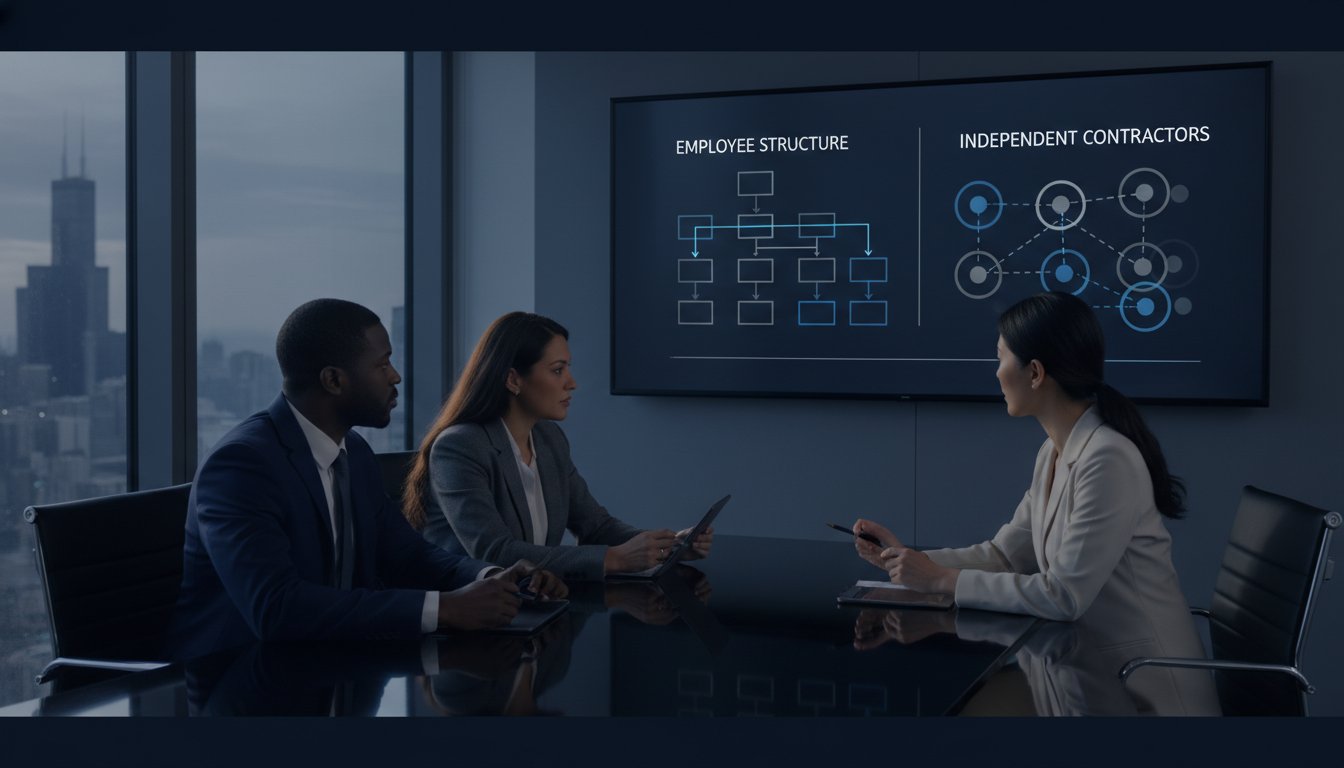
Did you know that up to 30% of U.S. employers have misclassified at least one worker? It is a staggering figure that often leads to devastating financial consequences. You have likely felt the pressure of the shifting regulatory landscape lately. Between the Department of Labor's 2026 proposed economic reality test and the IRS's rigid standards, determining the line between an independent contractor vs employee can feel like a moving target. You want to focus on your team's potential rather than losing sleep over potential back-tax liability, administrative errors, or government audits.
This guide will help you master the critical 2026 distinctions to protect your business from costly regulatory scrutiny. We will provide the clarity you need to secure your legacy and maintain total compliance peace of mind. We will explore the new core factors of control, the specific penalties your business must avoid, and how a unified HCM strategy keeps your internal classification policy airtight. It is time to move toward a future where your talent acquisition, compensation, and organizational security are handled with expert precision.
Key Takeaways
- Learn why the fundamental distinction between an independent contractor vs employee hinges on whether you control the specific work process or simply the final result.
- Identify the specific "How, When, and Where" instructions the IRS uses to evaluate behavioral control and determine worker status.
- Understand the Department of Labor’s "Integral Part" test to see if a worker's services are central to your core business operations.
- Discover how to build a defensive paper trail through proactive internal audits of contracts, invoices, and communication logs.
- See how a unified HCM platform and isolved automation can streamline your payroll administration while securing long-term compliance.
Understanding the High Stakes of Worker Classification in 2026
Are you prepared for the 2026 regulatory shift? The Department of Labor recently proposed a new rule on February 27, 2026, that aims to return to a strict "economic reality" test. This shift makes the distinction between an independent contractor vs employee thinner and more dangerous for businesses that aren't paying attention. It isn't just about a job title or a line item in your budget. It's about who truly holds the power over the daily work. Classification is no longer a one-time paperwork event; it's an ongoing operational reality that requires a protective mindset.
Regulators now look past your paperwork to see the operational truth. Do you control the specific steps of the task, or do you simply wait for the final result? This legal distinction between independent contractors and employees determines your entire tax, benefit, and insurance structure. When classification fails, the dominoes fall quickly. Your payroll administration becomes a source of liability. Your workers' compensation insurance coverage gaps widen. Your business stability wavers. Moving from a transactional view to a protective compliance mindset is the only way to safeguard your professional potential.
The Financial and Legal Consequences of Misclassification
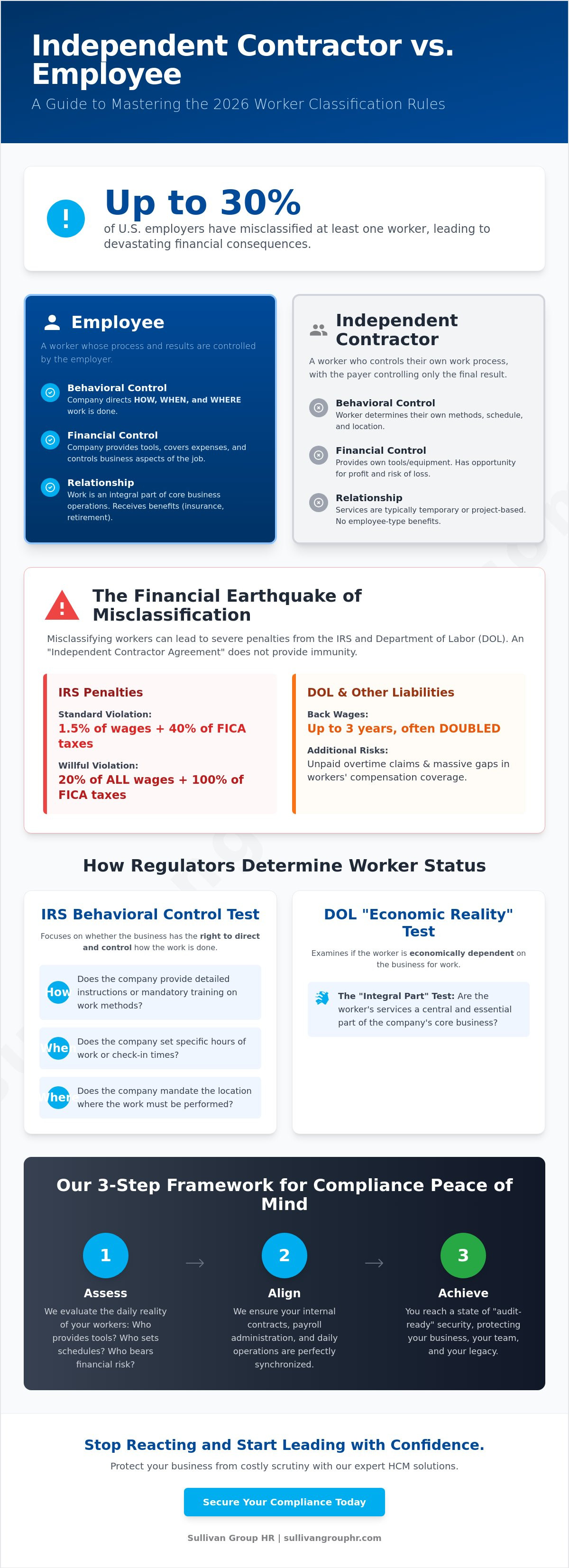
Misclassification isn't a small clerical error. It's a financial earthquake. If the IRS deems a worker was actually an employee, you face penalties including 1.5% of wages plus 40% of the employee’s FICA taxes. For willful violations, these costs can skyrocket to 20% of all wages paid and 100% of the FICA taxes. The Department of Labor can also demand back wages for up to three years. They often double that amount through liquidated damages, effectively creating a debt that can crush a growing firm.
Think a signed "Independent Contractor Agreement" provides absolute immunity? It doesn't. Regulators routinely ignore the contract if the daily reality tells a different story. Without proper classification, you leave your business exposed to unpaid overtime claims and massive gaps in your workers' compensation insurance. These risks aren't just theoretical. In May 2026, reports showed that up to 30% of U.S. employers have misclassified at least one worker, leaving them vulnerable to life-altering audits.
The Three-Word Framework for Compliance: Assess, Align, Achieve
We help you move from administrative anxiety to total organizational security. Our protective approach relies on a simple, three-part functional framework to simplify your complex HR needs:
- Assess: We evaluate the daily reality of your workers. Who provides the tools? Who sets the schedule? Who bears the risk of loss?
- Align: We ensure your internal contracts and your payroll administration match your actual operational practices.
- Achieve: You reach a state of "audit-ready" security that protects your legacy and your team.
By using this framework, you stop reacting to changes and start leading with confidence. You deserve a partner who understands the nuances of the 2026 landscape and prioritizes your success as the primary metric of their own.
The IRS Behavioral Control Test: Who Pulls the Strings?
How much influence do you actually have over your workers? When determining the status of an independent contractor vs employee, the IRS looks specifically at behavioral control. This isn't just about the work being done. It is about whether the business has the right to direct and control how the worker performs the task. Even if you don't exercise this right, simply having it can shift a worker into the employee category. As regional experts, we've seen how easily this line blurs when business owners focus on convenience over compliance.
The IRS uses the "How, When, and Where" rule to measure this influence. If you dictate the specific sequence of steps, the hours of work, or the location where the job must happen, you are likely looking at an employee relationship. While the DOL's Economic Reality Test focuses more on financial dependence, the IRS remains fixated on the strings you pull during the workday. For modern hybrid or remote teams, this often means checking if you require specific software or check-in times that mirror your full-time staff.
Instructions and Training: The "How" of the Work
Detailed instructions are a major red flag for auditors. If you provide a manual that outlines every click or phone script, you are exerting behavioral control. Similarly, providing specific tools or proprietary software can influence the classification outcome. Contractors are generally expected to bring their own expertise and equipment to the table. One of the most common mistakes is "shadow" training. If you put a contractor through your internal onboarding and teach them how to do the job from scratch, you've likely crossed the line. Real contractors should already be experts in their field. If you are unsure where your team stands, human resources consulting can provide the clarity needed to protect your business.
Evaluation Systems and Performance Management
How do you measure success? In a contractor relationship, you should only evaluate the final result. If your evaluation system tracks the specific steps taken or includes employee-style performance reviews, you are signaling a higher degree of control. Behavioral control is the right to direct the process. High-frequency reporting is another indicator that regulators watch. Asking for a daily log of activities suggests an employee relationship, whereas project-based milestones align with independent contracting. Maintaining this balance is essential for your long-term organizational security and audit-readiness.
The DOL Economic Reality Test: Financial Independence vs. Integration
Does your worker rely on you for their entire livelihood, or are they truly in business for themselves? While the IRS focuses on behavioral control, the Department of Labor (DOL) looks at economic dependence. Under the Fair Labor Standards Act (FLSA), the 2026 regulatory shift emphasizes the "totality of the circumstances" to decide the status of an independent contractor vs employee. This means no single factor is the "smoking gun." Instead, regulators look at the whole picture to see if a worker is economically dependent on your business or operating as a separate entity.
One major factor is the "Integral Part" test. Is the work central to your core business offering? If you run a marketing agency and hire a graphic designer for client work, that role is likely integral. If you hire a plumber to fix a leak in your office, they are likely a contractor. You must also compare investments. Who provides the equipment, supplies, and office space? True contractors bring their own tools and bear their own costs. When you provide everything, you move closer to an employment relationship. Understanding these IRS common law rules alongside DOL standards is vital for your organizational safety.
Opportunity for Profit or Loss
Does the worker have the ability to increase their income through managerial skill? The proposed 2026 rule specifically prioritizes the opportunity for profit or loss as a core factor in the classification of an independent contractor vs employee. A true contractor can make more money by working faster, hiring help, or finding cheaper supplies. They also face a real risk of financial loss if a project goes over budget. In contrast, an employee typically receives hourly pay or a salary regardless of the business's overhead. Flat fees often suggest a contractor relationship, while hourly rates frequently suggest an employee status. We help you look at these financial details to ensure your payroll administration remains compliant and secure.
Permanence and Exclusivity of the Relationship
How long has the worker been with you? Project-based work with a defined end date is a hallmark of a contractor. Indefinite, continuous work usually points toward an employee. Exclusivity is another key marker. True contractors have the right to work for others. If your contract prevents them from taking other clients, you are treating them like an employee. Long-term "perma-lancing" creates significant HR risk management issues that can lead to back-tax liability and administrative burdens. We act as your ally, helping you align these relationships with current 2026 standards so you can focus on growth and professional potential.
Proactive Risk Management: Conducting an Internal Classification Audit
Are you waiting for a knock on the door, or are you taking charge of your business's future? An internal audit is your first line of defense against a Department of Labor inquiry. It is far better to discover a classification error on your own terms than to have a federal investigator find it for you during a high-stakes audit. By being proactive, you demonstrate a good-faith effort to comply with the law. This can often mitigate penalties if the IRS or DOL ever questions your independent contractor vs employee designations.
Start by gathering your evidence. You need a complete paper trail for every worker. This includes signed contracts, every invoice submitted, and even email communication logs. These logs help prove that you aren't providing the level of behavioral control typical of an employer. You must also perform a "Daily Reality Check." Does the worker’s actual daily routine match what is written in their agreement? If you find that a contractor is attending your internal staff meetings or using company equipment, you have a problem. Remediating these errors involves a careful transition. You may need to reclassify the worker as an employee and adjust your payroll administration to include tax withholdings and benefits.
Reviewing Contracts and Operational Realities
Your first step is to cross-reference your I-9 compliance services list with your active worker roster. This helps you identify "hybrid" roles that carry the highest risk of misclassification. These are often long-term contractors who have slowly integrated into your core team. Consistency between the written contract and daily conduct is mandatory for legal safety. If the reality of the work has shifted over time, your documentation must shift with it to maintain organizational security. If you feel overwhelmed by the paperwork, our human resources consulting team can help you build a bulletproof audit process.
Documenting the "Relationship of the Parties"
We recommend creating a "Compliance Folder" for every independent contractor you engage. This folder acts as your shield during an audit. It should contain evidence that the worker is truly a separate business entity. Look for items like:
- The contractor's Federal Employer Identification Number (EIN).
- A copy of their professional website or a business card.
- Certificates of insurance for their own workers' compensation or liability coverage.
- Invoices that show a flat-fee or project-based billing structure.
Setting a schedule for quarterly classification reviews is essential as your business grows. What worked for a small startup might not pass muster as you scale. Regular reviews ensure that your talent acquisition and compensation models remain aligned with the latest 2026 standards. This steady, reliable beat of compliance creates an atmosphere of advocacy and protection for your business legacy.
Navigating Classification with Sullivan Group HR’s HCM Solutions
How do you balance the need for aggressive growth with the weight of regulatory rigor? Managing the distinction between an independent contractor vs employee shouldn't feel like a solo mission. A unified Human Capital Management platform simplifies worker tracking by keeping all your data in one secure location. While automated software often offers a sterile, one-size-fits-all approach, we provide a localized handshake that larger national firms cannot replicate. We help you move from administrative burden to total compliance peace of mind through a blend of high-tech tools and hard-earned wisdom.
Success in 2026 requires more than just a legal contract. It requires a unified operational strategy. By integrating your talent acquisition, compensation, and long-term security into a single workflow, you eliminate the gaps where misclassification risks hide. We position ourselves as your coach and ally. Our goal is to foster a sense of security for business owners who feel overwhelmed by the administrative noise of modern regulations. We value people over systems, and we ensure your systems reflect that value.
Leveraging isolved for Unified Compliance
We utilize the isolved platform to streamline your complex professional functions. This system automates tax withholding and payroll administration for your employees while keeping contractor records distinct and organized. By implementing accurate workforce management solutions across your entire team, you reduce the risk of manual data entry errors. These errors are often the first thing an auditor notices. With our approach, you can:
- Streamline onboarding for both contractors and employees within one secure system.
- Automate complex tax filings to ensure every dollar is accounted for correctly.
- Track time and attendance with precision to avoid unpaid overtime disputes.
Strategic HR Consulting: Your Protective Partnership
Technology is only half the battle in the independent contractor vs employee debate. You need a partner who understands the specific nuances of your local territory. Our Human Resources Consulting offers no-nonsense expert advice on complex classification scenarios that automated software simply cannot handle. We act as a reliable authority, helping you navigate the actual lifecycle of your professional relationships. We don't just provide a service; we build a long-term relationship centered on your protection. Is your business ready for the next level of organizational security? Partner with Sullivan Group HR for a secure 2026.
Secure Your Professional Potential in 2026
How will you lead your business through the next wave of regulatory changes? Mastering the line between an independent contractor vs employee is no longer just a legal necessity; it's a strategic advantage. You've seen how behavioral control and economic dependence define your risk. You know that proactive internal audits are your shield against the IRS and DOL. Now, it's time to turn that knowledge into long-term organizational security.
Sullivan Group HR stands as your reliable advocate. We combine the power of the industry-leading isolved HCM platform with our established expertise in complex regulatory environments. Our personalized, human-centric HR consulting ensures you never have to face an audit alone. We focus on your success so you can focus on your people. Our no-nonsense approach simplifies your complex professional functions through a framework of movement, safety, and results.
Protect Your Business with Sullivan Group HR Compliance Consulting
Your legacy deserves the protection of a partner who values your growth as much as you do. Let's build a secure future together.
Frequently Asked Questions
What is the "Economic Reality Test" used by the DOL?
The Economic Reality Test is a standard used by the Department of Labor to determine if a worker is economically dependent on an employer. It examines the totality of the relationship rather than just one factor. In 2026, the proposed focus shifts back to two core factors: the degree of control and the individual's opportunity for profit or loss. This test ensures that workers who are central to your business receive the protections they deserve.
Can a worker be an independent contractor if they sign a contract saying so?
A signed contract does not provide absolute legal immunity. Regulators prioritize the daily operational reality over the language in a written agreement. If you treat a worker like an employee by setting their hours or providing their tools, the IRS will classify them as an employee. Your documentation must align with your actual practices to maintain organizational security and pass a potential audit.
How does the IRS determine behavioral control for remote workers?
The IRS determines behavioral control by assessing your right to direct the work process. For remote workers, this includes requirements for specific software, mandatory check-in times, or detailed instructions on how to complete tasks. Are you measuring the final result or the specific steps taken? Even in a digital environment, exerting control over the "how" of the work suggests an employee relationship.
What are the penalties for misclassifying an employee as a contractor in 2026?
Penalties for misclassifying an independent contractor vs employee in 2026 are severe. You may face a fine of $50 per unfiled W-2, 1.5% of wages, and 40% of the employee's FICA taxes. The DOL can also demand back wages for up to three years plus an equal amount in liquidated damages. Willful violations can escalate to criminal penalties and fines up to $1,000 per violation.
Do I have to provide benefits to independent contractors?
You generally should not provide employee benefits to independent contractors. Offering health insurance, paid time off, or retirement plans is a significant indicator of an employment relationship. Providing these perks can undermine your classification defense during a regulatory audit. Instead, focus on paying a fair project fee that allows the contractor to secure their own benefits as a separate business entity.
Can a worker be both a contractor and an employee for the same company?
It is highly unusual and risky for a worker to serve as both an employee and a contractor for the same firm. Regulators typically view this as an attempt to avoid overtime or payroll taxes. If a worker performs similar tasks in both roles, the IRS will likely classify all their work as employment. Maintaining a clear, singular classification is the safest path for your organizational stability.
How do I change an independent contractor to an employee?
Transitioning a worker involves moving them into your standard payroll administration and benefits systems. You must have the worker complete a Form W-4 and verify their eligibility through I-9 compliance services. Once they are on your Applicant Tracking System and enrolled in your HCM, you must begin withholding taxes and providing required benefits. This process ensures your team remains aligned with 2026 regulatory standards.
Does a 1099 worker need workers’ compensation insurance?
While true independent contractors usually carry their own coverage, your business may still be at risk. If a 1099 worker is injured and later reclassified as an employee, you could be liable for their medical costs and lost wages. Requiring contractors to provide a certificate of their own workers' compensation insurance is a vital step in your protective compliance strategy. It safeguards your business from unexpected financial gaps.


