
How much of your professional potential is currently buried under a mountain of redundant data entry? You started your business to lead a team, not to spend your nights reconciling spreadsheets between disconnected platforms. Managing fragmented systems creates the data silos that lead to payroll errors and constant compliance anxiety. We believe you deserve integrated payroll and HR solutions that protect your legacy by simplifying your daily operations.
We understand the pressure of keeping up with shifting regulations across multiple states. That's why this 2026 guide to unified HCM explores how a single source of truth eliminates administrative friction and restores your focus. By moving your entire employee lifecycle into a robust platform like isolved, you can stop chasing data and start empowering your workforce. You'll learn how a "people over systems" approach ensures your business is built to acquire, compensate, and protect your most valuable assets.
In the following sections, we'll dive into the benefits of automated compliance reporting and the impact of improved employee self-service adoption. It's time to move away from transactional vendor relationships and toward a unified strategy that provides total organizational security and peace of mind.
Key Takeaways
- Identify the hidden "manual entry tax" that drains your productivity and learn how to reclaim time for high-level leadership.
- Discover how integrated payroll and HR solutions create a single source of truth, ensuring data stays accurate from hire to retire.
- Uncover the strategic ROI of a unified HCM platform, focusing on proactive risk management and reduced administrative overhead.
- Master our success checklist to audit your current tools and identify must-have features like Workers' Comp and Applicant Tracking Systems.
- Learn how to balance powerful automation with a personalized approach that prioritizes your people over your systems.
The Hidden Cost of Fragmented HR and Payroll Systems
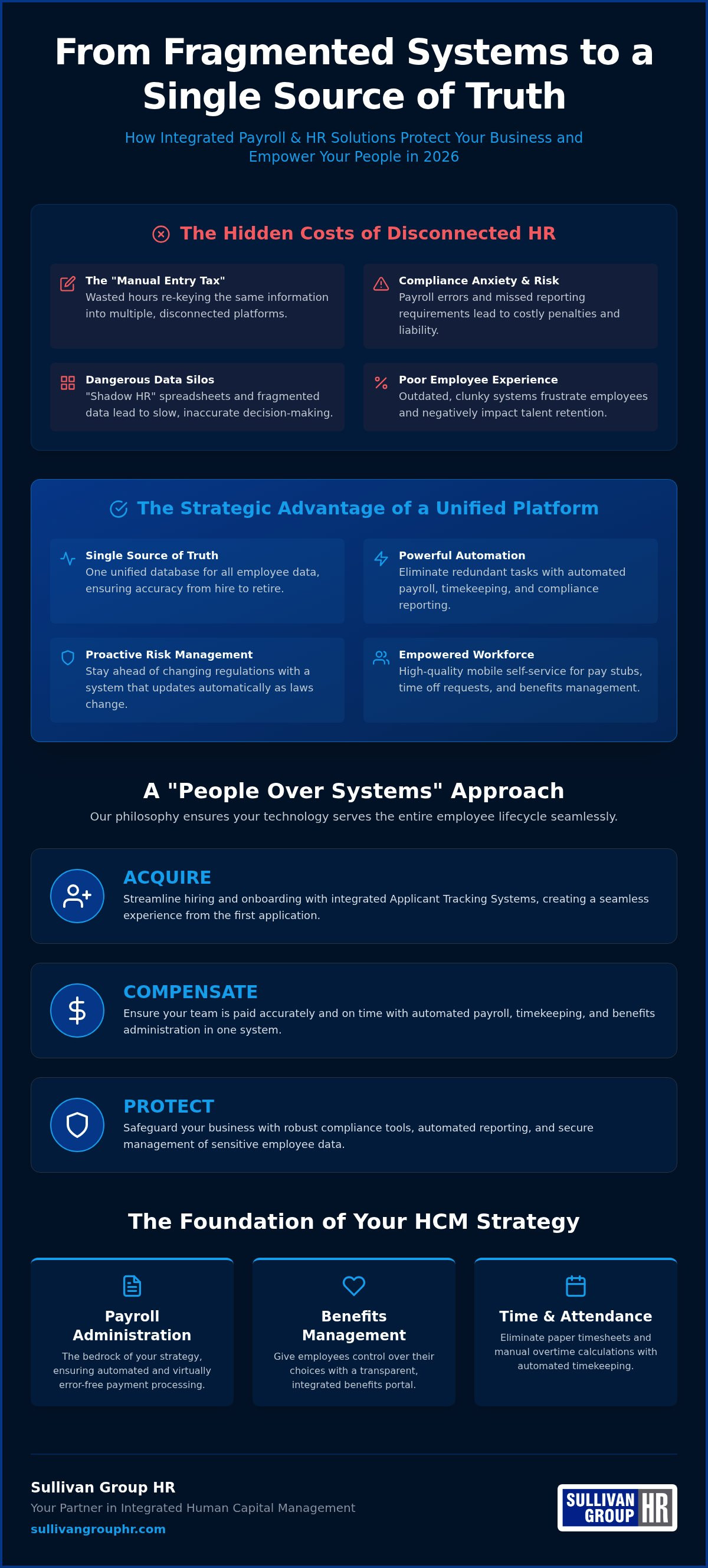
What exactly is a unified ecosystem? It is more than just a software bundle. It is a protective environment where every piece of employee data, from their first application to their final paycheck, lives in one place. When you implement integrated payroll and HR solutions, you create a single source of truth for your entire organization. This prevents the "manual entry tax," which is the silent drain on your productivity caused by re-keying the same information into three different tools. Every minute your staff spends syncing spreadsheets is a minute they aren't spent growing your business.
Data gaps are dangerous. If your payroll software doesn't speak to your benefits portal, you risk missing a deduction or failing a state-specific reporting requirement. This fragmentation doesn't just create extra work; it creates unnecessary liability. Is your current setup helping you grow, or is it holding you back?
The Reality of Data Silos in 2026
In 2026, disconnected systems lead to "shadow HR." This happens when managers keep their own private spreadsheets because they don't trust the main system's accuracy. This redundant processing slows down your entire organization. Without a centralized Human Resource Management System (HRMS), executive decision-making becomes a guessing game. You can't lead effectively if your reporting is thirty days behind or spread across five separate logins. A single payroll error in 2026 can cost thousands in penalties, lost employee trust, and administrative rework.
Why 'Good Enough' Systems Are No Longer Enough
The days of using a simple, standalone payroll tool are over. Modern businesses need a comprehensive HCM platform that manages the entire employee lifecycle. Your team now expects high-quality self-service options. They want to check their pay stubs, update their address, and request time off from their mobile devices without needing to call the office. If your system feels like a relic from a decade ago, you'll struggle to retain top talent.
Compliance anxiety is a real burden for small business owners who feel overwhelmed by paperwork. Staying legal in a rapidly changing landscape requires more than just a calculator; it requires a system that updates automatically as laws change. Moving toward integrated payroll and HR solutions isn't just about efficiency. It's about finding a reliable partner who understands the nuances of your territory and values your people over the systems they use.
Defining Integrated Payroll and HR Solutions: More Than Just a Bundle
What does it mean to truly integrate your office functions? It is more than just buying three separate apps from the same salesperson. A genuine Human Capital Management (HCM) platform relies on a single, unified database. This ensures you have "one version of the truth" for every employee record. When an employee changes their tax withholdings in the portal, it instantly updates your payroll records and benefits data. This eliminates the lag time and data errors common in fragmented systems that rely on manual syncing.
We approach this through a three-part framework: Acquire, Compensate, and Protect. This philosophy ensures that your technology serves your people, not the other way around. By streamlining the entire lifecycle, from the first interview to the final retirement party, you create a seamless experience for your team. You stop being a data entry clerk and start being a strategic leader. Is your current technology providing that level of clarity?
The Core Pillars: Payroll, Benefits, and Timekeeping
A solid foundation starts with payroll administration outsourcing. This is the bedrock of your HCM strategy. When you pair this with integrated time and attendance, your payroll processing becomes automated and virtually error-free. You no longer have to chase down paper timesheets or manually calculate overtime. The system does the heavy lifting for you.
Managing your team's health and wellness is just as critical. By utilizing benefits management solutions within the same portal, you give employees total control over their choices. This level of transparency is why many regional businesses are looking for the best payroll services of 2026 that offer deep, native integration rather than shallow software patches.
Talent Acquisition and Onboarding Integration
The employee journey begins long before the first day of work. A unified system moves a candidate from applicant tracking and onboarding directly into active employee status without re-entering a single field of data. This reduces the "time to productivity" for new hires. They can focus on learning their roles rather than filling out the same forms three times.
Modern teams also demand a high-quality self-service portal. They want to access their own data on their own time. When you provide integrated payroll and HR solutions, you empower your staff and reduce the administrative burden on your managers. If you are ready to see how this works in practice, you might consider how partnering with a regional expert can transform your daily operations and secure your company's future.
The Strategic Advantage: Why Integration is the Standard for 2026
How much could your business achieve if your leadership team made decisions based on facts rather than old data? Integration isn't just a convenience for your office staff; it's a high-level financial strategy. The return on investment for integrated payroll and HR solutions comes from two primary sources: lower administrative overhead and significantly higher data accuracy. When your payroll and HR systems live in the same house, you stop paying for the mistakes that occur during manual transfers. You gain a protective shield around your bottom line.
A unified platform also enables proactive HR risk management. Instead of reacting to a problem after it happens, you can spot trends in turnover, overtime, or compliance gaps in real time. This visibility is vital for labor cost allocation and budgeting. You can see exactly where your money is going as it happens, not three weeks after the pay period ends. We often hear the objection that switching systems is a major investment. It is. However, the long-term savings from reduced errors and reclaimed time make it an undeniable necessity for any growing company.
Navigating Multi-State Compliance with Ease
Expanding your team across state lines shouldn't feel like a legal minefield. Integrated systems automatically track differing state tax laws and local labor regulations, ensuring you stay on the right side of the law. This automation is your best defense against Department of Labor audits and expensive penalties. Multi-state tax filing in 2026 requires navigating a patchwork of local ordinances and remote-work nexus rules that change almost weekly. A unified HCM platform handles these complexities behind the scenes, allowing you to hire the best talent regardless of their zip code.
Empowering Employees Through Self-Service
Your team wants autonomy. By giving employees control over their own personal data, you reduce the constant stream of "how do I find my W-2" emails hitting your inbox. Mobile-first tools allow your staff to manage their professional lives from their pockets, which directly impacts retention and satisfaction. Modern workforce management solutions successfully balance high-tech efficiency with the human touch your talent deserves. When employees feel empowered by their technology, they feel more connected to your mission. This connection is the ultimate competitive advantage in a tight labor market.
Transitioning to a Unified System: A Checklist for Success
Are you ready to stop managing software and start leading people? Moving to a unified platform is a significant shift, but it doesn't have to be a chaotic one. The transition toward integrated payroll and HR solutions is most successful when you follow a logical, phased roadmap. You don't need to do everything at once. You just need to do it right. Use this four-step checklist to ensure your migration is smooth and your data stays secure.
- Step 1: Conduct a thorough audit. Map out every disconnected tool, spreadsheet, and manual process currently in use. Identify exactly where data is being re-keyed and where errors typically occur.
- Step 2: Identify your 'must-have' features. Determine which functions are non-negotiable for your 2026 growth. This often includes a built-in Applicant Tracking System (ATS) and seamless integration with Workers' Compensation Insurance.
- Step 3: Evaluate the partner, not just the product. Look for a provider that offers both a powerful platform and dedicated Human Resources Consulting. You need people who understand your local territory, not just a help desk ticket system.
- Step 4: Plan a phased migration. Avoid the "big bang" approach. Move your data in stages to ensure integrity and give your team time to adapt to the new workflow.
What to Look for in an HCM Provider
Scalability is essential for mid-market businesses. We recommend the isolved platform because it provides the robust infrastructure needed to handle complex growth without losing the user-friendly interface your team expects. However, the software is only half the battle. You should evaluate a provider's history of regulatory expertise and their ability to offer proactive support. A "no-nonsense" regional authority is always a better choice than a sterile, national vendor that treats you like a number. You deserve a partner who values your legacy and works to protect your future. If you want to see how a local handshake meets high-tech efficiency, reach out to our team for a personalized consultation.
Avoiding Common Implementation Pitfalls
The most frequent mistake in any software transition is migrating "dirty" data. You must ensure a clean data conversion before you flip the switch. This means verifying employee records, tax IDs, and benefit elections in your old system before they move to the new one. Garbage in leads to garbage out.
Change management is equally vital. Your internal team needs proper training and clear communication to buy into the new process. If they don't understand the "why" behind the change, they'll resist the new tools. Business continuity depends on a steady hand at the wheel. By focusing on training and data integrity, you can maintain your daily operations while building a more efficient foundation for the years ahead.
Sullivan Group HR: Your Partner in Integrated Human Capital Management
What if your HR technology actually felt like a partnership? At Sullivan Group HR, we bridge the gap between powerful automation and personalized advocacy. We believe that integrated payroll and HR solutions should do more than just process checks; they should protect your business and empower your people. Our mission is built on a simple, three-part framework: Acquire, Compensate, and Protect. We invite you to move away from transactional, tech-only vendors and toward a long-term relationship built on stability and hard-earned wisdom. You deserve a coach and an ally who understands your professional potential.
We approach every client relationship with a "people over systems" philosophy. While we provide access to the best technology in the industry, we know that software alone cannot solve complex human problems. You need a reliable expert who can translate regulatory jargon into actionable steps. Our goal is to provide a sense of security for business owners who feel overwhelmed by the weight of administrative burdens. By focusing on your success as our primary metric, we ensure that your organization is built on a foundation of reliable advocacy and no-nonsense expertise.
Why the isolved Platform is the 2026 Leader
Modern businesses need the power of the isolved People Cloud to stay competitive in a fast-moving market. This industry-leading platform brings your applicant tracking, payroll, and benefits into a single, secure cloud environment. You no longer have to navigate multiple logins or reconcile mismatched data across different vendors. Everything you need lives in one place. Sullivan Group HR takes this powerful technology and customizes the experience to fit the specific nuances of your company. We ensure the system works for your unique workflow, providing the mid-market scalability you need without losing the user-friendly interface your team expects. Having a single source of truth allows you to move with speed and confidence.
The Sullivan Group Difference: Expertise Meets Advocacy
We have a long legacy of providing comprehensive human resources management services that go far beyond the screen. When you partner with us, you gain a supportive ally who understands the complexities of workers' comp, risk management, and local labor laws. We don't just give you a login and walk away. We provide the professional consulting you need to navigate difficult regulatory waters and protect your company's future. Our regional expertise acts as a localized handshake, giving you a level of personalized touch that national firms simply cannot replicate. We are here to help you build a more secure, efficient, and people-focused organization. Contact us today to unify your HR and payroll strategy.
Securing Your Business Future with Unified HCM
Are you ready to reclaim your time and focus on the growth of your team? We've explored how fragmented data creates a "manual entry tax" that slows your operations and increases your liability. By moving toward integrated payroll and HR solutions, you eliminate these silos and create a single source of truth that protects your company. You now have a roadmap to audit your current tools and a framework to evaluate the right partner for your 2026 goals.
Success in the modern market requires more than just high-tech software like the isolved platform. It requires a supportive ally who provides professional HR consulting and genuine advocacy. Our "Acquire, Compensate, Protect" framework is designed to give you total organizational security while keeping your people at the center of everything you do. You don't have to navigate these administrative burdens alone. Ready to unify your workforce strategy? Let’s talk about your integrated solution.
Your business legacy is worth protecting. We are here to help you build a more efficient, compliant, and thriving workplace for years to come. Your potential is limitless when you have the right support behind you.
Frequently Asked Questions
What are the primary benefits of integrated payroll and HR solutions?
The primary benefits include eliminated data silos, reduced manual entry, and a single source of truth for your entire workforce. When you utilize integrated payroll and HR solutions, you stop acting as a data clerk and start leading as a strategist. This unified approach streamlines the entire employee lifecycle. It ensures that your data flows naturally from the initial hire to the final paycheck without the friction of disconnected tools.
How does a unified HCM platform improve regulatory compliance?
A unified platform improves compliance by automating tax updates and regulatory reporting across multiple jurisdictions. You no longer have to manually track shifting state laws or local ordinances that could lead to penalties. The system handles these complexities behind the scenes, which significantly reduces your risk of Department of Labor audits. This proactive protection allows you to focus on your professional potential rather than worrying about paperwork errors.
Can an integrated system help reduce payroll processing errors?
Yes, an integrated system virtually eliminates processing errors by removing the need for redundant data entry. When your payroll and HR records live in a single database, a change in one area instantly reflects in the other. This "one version of the truth" prevents the mismatched records that typically cause overpayments or tax penalties. It provides a level of accuracy that fragmented spreadsheets simply cannot match; providing peace of mind for you and your team.
Is it difficult to switch from multiple HR vendors to one integrated provider?
Switching is a manageable process when you follow a phased migration plan with a dedicated partner. While the initial setup requires an investment of time, the long-term productivity gains are undeniable. We focus on a "clean conversion" of your data to ensure everything is accurate before the new system goes live. This transition period is the perfect time to audit your old processes and build a more secure foundation for your company's future.
What features should I look for in an integrated HR and payroll software?
Look for a platform that includes a native Applicant Tracking System (ATS), mobile-first self-service, and automated timekeeping. Your integrated payroll and HR solutions should also offer seamless integration with workers' compensation insurance. These features ensure your technology supports the full lifecycle of your team. You want a system that is robust enough for mid-market growth but simple enough for daily use by your employees and managers.
How does integration impact the employee experience?
Integration empowers employees by giving them direct control over their personal information and benefits through a self-service portal. They can access pay stubs, request time off, or update their address from their mobile devices without needing to call the office. This level of transparency builds trust and improves overall retention. When your technology is human-centric, your team feels more connected to your organization's mission and values; creating a more engaged workforce.
Does Sullivan Group HR offer support for multi-state payroll?
We provide comprehensive support for multi-state payroll, combining our local expertise with the powerful isolved platform. Our team understands the specific nuances of different territories and ensures your business remains compliant regardless of where your employees live. We act as your regional handshake, providing a personalized touch that national vendors often lack. This allows you to hire the best talent across state lines with total confidence and security.
How does workers' compensation insurance integrate with payroll?
Workers' compensation integrates with payroll through a "pay-as-you-go" model that uses real-time data to calculate premiums. This approach improves your cash flow by ensuring you only pay for your actual exposure each pay period. It also simplifies the year-end audit process because your records are already synchronized. By connecting your insurance directly to your payroll, you add another layer of protection to your business and eliminate the guesswork from your budgeting.


