
Is your current employee handbook a protective shield or a ticking compliance clock? We know that keeping up with shifting regulations feels like a full-time job. It is a heavy lift to track every new mandate while trying to lead your people. As we move into the new year, the legal requirements for employee handbooks 2026 have shifted from simple guidelines to strategic necessities. You might be feeling the weight of the new OBBBA overtime reporting or the complexity of multi-state legal variations. We are here to help you turn that anxiety into a clear, actionable plan.
In this guide, you will learn how to master the 2026 regulatory shifts to protect your business and empower your workforce. We will show you how to handle mandatory AI policies, the restored FLSA overtime thresholds, and the new $7,500 dependent care exclusions. We cover everything from W-2 reporting changes to workplace safety protocols. By the end, you will have the clarity needed to build a defensible, modern handbook that fosters trust, ensures total compliance, and secures your professional legacy.
Key Takeaways
- Align your payroll administration with the OBBBA mandate to ensure precise W-2 reporting for qualified overtime and tips.
- Update your legal requirements for employee handbooks 2026 to include clear boundaries for AI tools and robust data privacy safeguards.
- Simplify multi-state compliance by implementing a "Core + Addendum" model that addresses local paid leave and pay transparency variations.
- Protect your business and empower your workforce by shifting from a defensive legal shield to a strategic tool for cultural alignment.
- Streamline your administrative burden by using human capital management tools to automate policy distribution and signature tracking.
Understanding the 2026 Regulatory Shift: OBBBA and Beyond
Are your internal policies keeping pace with the rapid changes in federal law? For years, many business owners viewed their manuals as a dusty "break glass in case of emergency" document. That era has ended. The legal requirements for employee handbooks 2026 demand a proactive approach that moves beyond simple litigation avoidance. We're seeing a transition from defensive compliance to active organizational strategy. If you're still relying on a template from 2024, you aren't just out of date; you're at risk. Old templates lack the specific language needed to address the One Big Beautiful Bill Act (OBBBA) and the nuanced boundaries of modern workplace technology.
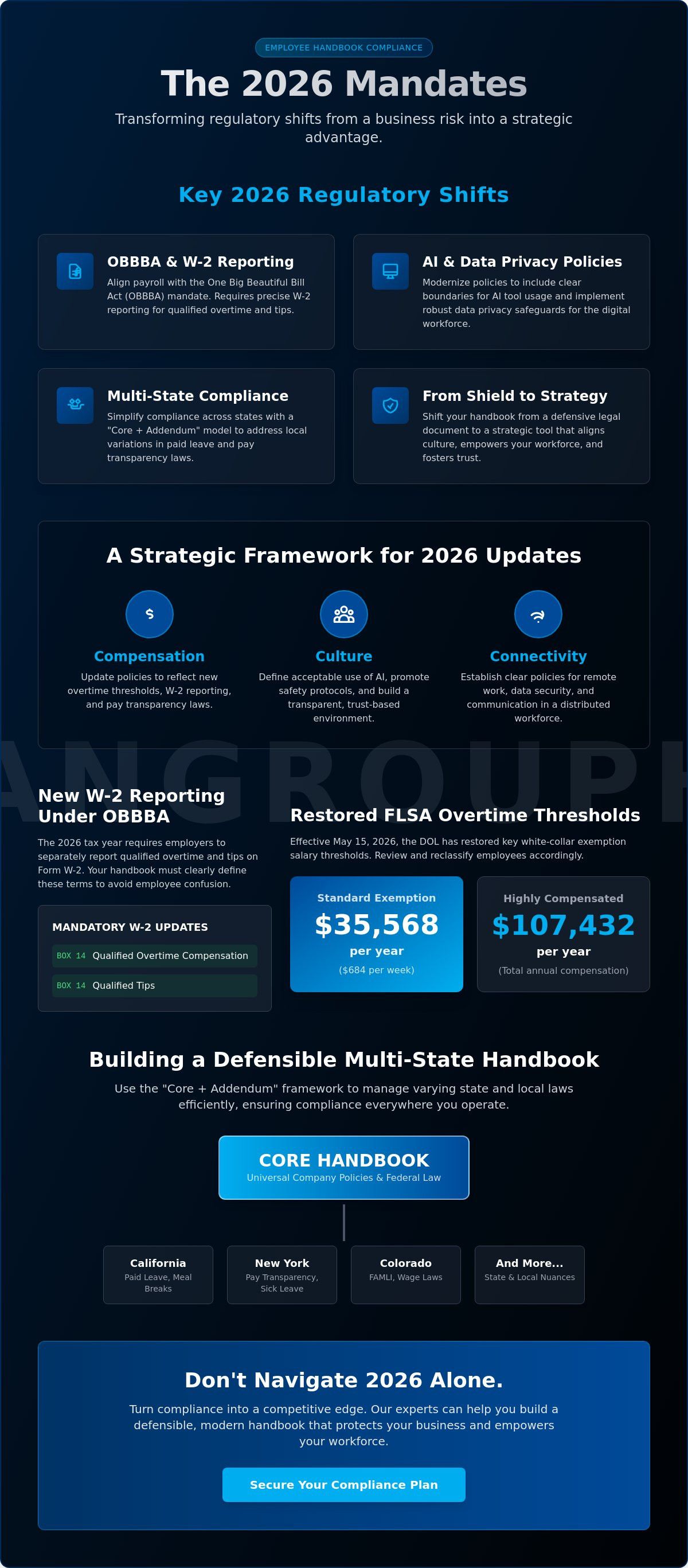
To stay ahead, we recommend a three-part framework for your 2026 updates: Compensation, Culture, and Connectivity. This structure ensures you address the hard numbers of wage reporting, the soft skills of team management, and the digital realities of a connected workforce. By organizing your handbook this way, you create a document that is manageable, organized, and effective. It transforms a bureaucratic burden into a roadmap for success.
The Core Mandates of the OBBBA for Employers
The OBBBA fundamentally changes how you track and report labor costs by introducing new tax deductions for employee overtime and tips. Under OBBBA § 70202, "qualified overtime compensation" is no longer just a standard payroll expense; it is a specific reporting category that impacts your employees' bottom lines. While the IRS provided some transition relief in 2025, that grace period has expired. Starting with the 2026 tax year, your systems must be ready to separate these earnings for mandatory W-2 reporting. Failure to clearly define these terms in your handbook can lead to confusion during tax season and potential disputes over take-home pay.
Why Handbooks are Your First Line of Defense
Think of your manual as a localized handshake between you and your team. It provides the "clear notice" required to avoid costly wage and hour litigation. When a Department of Labor (DOL) or IRS auditor walks through your door, your employee handbook is the first document they'll request. It proves you have communicated the legal requirements for employee handbooks 2026 to every member of your staff. This transparency builds a culture of trust and reduces the likelihood of internal friction. For a deeper look at protecting your assets, check out our guide on HR risk management. A well-drafted policy doesn't just stop lawsuits; it creates a sense of security for business owners who want to focus on growth rather than administrative burdens.
Overtime, W-2 Reporting, and the New Wage Framework
How will your employees react when they see new categories on their 2026 tax forms? The One Big Beautiful Bill Act (OBBBA) has introduced a significant shift in how we handle take-home pay. Specifically, OBBBA § 70202 creates a tax deduction for "qualified overtime compensation." This means your handbook must do more than just list hours. It needs to define what counts as qualified overtime so your team understands the tax benefits they are earning. The legal requirements for employee handbooks 2026 now dictate that your wage policies align perfectly with these new federal reporting standards.
The transition relief we saw in 2025 is officially over. For the 2026 tax year, employers are required to separately report qualified tips and qualified overtime compensation on Form W-2. This isn't just a back-office payroll task. It's a communication challenge. If your handbook doesn't clearly outline these definitions, you're opening the door to constant questions and potential disputes. You must track, report, and communicate these figures with total precision to remain compliant.
Updating your overtime eligibility language is equally critical. As of May 15, 2026, the Department of Labor has restored the 2019 white-collar exemption threshold of $684 per week, or $35,568 per year. The highly compensated employee exemption now sits at $107,432. We recommend reviewing your current job classifications against these federal overtime provisions to ensure no one is misclassified. Misclassification is a leading cause of Department of Labor audits, and a clear handbook policy is your best evidence of a good-faith effort to comply.
Updating Your Compensation and Payroll Policies
Your handbook should clarify how the "regular rate of pay" interacts with these new deductions. When you offer premium pay for weekends or holidays, you need to state whether that pay qualifies for the OBBBA deduction. We suggest providing clear examples of these calculations without crossing the line into specific tax advice. If you need help managing these complex calculations, our team at Sullivan Group HR can help you modernize your approach. You can also explore our insights on payroll administration outsourcing to see how experts handle these granular tracking requirements.
Reporting and Compliance Documentation
To stay audit-ready, your documentation must be airtight. We recommend an integrated approach to time and attendance. Your handbook should mandate that employees review and sign off on their "qualified" hours every pay period. For 2026, the mandate is clear: every dollar of qualified overtime must be identifiable and reportable. By setting these expectations early, you protect your business and provide your employees with the transparency they deserve.
- Audit your current W-2 reporting boxes for OBBBA compliance.
- Update exemption language to reflect the $35,568 annual threshold.
- Define "qualified overtime" based on OBBBA § 70202 standards.
- Establish a clear process for employees to dispute reported overtime hours.
Modernizing Policies for the Digital Workforce: AI and Privacy
Are you prepared for the day an employee accidentally uploads sensitive client data into a public AI prompt? The digital landscape moves fast. Your handbook must move faster. Meeting the legal requirements for employee handbooks 2026 means addressing the tools your team is already using. It isn't about banning technology. It's about creating a safe, productive space where innovation and security coexist. By formalizing these digital boundaries, you act as a protective coach for your team, guiding them through the complexities of the modern workplace.
The "Connectivity" pillar of our framework focuses on how your team interacts with technology and each other. In 2026, this requires a shift in how we view the "office." Whether your team is local or distributed across the country, they need a clear roadmap for digital expression. From social media conduct to remote work expectations, your policies should provide a steady, reliable beat that keeps everyone in sync. This clarity minimizes cognitive load for your managers and creates an atmosphere of reliable advocacy for your staff.
Crafting a Proactive AI Use Policy
How do you define the difference between "AI-assisted" and "AI-generated" work? Your policy needs to be crystal clear. AI-assisted work uses tools to refine human ideas, while AI-generated work is created primarily by the machine. This distinction is vital for protecting your intellectual property. You must also address the confidentiality risks inherent in AI prompts. To keep your team on the right track, we recommend a three-part standard for all AI use:
- Transparency: Employees must disclose when generative AI significantly contributes to a work product.
- Accuracy: Every AI-generated output must be fact-checked and verified by a human expert.
- Oversight: Final accountability for all work remains with the human employee, not the software.
Data Privacy and Employee Monitoring
Trust is the foundation of a healthy culture. In an HCM-driven world, you likely collect more data than ever before to ensure accurate payroll and safety. Your 2026 handbook should include updated transparency notices for employee monitoring and time tracking. Instead of just listing what you track, explain the "why" behind it. Are you ensuring fair compensation? Are you optimizing workplace safety? When employees understand the purpose of data collection, they feel protected rather than watched. This approach aligns perfectly with our workforce management solutions framework, which balances high-tech efficiency with a supportive, human-centric touch.
Managing a distributed team also requires formalizing remote and hybrid expectations. Your handbook should clearly outline work hours, communication response times, and equipment security protocols. Similarly, digital expression on social media can impact your brand. While you can't control off-duty conduct entirely, you can set boundaries for how employees represent your company online. Clear guidelines prevent misunderstandings and protect your hard-earned reputation in the community.
Building a Defensible Multi-State Handbook Framework
Does your business operate across state lines? Managing a distributed team shouldn't feel like a legal balancing act. If you have one employee in South Carolina and another in California, you are playing by two different sets of rules. The legal requirements for employee handbooks 2026 demand a structure that is both firm and flexible. We recommend the "Core + Addendum" model to stay organized. This approach allows you to maintain a consistent company culture while respecting local mandates. It turns a logistical nightmare into a manageable, scalable system.
Sometimes, the simplest path is the most restrictive one. If one state requires a higher level of protection, like California's mandatory five days or 40 hours of paid sick leave, you might choose to apply that standard to your entire team. This "Highest Standard" rule reduces administrative friction and ensures no one is left behind. It simplifies your payroll administration and builds equity across your workforce. By choosing the most protective policy as your baseline, you create an atmosphere of reliable advocacy for every member of your staff.
The Core + Addendum Approach to Compliance
Your "Core" policies are the non-negotiables. These include your mission statement, anti-harassment rules, and equal opportunity employment standards. These apply to every member of your team, regardless of their zip code. The "Addendum" consists of state-specific riders. These riders address local nuances like jury duty pay, meal breaks, and specific leave laws. This model provides legal clarity and makes it easy to add new states as your business grows. It protects your legacy by ensuring you are always compliant, no matter where your talent lives. We have found that this structure minimizes cognitive load for busy entrepreneurs.
Pay Transparency and Salary History Bans
The 2026 landscape for pay transparency is more complex than ever. Many states now require you to post salary ranges directly in your job descriptions. To manage this effectively, you should update your applicant tracking and onboarding processes. This ensures you are collecting the right data and providing the necessary disclosures from the first interaction. Mismanaging multi-state wage reporting can lead to significant penalties and a loss of candidate trust. If you're feeling overwhelmed by these variations, our human resources consulting team can help you build a defensible framework tailored to your specific footprint.
Strategic HR Consulting: Turning Compliance into a Competitive Edge
What if your most complex administrative burdens became your greatest competitive advantages? Compliance doesn't have to be a weight that holds you back. Instead, it can be the foundation that allows you to move faster and hire better. Meeting the legal requirements for employee handbooks 2026 is a significant task, but you don't have to face it alone. We act as your coach and ally, turning rigid regulations into a clear strategy for growth. Our goal is to help you move from a place of anxiety to a state of total organizational security.
A handbook is only as strong as the people who enforce it. Beyond the written text, we focus on training your managers to live these policies every day. When your leadership team understands the "why" behind your OBBBA reporting or AI boundaries, they can lead with confidence. This alignment creates a culture of transparency and trust. It ensures your handbook isn't just a legal shield; it's a living document that defines your success. Our three-part promise is to help you Simplify, Protect, and Scale your business with ease.
HCM Integration: Compliance on Autopilot
How much time do you spend chasing down signed paper documents? By leveraging unified human capital management, you can put your distribution on autopilot. Our isolved HCM platform ensures every employee receives the latest version of your handbook the moment it's updated. This system creates a digital audit trail for acknowledgments that is invaluable during a DOL or IRS audit. It also streamlines the 2026 W-2 reporting process we discussed earlier, ensuring that qualified overtime is tracked accurately from the time clock to the final tax form.
Your Partnership with Sullivan Group HR
We pride ourselves on being an established regional expert with a no-nonsense approach to HR. Our team understands the specific nuances of your territory and the unique challenges you face as a business owner. We invite you to join us for a proactive "Handbook Health Check" for 2026. We will review your current policies, identify gaps in your legal requirements for employee handbooks 2026, and build a defensible framework together. Let us help you build a safer, more productive workplace today.
Secure Your Future with a Modern Handbook Strategy
The regulatory landscape for 2026 demands more than just a defensive posture. You've seen how OBBBA reporting, AI boundaries, and multi-state riders are reshaping the modern workplace. It's time to move toward a model that simplifies your operations while protecting your people. Mastering the legal requirements for employee handbooks 2026 is about more than avoiding fines; it is about building a culture of trust and transparency. When your policies are clear, your team feels secure, and your business can thrive without the weight of administrative anxiety.
Since 1998, our team has provided the expert HR consulting needed to navigate these complex shifts with ease. We offer proactive multi-state compliance management and access to the industry-leading isolved HCM platform to keep your digital audit trails airtight. Don't let new mandates slow your momentum. Secure Your Business with a 2026 Handbook Audit and turn your compliance burdens into a strategic roadmap for growth. You have worked hard to build your legacy, and we're here to help you protect it. Let's step into the new year with confidence and clarity together.
Frequently Asked Questions
What is the OBBBA and how does it affect my 2026 employee handbook?
The One Big Beautiful Bill Act (OBBBA) is a significant piece of legislation that introduces new tax deductions for qualified overtime and tips. It affects your handbook by requiring clear, updated definitions of "qualified overtime" so employees understand their specific tax benefits. You must revise your compensation section to reflect these 2026 mandates and ensure your reporting processes align with the new law.
Do I need a separate handbook for every state where I have employees?
You don't need a completely different book for every state; instead, we recommend a "Core + Addendum" model. This structure keeps your company-wide culture and policies in a main section while using state-specific riders for local leave, pay transparency, or wage laws. It's a scalable way to stay organized and legally defensible as your team grows across different jurisdictions.
What are the new W-2 reporting requirements for overtime in 2026?
Starting with the 2026 tax year, employers are required to separately report qualified tips and qualified overtime compensation on Form W-2. The transition relief offered by the IRS in previous years has officially ended. Your payroll administration systems must be configured to track these specific earnings separately to ensure total compliance with federal tax reporting standards.
Should I include an AI usage policy in my employee handbook?
Yes, you should absolutely include a formal AI policy to protect your intellectual property and set clear boundaries for acceptable use. Your policy should distinguish between AI-assisted work and AI-generated products while emphasizing the need for human oversight. This proactive step prevents confidentiality leaks and ensures your team uses these tools safely and ethically.
How often should an employee handbook be updated for legal compliance?
We recommend reviewing and updating your manual at least once a year or whenever major state or federal regulations shift. The legal requirements for employee handbooks 2026 demonstrate how quickly the landscape can change. Regular audits ensure your policies remain a protective shield rather than a liability during a Department of Labor or IRS inspection.
Can an employee handbook be distributed digitally through an HCM platform?
Yes, distributing your handbook through a human capital management platform like isolved is the most efficient way to manage compliance. Digital distribution provides an instant audit trail of employee signatures and ensures every team member has access to the most current version. It simplifies the administrative process and creates a steady, reliable beat for your organizational security.
What happens if my employee handbook is not compliant with 2026 laws?
Non-compliant handbooks leave your business vulnerable to wage and hour litigation, significant IRS penalties, and costly Department of Labor audits. Without "clear notice" of your policies, you lose your primary defense in legal disputes. Beyond the financial risk, outdated policies can damage employee trust and create confusion that hinders your daily operations.
Is an employee handbook legally required for small businesses in 2026?
While federal law doesn't strictly mandate a single document called a "handbook," it does require you to communicate specific policies like anti-discrimination, FMLA rights, and safety protocols. A handbook is the most practical way to meet the legal requirements for employee handbooks 2026. It provides a consistent framework that protects your business and empowers your workforce through transparent communication.


