

Managing garnishments in payroll can feel uncertain when notices arrive with deadlines, different rules, and questions about other active orders. The risk is not only the deduction itself, but also treating each order as a one-off task. A repeatable process helps you respond consistently and keep important details from slipping through the cracks.
It’s reasonable to pause before making a deduction. First identify the type of notice, confirm which employee it concerns, and determine how the order interacts with applicable limits and any other garnishments. You also need to coordinate payroll timing, payment, records, and employee communication without guessing when the rules aren’t clear.
This 2026 employer guide walks through the process from receipt to resolution: routing and reviewing an order, calculating and prioritizing deductions, meeting deadlines, and maintaining clear documentation. You’ll also learn when to seek guidance from a qualified legal or government resource. With an organized workflow, payroll teams can handle orders more steadily and protect both employees and payroll operations.
Key Takeaways
- Separate your payroll duties from the creditor’s collection process, and identify what the order requires before taking action.
- Use a consistent intake-to-recordkeeping sequence to route each notice, track deadlines, process withholding, and retain documentation.
- When managing garnishments in payroll, verify the order’s calculation basis and applicable rules instead of relying on one formula or priority assumption.
- Assign clear responsibilities across HR, payroll, and finance, and protect sensitive notices with secure access and handling practices.
- Assess whether your payroll team can manage intake, approvals, exceptions, remittance, and records consistently, and know when to seek qualified guidance.
What managing garnishments in payroll means for employers
Wage garnishment is a legally directed withholding from an employee’s earnings. The employer follows the instructions in the order and applicable law. The employer doesn’t decide whether the employee owes the debt or take part in the creditor’s collection efforts. For a general introduction to the legal process, see Garnishment.
That distinction matters. The employee’s underlying obligation belongs to the employee and creditor or government agency. The employer’s responsibility is to handle the notice correctly through payroll. As a practical summary: An employer receives, reviews, processes, and documents the order according to its instructions and applicable requirements.
There isn’t one process or calculation that fits every notice. Requirements can depend on the order type, federal rules, state law, and employee circumstances. Managing garnishments in payroll means identifying those details before setting up a deduction and checking current requirements when the order or applicable jurisdiction raises questions.
Which garnishment orders might reach an employer?
Employers may receive notices involving child support, tax levies, creditor garnishments, or bankruptcy-related matters. These categories can have different issuing authorities, instructions, deadlines, and payroll treatment. A bankruptcy-related notice, for example, may affect how an existing withholding is handled. Follow the specific notice and verify applicable requirements rather than assuming what it means.
Start by identifying who issued the notice and what type of order it is. This first check helps route it to the right reviewer and prevents procedures for one category from being mistakenly applied to another. If the order is unclear, seek clarification from an appropriate government resource or qualified legal counsel.
What does the employer need to do first?
Move promptly, but don’t rush into a deduction without review. Route the notice to the designated payroll or HR contact, then record when and how it arrived. Capture the issuing authority, employee details, case or reference information, and any stated response, withholding, or remittance instructions and deadlines.
Next, confirm that the notice identifies the correct employee and determine what action it directs. Keep the document secure because it contains sensitive employee and case information. If an employee says the debt has been paid, disputes the notice, or offers other context, note the concern and direct it through the appropriate channel. Don’t ignore the order or change payroll treatment based only on a verbal explanation. If instructions conflict or key details are missing, pause to seek qualified guidance before making assumptions.
How a garnishment order moves from receipt to payroll withholding
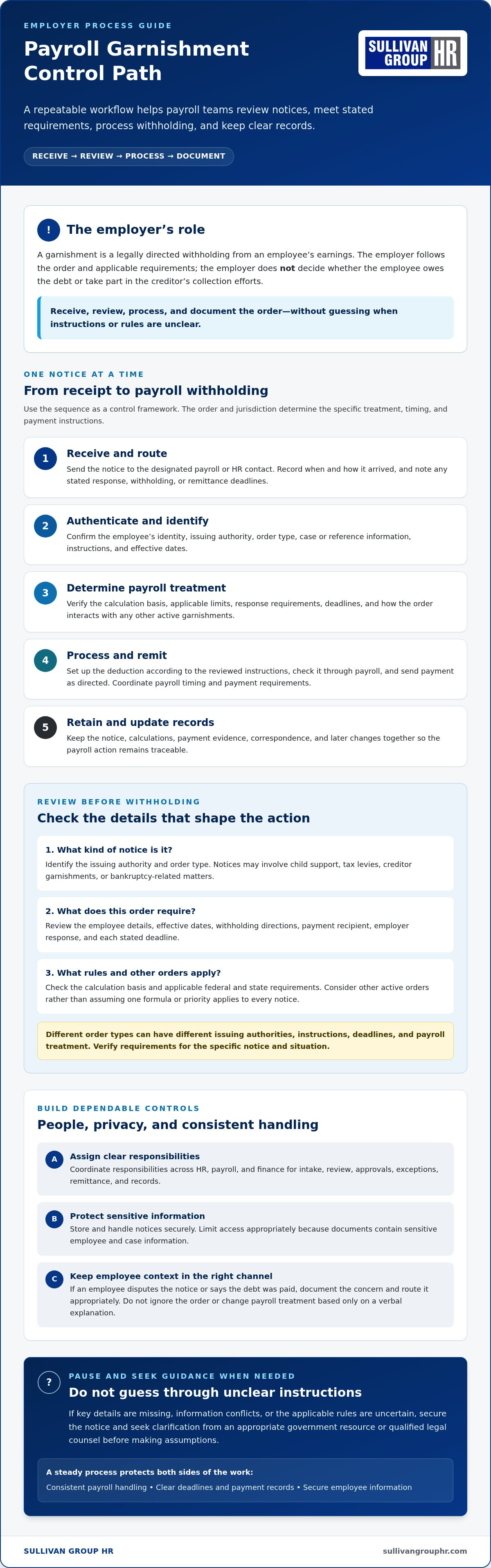
A dependable workflow turns a notice into a reviewed, traceable payroll action. The steps are straightforward, but the required response, calculation, timing, and payment instructions can depend on the order and jurisdiction. Check the order and governing requirements before withholding begins.
- Receive: Route the notice to the designated payroll or HR contact and record its arrival date.
- Authenticate and review: Confirm the employee’s identity, issuing authority, order type, instructions, and effective dates.
- Determine payroll treatment: Verify the calculation basis, applicable limits, response requirements, and deadlines.
- Process and remit: Set up the approved deduction, review it through payroll, and send payments as directed.
- Retain records: Keep the notice, calculations, payment evidence, correspondence, and any later changes together.
This sequence is a control framework, not a universal rulebook. The method and limits for one kind of order may not apply to another. Check the federal wage garnishment rules and verify any applicable state requirements before determining how an order should be handled.
Review the notice before setting up a deduction
Confirm that the order names the right employee and identifies the issuing authority. Then review the order type, effective dates, withholding directions, required employer response, and payment recipient. Note each stated deadline and verify which rules apply to the employee and payroll situation. Don’t rely on an old order or a familiar-looking form as proof that the instructions are current.
If information is missing, inconsistent, or unclear, secure the notice and contact the issuing authority through an appropriate channel for clarification. Escalate questions that require interpreting legal obligations to qualified legal counsel or a government resource. Don’t fill gaps with assumptions that could lead to an incorrect deduction.
Set up, remit, and document the deduction
Once reviewed, transfer the approved instructions into payroll and have the setup checked against the notice before processing. Confirm the deduction amount or method, start date, payment destination, and any required reporting. Remittance and reporting are order-specific. Don’t assume every notice uses the same schedule, method, or recipient.
Keep dated copies of the notice, calculation details, payroll records, payment confirmations, correspondence, and updates such as a revised instruction or release. A consistent file makes it easier to explain what happened and when. For employers reviewing how payroll administration could support organized processes, payroll administration support may be worth exploring.
How to review garnishment calculations and competing orders
A correct calculation starts with the right inputs, not a familiar percentage. Separate the employee’s gross pay from disposable earnings, identify any protected amount, and follow the calculation basis specified by the order and governing requirements. Review every deduction against both the order and applicable limits before applying it to payroll.
The U.S. Department of Labor guidance on wage garnishment offers a federal starting point, but it doesn’t replace checking state requirements or the specific instructions in each notice. Keep a record of the rules and assumptions used for a calculation, including who reviewed them and when. If an order is unclear, seek qualified legal or government guidance rather than treating a payroll estimate as a legal interpretation.
What information affects the amount withheld?
Before calculating, gather the employee’s pay frequency, earnings for the relevant pay period, applicable deductions, order instructions, and any required protected amount. Gross wages aren’t automatically the calculation base: the meaning of disposable earnings and which deductions may be subtracted depend on the governing requirements. Pay frequency matters, too, because an order may specify a period or method that payroll must account for.
For example, if a notice describes a withholding method but doesn’t make clear how it applies to the employee’s pay schedule, don’t guess or copy the setup from another case. Ask a qualified reviewer to confirm the assumptions before the deduction is entered. Use any numerical example only after its legal assumptions have been checked for the relevant order and jurisdiction.
What if an employee has multiple garnishments?
Don’t process orders simply in the order they arrived, and don’t combine them using one blanket formula. Compare each notice’s type, instructions, stated priority, and applicable protections. The appropriate treatment can depend on the combination of orders and the employee’s circumstances, so verify priority and available earnings with qualified guidance when the rules aren’t clear.
If the available earnings may not cover all directed withholdings, escalate the issue before deciding how to divide or sequence deductions. Document the decision, the supporting instructions, the calculation, and who approved the treatment. Revisit the review when an order changes, a new order arrives, or payroll circumstances shift. This disciplined approach helps teams manage garnishments in payroll without allowing assumptions from a previous case to dictate a new one.
How to build a dependable payroll garnishment control process
A reliable process needs more than a checklist. It needs clear ownership, secure information handling, and regular checks that connect each order to the right payroll action. When responsibilities are split across HR, payroll, finance, and an external payroll administrator, document who receives notices, who reviews them, who approves setup, and who confirms remittance.
If payroll duties are delegated, define the handoffs in writing. Clarify which party tracks deadlines, approves changes, handles exceptions, and keeps records. Employers considering payroll administration outsourcing can use those questions to set expectations and understand how responsibilities will be coordinated.
Create a repeatable intake and review checklist
Use a standard checklist for each notice so important details don’t depend on memory or who happens to be working. Include the receipt date, employee match, order type, issuing authority, instructions, relevant deadlines, and reviewer sign-off. Set an escalation path for unclear notices, competing orders, and disputed payroll data. Identify who can contact the issuing authority or seek qualified guidance.
Build in review points after setup and whenever circumstances change. Periodically compare the deduction and remittance records with the current order instructions. Recheck after a payroll change, missed or returned payment, employment-status change, or updated notice. These controls help catch a stale instruction before it carries into another pay cycle.
Protect records and communicate carefully
Garnishment notices contain sensitive employee and case information. Limit access to staff who need it for their assigned work, store documents securely, and use approved channels for sharing details with an external administrator. Retain notices, calculations, approvals, payment confirmations, and correspondence under the organization’s applicable record-retention policies. Verify any required retention period rather than assuming one duration applies to every record.
Employee communication should be private, respectful, and limited to appropriate payroll information. Explain that the employer received an order and describe how payroll will handle the instructions, but don’t offer legal conclusions about the debt, the order’s validity, or an employee’s options. Direct questions about legal rights or disputes to qualified legal or government resources.
Managing garnishments in payroll becomes more consistent when every person knows their role and every change leaves a clear trail. Sullivan Group HR provides payroll administration and HR outsourcing for organizations reviewing how to coordinate broader payroll processes. Learn about Sullivan Group HR’s payroll administration support.
When to seek payroll support for garnishment administration
Is your team handling each order consistently, or does the process depend on who happens to be available? Consider additional payroll support if notices are difficult to track, calculations require repeated rework, deadlines are hard to monitor, or payment and documentation steps lack clear ownership. A support arrangement can help organize recurring payroll administration, but it doesn’t remove the employer’s need to review orders and follow applicable requirements.
Before choosing support, map the tasks your team handles today: intake, order review, payroll setup, approvals, remittance, employee or employment changes, and recordkeeping. Look for gaps and handoffs that aren’t clearly assigned. In managing garnishments in payroll, clarity about who does what matters as much as the tools used to do it.
What to evaluate in a payroll support arrangement
Ask a prospective payroll administrator who enters order details, approves changes, checks deductions, and submits remittances. Confirm how the provider routes unclear or conflicting instructions, exceptions, missed payments, and employee-status changes. Find out what records are maintained, who can access them, and how your team can review relevant documentation.
Also ask which steps remain your organization’s responsibility and how questions are escalated. If a provider describes HCM platform functions for garnishment processing, verify those specific capabilities and responsibilities directly before relying on them. Software or outsourced administration can support a process, but it doesn’t replace checking the legal order or confirming applicable rules. Seek qualified legal or government guidance when a question requires interpreting an obligation.
How Sullivan Group HR can support broader payroll operations
Sullivan Group HR provides payroll administration and HR outsourcing, with access to the isolved HCM platform. These are operational resources for organizing broader payroll work. Specific garnishment features or workflows aren’t assumed, so ask what support is available for your needs and confirm any relevant platform capabilities before making decisions.
When discussing a potential arrangement, bring practical questions: Which tasks would be handled by your team and which by the provider? How would approvals, exceptions, and documentation work? What information would you need to supply, and how would responsibilities be coordinated? Clear answers help you assess whether outside support fits your payroll operations without confusing administrative assistance with legal advice.
If your current process needs added structure, explore payroll administration outsourcing and discuss the support your organization is looking for.
Make Garnishment Administration More Consistent
Managing garnishments in payroll is easier to control when every order follows a documented path: review its instructions, confirm the applicable calculation and priority, process and remit as directed, and retain a clear record. Because requirements can vary by order and jurisdiction, don’t rely on a single formula or assume that software or an outside administrator replaces careful review.
Clear ownership across HR, payroll, and finance helps keep notices, approvals, deadlines, and changes connected. When instructions conflict or legal requirements are uncertain, pause and seek guidance from a qualified legal or government resource.
Sullivan Group HR provides payroll administration and HR outsourcing, with access to the isolved HCM platform. Ask about your operational needs and verify any garnishment-specific platform functions before relying on them. Explore payroll administration support with Sullivan Group HR to discuss how support may fit your processes.
With a repeatable workflow and the right support, your team can approach each order with greater clarity and care.
Frequently Asked Questions
What should an employer do after receiving a wage garnishment order?
Route the notice promptly to the designated payroll or HR contact and record its arrival date. Review the employee’s identifying details, issuing authority, order type, instructions, and stated deadlines. Before setting up a deduction, confirm which requirements apply to the order and employee. If details are missing or conflict, seek clarification through the appropriate channel rather than guessing. Keep a record of the review, decisions, and actions taken.
Can an employer ignore a garnishment notice if the employee disputes it?
No. Don’t disregard a notice solely because an employee disputes the debt or order. The employer generally handles the payroll instructions rather than deciding the merits of the case. Promptly route the employee’s question or dispute to the issuing authority or qualified legal counsel, and check the notice for response instructions. Verify applicable duties and timelines before acting, and document the steps taken. Avoid making legal conclusions about the employee’s case.
How much can an employer withhold from an employee’s paycheck?
There’s no single withholding amount that applies to every garnishment. The calculation may depend on the order type, the employee’s earnings and pay period, applicable federal protections, state requirements, and any other active orders. Review the specific instructions and current rules before entering a deduction. If the calculation isn’t clear, don’t rely on a familiar formula or guess. Pause and seek qualified guidance to reduce the risk of an incorrect payroll entry.
What happens if an employee has more than one garnishment?
Multiple orders may have different instructions, priorities, protections, and issuing authorities. Don’t automatically process them by arrival date or apply the same calculation to each. Gather the complete orders and relevant payroll information, then have a qualified reviewer determine the appropriate treatment under current requirements. Document the decision and supporting rationale, including related correspondence. Revisit the review if an order changes or another notice arrives, so payroll treatment reflects current instructions.
Does an employer have to notify an employee about a garnishment?
Notice and communication duties can depend on the order and applicable law. Review the instructions, then communicate privately and respectfully through your established HR process. You can explain relevant payroll steps without making legal conclusions about the employee’s case. If you’re unsure what notice is required, when to provide it, or what information may be shared, verify the requirements with the issuing authority or qualified legal counsel before communicating.
How should payroll handle a garnishment when an employee leaves the company?
Don’t assume that an employee’s departure automatically ends the employer’s responsibilities. Review the order for instructions about employment changes, final-pay treatment, and required reporting, then verify applicable deadlines. Update payroll records, document the final deduction decision, and send any required communication through the specified channel. Final-pay and garnishment requirements can vary. If the order doesn’t clearly address the situation, seek qualified guidance before deciding how to handle the final payroll.
Can payroll software manage garnishments automatically?
Payroll software or an HCM platform may help organize employee data, deductions, approvals, or records, but features vary by product and configuration. Confirm the provider’s specific capabilities and test the workflow before relying on automation. Employers still need to review each order, apply current requirements, manage exceptions, and maintain appropriate oversight. Don’t assume software alone ensures compliance. Ask who reviews setup and changes, handles unclear instructions, and confirms that payroll actions match the order.


