
Could your onboarding process be the difference between a long-term leader and a 45-day turnover? You already know that the first few days of employment are critical, yet the mounting administrative burden often gets in the way of a warm welcome. It is completely normal to feel overwhelmed by the shifting landscape of new hire paperwork requirements and the fear of a costly compliance error. You want to focus on your people, not just their files.
We are here to help you hire, pay, and protect with confidence. This guide provides a definitive list of the federal and state documentation you need to secure your business in 2026. You will learn about the latest I-9 edition, the updated $2,200 Child Tax Credit on the 2026 W-4, and California's new "Know Your Rights" notice requirements. We will preview the digital tools that simplify acquisition, compensation, and long-term security. By the end of this article, you will have a clear roadmap for a streamlined onboarding process that offers both peace of mind and professional rigor.
Key Takeaways
- Update your onboarding toolkit with the latest 2026 versions of Form I-9 and Form W-4 to ensure federal tax and employment eligibility compliance.
- Protect your business culture and assets by securing signed offer letters and employee handbook acknowledgments during the first week of employment.
- Master the latest new hire paperwork requirements to avoid costly government fines while providing a professional, welcoming experience for your team.
- Transition to a digital-first strategy using the isolved HCM platform to automate document storage and eliminate administrative friction.
- Partner with experts for human resources consulting to navigate complex state-specific mandates and ensure your organizational compliance remains ironclad.
The Essential Federal Forms Every New Hire Must Complete
Are you building your team on a foundation of solid compliance or a house of cards? The initial administrative phase defines the relationship between your business and the government. Federal mandates serve as the baseline for all new hire paperwork requirements, ensuring that every individual on your payroll is legally authorized to work and correctly taxed. Missing these marks doesn't just invite administrative headaches; it opens the door to significant financial penalties. We believe in a three-part framework for success: verify, document, and protect.
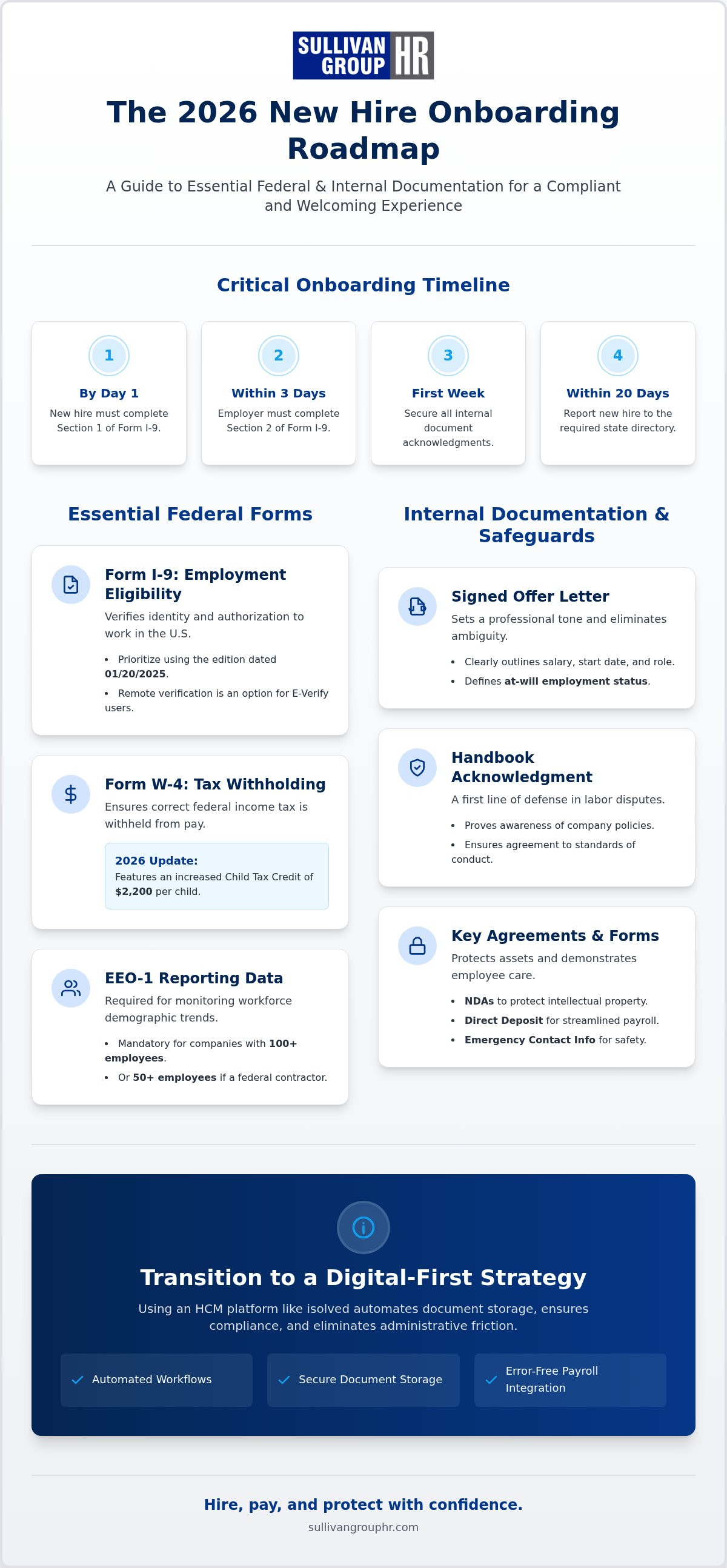
The Form I-9 remains the cornerstone of this process. In 2026, employers should prioritize the edition dated 01/20/2025 to verify identity and employment authorization. While the previous 2023 version remains valid through May 2027, adopting the newest standards early demonstrates a proactive commitment to regulatory rigor. This document is not merely a formality. It is a vital safeguard for your organizational security.
The I-9 Process: Accuracy and Deadlines
Compliance is a race against the clock. Your new team member must complete Section 1 of the I-9 no later than their first day of work. You then have exactly three business days to complete Section 2 after reviewing original documents. In our digital-first world, 2026 standards allow for remote verification, but only if you are enrolled in E-Verify and follow strict document inspection protocols. Utilizing a platform like isolved ensures these deadlines never slip through the cracks. Automated workflows prompt both the manager and the employee at every critical junction, turning a daunting task into a manageable routine.
Tax and Reporting Compliance
Accuracy in compensation starts with the 2026 Form W-4. This year's update is significant. It features an increased Child Tax Credit of $2,200 per child and expanded deduction worksheets. Collecting this form immediately prevents payroll processing errors that frustrate new hires and complicate your tax liabilities. While the W-4 handles federal withholding, you must also account for state-specific forms that vary based on where your employee actually works. Failing to report these hires to the state directory within the required window, often 20 days, can lead to unnecessary administrative fines. Integrating payroll administration outsourcing into your onboarding workflow ensures that tax data flows directly from the source to the paycheck without manual re-entry.
Finally, keep an eye on your company size. If you have reached 100 or more employees, or 50 if you are a federal contractor, EEO-1 reporting becomes a mandatory part of your data collection. This demographic data helps the government monitor workforce trends. Having a system that captures this information during onboarding saves hundreds of hours during the annual reporting season. We help you stay ahead of these triggers so you can focus on your professional potential, not just your paperwork.
Internal Documentation: Protecting Your Culture and Assets
Is your business truly protected, or are you just hoping for the best? While federal forms satisfy the government, your internal documentation satisfies your need for operational security. These specific new hire paperwork requirements are the tools you use to build a culture of accountability and respect. We view these documents as a three-part shield: they define the role, protect your ideas, and ensure physical safety. By being intentional today, you prevent the administrative headaches of tomorrow.
The offer letter is your first opportunity to set a professional tone. It should go beyond salary and start dates. By clearly outlining at-will status and specific role expectations, you eliminate the ambiguity that often leads to future disputes. Similarly, the employee handbook acknowledgment is more than just a checkbox. It is your first line of defense in labor disputes, proving that the employee was aware of and agreed to your company standards of conduct from day one.
Efficiency is also a form of employee care. Direct deposit authorizations streamline your payroll and reduce manual errors, while emergency contact forms demonstrate a human-centric approach to safety. These records must be kept in a secure, organized manner alongside the I-9, Employment Eligibility Verification to ensure your entire personnel file is audit-ready. When these systems work together, they create a sense of stability for your new hire.
Legal Safeguards and Agreements
Your intellectual property is the lifeblood of your business. Non-disclosure agreements (NDAs) and confidentiality clauses must be tailored to your specific industry to be effective. These agreements prevent the unauthorized sharing of sensitive data and protect your competitive advantage. For those looking to strengthen their defensive posture, reviewing our guide on HR risk management provides deeper strategies for protecting your business assets and long-term security.
Policy Acknowledgements
Clear communication prevents conflict. Signatures on anti-harassment and discrimination policies show your commitment to a healthy workplace and provide vital legal protection. You must also ensure employees understand safety protocols and workers’ compensation procedures, especially in high-risk environments. In our modern hybrid world, specific technology and remote work equipment policies are essential. They define who owns the hardware and how data should be handled outside the office. If you feel overwhelmed by the volume of these documents, our team at Sullivan Group HR can help you organize and automate your entire internal filing system.
Managing Benefits Enrollment and Compliance
Are you treating your benefits package as a legal obligation or a competitive advantage? While federal forms verify identity, benefit documents verify your commitment to your team's future. These specific new hire paperwork requirements often represent the most complex part of the onboarding journey. We guide you through a three-part process: providing clarity, capturing choices, and securing futures. When handled with care, these documents do more than satisfy auditors; they build trust.
The Summary Plan Description (SPD) is your primary tool for transparency. You're legally required to provide these overviews to ensure every employee understands their coverage, rights, and obligations. Beyond basic health and dental enrollment forms, you must prioritize beneficiary designations. Ensuring that life insurance and 401(k) assets are directed correctly is a simple act of protection for your employee's family. For 2026, keep in mind that employee 401(k) contribution limits have risen to $24,500, with an $8,000 catch-up for those over 50. Highlighting these growth opportunities during onboarding shows you value their long-term success.
Strategic Benefits Onboarding
Don't let your best perks get lost in a mountain of paper. Educating new hires on the true value of your benefits management solutions is essential for retention. Setting firm deadlines for enrollment ensures there are no gaps in coverage that could leave an employee vulnerable. We often see that voluntary benefits, like supplemental disability or wellness programs, act as the deciding factor for top talent staying long-term. You're selling a lifestyle, not just a job.
Compliance with ERISA and ACA
Regulatory rigor is the only way to avoid the steep penalties associated with ERISA and the ACA. You must provide required notices regarding the Health Insurance Marketplace and maintain meticulous records for annual 5500 filings. This is where modern technology becomes your greatest ally. Our unified HCM platform, isolved, tracks benefit eligibility automatically based on hours worked and employment status. It captures everything from HSA selections, which for 2026 have limits of $4,400 for individuals and $8,750 for families, to COBRA notices for departing staff. By automating the data flow, you transition from a stressed administrator to a strategic leader.
Modernizing the Experience with Digital Onboarding
Is your onboarding process a welcoming handshake or a paper-cluttered hurdle? In 2026, the way you manage new hire paperwork requirements defines your employer brand before a single task is completed. Moving from physical filing cabinets to secure, cloud-based storage isn't just about saving space. It's about security, speed, and accuracy. We believe in a three-part digital framework: centralize the data, secure the documents, and scale the process.
E-signatures are the engine of this transformation. They reduce administrative friction and ensure every signature is captured in the correct sequence without manual follow-up. Statistics show that organizations with a strong onboarding process improve retention by 82% and productivity by over 70%. By using self-service portals, you empower your team members to manage their own data from day one. This shift moves your HR team from being a gatekeeper to being a coach, focusing on people rather than forms.
The digital employee onboarding platform market is projected to reach $7.59 billion in 2026. This growth reflects a universal need for automated workflows that ensure no document is missed during the first week. When you remove the manual burden, you create a seamless experience that reflects the professional potential of your company. It turns a daunting regulatory task into a structured, manageable routine.
The isolved Advantage
Centralizing applicant tracking and onboarding into a single platform eliminates the risk of data silos. The isolved People Cloud acts as a protective vault for sensitive employee information, providing real-time compliance tracking across multiple states. This is vital for businesses navigating the specific nuances of local territories. You gain a birds-eye view of every pending document, ensuring your business remains audit-ready and secure.
Best Practices for Remote Onboarding
Remote work shouldn't mean remote compliance. Conducting virtual I-9 verifications is now a legal standard for employers enrolled in E-Verify, allowing you to maintain new hire paperwork requirements without physical proximity. You can ship hardware and collect digital signatures simultaneously, creating a professional start for remote staff. We recommend using digital "welcome" modules to build culture during the preboarding phase. This bridges the gap between the offer letter and the first team meeting, making your new hire feel like a valued partner immediately.
Ready to leave the paperwork piles behind and embrace a faster, safer way to grow? Discover how our digital onboarding solutions can protect your business and delight your new hires today.
How Sullivan Group HR Simplifies Your Compliance Journey
How much of your professional potential is currently trapped behind a desk full of forms? Research indicates that nearly two-fifths of HR departments spend more than a quarter of their workweek managing compliance-related issues. This administrative weight doesn't just slow you down; it creates a vulnerability in your organizational security. We believe you deserve a partner who removes the friction of new hire paperwork requirements so you can focus on the growth of your team and your business.
Our approach goes beyond providing software. We provide a "no-nonsense" shield against the risks of Department of Labor (DOL) audits and shifting state mandates. By combining expert human resources consulting with the seamless integration of payroll administration outsourcing, we ensure that every data point captured during onboarding flows directly into your compensation systems. This eliminates the manual re-entry errors that often lead to tax penalties and employee frustration. You gain the security of an established expert and the efficiency of modern technology.
Our Three-Part Framework for Success
We simplify complex professional functions through a steady, reliable beat of three core actions. First, we Assess your current hiring paperwork to identify gaps where federal or state updates, like the 2026 I-9 or W-4 changes, may have been missed. Next, we Implement the isolved platform to automate these workflows, ensuring every signature is captured and stored securely in the cloud. Finally, we Protect your business through continuous monitoring and dedicated HR support, providing long-term security as regulations evolve. This transition from high-level strategy to practical service ensures your compliance is always ironclad.
Your Partner in Growth
Why settle for a transactional relationship with a national tech giant when you can have a regional ally? We offer a localized "handshake" that national firms cannot replicate, combining hard-earned wisdom with a personalized touch that understands your specific territory. We don't just see ourselves as a service provider; we are a protective coach for your business. In an overwhelming regulatory landscape, having a supportive advocate makes the daunting task of administrative volume feel manageable and organized. Sullivan Group HR serves as the bridge between bureaucratic rigor and empathetic partnership.
Are you ready to trade your administrative burdens for organizational security? We invite you to experience the warmth of professional rigor that puts your people first and your systems second. Together, we can turn your onboarding process into a seamless engine for success.
Secure Your Success Through Compliance
Mastering the 2026 new hire paperwork requirements is about more than avoiding fines; it's about protecting your company culture and empowering your team from day one. You've seen how digital tools like the isolved platform and strategic internal policies create a foundation for long-term retention. By moving from manual paper piles to automated, cloud-based workflows, you secure your assets and your time. You deserve to focus on the future of your business rather than the friction of its files.
Don't let the weight of administrative volume dim your professional potential. With over 25 years of HR expertise, we provide comprehensive payroll and compliance protection that national giants simply can't match. We are here to act as your ally, coach, and partner through every regulatory shift. Streamline your onboarding with Sullivan Group HR today. You have the vision to grow your business. We have the hard-earned wisdom to keep it safe and secure.
Frequently Asked Questions
What paperwork is legally required for a new employee in 2026?
Legal requirements include Form I-9, Form W-4, and state-specific tax withholding documents. You are also required to submit new hire reporting to your state directory within a specific window, often 20 days. In 2026, specific local notices, such as California’s "Workplace Know Your Rights" form, are also mandatory. These new hire paperwork requirements serve as the legal foundation for your relationship with the government and your staff.
How long must an employer keep I-9 forms after an employee leaves?
Retention rules require you to keep I-9 forms for three years after the hire date or one year after the employee leaves, whichever date is later. This rule ensures you are protected during potential government audits. We recommend a "no-nonsense" filing system that tracks these dates automatically. Clear record-keeping is a vital part of your long-term organizational security and risk management strategy.
Can I-9 and W-4 forms be completed and stored digitally?
You can absolutely use digital completion and storage for these forms. The system you choose must maintain a secure audit trail and meet federal standards for electronic signatures. Transitioning to a digital-first approach reduces the friction of physical paperwork and ensures your sensitive data is encrypted. Platforms like isolved are designed specifically to handle these tasks securely, providing a seamless experience for both you and your new hires.
What is the deadline for state new hire reporting?
Federal law sets a maximum 20-day window for reporting new hires, but many states have stricter requirements. For instance, you might find that certain territories require reporting in as little as 14 days. These reports help the state manage child support enforcement and unemployment benefits. Automating this through your payroll administration ensures you never miss a deadline or face unnecessary administrative fines.
Do independent contractors require the same paperwork as employees?
Independent contractors are handled differently than your standard employees. You won't collect an I-9 or W-4; instead, you must secure a Form W-9 for tax reporting purposes. They are generally not eligible for company benefits and don't fall under state new hire reporting rules. Understanding this distinction is critical to avoiding worker misclassification, which can lead to costly back taxes and legal penalties.
What happens if I miss a new hire paperwork deadline?
Lateness leads to liability. Missing an I-9 deadline can result in fines ranging from hundreds to thousands of dollars per form. Beyond the financial cost, it creates a gap in your compliance shield that can be exploited during a DOL audit. These administrative errors often signal larger issues within your HR processes. We help you implement automated workflows to ensure every form is captured on time, every time.
Is an employee handbook acknowledgement legally required?
Federal law doesn't strictly require a handbook acknowledgement, but your legal counsel certainly will. This document serves as proof that your employees are aware of your expectations, safety protocols, and codes of conduct. It acts as a protective shield during labor disputes or unemployment claims. By securing this signature, you demonstrate professional rigor and a commitment to a transparent, fair workplace for everyone.
How does an HCM platform help with new hire compliance?
An HCM platform simplifies the complex new hire paperwork requirements by centralizing every task into a single, secure portal. It utilizes automated alerts to keep you on schedule and provides a digital vault for all essential documents. This technology moves you away from a transactional vendor identity and toward a long-term strategic partnership. You gain the freedom to lead your business while the platform manages the administrative volume.


