
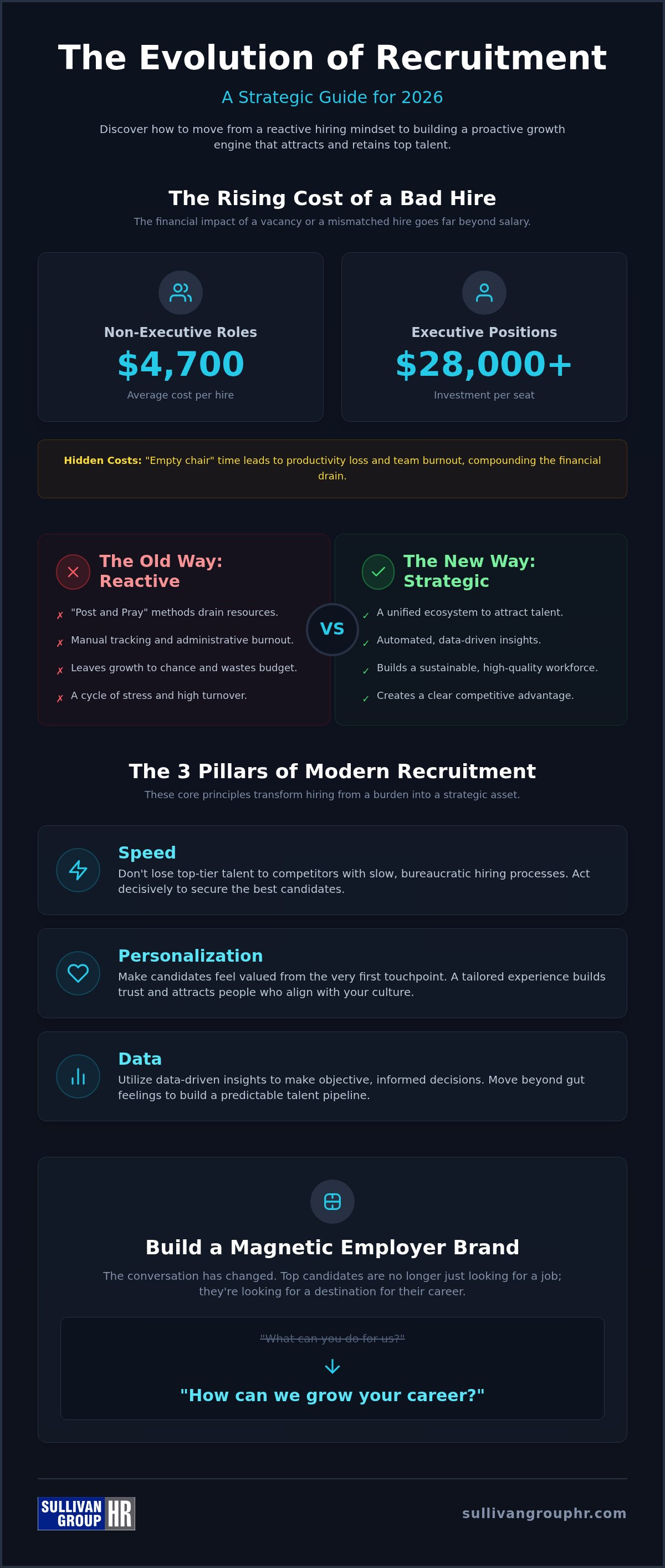
Did you know that the average cost per hire in 2026 has climbed to approximately $4,700 for non-executive roles? For executive positions, that investment can reach $28,000 or more per seat. It is exhausting to watch your time and budget vanish into a pile of unqualified resumes while faster competitors snap up the best talent. You need effective recruitment strategies that move beyond manual tracking and reactive fixes. We believe your hiring process should provide clarity, stability, and connection rather than just filling a vacancy.
We understand the heavy weight of administrative burnout and the high price of a bad hire. You deserve a repeatable system that aligns top talent with your unique company culture. This guide will show you how to transform your recruitment into a strategic growth engine using modern HCM technology and data-driven insights. We will explore how to lower your time-to-hire metrics and bridge the gap between software and strategy. It is time to stop chasing candidates and start building your legacy with the right people by your side.
Key Takeaways
- Stop relying on "post and pray" methods that drain your resources. Learn to build a unified recruitment ecosystem that attracts high-quality candidates consistently.
- Shift your brand focus from what candidates can do for you to how you can grow their careers. A magnetic employer brand is your strongest asset for winning talent.
- Adopt effective recruitment strategies by using an integrated Applicant Tracking System to remove hiring friction. Automate screening and scheduling to free your team for meaningful interviews.
- Follow five actionable steps to audit your candidate journey and implement structured evaluations. These tools ensure every new hire is a perfect match for your company culture.
- Discover how the isolved platform and expert consulting work together to streamline your entire hiring lifecycle. Transform your HR function from a manual burden into a strategic advantage.
What Are Effective Recruitment Strategies in 2026?
In 2026, the labor market doesn't reward those who wait. Effective recruitment strategies are no longer just a series of job postings; they are a unified ecosystem designed to attract and retain the best. The "post and pray" methods of the past are obsolete. They leave your growth to chance and your budget to waste. To win, you must build your approach on three essential pillars: Speed, Personalization, and Data. This isn't just about hiring; it's the foundational first step in your broader Human Capital Management strategy.
When you treat the Recruitment process as a strategic growth engine, the focus shifts. You move from simply filling gaps to building a sustainable workforce. Speed ensures you don't lose talent to competitors. Personalization makes candidates feel valued from day one. Data provides the clarity you need to make objective decisions. This combination transforms a reactive burden into a competitive advantage for your business.
The Cost of a Reactive Hiring Mindset
How much does a vacancy really cost your business? The financial impact of "empty chair" time often exceeds the visible recruitment costs. While you wait, productivity drops and your current employees face burnout from covering extra shifts. Yet, rushing the process is equally dangerous. Research shows the average cost of a bad hire in 2026 is approximately $4,700 for non-executive roles, while an executive misfire can cost $28,000 or more. These numbers represent a direct hit to your bottom line.
Slow hiring processes are the primary reason top-tier talent "ghosts" employers today. High-quality candidates have options and they won't wait for a slow bureaucracy to catch up. You have to ask yourself: Is your current process a bridge to your company's growth or a barrier that keeps talent away? A reactive mindset keeps you in a cycle of stress and high turnover that limits your professional potential.
Predictive vs. Reactive Sourcing
Winning the talent war requires you to see around corners. Workforce planning is the practice of identifying your needs before a vacancy ever occurs. By utilizing data-driven insights, you can establish an "always-on" talent pipeline. This ensures you have a pool of qualified candidates ready to engage the moment a need arises. It turns a frantic search into a calm, organized transition.
This is where expert HR consulting becomes your greatest ally. We help you forecast future labor demands by looking at your growth trajectory and regional market trends. Instead of scrambling to find someone when a key employee leaves, you have a roadmap. This proactive sourcing protects your stability and ensures your team remains strong, capable, and ready for whatever comes next. It's about moving with confidence and precision rather than desperation.
Building a Magnetic Employer Brand and Value Proposition
Have you ever wondered why some companies attract top talent effortlessly while others struggle to get a single click? Your employer brand is not just a logo or a catchy slogan. It is the living reputation of your workplace. In a market where candidates have more choices than ever, your brand serves as your most powerful recruitment tool. It signals safety, opportunity, and belonging. When you lead with your values, you stop being a transactional vendor of jobs and start becoming a destination for careers.
We are seeing a fundamental shift in the hiring dialogue. The old question of "What can you do for us?" is being replaced by "What can we do for your career?" Candidates in 2026 prioritize growth and alignment over a simple paycheck. By integrating your brand values into every touchpoint of the candidate journey, you create a seamless experience that builds trust before the first interview. This is a core component of human resources consulting that helps local businesses compete with national giants.
Your current employees are your best advocates. When they share their stories, they provide the social proof that job seekers crave. This authentic storytelling is one of the most 11 effective recruitment strategies for building long-term credibility. It humanizes your company and moves you away from being just another automated system. People want to work for people; they want to know that their work has meaning and their presence is valued.
Defining Your Employee Value Proposition (EVP)
A strong EVP rests on three pillars: Compensation, Culture, and Career Growth. While "big box" competitors might offer higher volume, they often lack the personalized touch of an established regional expert. You can differentiate by showing how a new hire's individual contribution directly impacts the organization. Imagine telling a candidate: "Join a team where your specialized skills aren't just utilized; they are the foundation for your next five years of professional mastery." That is the kind of clarity that makes a top performer consider a move.
Optimizing Your Digital Footprint
Is your career page a window into your culture or a dusty 2010 template? First impressions are almost entirely digital now. Modern candidates expect transparent communication about benefits, work-life balance, and salary ranges. With new laws in states like Illinois and Minnesota requiring salary transparency starting in January 2026, being open about pay is no longer optional; it's a mark of respect. Using video to showcase your actual workspace or team lunches adds a layer of warmth that text cannot match. It makes the daunting task of applying feel safe, organized, and manageable.
Leveraging Technology: The Role of an Integrated Applicant Tracking System
Does your hiring process feel like a black hole where resumes disappear and communication dies? Many business owners feel overwhelmed by the manual labor of tracking applicants across spreadsheets and emails. In 2026, technology acts as your protective shield against this administrative burden. By implementing an integrated Applicant Tracking System (ATS), you eliminate the "resume black hole" and provide candidates with a clear, professional journey. This is a cornerstone of effective recruitment strategies that value time as much as talent.
Automation doesn't replace the human touch; it preserves it. Using AI for initial screening and scheduling removes the mundane tasks that lead to recruiter burnout. This allows your team to focus on initial engagement and cultural alignment. The "Sullivan Advantage" lies in moving away from fragmented software stacks that don't talk to each other. We provide a unified approach that ensures a seamless transition from Applicant Tracking to Onboarding. When your tech works together, your business moves faster and with more precision.
Why isolved is the Modern Recruiter's Secret Weapon
We provide access to isolved, an industry-leading HCM platform that centralizes every piece of candidate data. This eliminates manual entry errors and ensures your hiring managers have real-time collaboration tools at their fingertips. You can move at the speed of business, making offers before your competitors even finish their first round of reviews. With mobile-first capabilities, you meet candidates exactly where they are. Applications and communication happen on their phones, making the process accessible, human, and modern.
Compliance and Risk Management in Hiring
Safety and results go hand in hand. Our technology ensures EEO and OFCCP compliance is built into your workflow, not added as an afterthought. Standardized, blind screening processes help reduce unconscious bias, ensuring you find the best fit based on demonstrated skills. This technical rigor links your recruitment data directly to broader HR risk management strategies. You gain the security of knowing your hiring practices are legally sound and professionally organized. Deploying effective recruitment strategies means protecting your legacy while you build your future team.
5 Actionable Steps to Implement a Repeatable Recruitment Strategy
Transforming your hiring from a reactive burden into a strategic growth engine requires more than just new software. It requires a deliberate mindset shift. By following these five steps, you can build a system that delivers consistent results and protects your company culture. These effective recruitment strategies are designed to be repeatable, allowing you to scale your team with confidence and clarity. When you have a roadmap, the daunting task of finding talent feels manageable and organized.
Step 1: Audit and Friction Removal
When was the last time you applied for a job at your own company? It is a revealing exercise. If the process feels clunky or repetitive, your best candidates are likely dropping out before they even finish. We recommend the "5-minute rule." A candidate should be able to complete an application from their mobile device in under five minutes. Removing unnecessary hurdles, such as forced account or profile creation before seeing the job details, ensures you don't lose top-tier talent to faster competitors. If your process is a barrier, your growth will be too.
Step 2: Structured Interviewing and Evaluation
Move away from "gut feelings" and toward competency-based scoring. Structured interviews ensure every candidate is evaluated against the same objective criteria. This not only improves the quality of your hires but also protects your business from potential legal pitfalls. Training your hiring managers to ask the right questions is essential for maintaining professional rigor. You can also use pre-employment assessments to validate technical skills before the final interview stage. This technical rigor saves hours of wasted time and ensures a better alignment between new hires and your organizational goals.
Beyond the interview, you must expand your reach and refine your measurement. Consider these additional steps to round out your strategy:
- Tap into the Hidden Workforce: Use specialized sourcing channels and niche industry groups rather than relying solely on generic, high-volume job boards.
- Launch a Referral Program: Your current team understands your culture best. Implement a formal program with meaningful incentives to turn employees into active brand ambassadors.
- Track Key Metrics: You cannot improve what you do not measure. Monitor your time-to-hire, cost-per-hire, and quality-of-hire to identify exactly where your system can be refined for better results.
Building these systems alone can feel like an administrative weight you aren't prepared to carry. If you're ready to modernize your approach and reclaim your time, our human resources consulting team can help you design and deploy a custom recruitment roadmap that fits your specific territory and industry needs.
The Sullivan Group HR Approach: Unifying Talent and Tech
Success in hiring isn't just about the tools you use; it is about the partnership you build. We believe that effective recruitment strategies should be as human as they are high-tech. Sullivan Group HR acts as your coach and ally, handling the administrative heavy lifting so you can focus on your professional potential. By combining the industry-leading isolved platform with our expert HR consulting, we provide a solution that is both powerful and personalized. We don't just hand you a software login; we provide the hard-earned wisdom of an established regional expert who understands your specific territory.
When you unify talent and technology, you close the loop on the entire employee lifecycle. A seamless hiring process leads directly to more accurate Payroll Administration and better long-term retention. It is about creating a steady, reliable beat for your business operations. This transition from talent acquisition to long-term organizational security is what differentiates a thriving company from one that is simply surviving. As you deploy effective recruitment strategies, we help you move with movement, safety, and results.
Your Coach in the Talent War
Why settle for fragmented software when you can have a unified ecosystem? We provide the wisdom of an established expert with the technical tools of a giant. Our team specializes in customizing recruitment workflows to fit your unique business culture. We prioritize clarity, brevity, and impact in every interaction. By focusing on the "Human" in Human Capital Management, we ensure your team feels valued from their first click to their first paycheck. It's a no-nonsense approach that values people over automated processes.
Ready to Scale Your Team?
Are you tired of feeling overwhelmed by administrative burdens? You deserve the peace of mind that comes with a professional, compliant, and automated system. It is time to move from the stress of reactive hiring to the confidence of strategic growth. We are here to protect your legacy and support your success as the primary metric of our own. Let us help you transform your hiring from a burden into a bridge. Discover how our integrated HCM solutions can transform your recruitment and give your business the stability it deserves.
Transform Your Workforce for 2026 and Beyond
Are you ready to move from administrative overwhelm to strategic growth? Winning the talent war in 2026 requires a shift from reactive habits to a unified ecosystem. You've learned that building a magnetic employer brand and leveraging an integrated Applicant Tracking System are the foundations of success. By automating the mundane, you reclaim the time needed to focus on the "human" in Human Capital Management. Implementing effective recruitment strategies isn't just about filling seats; it is about protecting your company's legacy and ensuring long-term stability.
We provide the tools and wisdom you need to succeed. With access to the industry-leading isolved HCM platform and expert HR consulting for national compliance, you gain a partner dedicated to your results. Our all-in-one Applicant Tracking and Onboarding system ensures every new hire experiences a professional, seamless journey from day one. It's time to stop struggling with fragmented software and start building a stronger team with confidence. Scale your business with Sullivan Group HR's unified HCM solutions and secure the future of your organization today. Your potential is our priority.
Frequently Asked Questions
What are the 7 stages of a successful recruitment strategy?
A successful recruitment cycle moves through seven distinct stages: planning, sourcing, screening, interviewing, evaluation, offering, and onboarding. Each stage must be handled with professional rigor to ensure you find and keep the right talent. By treating these stages as a unified ecosystem, you protect your company culture and ensure a high quality of hire. This structured approach transforms hiring from a reactive burden into a strategic growth engine.
How can small businesses compete with larger firms for top talent?
Small businesses win by offering the personalized touch and agility that national giants often lack. Focus on your unique culture, direct access to leadership, and flexible career growth paths. When you highlight your local territory expertise and community-oriented values, you appeal to candidates seeking a relationship rather than just a transaction. It is about positioning your business as a coach and ally in their professional journey.
What is the most effective way to reduce time-to-hire without sacrificing quality?
The most effective way to lower time-to-hire is to automate administrative tasks and use structured interview scoring. By removing the manual burden of scheduling and initial screening, your team can focus on making human connections. This technical rigor allows you to move at the speed of business without compromising your standards. Effective recruitment strategies prioritize speed while maintaining the stability of your hiring process.
Why is an Applicant Tracking System (ATS) necessary for mid-market businesses?
An Applicant Tracking System is essential for mid-market businesses to centralize candidate data and ensure legal compliance. It eliminates the "resume black hole" and prevents manual entry errors that drain your resources. For a growing company, an ATS provides the stability and organization needed to scale without administrative burnout. It ensures your hiring process remains manageable, organized, and ready for the future of your organization.
How do I measure the ROI of my recruitment strategies?
To measure the ROI of your effective recruitment strategies, you must track time-to-hire, cost-per-hire, and quality-of-hire. Compare these metrics against your historical data to see how much you've saved in productivity and reduced turnover costs. Real ROI is found in the long-term success and cultural alignment of your new team members. It's about seeing the client's success as the primary metric of your own.
What is the 'hidden workforce' and how do I recruit from it?
The "hidden workforce" includes millions of potential workers, such as caregivers, retirees, and neurodivergent individuals, who are often overlooked by traditional screening. This also includes veterans who may need specialized advocacy to access their earned benefits; you can discover Military Veteran Solutions, LLC to learn about the resources available to them. Recruit from this pool by using skills-based hiring practices rather than strictly job history. This approach requires a supportive culture and flexible onboarding to unlock their full professional potential and turn an overlooked talent pool into a reliable source of organizational strength.
How does an integrated HCM platform improve the candidate experience?
An integrated HCM platform improves the candidate experience by providing a seamless transition from application to onboarding. It offers mobile-first capabilities that allow candidates to engage with you on their own terms. This transparency and speed build trust, making your organization appear professional, organized, and supportive. When your technology works together, it creates an atmosphere of reliable advocacy that top-tier talent finds deeply reassuring.
What are the biggest recruitment compliance risks for employers in 2026?
The biggest compliance risks in 2026 involve pay transparency and wage history prohibitions. For example, employers in Illinois and Minnesota must provide salary ranges in job postings starting January 1, 2026. Virginia also prohibits seeking wage history as of July 2026. Failing to follow these regional nuances can lead to significant legal exposure. You need a partner who understands these specific nuances to keep your business safe and compliant.


