
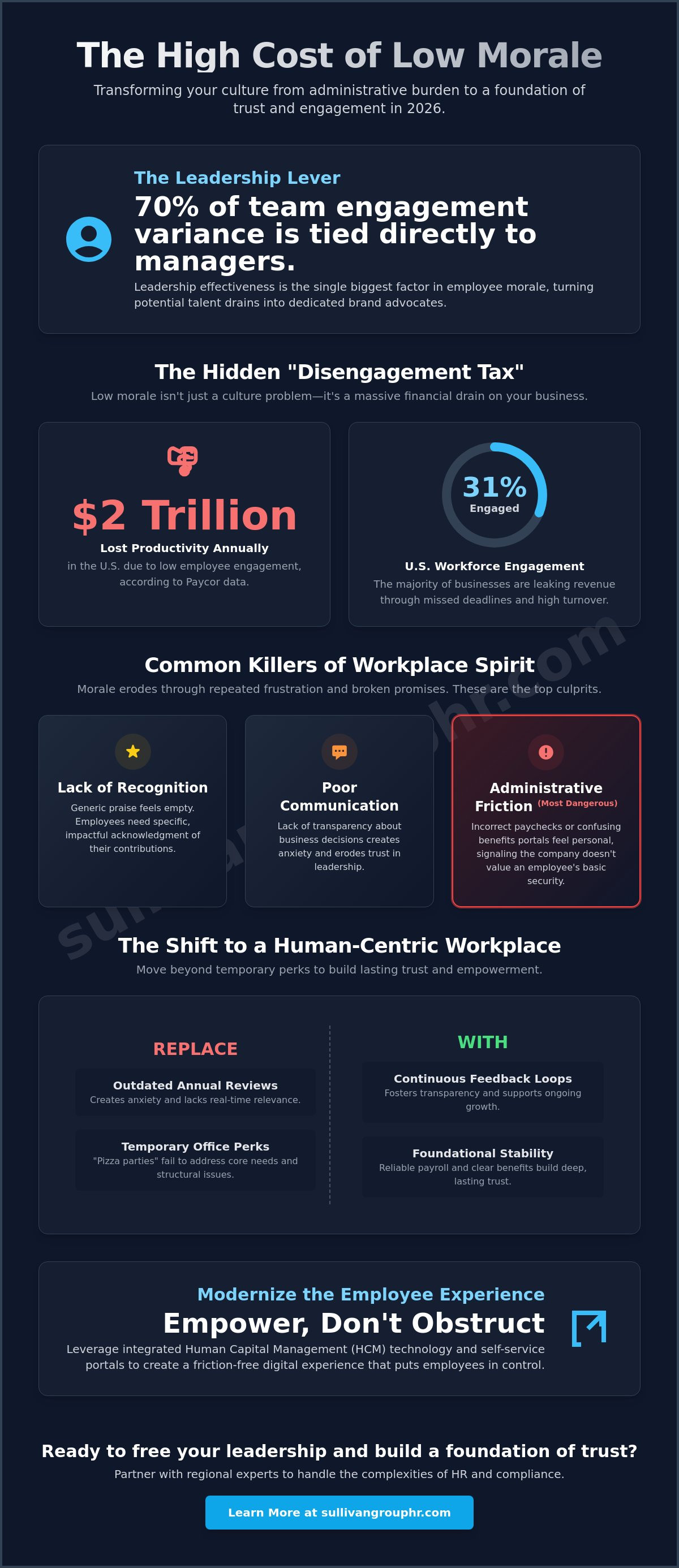
Did you know that managers account for a staggering 70% of the variance in team engagement levels? If your leadership team feels more like productivity police than mentors, it is no surprise that turnover costs are climbing. You are likely searching for effective strategies for improving employee morale to stop the talent drain and reduce the burnout currently weighing down your organization. It is a common frustration, especially when fragmented HR systems create more friction than flow for your employees.
We understand that you want a workplace where people feel valued and empowered. This 2026 guide reveals how to transform your culture by balancing human-centric leadership with powerful human capital management technology. You will discover how to move beyond administrative burdens to build a self-sufficient workforce. We will explore a streamlined approach to talent acquisition, compensation, and organizational security that supports your team instead of hindering them. Let's look at how to create a foundation of trust that keeps your best people right where they belong.
Key Takeaways
- Identify the hidden "Disengagement Tax" and understand how your team's collective confidence directly impacts your organization's bottom line.
- Replace outdated annual reviews with continuous feedback loops that prioritize transparency and reduce employee anxiety.
- Learn why foundational strategies for improving employee morale, such as reliable payroll administration, are more effective than temporary office perks.
- Leverage integrated HCM technology and self-service portals to create a friction-free digital experience that empowers your workforce.
- Free your leadership team from administrative burdens by partnering with regional experts who handle the complexities of HR and compliance.
What is Employee Morale and Why Does it Matter in 2026?
Employee morale isn't a "soft" HR metric; it is the pulse of your entire business. It represents the collective outlook, confidence, and discipline of your workforce. While many view it as a synonym for simple happiness, the Definition of Employee Morale goes much deeper. It touches on the mental and emotional attitude employees hold toward their tasks, their coworkers, and your leadership. In 2026, this outlook has shifted significantly. After years of market volatility and rapid technological change, workers aren't just looking for a paycheck. They prioritize stability, clarity, and an environment where work feels manageable rather than a constant uphill battle.
When engagement falters, your company pays what we call a "Disengagement Tax." According to 2026 data from Paycor, low employee engagement costs U.S. companies approximately $2 trillion in lost productivity every year. With only 31% of the U.S. workforce actively engaged, most businesses are leaking revenue through missed deadlines, poor customer service, and high turnover. Much like how SMG (Strategic Marketing Group) utilizes electorate analysis to understand public sentiment, businesses must honestly assess whether their HR structure is building trust or creating friction. Implementing effective strategies for improving employee morale starts with answering that question honestly.
The Link Between Morale and Retention
High morale transforms your employees into brand advocates. These are the people who recruit for you, protect your reputation, and drive innovation. Conversely, low morale fuels the evolution of "Quiet Quitting," where staff do the bare minimum while actively searching for their next role. You can spot early warning signs in a sudden drop in voluntary collaboration or decreased participation in team discussions. Improving engagement by just 10% can significantly boost your bottom line by drastically reducing the costs associated with recruitment and training.
Common Killers of Workplace Spirit
Workplace spirit rarely vanishes overnight. It erodes through repeated frustration and broken promises. We consistently see three primary killers: lack of recognition, poor communication, and administrative friction. While the first two are often discussed in leadership seminars, administrative friction is the most dangerous because it feels personal. When a paycheck is incorrect or a benefits portal is confusing, it signals that the company doesn't value the employee's basic security. Understanding what is human capital management is essential here, as it provides the structural framework to eliminate these stressors. Your strategies for improving employee morale must address these foundational needs to create a culture of reliable advocacy and long-term success.
Strengthening the Human Connection: Communication and Recognition
If morale is the pulse of your business, then communication is the oxygen. You can't eliminate a "Disengagement Tax" with a simple memo. It requires a fundamental shift toward a 'Transparency First' leadership model. This approach removes the mystery from business decisions and replaces workplace anxiety with a sense of shared purpose. When employees understand the direction of the company, they feel more secure in their roles. This security is one of the most effective strategies for improving employee morale because it builds a foundation of administrative trust.
The Power of Radical Transparency
Sharing the "why" behind business decisions is a powerful way to build executive trust. Whether you're navigating a market shift or implementing new technology, your team deserves to know the strategy. Town halls shouldn't be dry, one-way lectures. Instead, they should be interactive sessions that encourage real participation through live Q&A or anonymous feedback tools. This level of openness shows you respect your team's intelligence and value their input. Clear career pathing is also essential. When people see a future for themselves within your organization, their daily work takes on a new level of meaning. They aren't just completing tasks; they're building a legacy.
Recognition That Resonates
Generic praise often feels like a box-ticking exercise. To truly move the needle, recognition must be specific and impactful. Instead of a vague "good job," highlight exactly how an employee's action saved a client relationship or improved a internal process. You can find many more ideas in this list of 25 Morale-Boosting Strategies. Integrating these moments into your daily workflow via HCM platforms ensures that appreciation becomes a consistent habit rather than a rare event. Peer-to-peer recognition is equally vital. It builds a horizontal support network where team members lift each other up without waiting for a manager's approval.
Managers should aim for meaningful, brief check-ins at least once a week to ensure no one feels invisible or unsupported. These micro-interactions are far more effective than a single, high-pressure annual review. Building these human connections is much easier when your leadership team isn't buried under piles of paperwork. Partnering with a dedicated HR consulting team can help you reclaim the time you need to focus on these vital strategies for improving employee morale. When you prioritize the person over the process, you create a culture where people actually want to stay and grow.
Beyond the Pizza Party: Why Structural Benefits Outperform Perks
Many leaders make the mistake of treating morale as a "fun" deficiency. They try to fix it with ping-pong tables or occasional pizza parties. While these gestures are nice, they don't address the underlying anxieties of the 2026 workforce. Real strategies for improving employee morale focus on structural stability. Employees don't just want snacks; they want to know their families are covered and their futures are secure. This is where the distinction between surface perks and foundational benefits becomes vital for long-term retention.
Foundational benefits like comprehensive health plans and reliable retirement options provide a sense of safety that a breakroom snack never will. One of the most overlooked morale boosters is a seamless, error-free pay cycle. Implementing a robust payroll administration outsourcing strategy ensures that "Paycheck Precision" becomes your company standard. When people are paid accurately and on time, it reinforces administrative trust. It eliminates the financial stress that often leads to burnout and distraction.
How do you know what your team actually values? Don't guess. Use data-driven surveys to ask them directly. You might find that your team values financial wellness programs or mental health support over a gym membership. When you align your benefits with their actual needs, you show them that their voices are heard and their well-being is a priority.
The Hierarchy of Employee Needs
Think of employee needs as a pyramid. At the base is financial and physical security. A one-time bonus provides a temporary spark, but a seamless health insurance experience provides year-round peace of mind. If the basic expectation of being paid correctly isn't met, every other engagement effort will fail. Utilizing professional benefits management solutions helps you build this foundation of long-term security. It moves the conversation from "what have you done for me lately" to "how are we building a future together."
Modern Benefits for a Modern Workforce
You don't need a Fortune 500 budget to offer high-quality benefits. The rise of voluntary benefits allows mid-market companies to offer identity theft protection, pet insurance, and robust mental health programs often at no additional cost to the employer. The key is communication. Many employees don't realize the full value of their compensation package. Providing a Total Rewards Statement clearly outlines the company's investment in their well-being. This clarity is one of the most powerful strategies for improving employee morale because it makes the invisible visible. It proves you are a partner in their success, not just a source of a paycheck.
Modernizing the Employee Experience with Integrated HCM Technology
Think of your HR technology as your digital front door. In 2026, the "Digital Workspace" is where the employee experience actually happens. If your systems are clunky or disconnected, your staff feels frustrated before they even start their first task. Conversely, a streamlined system signals that you value their time and professional ease. Integrated human capital management (HCM) platforms like isolved provide a single source of truth for the entire hire-to-retire lifecycle. This continuity is one of the most effective strategies for improving employee morale because it replaces administrative chaos with reliable, predictable processes.
Beyond simple record-keeping, modern technology allows you to move from reactive to proactive leadership. By leveraging data and analytics, you can spot the warning signs of burnout before a resignation letter hits your desk. Are people skipping their scheduled time off? Is overtime suddenly spiking in a specific department? These insights allow you to step in as a supportive coach, offering help exactly when it is needed. Using data to protect your team is a hallmark of a leader who values people over mere systems.
Empowerment Through Self-Service
Employees in 2026 expect the same level of convenience at work that they have in their personal lives. They don't want to wait for an HR representative to email a tax form or confirm a PTO balance. Mobile-first self-service portals empower your workforce to manage their own information instantly. This shift reduces "HR Bottlenecks" and allows your team to feel more in control of their professional lives. You can explore how these workforce management solutions balance high-tech efficiency with a human-centric touch to keep your operations running smoothly.
Seamless Onboarding as a First Impression
Morale starts on "Day Zero" during the recruitment phase. A professional applicant tracking and onboarding process sets the tone for a long-term relationship. When a new hire can complete their paperwork digitally and arrive on their first day ready to meet the team, you eliminate the "New Hire Anxiety" that often plagues the first week of employment. A unified HCM platform ensures that the transition from candidate to contributor is frictionless and welcoming. It proves that your organization is organized, stable, and ready to invest in their success.
Ready to see how the right technology can transform your workplace culture? Discover the Sullivan Advantage and learn how our integrated HCM solutions can help you build a more engaged and self-sufficient workforce.
Reclaiming Your Leadership Focus with Sullivan Group HR
How can you expect to inspire your team if you are drowning in tax filings and workers' compensation claims? You simply can't. Building a culture of trust and high performance requires your presence, your empathy, and your strategic vision. When you are buried in the bureaucratic side of business, the people side inevitably suffers. This is where the most effective strategies for improving employee morale begin: by clearing the path for leadership to actually lead. Recruit with confidence. Pay with precision. Protect with expertise.
The Sullivan Advantage combines professional rigor with the power of the isolved platform. We take the administrative weight off your shoulders, handling the complex professional functions that often lead to manager burnout. By outsourcing your payroll and compliance, you reclaim the hours needed to focus on mentorship and team development. You move away from being a "policer" of productivity and become a true advocate for your staff. This shift allows you to focus on the human element of your business while we handle the systems that support it.
Security is the bedrock of morale. Our approach to HR risk management ensures your business stays protected against shifting regulations and evolving compliance needs. This peace of mind allows you to operate with confidence, knowing that the foundational elements of your organization are managed by experts who understand the nuances of the local territory. When the "structural" problems are solved, you are free to solve the "cultural" ones.
A Partnership for Growth
We don't view ourselves as just another vendor. Sullivan Group HR acts as a coach and ally in your journey toward a more engaged workforce. We help you transition from transactional, "check-the-box" HR to a strategic human capital management model. This shift is essential for long-term organizational security. Having a no-nonsense authority handle your administrative burden means you can stop worrying about the "how" of HR and start focusing on the "who." We prioritize interpersonal value over automated processes, ensuring your team feels seen and supported.
Next Steps for Your Team
Where do you start? We recommend conducting a thorough "Morale Audit" of your current HR processes. Look for the friction points we have discussed throughout this guide. Are your benefits packages actually meeting the needs of your 2026 workforce? Does your technology empower employees or frustrate them? Is your leadership team free to focus on connection rather than compliance? The right partner makes these daunting tasks feel manageable and organized. You don't have to navigate these changes alone. It is time to implement real strategies for improving employee morale by focusing on what matters most: your people. Partner with Sullivan Group HR to elevate your workforce today.
Build a Culture of Administrative Trust
Are you ready to stop policing productivity and start leading your people? We have explored how the most effective strategies for improving employee morale are rooted in structural stability and administrative trust. By moving beyond surface-level perks and investing in reliable benefits, precise payroll, and integrated technology, you create a foundation where your team can truly thrive. You deserve a partner who understands the local landscape and provides the security your business needs to grow.
Sullivan Group HR offers decades of professional HR consulting expertise to help you navigate these complexities. We provide access to the industry-leading isolved HCM platform and handle comprehensive payroll and benefits management so you don't have to. Ready to transform your workplace culture? Let Sullivan Group HR handle the heavy lifting.
Your workforce is your greatest asset. When you prioritize their security and ease of work, you aren't just improving morale; you are securing the future of your company. It is time to reclaim your focus and lead with confidence. Let's build something lasting together.
Frequently Asked Questions
What are the most effective strategies for improving employee morale on a budget?
Focus on non-monetary recognition and radical transparency. Start by implementing regular, specific feedback loops and celebrating small wins. These strategies for improving employee morale don't cost a dime but build immense trust. When you share the "why" behind business decisions, you reduce workplace anxiety. This creates a sense of shared purpose that is far more valuable than a one-time bonus or a temporary perk.
How can I measure employee morale accurately in 2026?
Move away from annual surveys and use continuous feedback models like pulse surveys. Modern HCM platforms provide real-time data on employee sentiment and engagement levels. You can also track behavioral indicators like voluntary participation and absenteeism rates. These metrics offer a clearer picture of your team's collective confidence. By reviewing this data monthly, you can address stressors before they lead to costly turnover or burnout.
Does remote work improve or hurt employee morale?
Remote work is a double-edged sword that depends entirely on your communication structure. For many, the flexibility improves work-life balance and individual outlook. However, without intentional connection, it can lead to feelings of isolation. The key is using integrated technology to maintain a "Digital Workspace." When remote staff have the same access to recognition and support as in-office teams, morale remains high and consistent across the board.
What is the role of leadership in boosting team spirit?
Leadership is the primary driver of team spirit because managers account for 70% of the variance in engagement. Your role is to act as a coach and ally rather than a productivity policeman. By modeling transparency and offering consistent support, you set the tone for the entire organization. When leaders prioritize interpersonal value over automated processes, employees feel safe, respected, and motivated to perform at their best.
How do I fix low morale in a toxic workplace environment?
Fixing a toxic environment requires identifying the root cause, which is often administrative friction or poor leadership. Start by conducting a "Morale Audit" to find where trust has broken down. You must address these structural issues immediately, whether they involve incorrect pay or lack of communication. Partnering with an HR consulting expert can provide the objective, no-nonsense authority needed to reset your culture and rebuild organizational security.
Can a new HR platform really improve employee engagement?
Yes, a unified HR platform like isolved directly improves engagement by removing daily frustrations. When employees can manage their own PTO, benefits, and tax forms through a mobile app, they feel empowered. This reduction in administrative friction signals that you value their time and professional ease. Technology isn't just a tool; it's the digital environment where your team's morale is either won or lost every single day.
What is the difference between employee morale and employee engagement?
Morale is the collective outlook and mental attitude of your workforce, while engagement is the resulting action and level of effort. Think of morale as "how they feel" and engagement as "how they work." High morale is the foundation that makes high engagement possible. Effective strategies for improving employee morale focus on building confidence and trust, which naturally leads to a more productive and committed team.
How often should I implement new morale-boosting initiatives?
Consistency is far more important than the frequency of new initiatives. Rather than launching a new program every month, focus on maintaining a steady beat of recognition and feedback. Your team needs to know that support is a permanent part of your culture, not a temporary trend. Aim to integrate small, meaningful check-ins weekly and review your broader benefits strategy annually to ensure it still aligns with your employees' actual needs.


