
Why should your hard-earned capital sit in an insurance carrier's bank account instead of your own? For many small business owners, traditional insurance feels like a guessing game that ends in a frustrating year-end audit. You're often forced to pay massive upfront deposits based on payroll estimates, only to face "audit shock" when those numbers don't align. It's an exhausting cycle that drains your cash flow and adds unnecessary administrative weight to your daily operations.
We believe your insurance should work for you, not against you. In this guide, you'll learn how to secure comprehensive protection that keeps you compliant while keeping your capital liquid. By utilizing pay as you go workers comp, you can sync your premiums with your actual payroll, eliminating the need for large down payments. We'll walk through the 2026 regulatory shifts, clarify complex classification codes, and show you how a modern approach helps you protect, manage, and grow your business. It's time to move beyond automated systems and embrace a strategy that values your people as much as your profits.
Key Takeaways
- Understand the "grand bargain" of insurance that provides medical support for your team while securing legal immunity for your business.
- Discover how pay as you go workers comp eliminates large upfront deposits and audit surprises by syncing premiums with real-time payroll data.
- Learn to identify the four pillars of coverage and how maintaining accurate NCCI classification codes prevents costly billing errors.
- Master your "Experience Modifier" (MOD rate) to proactively lower your insurance costs through smarter workplace risk management.
- Explore how unifying payroll, HR, and insurance within the isolved platform removes administrative silos and protects your company's growth.
Why Workers’ Comp Insurance is the Foundation of Small Business Protection
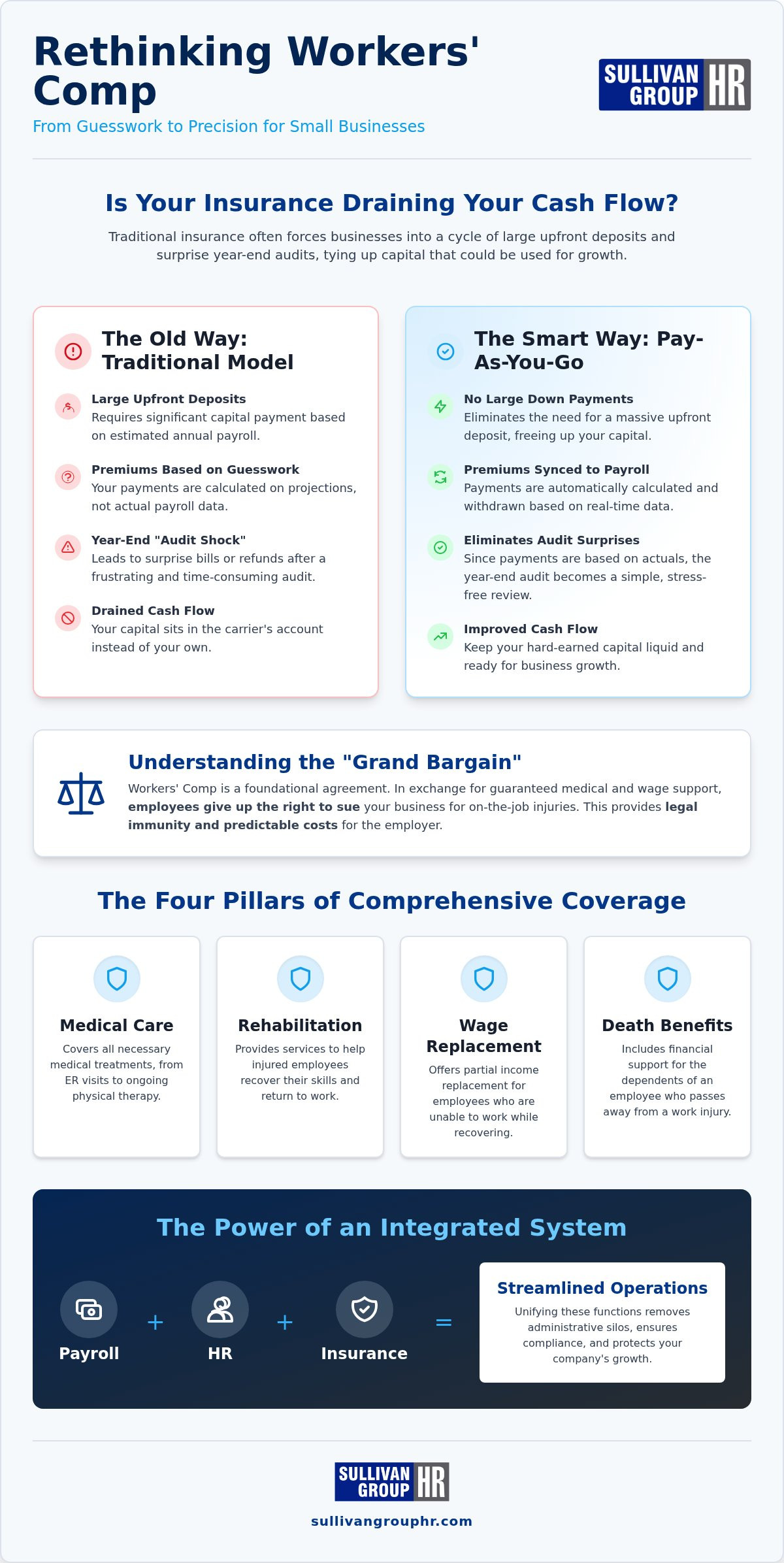
Have you ever wondered why workers' compensation is often called the "grand bargain"? It's a century-old agreement that balances the scales between labor and leadership. Employees give up their right to sue for negligence. In exchange, they receive guaranteed medical care and wage replacement if they're hurt on the job. For the business owner, this means predictable costs and a shield against ruinous lawsuits. Understanding What is Workers’ Comp Insurance? is the first step toward building a resilient organization. It's not just a line item on your budget; it's the safety net that allows your team to work with confidence.
This protection is almost universal across the United States. If you have employees, you likely have a legal obligation to provide coverage. Even in low-risk environments like professional offices or creative studios, accidents happen. A simple trip over a computer cord or a repetitive motion injury can lead to thousands in medical bills. Without a policy, those costs come directly out of your pocket. Modern solutions like pay as you go workers comp make this necessity easier to manage by aligning your payments with your actual payroll cycles rather than relying on broad estimates.
Understanding the Legal Mandate
In most states, the requirement to carry insurance triggers the moment you hire your first employee. Non-compliance is a gamble you can't afford to take. State agencies frequently issue stop-work orders or heavy daily fines to businesses operating without coverage. These penalties often exceed the cost of the insurance itself. Proper HR risk management starts with this foundational compliance. It ensures your business stays open, your reputation remains intact, and your legal standing is secure. We help you handle the paperwork so you can stay focused on your team.
Protecting Your Business from Civil Litigation
The most powerful benefit for an owner is the "exclusive remedy" rule. This legal principle prevents injured workers from suing you for damages in civil court in most scenarios. Your policy doesn't just pay for doctors; it pays for your legal defense if a claim is contested. This creates a stable environment where you can focus on your mission. We look at this through a simple lens: Protect, Manage, and Grow. By securing a pay as you go workers comp plan, you protect your assets from litigation while managing your cash flow with precision. This stability provides the peace of mind you need to grow your enterprise without the fear of a single accident causing a financial collapse.
Navigating Coverage: What Workers’ Comp Does (and Doesn’t) Protect
What exactly happens when a team member gets hurt? It's more than just a doctor's visit. A comprehensive policy stands on four pillars: medical care, rehabilitation services, wage replacement, and death benefits. This structure ensures that both the employee's health and the family's financial stability remain intact. While traditional policies often require high upfront costs to secure these benefits, many owners now opt for pay-as-you-go workers' comp to keep their cash flow flexible while maintaining this vital safety net. Utilizing pay as you go workers comp ensures you aren't overpaying for this essential protection while your team stays covered.
For a claim to be valid, it must meet the "Arising Out Of and In the Course of Employment" (AOE/COE) standard. This simply means the injury happened while the employee was performing their professional duties. Common small business claims often involve:
- Slips and falls on wet or uneven surfaces.
- Strains from lifting heavy inventory or equipment.
- Repetitive motion injuries, such as carpal tunnel syndrome.
It's vital to note that coverage has specific limits. Injuries sustained during a typical daily commute or while an employee is intoxicated are generally excluded from benefits. By understanding these boundaries, you can better manage expectations and maintain a safer workplace.
Essential Employee Benefits and Recovery
Medical coverage is the most immediate benefit. It handles everything from the initial ER visit to long-term physical therapy. If the injury prevents work, the policy provides disability payments. Temporary disability helps while they heal, while permanent disability offers long-term support if they can't fully recover. Vocational rehabilitation also plays a key role. It provides the training or support needed to help employees find new ways to be productive. This holistic approach focuses on the person, not just the claim, helping them return to their professional potential.
The Anatomy of a Workers' Comp Claim
The first 24 hours after an incident are critical. Prompt reporting is the best way to control costs and ensure better medical outcomes for your staff. When you report an injury immediately, you show your team that you value their safety over systems. It also allows the insurance carrier to start the recovery process right away. A strong "Return to Work" program is your best tool for lowering long-term premiums. By offering light-duty tasks, you keep employees engaged and reduce the duration of wage replacement payments. Managing these moving parts doesn't have to be a solo effort. Our team provides the integrated workers' compensation insurance support you need to handle claims with confidence.
Pay-As-You-Go vs. Traditional Workers’ Comp: Which Fits Your Cash Flow?
Why should your hard-earned capital sit idle in an insurance carrier's bank account? For many entrepreneurs, the choice between traditional insurance and modern billing models is the difference between a strained budget and a healthy one. Traditional policies rely on guesswork, while pay as you go workers comp relies on reality. If you want to protect your people, manage your costs, and grow your bottom line, you need a payment structure that mirrors your actual business activity. This real-time approach ensures you're never paying for "ghost" employees or estimated payroll that hasn't happened yet.
The Traditional Down Payment Trap
Traditional insurance models are built on estimates. At the start of your policy year, you guess what your total payroll will be. The carrier then typically demands an upfront deposit, often ranging from 15% to 25% of the total estimated annual premium. This ties up significant cash that could be better spent on inventory, marketing, or new equipment. It forces you into a state of "over-insurance" where you're paying for coverage you haven't used yet.
The real pain arrives during the year-end audit. If your business grew faster than expected, you'll face "audit shock." This is the dreaded "big check" you must write to cover the gap between your initial estimate and your actual payroll. Conversely, if your payroll was lower than expected, you've essentially given the insurance company an interest-free loan for twelve months. Both scenarios hurt your business agility and make financial planning a nightmare.
The Accuracy of Pay-As-You-Go Billing
Choosing pay as you go workers comp eliminates the guesswork entirely. Instead of one massive upfront payment, your premiums are calculated and collected based on your actual payroll runs. If you have a slow month with fewer hours worked, your premium drops. If you hire a new team during a growth spurt, your premium adjusts automatically to keep you compliant. This model is a game-changer for seasonal businesses or rapidly growing startups that need to keep their cash flow liquid.
Precision is the primary benefit here. Because the billing is tied to real-time data, the year-end audit becomes a simple verification of facts rather than a source of financial stress. There are no surprise bills and no large deposits. To make this work seamlessly, many owners look toward payroll administration outsourcing. By connecting your payroll system directly to the insurance carrier, the data flows automatically, ensuring your premiums are always accurate down to the cent. It's a no-nonsense way to handle a complex administrative task while keeping your focus on your professional potential.
Reducing Premiums: Proactive Risk Management and Classification Accuracy
How can you take the driver's seat when it comes to your insurance costs? Many business owners assume premiums are fixed, but they're actually quite flexible based on your actions. The most significant lever you have is your Experience Modifier, or MOD rate. This number acts as a multiplier for your base premium. A safe workplace leads to a lower MOD rate, which leads to lower costs. This proactive approach is exactly what human capital management means in a modern context. It's about protecting your bottom line by protecting your people. When you combine safety initiatives with pay as you go workers comp, you gain ultimate control over your monthly expenses.
Mastering Employee Classification Codes
One of the most common ways small businesses overpay is through incorrect NCCI classification codes. These codes describe the type of work your employees perform. For example, a clerical worker has a much lower risk profile than someone working in the field or on a construction site. If your office manager is accidentally coded as a field technician, you're paying significantly more than necessary. Errors often occur during rapid hiring or when roles shift over time. A professional HR partner can audit these codes to ensure every dollar is spent accurately. This level of precision is especially important when using pay as you go workers comp. It ensures your real-time payments are based on the correct risk levels from the start.
Implementing a Safety-First Culture
Lowering your premiums isn't just about math. It's about culture. A safety-first environment is the best long-term investment you can make. Simple steps like regular safety training, clear hazard signage, and ergonomic workstation checks can prevent the slips and strains that drive up claims. You should use your employee handbook to set these expectations from day one. Additionally, many states offer premium discounts for certified "Drug-Free Workplace" programs. These initiatives provide a safer environment and a direct reduction in your insurance bill. By prioritizing safety, you protect your team, manage your risks, and grow your profitability. If you're ready to audit your current codes and cut unnecessary costs, contact our workers' comp specialists for a policy review.
Why Integrated HR Outsourcing is the Smartest Way to Manage Workers' Comp
Are you tired of playing messenger between your insurance agent, your payroll provider, and your HR manager? This is the "silo problem." Information gets lost. Deadlines get missed. Errors occur. When these critical functions don't talk to each other, your business bears the administrative burden. We believe there's a better way to protect your legacy. By unifying these functions into a single partnership, Sullivan Group HR removes the static. You get one point of contact for claims, billing, and compliance. This isn't just about efficiency; it's about choosing people over systems.
One contact. One platform. One goal. This integrated approach ensures that your risk management strategy isn't just a policy sitting in a drawer. It becomes a living part of your business operations. When your HR partner understands your payroll data and your safety culture, they can provide advocacy that a sterile, automated insurance portal simply can't match. It's the difference between being a policy number and being a partner.
The Power of Payroll Integration
The real magic happens when your payroll and insurance become one. In a traditional setup, you're constantly entering data twice. With an integrated pay as you go workers comp solution, that manual labor disappears. The data flows automatically from your payroll run to the insurance carrier. This creates a "set it and forget it" environment for busy entrepreneurs. You can stop worrying about administrative minutiae and start focusing on your team's professional potential. It reduces the weight on your internal staff and ensures your compliance is always current. You pay for exactly what you use, when you use it, without lifting a finger.
Leveraging the isolved HCM Platform
We provide access to the isolved HCM platform, which serves as your "single source of truth" for all employee data. This isn't just a payroll tool. It's a comprehensive hub where you track time, attendance, and even safety training progress in one place. Why does this matter for workers' comp? Because when an audit or a claim occurs, all your documentation is already organized. You aren't hunting for training logs or timesheets; they're already linked to the employee record.
Beyond the technology, you have the backing of professional HR consulting. We've been helping businesses navigate these complexities since 1998. Our experts help you navigate complex claims, interpret changing regulations, and prepare for audits with confidence. We handle the paperwork, defend your interests, and help you scale. It's the ultimate way to Protect, Manage, and Grow your organization. When you combine the precision of pay as you go workers comp with the power of isolved, you're not just buying insurance. You're investing in a foundation for long term security.
Protect Your Future with Smarter Risk Management
Securing your company's legacy shouldn't feel like a bureaucratic burden. By moving away from the "estimated premium" trap, you regain control over your capital and your time. You've seen how pay as you go workers comp aligns your insurance costs with your actual payroll cycles, eliminating audit shock and heavy upfront deposits. When you combine this precision with accurate employee classification and a safety-first culture, you don't just stay compliant; you build a more resilient organization.
Managing these moving parts is easier when you have a partner who understands the nuances of national risk management. We provide the tools and expertise you need to protect your people and your profits. With access to the industry-leading isolved HCM platform, you can enjoy comprehensive HR, payroll, and benefits integration that simplifies every administrative task. It's time to stop guessing and start growing.
Protect your business and streamline your payroll with Sullivan Group HR. We're here to help you navigate the complexities of 2026 and beyond. You have the professional potential to reach new heights, and we have the stability to support your journey every step of the way.
Frequently Asked Questions
Is workers' comp insurance mandatory for a small business with only one employee?
Yes, in almost every state, coverage is required the moment you hire your first employee. Whether they are part-time, temporary, or a full-time hire, the law typically mandates protection to ensure medical care and wage support are available. Failing to comply can lead to severe daily fines or stop-work orders that threaten your organizational security. Protecting your first hire is the first step toward protecting your entire legacy.
How much does workers' comp insurance typically cost for a small business?
Costs depend on your specific industry, total payroll, and state-mandated rates. High-risk fields like construction naturally pay more than professional services. While national averages exist, your specific premium is calculated based on your classification codes. Choosing a pay as you go workers comp model helps you manage these costs by billing you based on actual payroll rather than broad annual estimates. This ensures you never overpay for protection.
Does workers' comp cover the business owner or just the employees?
Coverage for business owners is often optional depending on your legal structure and state regulations. Sole proprietors and partners frequently exclude themselves to save on costs, while corporations may require officers to be covered. It's a strategic decision that balances personal protection with your business budget. We can help you evaluate your specific situation to ensure your leadership team is secure without overextending your financial resources.
What happens if an employee is at fault for their own workplace injury?
Workers' compensation is a no-fault system, meaning benefits are paid regardless of who caused the accident. As long as the injury occurred within the course of employment, the employee is protected. This "grand bargain" prevents expensive litigation over negligence and ensures the worker receives immediate care. However, exceptions exist for injuries caused by willful misconduct, intoxication, or intentional self-harm. It is a system built on protection, not blame.
Can I get workers' comp insurance if I use independent contractors instead of employees?
Traditional policies don't cover independent contractors, but you must be wary of misclassification risks. If a state agency determines your contractors are actually employees based on your level of control, you could face back-premiums and heavy penalties. Many businesses require contractors to carry their own coverage to mitigate this risk. We recommend auditing your worker relationships to maintain compliance and protect your professional potential from unforeseen legal challenges.
How does a pay-as-you-go policy help with my business cash flow?
A pay as you go workers comp policy improves cash flow by eliminating the large upfront deposit required by traditional plans. Instead of tying up significant capital in an estimated annual premium, you pay in small increments alongside your payroll. This real-time billing ensures your capital stays in your business where it can fuel growth. It's a no-nonsense approach to managing one of your most important administrative functions.
What should I do immediately after an employee gets injured on the job?
Your first priority is ensuring the employee receives medical attention. Once they are safe, you must document the incident and report the claim to your carrier immediately. Prompt reporting reduces the total cost of the claim and speeds up the recovery process. Maintaining a clear response plan in your employee handbook ensures your team feels supported during a crisis. This immediate advocacy fosters a sense of security for your entire workforce.
How do I lower my workers' comp premiums over the long term?
You can lower your premiums by focusing on safety training, accurate classification, and managing your Experience Modifier. A clean safety record over time signals to carriers that you are a low-risk partner. Implementing a drug-free workplace program and conducting regular ergonomic checks are proactive steps that lead to lasting results. Protect your people, manage your risks, and grow your profitability. Consistency in safety is the surest path to financial stability.


