

Did you know that 90% of companies missed their hiring goals last year while the time-to-hire for critical roles continued to stretch? It's a frustrating reality that leaves many business leaders feeling like they're running in place. You shouldn't have to settle for a revolving door of candidates or disconnected systems that make data analysis impossible. To win in 2026, you need a modern talent management strategy that treats your people as your greatest asset rather than just another line item on a balance sheet.
We understand the weight of managing high turnover and the complexity of shifting AI regulations. You want a stable team, lower recruitment costs, and a clear ROI on every HR investment. This guide provides the roadmap to transform your workforce from a payroll expense into a strategic growth engine. We'll explore how to leverage the isolved HCM platform to simplify operations, bridge the gap between software and strategy, and foster a culture where high-performing employees choose to stay. It's time to stop acting like a vendor to your staff and start acting like the partner they deserve.
Key Takeaways
- Shift your perspective to see your team as a strategic growth engine rather than a recurring administrative burden.
- Implement a comprehensive talent management strategy that secures top-tier talent and fosters long-term internal mobility.
- Replace disconnected "Franken-software" with an integrated system to gain the data visibility required for smarter decision-making.
- Follow a structured five-step blueprint to bridge the gap between the skills you have and the skills you need for future growth.
- Leverage expert HR consulting to turn complex technology into a personalized roadmap for organizational security and success.
What is a Talent Management Strategy in 2026?
Is your workforce a line item on a spreadsheet or the engine driving your revenue? For many business owners, employees feel like an administrative burden. They're a source of payroll taxes, compliance risks, and turnover headaches. But in 2026, the most successful organizations have flipped this script. They use a comprehensive talent management strategy to turn potential into performance.
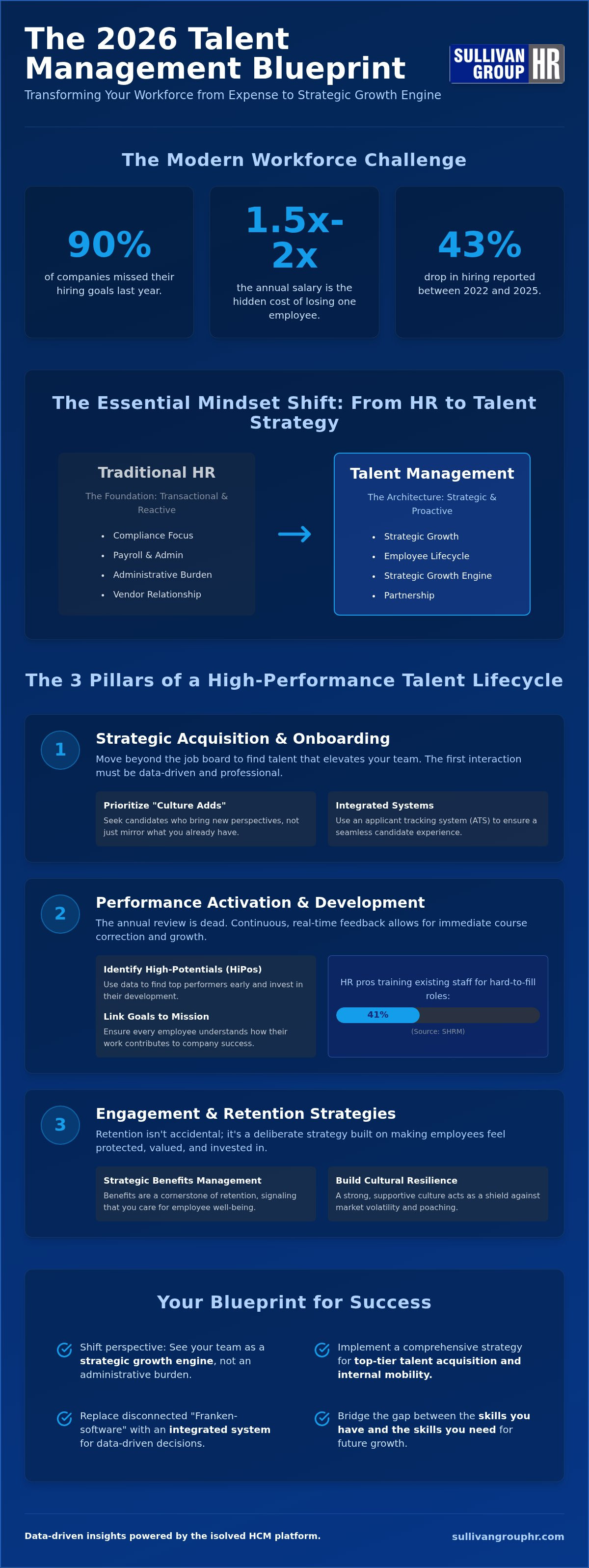
Talent management isn't a one-time hiring event. It's a continuous, strategic process of attracting, developing, and retaining high-potential people. While 90% of companies missed their hiring goals last year and McKinsey reported a 43% drop in hiring between 2022 and 2025, those with an agile, data-driven approach found ways to fill the gaps. The 2026 labor market moves too fast for slow, reactive habits. You need a framework that anticipates needs rather than just reacting to resignations.
Talent Management vs. Traditional HR
Think of traditional HR as the foundation of your house. It handles the "must-haves": compliance, payroll, and daily administration. It's essential, but it's transactional. Talent management is the architecture that makes the house a home. It focuses on the long-term lifecycle and the employee experience.
Sullivan Group HR helps you bridge this gap. We provide the no-nonsense authority of an established expert to handle your payroll administration while coaching you on how to develop your staff. When these two functions work in tandem, your business gains organizational health. You don't just stay compliant; you stay competitive. It's about moving from a vendor-client relationship to a long-term partnership.
The ROI of a People-First Strategy
Why invest the time? The numbers tell a clear story. The cost of losing a single employee often reaches 1.5x to 2x their annual salary. When you factor in recruitment fees, lost productivity, and training time, turnover is a silent profit killer. A people-first talent management strategy protects your bottom line in three key ways:
- Reduced Costs: Lower turnover means you spend less on constant recruitment and onboarding.
- Higher Productivity: Better alignment between skills and roles ensures your team works at peak efficiency.
- Cultural Resilience: A strong culture acts as a shield against market volatility.
By using the isolved HCM platform, you get the data visibility needed to see exactly where your investments are paying off. You can track performance, identify skills gaps, and make strategic decisions that lead to a stable, high-performing team. This data allows you to act as a partner to your employees, helping them grow alongside the company.
The Three Pillars of a High-Performance Talent Lifecycle
How do you ensure no employee is left behind? A lifecycle approach treats the journey from "hire to retire" as a single, cohesive experience. It's the difference between a collection of disconnected HR tasks and a truly integrated talent management strategy. By viewing the employee journey through three distinct pillars, you can build a more resilient and productive organization.
Strategic Acquisition and Onboarding
Pillar 1 focuses on Strategic Acquisition. Finding a "warm body" is a short-term fix that leads to long-term turnover. Today, you need to move beyond the job board. Utilizing an applicant tracking and onboarding system allows you to identify "culture adds," which are people who bring new perspectives, rather than just "culture fits" who mirror what you already have. This integrated approach ensures that your very first interaction with a candidate is data-driven and professional.
Performance Activation and Development
Continuous Development represents the second pillar. The annual review is dead. In 2026, real-time feedback wins because it allows for immediate course correction. Use data from your isolved HCM platform to identify High-Potential employees (HiPos) early. According to SHRM, 41% of HR professionals are now training existing employees for hard-to-fill roles. For insurance agencies, this often involves utilizing specialized resources like IICS to develop elite producers through their Sales Academy. Linking individual goals to your broader mission ensures everyone knows how their work moves the needle and contributes to the company's success.
Purposeful Retention is the final pillar. Retention isn't accidental; it's a deliberate choice. A major part of this is strategic benefits management. When employees feel protected and valued, they're less likely to look elsewhere. Empowerment also plays a role. Employee self-service portals give your team control over their data, reducing administrative friction. If someone does leave, use exit interviews as a diagnostic tool to refine your talent management strategy for the future.
Sullivan Group HR acts as your coach throughout this entire cycle. Our human resources consulting services help you bridge the gap between having the right tools and knowing how to use them effectively to protect your business and grow your team.
Bridging the Gap: Why Integrated Technology is Non-Negotiable
Does your HR tech talk to itself, or are you living in spreadsheet hell? Many business owners find themselves trapped by "Franken-software," a patchwork of disconnected systems for payroll, time keeping, and hiring that refuse to share information. This fragmentation is the primary enemy of a successful talent management strategy. When your systems are siloed, your data becomes unreliable, making it nearly impossible to see how your investments in people actually impact your bottom line.
A unified human capital management platform creates "one version of the truth" for your entire organization. It provides the visibility required to see the direct connection between training, performance, and payroll. When an employee completes a new certification, that milestone should automatically trigger a performance update or a compensation review without manual intervention. Without this level of integration, your strategy is based on guesswork rather than growth.
The Power of the isolved Platform
Sullivan Group HR provides access to the industry-leading isolved platform to centralize your entire employee lifecycle. By housing applicant tracking, time keeping, and performance metrics in one secure place, you eliminate the need for repetitive data entry. This significantly reduces the administrative burden on your team. Instead of chasing down missing timecards or managing lost resumes, your HR professionals can focus on coaching and high-level strategy. Real-time reporting allows for proactive management; you see the bottlenecks in your pipeline before they stop your progress.
Data-Driven Decision Making
In 2026, managing by "gut feeling" is a luxury you can't afford. Recent data shows that 60% of organizations saw their time-to-hire increase last year, a trend that can cripple a growing company. To combat this, many leaders are turning to specialized hiring platforms like saasnine.com to access pre-qualified talent and accelerate the recruitment process. Integrated technology helps you identify these turnover trends before they become a full-blown crisis. You can measure the effectiveness of your training programs by comparing performance metrics before and after the intervention. Workforce analytics serve as the GPS for your talent management strategy, providing the real-time coordinates you need to reach your organizational goals.
Building a world-class team doesn't happen by accident. It requires a deliberate, step-by-step process that aligns your human potential with your financial goals. This is your organizational talent blueprint. By following a structured approach, you move away from reactive "firefighting" and toward a proactive talent management strategy that secures your company's future.
Aligning Vision with People
If your business grows by 20% over the next three years, do you have the leadership to handle it? This is the fundamental question of Step 1. You must align your talent goals with your business objectives. Start by defining the specific behaviors that drive your success today. Once you know what excellence looks like, you can move to Step 2: conducting a gap analysis. This process identifies the skills you have versus the skills you need to reach that three-year milestone. Creating a succession plan for every critical role ensures your legacy remains secure regardless of market shifts or unexpected departures.
Empowering Managers as Talent Coaches
Step 3 involves deploying a unified HCM platform to provide the data visibility your team needs. However, the best software in the world can't replace human leadership. Managers don't leave companies; they leave managers. To flip the script, Step 4 requires you to empower your supervisors as talent coaches. Give your supervisors the tools to recognize and reward performance instantly. This standardizes the employee experience across different departments; ensuring every team member feels the same level of advocacy and support. When managers are trained to lead with empathy and rigor, they become the primary drivers of your talent management strategy.
Finally, Step 5 is to measure, refine, and repeat. Nearly 42% of HR professionals reported difficulty retaining full-time employees over the last year according to SHRM. You must use KPIs like time-to-productivity and internal mobility rates to track your success. If the data shows a bottleneck, adjust your approach. Sullivan Group HR acts as your coach and ally, providing the professional rigor you need to navigate these steps with confidence. Our experts help you bridge the gap between administrative tasks and high-level growth.
Ready to transform your workforce? Contact Sullivan Group HR today to start building your custom talent blueprint.
Partnering for Potential: How Sullivan Group HR Elevates Your Strategy
You don't have to navigate the complex world of HR alone. While the tools we've discussed are powerful, they are most effective when guided by a steady hand. Sullivan Group HR combines the industry-leading isolved platform with a personalized, coaching approach. We move beyond the role of a transactional service provider to become a strategic partner in your long-term growth. Our goal is to help you leverage your talent management strategy to its full potential, ensuring your organization remains secure and agile.
We believe in the power of human partnership. In an era dominated by automated, tech-only competitors, we stand out by prioritizing interpersonal value. You aren't just a client; you're a collaborator. We provide the professional rigor of a national firm with the warmth and accessibility of a dedicated ally. This relationship-first model ensures that your administrative burdens are managed with care, leaving you free to focus on your team's professional potential.
Beyond the Software: Professional HR Consulting
Software provides the raw data, but our experts provide the wisdom to act on it. What does a 15% increase in time-to-hire actually mean for your specific department? We help you interpret these metrics and develop a customized strategy tailored to your unique organizational goals. This isn't a one-size-fits-all solution. It's a bespoke plan designed to move your business forward safely and efficiently.
Protection is just as vital as growth. We focus on comprehensive HR risk management to shield your business from the regulatory complexities of 2026. From shifting overtime thresholds to new AI regulations, we act as your reliable advocate. We bridge the gap between compliance and culture, allowing you to lead with confidence. Our consulting services ensure that your talent management strategy is built on a foundation of stability and hard-earned wisdom.
Ready to Transform Your Workforce?
Is your current approach to people management helping you grow or holding you back? Now is the time to audit your talent lifecycle. The peace of mind that comes from a unified, expert-backed strategy is invaluable. It allows you to focus on your core business while we handle the professional rigor of human capital management. You deserve a partner who values people over systems and views your success as the primary metric of our own.
Don't wait for turnover to become a crisis. Take the first step toward building a high-performing, stable team today. Our coaches are ready to help you unlock the human potential within your organization. Connect with a Sullivan Group HR coach today to start your talent transformation.
Securing Your Competitive Edge for the Future
Your people are the heartbeat of your business. As we explored, a modern talent management strategy is no longer just a luxury for large corporations; it's a survival requirement for every growing organization in 2026. By shifting from reactive paperwork to proactive development and embracing the power of integrated technology, you protect your company from the rising costs of turnover and the risks of regulatory shifts. You don't have to carry the burden of administrative complexity alone.
Sullivan Group HR is here to act as your coach and ally. We provide the professional rigor you need through the industry-leading isolved HCM platform, comprehensive payroll and benefits integration, and expert HR consulting. This partnership allows you to focus on what you do best while we ensure your workforce remains a high-performing growth engine. It's time to stop managing spreadsheets and start leading people. Discover how Sullivan Group HR can transform your talent strategy and help you build a legacy of success. You have the potential; we have the roadmap to help you reach it.
Frequently Asked Questions
What is the difference between talent management and HR management?
HR management is primarily transactional and focused on compliance, payroll, and daily administration. In contrast, a talent management strategy is a holistic approach focused on the long-term employee lifecycle. While HR handles the "here and now" of employment law, talent management looks toward the future. It prioritizes attracting, developing, and retaining high-potential individuals to ensure the organization has the leadership it needs to grow over time.
How can a small business with a limited budget develop a talent strategy?
You don't need a massive budget to start. Focus on high-impact activities like defining your company values and creating clear career paths for existing staff. Small businesses can leverage human resources consulting to identify their biggest talent gaps first. By partnering with an expert like Sullivan Group HR, you gain access to sophisticated tools like isolved without the overhead of an internal department. This allows you to scale your strategy as your revenue increases.
What are the most important KPIs for measuring talent management success?
The most critical metrics include time-to-productivity, internal mobility rates, and voluntary turnover among high performers. You should also track the cost-per-hire and employee engagement scores. Using a unified HCM platform makes it easier to gather this data in real time. These KPIs act as a diagnostic tool for your talent management strategy; showing you exactly where your investments are yielding a return and where you need to refine your coaching approach.
How does an applicant tracking system improve my talent strategy?
An applicant tracking system streamlines the hiring process by centralizing candidate data and automating communication. It helps you identify "culture adds" rather than just filling seats with any available candidate. By using an ATS integrated within the isolved platform, you ensure a seamless transition from candidate to new hire. This professional first impression sets the tone for the entire employee lifecycle; reducing early-stage turnover and improving the quality of your talent pool.
Can talent management software really help with employee retention?
Yes, software improves retention by providing visibility and empowerment. When employees use self-service portals to manage their benefits or track their performance goals, they feel more in control of their careers. The data provided by talent management software also allows managers to identify signs of burnout or disengagement before they lead to a resignation. This proactive approach turns your HR system from a passive database into an active tool for building a stable, high-performing team.
What is succession planning and why is it part of talent management?
Succession planning is the process of identifying and developing internal candidates to fill critical leadership roles in the future. It's a vital part of your strategy because it ensures organizational stability. Without a plan, a single departure can derail your growth. By mapping out career paths and providing targeted training, you show your best people that they have a future with your company. This builds a legacy of internal wisdom and hard-earned leadership.
How long does it take to see results from a new talent management plan?
While some administrative efficiencies are immediate, cultural shifts typically take six to twelve months to manifest. You'll likely see a drop in time-to-hire and an improvement in onboarding feedback within the first quarter. Long-term results, such as reduced turnover and higher internal promotion rates, become more visible as your data matures. Consistency is key. A successful talent management strategy requires ongoing refinement and a commitment to coaching your managers as the primary drivers of change.
Is isolved the right platform for mid-market talent management?
The isolved HCM platform is specifically designed to scale with mid-market businesses. It offers an integrated suite that covers payroll, benefits, and performance management in one secure place. This eliminates the need for disconnected "Franken-software" and provides a single version of the truth for your data. Sullivan Group HR helps you maximize this technology by providing the consulting and support needed to turn raw data into a clear roadmap for organizational security and growth.


