

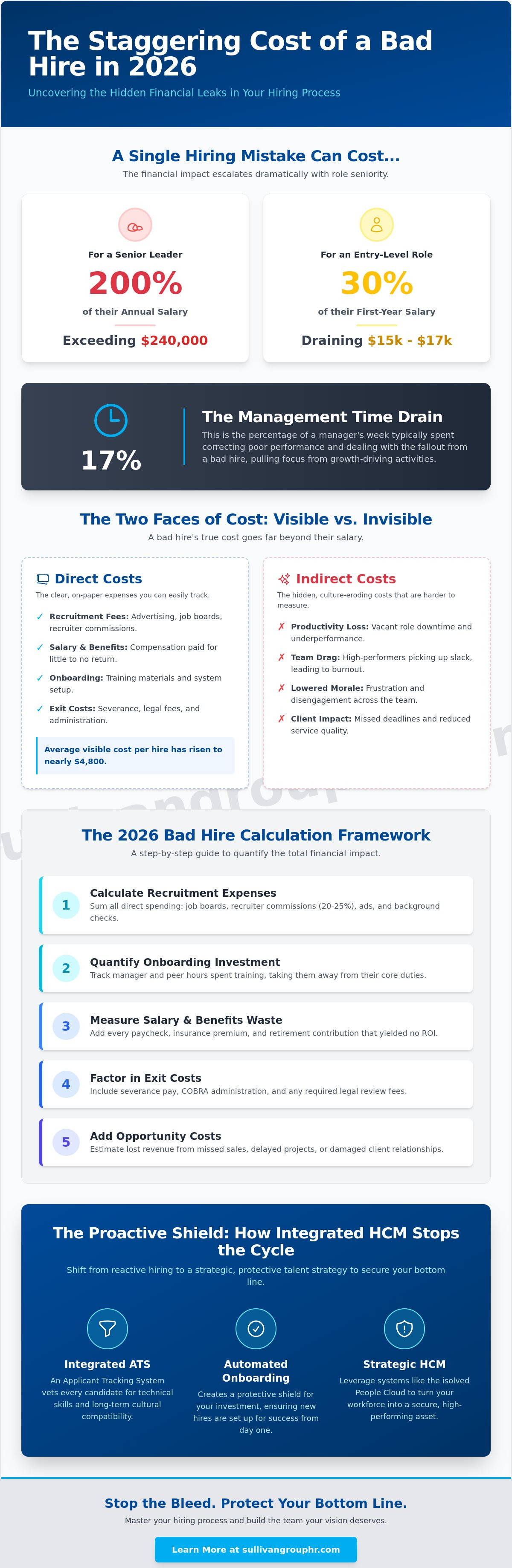
Did you know that a single hiring mistake in 2026 can cost your business up to 200% of that employee's annual salary? For a senior leader, that financial leakage often exceeds $240,000. It's a staggering figure that doesn't even account for the 17% of a manager's week spent correcting poor performance. You deserve a team that moves your vision forward, not one that holds it back. Mastering a clear cost of a bad hire calculation is the first step toward protecting your hard-earned growth and ensuring long-term stability.
You understand that high turnover isn't just an HR issue; it's a direct threat to your profitability and morale. You've felt the frustration of wasted interview hours and the sting of the 90-day churn cliff. We promise to help you reclaim your time and your budget. This guide provides the exact math you need to quantify hiring mistakes and introduces how integrated human capital management stops the bleed. We will explore the hidden expenses of vacancies, the formula for true replacement costs, and the strategic shifts that improve retention for good.
Key Takeaways
- Understand the 2026 financial benchmarks, including why entry-level hiring mistakes often cost at least 30% of a first-year salary.
- Learn a precise cost of a bad hire calculation that accounts for both visible recruitment expenses and invisible onboarding investments.
- Identify the "team drag" effect and how poor performance ripples through your culture to impact high performers and client trust.
- Discover how an integrated Applicant Tracking System (ATS) and automated onboarding create a protective shield for your bottom line.
- Leverage the isolved People Cloud to simplify complex HR functions and ensure you hire for long-term operational compatibility.
The Financial Reality: Why the Cost of a Bad Hire Matters in 2026
A bad hire is more than just a resume that didn't live up to the hype. It's a fundamental misalignment of skills, culture, and long-term potential. When a new team member lacks the rhythm of your operations or the drive of your mission, they don't just sit still; they create a drag on your entire organization. Hiring precision is the cornerstone of your organizational security. Without it, you aren't just losing a person; you're losing momentum, stability, and profit.
The numbers in 2026 are unforgiving. According to the U.S. Department of Labor, the "30% Rule" remains a baseline for entry-level roles. This means a single mistake for a junior position typically costs your business at least 30% of that employee's first-year earnings. In practical terms, an entry-level bad hire drains between $15,000 and $17,000 from your bottom line. Performing an accurate cost of a bad hire calculation allows you to see these leaks before they become floods.
The stakes escalate quickly as you move up the ladder. For specialized roles or executive leadership, the financial impact often reaches 200% of their annual salary. A single executive-level mistake can cost your business over $240,000. These aren't just theoretical figures; they represent real capital pulled away from innovation, expansion, and team rewards. Protecting your business requires a shift from reactive filling of seats to proactive talent strategy.
The 2026 Talent Landscape
The market for specialized skills is tighter than it has been in decades. You face a national stage where talent is mobile and expensive. You might feel pressured to "hire fast" to keep up with demand, but speed is often the most expensive mistake a business makes. Rapid, desperate hiring leads to high employee turnover, which restarts the costly cycle all over again. Integrated human capital management serves as your protective barrier. It ensures that every candidate is vetted for both technical ability and cultural compatibility, turning your workforce into a secure asset rather than a revolving door.
Direct vs. Indirect Costs
To master your cost of a bad hire calculation, you must look at two distinct categories of loss. Direct costs are the ones you see on your bank statement. These include salary, benefits, job board advertising fees, and background checks. Working with a screening partner like SimpliVerified ensures these costs are an investment in quality rather than a sunk expense. In 2026, the average cost per hire has risen to nearly $4,800 just in these visible expenses.
Indirect costs are quieter but more destructive. Think about the 17% of a manager's week spent coaching an underperformer. Consider the friction created when high achievers have to pick up the slack, or the 42 days of lost productivity while a position sits vacant. These "soft" costs represent the true weight of a hiring error. By identifying these three pillars—recruitment spend, management drain, and productivity loss—you can finally quantify the real impact on your growth.
The 2026 Bad Hire Calculation Framework: A Step-by-Step Guide
How do you turn a vague sense of frustration into a concrete financial report? You need a framework that captures every dollar lost to a poor recruitment decision. By following a structured cost of a bad hire calculation, you can move from guesswork to strategic precision. This process requires looking past the obvious expenses and uncovering the hidden drains on your resources. Use these five steps to build your total:
- Step 1: Calculate Recruitment Expenses. Sum up your direct spending on job boards, background checks, and advertising. Don't forget the recruiter commissions, which often range from 20% to 25% of the first-year salary.
- Step 2: Quantify Onboarding and Training Investment. Track the hours your managers and peers spend away from their primary duties to train the new hire. Their time has a specific dollar value.
- Step 3: Measure Salary and Benefits Waste. Add together every paycheck, insurance premium, and retirement contribution paid during the employee's tenure. This is capital that yielded no long-term return.
- Step 4: Factor in Exit Costs. Include severance pay, COBRA administration fees, and any legal review required for the termination.
- Step 5: Add Opportunity Costs. Estimate the revenue lost from missed sales or delayed project deadlines while the role was underperforming or vacant.
Recruitment and Sourcing Leakage
How much is your leadership's time worth? If your executive team spends twenty hours screening resumes for a role that ultimately fails, that is a direct withdrawal from your strategic growth fund. Recruitment leakage is the sunk cost of failed talent acquisition. When a candidate "ghosts" your team or a new hire quits in the first 90 days, you are forced to re-advertise and restart the cycle. This isn't just a nuisance; it's a repetitive financial drain that compounds with every failed attempt. When you need to refine your talent acquisition strategy, consulting with a human resources consulting expert can provide the clarity you need to stop the leak.
The Training and Ramp-Up Drain
Every new hire goes through a "ramp-up" period where their salary exceeds their actual output. When a hire is a poor match, this period extends indefinitely. You aren't just paying for their learning curve; you are also paying for the productivity dip of the high performers who have to train them. According to the State of the Global Workplace Report, disengaged or poorly matched employees significantly drag down team morale and financial performance. This is why investing in modern applicant tracking and onboarding is so critical. A streamlined process ensures early engagement, which shortens the ramp-up time and protects your team from the exhaustion of constant retraining.
Beyond the Spreadsheet: Measuring Organizational Friction
What happens to your top performers when a bad hire enters the mix? They don't just notice the underperformance; they compensate for it. This creates "Team Drag," an invisible weight that slows your entire operation and drains your resources. While your cost of a bad hire calculation captures the direct financial hit, it often misses the ripple effect on your culture. High achievers thrive in environments of excellence and shared responsibility. When they are forced to carry the load for a poor fit, their engagement drops almost immediately. Eventually, they leave in search of a more balanced environment. This "turnover contagion" can gut your most productive departments before you even realize there is a problem.
Your brand reputation is also on the line. Clients don't see your internal spreadsheets; they see the results of poor service or missed deadlines. One bad hire in a customer-facing role can dismantle years of hard-earned trust in a single afternoon. You might worry that you can't afford comprehensive human capital management solutions right now. However, the reality is that the cost of organizational friction is far more expensive than the fix. It's helpful to calculate the potential cost of a bad hire to see how quickly these friction points exceed the investment in better systems. A precise cost of a bad hire calculation proves that precision in hiring isn't a luxury; it's a vital survival strategy for your growth.
The Morale Tax
Consider the psychological toll on your leadership team. Managers often spend nearly a fifth of their workweek trying to salvage a failing employee. This leads to management frustration and eventual burnout. By utilizing workforce management solutions, you can monitor team health and identify these friction points early. You protect your culture by ensuring that your leaders are focused on growth, not damage control.
Risk and Compliance Exposure
When a hire fails, they often bring legal risk along with poor performance. Improper termination procedures or simple I-9 errors can lead to massive fines. Every hiring mistake increases your vulnerability to HR risk management failures. Relying on professional consulting ensures you have expert guidance to mitigate legal blowback. We act as your advocate, providing the stability and wisdom needed to navigate these regulatory minefields safely.
Strategic Prevention: How Integrated HCM Stops the Cycle
Why wait for a financial leak to occur before you take action? While a cost of a bad hire calculation serves as a vital diagnostic tool, your ultimate goal should be to stop the cycle before it starts. Integrated Human Capital Management (HCM) provides the infrastructure you need to make better decisions from day one. By connecting your recruitment, onboarding, and payroll data, you eliminate the silos where hiring mistakes often hide. You move your business from reactive damage control to proactive, strategic growth.
An all-in-one Applicant Tracking System (ATS) ensures that candidate matching is based on hard data rather than a subjective gut feeling. You can identify the specific traits of your current top performers and search for those exact markers in new applicants. Once you find the right person, automated onboarding keeps them engaged and productive. This early momentum is essential for long-term retention. When you integrate payroll administration outsourcing, you also reduce the administrative friction that often leads to errors and frustration during an employee's first few weeks. Precision in these early stages is the best way to protect your bottom line.
The Power of the isolved Platform
The isolved People Cloud serves as your single source of truth for the entire employee lifecycle. Communication gaps are one of the leading causes of bad hires. When your recruitment data doesn't talk to your performance management system, you lose sight of what actually makes a successful employee in your specific territory. isolved streamlines the entire process. It ensures that every stakeholder has the same information at the right time. This unified approach prevents the "operational mismatch" that causes so many new hires to churn within their first 90 days. It creates a steady, reliable beat for your organizational health.
Professional HR Consulting as a Safety Net
Technology is a powerful ally, but a second set of expert eyes is invaluable. Professional HR consulting acts as a safety net for your growth. We help you move away from subjective hiring toward a structured, defensible process that stands up to scrutiny. Our team works with you to refine your selection criteria and ensure your interviews are both compliant and effective. This combination of high-tech tools and high-touch wisdom is the most reliable way to secure your organization's future. Discover how our HCM solutions protect your growth and simplify your professional life.
Partnering for Precision: The Sullivan Group HR Approach
You have done the math. You have seen how the numbers add up against your growth. Now what? Knowing your cost of a bad hire calculation is a powerful diagnostic, but diagnosis without treatment won't save your bottom line. At Sullivan Group HR, we act as your dedicated ally, taking on the heavy lifting of recruitment, compliance, and administration so you can focus on your vision. We don't just provide a platform; we provide a partnership built on professional rigor and empathetic support.
Modern recruitment requires a balance of sophisticated technology and human wisdom. We leverage the isolved People Cloud to bring order to your talent lifecycle. This isn't just about automated filtering; it's about using unified data to ensure every new hire is a long-term fit for your culture and your goals. By integrating your systems, we eliminate the friction that leads to turnover. You gain the peace of mind that comes from comprehensive human resources management services, ensuring your business is protected from the hidden expenses of hiring mistakes. Our goal is to move you from a state of reactive worry to one of reliable organizational security.
Our Legacy of Supportive Expertise
We aren't a national, faceless corporation. We are an established regional expert with a long-standing history of serving our local territory. Our "no-nonsense" approach to organizational security is rooted in hard-earned wisdom and a deep understanding of our community. While we utilize world-class tech, we never let it replace the human touch. We value people over automated, tech-only processes because we know that a resume can't tell the whole story. Our team acts as a coach and advocate, helping you navigate the nuances of your specific market with confidence and warmth. We focus on your success as the primary metric of our own.
Ready to Protect Your Bottom Line?
You've moved from cost awareness to a strategic understanding of your risks. You know that a single bad hire can trigger a turnover contagion or a compliance nightmare. Now is the time to move from calculation to correction. Your professional potential is too high to be weighed down by administrative burdens and recruitment failures. We are here to help you secure your organization's future and build a team that actually drives results. Stop the drain of turnover today by choosing a partner who understands your territory and values your success. Contact Sullivan Group HR for a consultation and let's turn your human capital into your greatest competitive advantage.
Turn Your Calculation Into a Competitive Advantage
You've seen the numbers. You've identified the leaks. Now it's time to act. Mastering a precise cost of a bad hire calculation gives you the clarity needed to protect your bottom line. It's not just about replacement fees; it's about safeguarding your team's morale and your organization's momentum. When you understand the true impact of turnover, you can finally move from reactive damage control to strategic growth.
True security comes from a unified approach that prioritizes recruitment, compensation, and long-term retention. By combining the industry-leading isolved HCM platform with our expert HR consulting, you replace guesswork with data-driven precision. We provide a legacy of stability through comprehensive payroll and benefits management. You deserve a partner who understands your local territory and values people over automated systems. Our no-nonsense advocacy ensures your administrative burdens become manageable assets.
Stop the drain of turnover—partner with Sullivan Group HR for expert HCM solutions today.
Your business has incredible potential. We're here to help you secure the right talent to reach it and keep your vision moving forward with confidence.
Frequently Asked Questions
How do you calculate the cost of a bad hire for a small business?
A small business cost of a bad hire calculation starts by adding your direct recruitment fees to the total compensation paid during that person's tenure. You must then factor in the value of the time your team spent training them. Finally, include any exit costs like severance or re-advertising fees. This simple formula reveals the hard capital lost to a single selection error.
Is the cost of a bad hire really 30% of their salary?
The 30% figure from the U.S. Department of Labor is a conservative baseline for entry-level roles. In reality, SHRM estimates that the total impact ranges from 50% to 200% of an annual salary. For specialized or leadership positions, the complexity of the role makes the financial damage much higher. You're paying for more than just a replacement; you're paying for lost momentum.
What are the hidden costs of a bad hire that most managers miss?
Most managers overlook the opportunity cost of unfilled roles and the specific damage to sales revenue. For a sales position, the total impact can reach 3 to 5 times their total compensation. This includes damaged customer relationships and missed deals that your competitors likely secured instead. These "soft" costs often represent the largest portion of your total financial drain.
How can an Applicant Tracking System (ATS) reduce the cost of a bad hire?
An ATS reduces costs by focusing on operational compatibility rather than just "culture fit." It uses data-driven screening to identify candidates who match the specific working rhythm of your team. This precision helps you avoid the 90-day churn cliff where 30% of new hires typically leave. By improving the initial match, you protect your onboarding investment from the start.
What role does HCM play in improving employee retention?
Integrated human capital management creates a seamless lifecycle that keeps employees engaged from their first day. It eliminates the communication gaps that lead to frustration and early exits. When payroll, benefits, and performance data live in one place, your team feels supported and seen. This stability fosters a sense of security, making your high performers less likely to look elsewhere.
Can outsourcing HR help prevent hiring mistakes?
Yes, because it provides a professional safety net for your selection process. Expert HR consultants bring a "no-nonsense" perspective that removes emotional bias from hiring decisions. We help you refine your criteria and conduct structured interviews that reveal true potential. This partnership ensures that your growth is built on a foundation of stable, vetted talent rather than gut feelings.
How much does management time contribute to the cost of a bad hire?
Management time is a significant but often ignored expense. Statistics show that managers spend about 17% of their weekly time trying to correct the underperformance of a poor hire. That is nearly one full day every week pulled away from strategic growth and team development. When you perform a cost of a bad hire calculation, you must value this lost leadership time.
What is the impact of a bad hire on existing team productivity?
A bad hire creates a "team drag" that can cost your business between $98 and $500 per day in lost productivity. Your high achievers often have to pause their own work to fix errors or provide extra training. This friction doesn't just slow down projects; it burns out your best people. Protecting your team's rhythm is essential for maintaining a healthy, profitable workplace.


