

A routine payroll delay can become a bigger problem when it affects an employee’s final paycheck. Understanding what happens if you pay an employee late starts with the federal rule: minimum wage and applicable overtime must be paid on the regular payday for the pay period in which they were earned. According to the U.S. Department of Labor, the Fair Labor Standards Act (FLSA) is the primary federal law governing wage and hour protections.
If you’re concerned that paying an employee late could trigger penalties, take it seriously. The consequences depend on the state, the type of wages involved, and whether the delay affects regular pay or an employee’s final wages.
This article explains when late payment may violate payday rules, why final-paycheck penalties can be more severe, and how federal and state requirements differ. It also covers how organized payroll processes can help prevent delays and keep paydays on track.
Key Takeaways
- Learn what records can support a wage claim and where employees can report suspected violations.
- Understand why final-pay deadlines can carry distinct penalties, including in Oregon.
- See how payday schedules differ by state and why a single nationwide schedule may not meet every requirement.
- Explore how coordinated payroll administration and HCM processes can help reduce delays before payday.
What constitutes a late payment violation under the law?
A payment can violate wage rules if required wages aren’t paid by the applicable payday. The deadline and potential consequences depend on federal protections and the employee’s state.
Federal wage payment requirements
The Fair Labor Standards Act (FLSA), the primary federal wage-and-hour law, requires minimum wage and applicable overtime to be paid on the regular payday for that pay period. The U.S. Department of Labor enforces the FLSA. The established payday matters even when payroll processing is delayed.
What exceptions or defenses can employers use when wages are paid late? If overtime for the final week can’t be calculated before payroll runs, the U.S. Department of Labor says employers may pay it as soon as practicable, but no later than the next payday. Otherwise, the key questions are whether wages were due and whether the full amount was paid on time.
State wage payment consequences
State laws can add penalties beyond the unpaid wages. In California, an initial late-payment violation carries a $100 penalty for each failure to pay each employee. In Illinois, employees are entitled to earned wages plus 5% of the underpayment per month. A violation can therefore expose an employer to more than the original wage shortfall.
Employees can pursue a wage claim or report a suspected labor violation. In California, workers can file a wage claim with the Labor Commissioner’s Office for statutory penalties payable to the employee. Suspected violations of federal wage protections can be reported to the Wage and Hour Division. Pay stubs, time records, and payment dates help establish the amount owed and when it was due.
Illinois also allows administrative fees after a wage demand or order. The fee is generally $250, or $1,000 for orders of $10,000 or more. The fee isn’t assessed if the employer pays before the demand or order is issued. State procedures and consequences differ, so the employee’s work location matters.
Are penalties worse for late final paychecks?
They can be. Final-pay deadlines may trigger separate penalties, and the amount depends on the state and circumstances.
Penalties for initial and repeat violations
Some state laws increase penalties after an employer receives notice of an earlier violation. In California, an initial late-payment violation carries a $100 penalty for each failure to pay each employee. A higher penalty for a later violation can apply after notice of the prior violation, whether or not a penalty was assessed then.
California employees may recover statutory penalties for late wages while still employed. That recovery became available when amendments to Labor Code section 210 took effect on January 1, 2020. The key distinction is whether the claim concerns an initial violation or a later one after notice.
Liquidated damages and late-pay penalties
Liquidated damages are additional amounts that may accompany unpaid wages under applicable law. For an FLSA violation, employees may be eligible for liquidated damages equal to the unpaid wages. In Illinois, an employer that misses an IDOL demand or final-order deadline owes the employee 1% of the underpayment for each day payment is delayed.
The same Illinois failure also carries a penalty equal to 20% of the underpayment, payable to IDOL. These amounts are separate from the wages still owed. Bank fees are consequential costs, not an automatic addition to the wage balance; document them separately from unpaid wages and statutory penalties.
Final wages and waiting-time penalties
Waiting-time penalties address an employer’s failure to pay all wages promptly after employment ends. California Labor Code sections 201, 202 and 203 apply when an employer does not timely pay all wages owed after an employee quits or is discharged. Unused vacation wages owed at the end of employment must also be paid in compliance with Labor Code section 203.
In Oregon, an employer may owe up to 30 days of an employee’s regular wages if final pay is late, according to the Oregon Bureau of Labor and Industries. A missed final-pay deadline can therefore create exposure beyond the original wages owed.
Calculating wages, penalties, and damages
Start with wages earned but unpaid, then identify the applicable statutory penalty or damages rule. Under the FLSA, eligible liquidated damages equal the unpaid wages. For an Illinois order missed after its deadline, calculate the employee penalty at 1% of the underpayment for each day payment is delayed, alongside the separate 20% IDOL penalty.
Final-pay calculations depend on all wages owed at separation and the state’s rule. California’s waiting-time provisions concern all unpaid wages, while Oregon’s potential penalty is measured in regular wages, up to 30 days. Keep the wage balance distinct from penalties and damages. A consistent payroll process support approach can help reduce repeat errors.
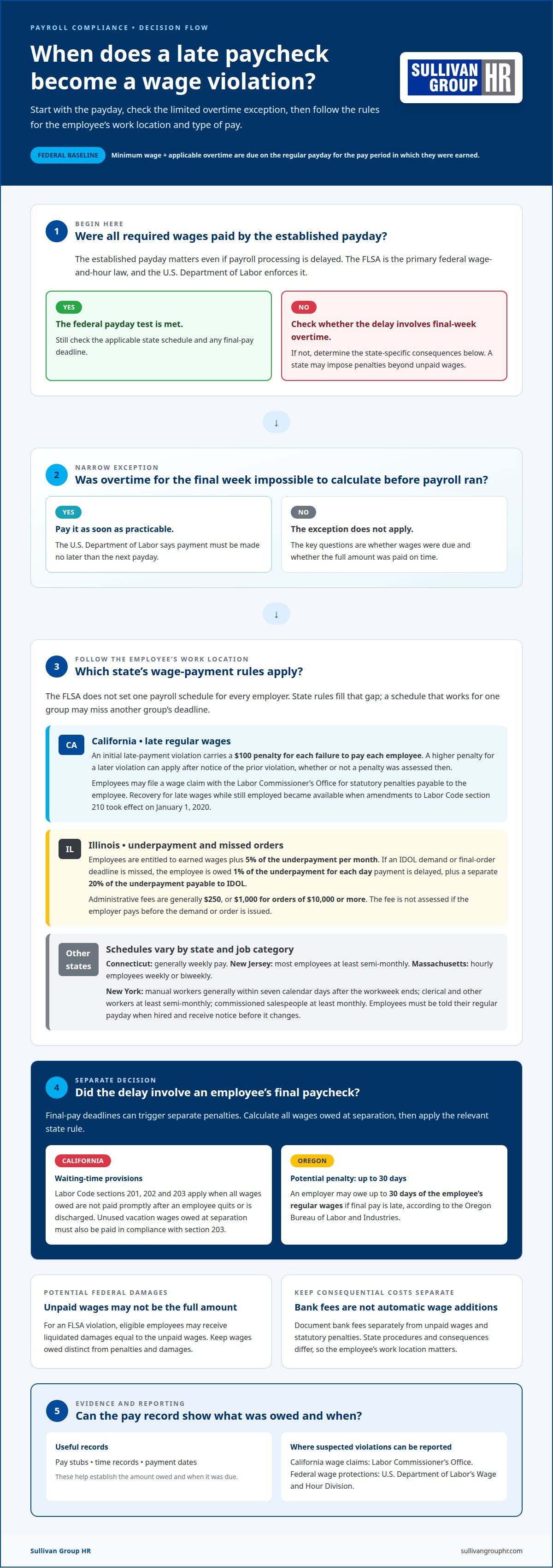
Federal and state payday requirements
Payday rules combine federal wage protections with state schedules. An employee’s work location and job category can determine how often wages must be paid.
Federal and state payday schedules
The FLSA requires prompt, regular payment but doesn’t set one payroll schedule for every employer. State rules fill that gap, so a monthly payroll schedule that works for one group may miss another group’s deadline.
For example, Connecticut generally requires weekly pay, while New Jersey requires most employees to be paid at least semi-monthly. Massachusetts requires hourly employees to be paid weekly or biweekly. New York sets different schedules by job category: manual workers generally must be paid within seven calendar days after the workweek ends, clerical and other workers at least semi-monthly, and commissioned salespeople at least monthly.
New York employees must be told their regular payday when hired and receive notice before it changes. The U.S. Department of Labor says overtime for a pay period’s final week, when it can’t be calculated before payroll runs, may be paid as soon as practicable, but no later than the next payday.
Responding to a missed payday
A missed payday calls for prompt fact-finding and correction. First, identify the affected pay period, employees, and unpaid amounts. Then determine whether the cause was a processing error, missing time data, or a payment-delivery issue. This helps distinguish wages that were never issued from a payment delayed in transit.
Next, arrange payment of verified unpaid wages promptly and tell affected employees what happened and when to expect payment. Keep the payroll record, time data, payment confirmation, and employee communication together. If overtime remains unresolved, follow the U.S. Department of Labor’s next-payday limit when the final-week calculation rule applies.
Finally, compare the payroll schedule with each state’s requirements and the roles on payroll. A New York manual worker and a New York commissioned salesperson can have different pay frequencies. Correcting the process behind a missed payday helps prevent the same delay in a later pay period.
Preventing late payroll
Understanding what happens if you pay an employee late starts with tracing the payroll process before payday. Clear responsibility and review points help catch missing time, incorrect rates, and processing issues before they affect employees.
Use a payroll calendar that reflects each employee group’s schedule and work location. Assign someone to track time approvals, review payroll, and release payments. Keep different schedules visible instead of relying on one company-wide deadline.
Build time for corrections into each pay cycle. Review hours worked, approved leave, pay rates, and overtime before finalizing payroll. Compare the current payroll file with the previous period to spot changes, such as missing employees or unexpected earnings. Resolve exceptions before issuing payments.
Set a clear handoff between managers and payroll staff. Managers submit approved time and changes by the internal cutoff; payroll staff review the file and confirm payment status. Keep approvals, edits, and transmission records together. If a question arises about what happens if you pay an employee late, these records can help show where the process failed.
Document backup coverage for payroll tasks and a process for addressing rejected or delayed payments. If a complaint or repeated claims arise, preserve relevant records and involve an employment attorney as appropriate. Reviewing the cause can reveal whether the issue was isolated or part of a process gap.
For help organizing payroll responsibilities, explore payroll outsourcing support. A structured process can help coordinate approvals, calculations, and payment administration around your schedule.
Sullivan Group HR: Employee Benefits Management
Sullivan Group HR helps employers organize payroll responsibilities through human capital management (HCM). If payroll deadlines, employee records, and benefits administration compete for attention, Payroll Administration or Payroll Outsourcing can help bring these processes together.
Employee Benefits Management supports another part of the employee experience, while HCM connects workforce functions within a broader management approach. The right support depends on where your process needs attention, whether that’s payroll administration or coordinating employee benefits.
Consider taking the next step if missed paydays have exposed gaps in payroll ownership, approvals, or processing. Contact Sullivan Group HR to discuss the support that fits your organization.
Build a payroll process that keeps pace
Understanding what happens if you pay an employee late can point to a practical next step: designing payroll around clear responsibility, accurate information, and reliable workflows. A process suited to your organization can support smoother administration as your workforce changes.
Sullivan Group HR offers HCM, Payroll Outsourcing, and Payroll Administration to help employers manage connected workforce and payroll needs. If payroll responsibilities are stretching your internal team or making routine processing uncertain, discuss how this support could fit your operations.
Contact Sullivan Group HR for support and take a practical step toward more organized payroll. With a clearer process in place, your team can focus on the work ahead with greater confidence.
Frequently Asked Questions
Can you pay employees late?
Employers must pay required wages on the applicable regular payday. A delay can violate wage-payment rules even if the employer later pays the full amount. The relevant deadline depends on federal protections and the employee’s state payday rules. For example, a state may require weekly payment for a particular worker group, making a less frequent schedule a potential compliance issue.
Are there protections if a worker is retaliated against because the worker complains about employee rights, including being paid timely?
Workers can report an employer that does not follow its pay schedule to the U.S. Department of Labor’s Wage and Hour Division. If a complaint is followed by adverse treatment, keep dated records of the complaint, messages, schedule changes, and disciplinary notices. These details help establish the sequence of events when describing the concern to the agency.
Does federal law require a specific payday?
No. The Fair Labor Standards Act does not set one specific payday or payroll frequency for every employer. It requires minimum wage and applicable overtime to be paid on the regular payday for the pay period when the wages were earned. State law may set a particular frequency, such as weekly or semi-monthly, so employers must account for where employees work.
Does the penalty apply if different types of wages are paid late?
It can. California Labor Code section 210 penalties can apply when an employer pays less than the full wages owed by the due date. That may include late meal- or rest-period premium wages: in Naranjo v. Spectrum Security Services, Inc. (2022) 13 Cal.5th 93, the California Supreme Court treated those premiums as wages. The wage type and applicable state rule matter.
How much is the penalty?
The amount depends on the state and violation. Arizona employees may recover up to three times their unpaid wages in a civil action. Massachusetts allows recovery of three times unpaid wages plus attorney fees for late or unpaid wages, including late final paychecks. These examples show why employers need to identify the governing state rule before estimating exposure.
What federal laws require employers to pay employees on time in the U.S.?
The Fair Labor Standards Act (FLSA) is the primary federal law governing wage-and-hour protections in the United States. It requires minimum wage and applicable overtime to be paid on the regular payday for the relevant pay period. The U.S. Department of Labor enforces the FLSA. State laws can add pay-frequency rules and separate consequences for late wages.


