

What should you look at when evaluating isolved hcm pricing? The headline amount is only useful when you understand which workforce needs and services the proposal covers. A clear view of the scope makes it easier to decide whether a solution fits your organization and to compare options on the same basis.
Start by listing the work you need to manage, such as payroll, time tracking, benefits administration, or hiring. Then separate the technology you need from the service support you want. This guide explains how to prepare for a pricing discussion, assess a proposal against your requirements, and consider the platform and its support together. Sullivan Group HR combines isolved HCM technology with a dedicated specialist and workforce services, including payroll administration, benefits management, workers’ compensation assistance, and HR guidance. The goal is to focus on the capabilities and support that matter to your organization, rather than paying attention to a headline figure alone.
Key Takeaways
- Assess isolved hcm pricing by reviewing the proposed scope, not just the total.
- Before evaluating a proposal, list the workforce functions you need and distinguish platform technology from service support.
- Compare proposals using the same assumptions about scope, service responsibilities, platform capabilities, and support.
- Explore how Sullivan Group HR brings isolved HCM together with applicant tracking, screening, onboarding, payroll, taxes, time tracking, benefits, and HR guidance.
Why isolved HCM pricing is customized instead of a public flat rate
There is no useful way to assess isolved hcm pricing without understanding what the proposed solution covers. A total on its own does not show which workforce processes, technology, or services are included. Focus on the scope described in the proposal and compare it with the needs you have documented.
What does customized HCM pricing mean?
In practice, evaluating a tailored HCM solution means identifying the functions and support your organization needs, then reviewing how those requirements appear in the proposal. This keeps the discussion grounded in your organization’s actual workforce tasks rather than an assumed bundle of capabilities.
The scope matters because human capital management can involve connected workforce functions. For background, a Human Resource Management System (HRMS) may bring together areas such as HR, payroll, benefits, and workforce tracking. An employer focused on payroll has different requirements to assess from one looking to address hiring, time tracking, and benefits administration as well. Use these distinctions to describe your needs, not to assume a particular isolved price formula or package.
Why a single number may not answer the buyer’s question
A total is difficult to evaluate without knowing what it represents. Does the proposal address the platform capabilities your organization needs, or does it also describe service support for workforce management? These are related but distinct parts of the decision. Access to technology and hands-on assistance from a dedicated specialist offer different kinds of support. Sullivan Group HR pairs isolved HCM technology with a dedicated specialist, so employers can consider the platform and personal service together.
Before comparing totals, list the work you want the solution to support, such as payroll, time tracking, benefits administration, or applicant tracking. Then separate the technology scope from the service responsibilities described in each proposal. This approach avoids assuming what a price includes and makes the pricing discussion more useful: the clearer the requirements, the easier it is to identify gaps and differences in scope.
What to clarify before evaluating an isolved HCM quote
Prepare a short scope brief before comparing proposals. Note the workforce tasks you need to manage now, identify who handles each task today, and distinguish platform technology from service support. This gives you a practical basis for assessing isolved hcm pricing without relying on headline totals alone.
Build a needs list around daily workforce tasks
Map the functions you are considering to real tasks. For example, identify whether you need support for payroll processing, tax filing, time tracking, benefits administration, or applicant workflows such as screening and onboarding. Note the number of employees and the pay schedules involved in your current processes, if those details are relevant to your discussion. Separate essential needs from capabilities you may consider later, so the proposal can be assessed against today’s priorities without treating future possibilities as current requirements. For a wider view of how these activities fit into workforce management, see this human capital management guide.
- Current tasks: Note what your team handles regularly, who is responsible, and where administrative work is concentrated.
- Needed functions: Identify which workforce processes you want the platform or service relationship to support.
- Future considerations: Keep possible later needs separate from the requirements you are evaluating now.
Clarify the service scope alongside the software
Read the proposal to distinguish platform technology from service support. If compliance support, workers’ compensation assistance, or HR guidance matters to your organization, list each as a separate requirement. Clarify how the dedicated specialist’s role relates to the service responsibilities described, rather than assuming every proposal covers the same work.
For payroll and tax administration, identify who handles each responsibility and how the proposed arrangement works. The IRS guidance on outsourcing payroll duties offers relevant context for employers considering outsourced payroll tasks. Sullivan Group HR provides payroll administration and HR guidance alongside isolved technology. Review the responsibilities in the proposed scope so you understand how those services relate to your organization’s needs.
Finally, compare proposals against the same requirements. Look beyond the total: check which functions are addressed, what services are described, and which responsibilities belong to each party. Consistent assumptions make the comparison more meaningful and help reveal where proposals differ.
How to compare isolved pricing with the value of the solution
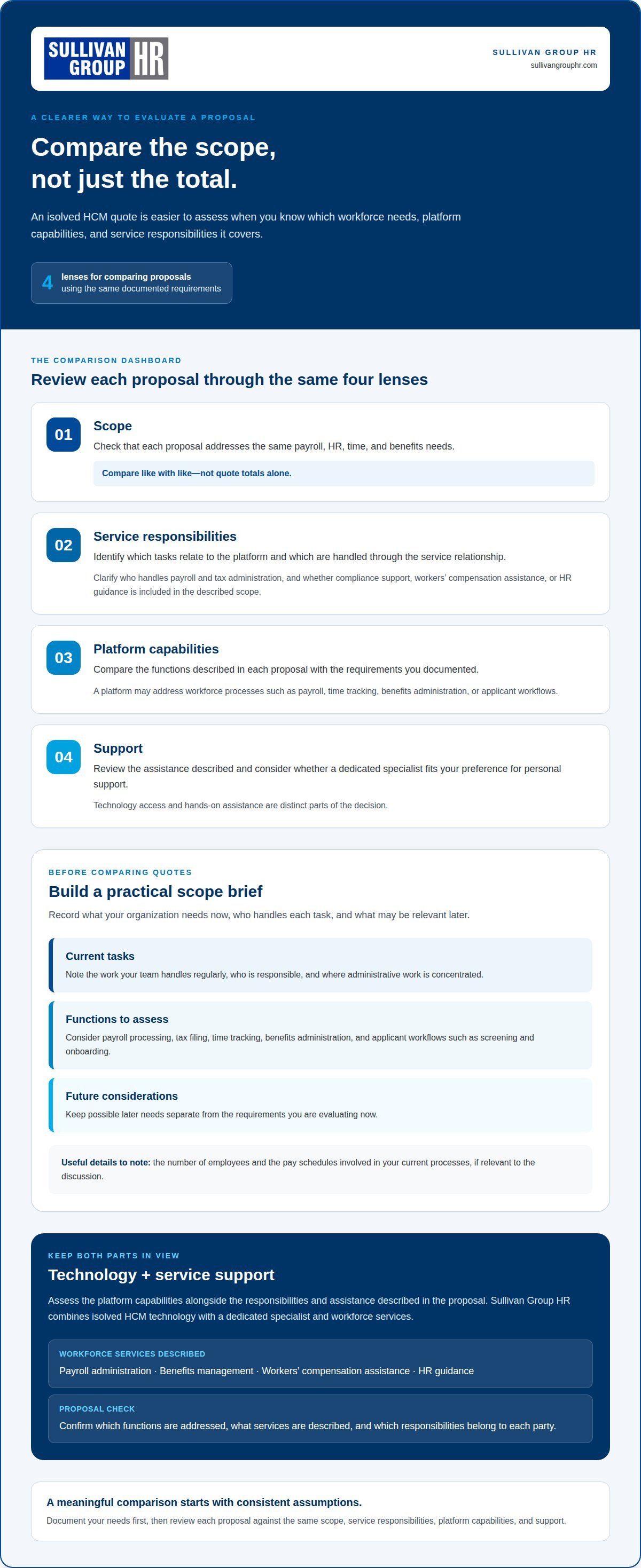
A useful comparison looks beyond the total. To evaluate isolved hcm pricing, assess each proposal against the same documented needs, then consider what the technology and service relationship contribute. Use this sequence:
- Scope: Check that each proposal addresses the same payroll, HR, time, and benefits needs.
- Service responsibilities: Identify which tasks relate to the platform and which are handled through the service relationship.
- Platform capabilities: Compare the functions described in each proposal with the requirements you documented.
- Support: Review the assistance described and consider whether a dedicated specialist fits your preference for personal support.
Compare like with like, not just quote totals
Similar labels do not guarantee identical scope. One proposal may focus on technology, while another also describes service responsibilities. Read the details alongside your needs list and note the differences instead of treating the proposals as equivalent. Keep each proposal’s assumptions visible, including the workforce tasks it addresses. A consistent comparison shows what the total represents without relying on services that are not described.
Assess the value of a dedicated service relationship
Technology is only one part of the decision. Consider whether your team wants a dedicated specialist and how that support aligns with the responsibilities in the proposal. Sullivan Group HR combines isolved HCM technology with payroll, time tracking, benefits administration, compliance support, workers’ compensation assistance, and HR guidance. For another way to think about service costs, explore this HR outsourcing cost guide.
General case studies or return-on-investment figures may provide context, but they do not determine the value for your organization. Your needs, responsibilities, and use of the solution are specific to your workforce. A useful HCM comparison weighs service scope and support alongside price.
For a workforce solution that pairs isolved technology with hands-on support, explore Sullivan Group HR’s HCM services.
Explore isolved HCM with Sullivan Group HR as your workforce partner
Choosing an HCM platform is also a decision about the people who support your workforce processes. Sullivan Group HR is an isolved Network Partner, pairing enterprise-grade isolved HCM technology with personal service. Each client has a dedicated Sullivan Group HR specialist. The company brings 40 years of experience in payroll, HR, and employee-benefits management.
What the Sullivan Group HR relationship brings
The HIRE, Pay, and Protect framework organizes workforce needs across related areas:
- HIRE: Applicant tracking, screening, and onboarding.
- Pay: Payroll, taxes, time tracking, and benefits administration.
- Protect: Compliance support, workers’ compensation assistance, and HR guidance.
These services and the technology are complementary parts of workforce management. isolved provides the HCM platform, while a dedicated specialist offers a personal point of support. As you consider isolved hcm pricing, compare the stated scope with your requirements rather than assuming what a particular proposal includes. A clear description of the work you want handled helps connect platform capabilities and service responsibilities to your organization’s needs.
Take the next step toward a tailored conversation
Start with the tasks that take the most attention today. You might want to connect payroll and time tracking, support hiring workflows, or bring HR guidance into your benefits administration process. Describe those priorities clearly so the conversation can focus on the scope and support that fit your organization.
Ready to discuss the workforce needs you want to address? Explore workforce solutions with Sullivan Group HR and consider how isolved technology and hands-on support can work together for your organization.
Make your next HCM decision with confidence
Turn the proposal into a clear decision by using your priorities to determine what needs support now, what can wait, and how much hands-on help your team wants. Then check whether the scope, responsibilities, and support described align with those priorities. This is a more practical way to assess a solution than choosing based on a number alone.
Keep your requirements at the center of your isolved hcm pricing discussion. A suitable solution should fit the workforce you have and the way you want to manage its needs. You do not need to address every possible future challenge at once. Start with the work that matters most, then assess how technology and support can help your team manage it.
Ready to explore a workforce solution shaped around your organization’s needs? Explore workforce solutions with Sullivan Group HR.
Frequently Asked Questions
How much does isolved HCM cost?
The amount depends on the scope and terms set out in the proposal you are evaluating. To make the figure useful for budgeting, review which workforce functions and services it covers, and compare them with your organization’s requirements. A total without that context is difficult to assess.
Does isolved publish its HCM pricing online?
When researching isolved hcm pricing, focus on the written proposal and the scope it describes rather than relying on a headline figure. For planning, document the workforce needs you want to address, then review how the proposal accounts for those requirements. This makes it easier to see what the total relates to and to compare it consistently with other options.
What should I compare in an isolved HCM quote?
Compare what each proposal actually describes, not just its headline total. If one proposal discusses payroll technology and another includes payroll administration support, they may represent different scopes. Review the stated functions, services, responsibilities, and assumptions. Ask for unclear terms to be explained during the proposal discussion, then base your comparison on the clarified scope.
Can isolved HCM pricing be customized for my organization?
To assess whether a proposal fits your organization, give a clear picture of the workforce processes you want to address and distinguish immediate needs from possibilities you are only considering. Then review how the proposal reflects those requirements. This helps you evaluate the scope without assuming that a later change would have a particular price or that every capability is included.
Is isolved HCM pricing the same as HR outsourcing pricing?
Not necessarily. HCM pricing relates to the technology and scope described in a platform proposal, while HR outsourcing pricing may also reflect services performed by a provider. The two can be considered together when an arrangement includes both technology and support, but they are not automatically interchangeable. Compare the responsibilities assigned to the platform and service team to understand what each proposal covers.


