
What if the annual insurance review felt less like an interrogation and more like a victory lap for your business? You probably know the specific stress of hunting down payroll records or the confusion of deciphering complex NCCI classification codes. Most business owners fear that one "surprise" bill that wipes out a month of profit. If you're seeking workers compensation audit help, you're not just looking for a checklist. You're looking for a way to reclaim your time and protect your bottom line.
We believe your audit should be clean, predictable, and fair. This guide provides a strategic framework to ensure you maintain total compliance while avoiding the common traps of overpayment. We've built this approach on three pillars: preparation, precision, and protection. It's a method that turns a daunting administrative burden into a manageable, repeatable success. We are here to act as your coach and ally throughout the entire lifecycle of your policy.
In the following sections, we'll preview the critical 2026 updates you need to know, including the March 2 OSHA electronic submission deadline and the latest rate shifts in states like Florida and Illinois. You will learn how to organize your records, verify your classifications, and lower your premiums over time. Let's move from uncertainty to total organizational security.
Key Takeaways
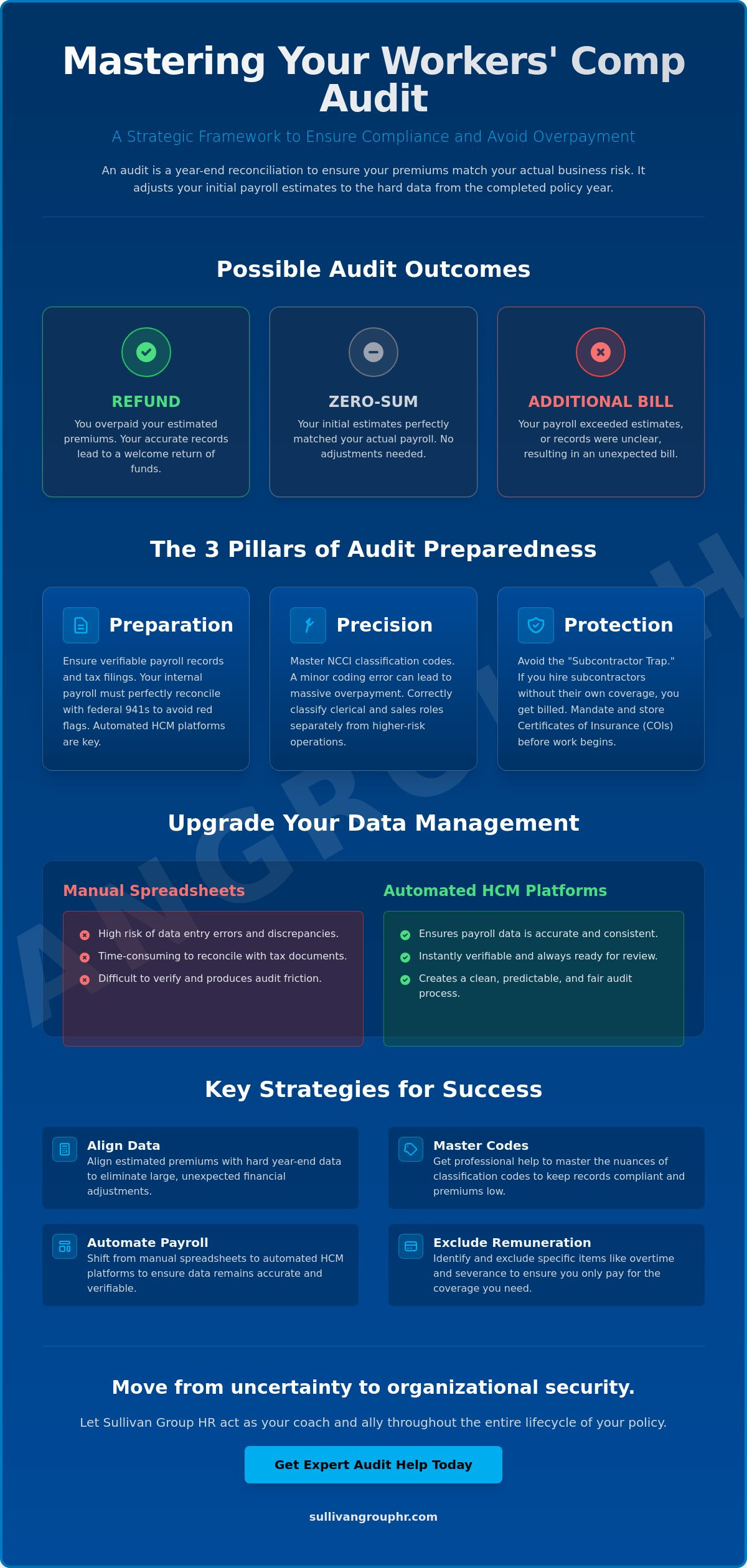
- Align your estimated premiums with hard year-end data to eliminate the fear of large, unexpected financial adjustments.
- Get professional workers compensation audit help to master the nuances of classification codes and keep your records organized and compliant.
- Shift from manual spreadsheets to automated HCM platforms to ensure your payroll data remains accurate, verifiable, and ready for review.
- Identify specific excludable remuneration items like overtime and severance to ensure you only pay for the coverage you actually need.
- Partner with an established regional expert to bridge the gap between your daily operations and complex insurance carrier requirements.
Understanding the Workers Compensation Audit Process
Does the thought of an insurance carrier digging through your files keep you up at night? It shouldn't. An audit is simply a formal review of your payroll and operations to ensure your premiums match your actual business risk. Think of it as a year-end reconciliation. When you first signed your policy, you provided an estimate of your payroll. The audit uses "hard" data from the completed policy year to adjust that estimate to reality.
This process is a fundamental part of the U.S. workers' compensation system. Because your business is dynamic, your initial projections rarely match your final numbers. You can generally expect to receive an audit notice within 30 to 60 days of your policy's expiration date. Depending on the accuracy of your records, the outcome will be one of three things: a "zero-sum" result where everything matches, a welcome refund for overpayment, or an additional premium bill that could impact your cash flow. Seeking professional workers compensation audit help early in the year ensures you're aiming for that first or second outcome.
The Three-Word Framework: Precision. Protection. Peace-of-Mind.
We approach every client relationship with a simple philosophy. Precision comes first; accurate data entry throughout the year prevents those painful year-end surprises. Next is Protection. Proper classification of your employees shields your business from unnecessary legal and financial liability. Finally, we provide Peace-of-Mind. There is an immense value in knowing your records are "audit-ready" at any moment. This framework moves you away from reactive stress and toward proactive management.
Common Audit Triggers to Watch
While most policies undergo a routine annual review, certain factors can draw extra attention from carriers. Have you experienced significant changes in your payroll volume compared to your initial estimate? This is a primary trigger. Adding new job roles or entire departments often requires different NCCI classification codes, which can complicate the process. Additionally, utilizing a high volume of independent contractors or 1099 workers often prompts a deeper look into your records to ensure proper coverage. If these scenarios sound familiar, getting workers compensation audit help now can save you from a massive, unexpected bill later.
The 3 Pillars of Audit Preparedness
Success in a workers' compensation audit isn't built on luck. It's built on a foundation of structured data and verified records. When business owners struggle, it's usually because their record-keeping is fragmented or relies on manual entry. To move from anxiety to authority, you need to master three specific pillars of preparedness. These pillars ensure that when you prepare for a workers' compensation audit, you're presenting a clear, undeniable picture of your business risk.
Mastering Classification Codes
Your premium is directly tied to the risk level of your employees' work. The National Council on Compensation Insurance (NCCI) sets these guidelines, and even a small coding error can lead to a massive overpayment. Don't let your team be "upskilled" into higher-risk categories if their daily duties don't justify it. For example, the "Standard Exception" rule allows you to properly code clerical and outside sales roles separately from higher-risk operations. This distinction alone often saves thousands in unnecessary premiums. If you find these codes confusing, professional workers compensation audit help can clarify exactly where each team member belongs.
The second pillar involves verifiable payroll records and tax filings. Your internal payroll must reconcile perfectly with your federal 941s. Any discrepancy here acts as a red flag for auditors. Seeking workers compensation audit help early ensures these documents are aligned long before the auditor arrives. The third pillar, and perhaps the most dangerous, is the Subcontractor Trap.
The Subcontractor Trap
Why should you pay for someone else's insurance? If you hire subcontractors who lack their own workers' compensation coverage, your carrier will treat them as your employees. This means you get billed for their payroll at your audit. To avoid this, you must have a mandatory process for collecting and storing Certificates of Insurance (COI) before any work begins. This also applies to 1099 workers. Without a valid COI on file, the auditor has no choice but to add their compensation to your premium total. Protecting your business means verifying that every partner carries their own weight.
These pillars often crumble due to manual entry errors. Spreadsheets are prone to mistakes, and paper files get lost. Fragmented record-keeping turns a simple request for data into a week-long scavenger hunt. By centralizing your labor data, you ensure these pillars remain strong and your business stays protected. Our team provides HR risk management expertise to help you build these systems from the ground up, ensuring every classification is accurate and every COI is accounted for.
Manual vs. Automated Data: Why isolved Changes the Game
How much time did you spend digging through dusty file cabinets last year? For many entrepreneurs, the audit process feels like a week-long scavenger hunt through disjointed spreadsheets and paper files. Manual systems invite human error. One misplaced decimal point or a forgotten 1099 form can lead to a massive premium adjustment. Automated platforms change this entirely by creating a "single source of truth" for your payroll and labor data. This shift doesn't just provide workers compensation audit help; it fundamentally transforms your administrative workflow.
The isolved Advantage for Audit Defense
The isolved platform offers a distinct advantage for defending your business during a review. You gain real-time tracking of payroll by class code, ensuring ongoing accuracy throughout the policy period. It also features automated tax filing integration for your 941s. This means you have instant verification ready the moment an auditor asks. Rather than searching for a lost folder, you have centralized document storage for certificates of insurance and employee handbooks. We focus on a simple three-step rhythm: Collect. Connect. Comply.
Why wait for a stressful year-end bill at all? A key strategy for 2026 is transitioning to pay-as-you-go workers compensation. This model calculates premiums based on actual payroll as it happens, rather than relying on guesses. It eliminates the "big check" and the fear of a massive audit adjustment. When you combine this automated approach with a comprehensive workers' compensation audit checklist, you move from reactive guessing to proactive management.
Reducing Administrative Burden
Reducing your administrative burden is about more than just surviving the next 30 days. Professional human capital management supports long-term risk mitigation for your entire organization. It eliminates the "year-end scramble" by maintaining audit-ready reports 365 days a year. This level of organization can reduce audit time from days of manual labor to just a few hours of digital review. You deserve the confidence that comes with a streamlined, repeatable process that protects your time and your capital. Seeking workers compensation audit help through automation ensures your data works for you, not against you.
How-To: Conduct a Pre-Audit Internal Review
Don't wait for the auditor to find your mistakes. A proactive internal review is your best defense against premium spikes and unexpected bills. Most business owners gather their documents, but few take the time to strategically review them for errors before the professional arrives. By conducting your own "mock audit," you take control of the narrative and ensure your data is beyond reproach. Seeking professional workers compensation audit help allows you to spot these discrepancies early, turning a stressful event into a routine check-up.
- Step 1: Reconcile your gross payroll with your 941 federal tax returns. These numbers must match exactly.
- Step 2: Identify and separate "Excludable Remuneration." This includes the premium portion of overtime, tips, and severance pay.
- Step 3: Verify that every subcontractor has a valid COI on file for the entire audit period. Gaps in coverage become your financial liability.
- Step 4: Conduct a "walk-through" of job descriptions. Ensure the reality of the work matches the NCCI class code assigned to the employee.
- Step 5: Organize your "Audit Kit." This is a single, organized folder containing all required records for easy delivery to the auditor.
Finding Hidden Savings in Your Payroll
Precision matters here. Many auditors include the full amount of overtime pay by default, but you are typically only required to pay premiums on the "straight time" portion. By properly deducting the overtime premium, you lower your overall basis and your final bill. You should also identify non-taxable fringe benefits, such as certain retirement contributions or group term life insurance, that should not be included in the audit total. Excludable remuneration can save you thousands in premiums if tracked correctly.
Managing the Auditor Relationship
Your interaction with the auditor should be professional, focused, and limited. Designate a single point of contact to ensure consistent communication and prevent conflicting stories. Provide only the data specifically requested. Over-sharing unrelated financial records only creates more opportunities for questions and confusion. Most importantly, ask to review the auditor's preliminary findings before they leave the building. This is your chance to correct simple clerical errors on the spot rather than fighting them months later. If you feel overwhelmed by these technical reconciliations, our payroll administration experts can manage the heavy lifting for you.
Sullivan Group HR: Your Ally in Risk and Compliance
Do you feel like you're managing your business, or just managing your paperwork? Administrative burdens shouldn't stifle your professional potential. At Sullivan Group HR, we believe in a protective partnership that goes beyond simple software. We combine the technological power of isolved with elite HR risk management expertise to safeguard your bottom line. Our team acts as a vital bridge between your business and the insurance carrier. While automated systems are essential, they lack the human touch required for nuanced advocacy.
We don't just provide a platform. We provide a dedicated team that reviews your classifications to prevent overpayment. This proactive approach is the ultimate form of workers compensation audit help. We also play a critical role in managing your claims and lowering your Experience Modifier (MOD) score over time. This score is a primary driver of your insurance costs. Lowering it requires a steady, reliable beat of safety and compliance. Are you ready to simplify your next audit? Let’s talk about your risk strategy today.
Proactive Advocacy vs. Passive Software
Many tech-only competitors offer tools that simply record data. We offer consultants who actually analyze that data. We look for the "Standard Exception" roles we discussed earlier to ensure your clerical staff isn't being billed at high-risk rates. This human-centric approach moves you from a transactional vendor relationship toward a long-term partnership. We focus on movement, safety, and results. When you have a question about a complex NCCI code, you don't get an automated chatbot. You get an established regional expert who understands your specific territory.
The Future of Your Business Security
The future of your business security depends on moving from a reactive stance to a strategic one. From applicant tracking to workers comp, we manage the entire lifecycle of your workforce. This unified human capital management approach ensures that data flows seamlessly from the first day an employee is hired to their final paycheck. This connectivity eliminates the data silos that typically cause audit discrepancies. By integrating time and attendance with payroll administration, we ensure every hour worked is coded correctly from the start.
Precision matters. Protection matters. Peace-of-mind matters most of all. We help you move from the heavy weight of administrative burden to a state of long-term organizational security. You deserve a partner who understands the nuances of your local territory and values people over automated systems. Let's build a repeatable, reliable process that protects your growth. Our legacy is built on your success. We are your coach. We are your ally. We are your advocate.
Reclaim Your Time and Protect Your Bottom Line
Are you ready to stop fearing the annual insurance review? You've seen how a strategic pre-audit review and the transition to automated HCM systems can transform your entire workflow. By focusing on accurate classification codes and verifiable payroll records, you eliminate the threat of unexpected premium bills. Professional workers compensation audit help isn't just about surviving a single week; it's about building a repeatable framework for long-term security. We are here to provide the precision, protection, and peace-of-mind your business deserves.
Our team combines the industry-leading isolved HCM platform with expert HR consultants who bring decades of risk management experience. We offer comprehensive payroll and benefits integration that ensures your data remains accurate and audit-ready 365 days a year. Secure Your Business with Sullivan Group HR’s Risk Management Solutions today. Your professional potential is limitless when you have a reliable ally dedicated to your safety and growth. Let's turn this administrative burden into a strategic advantage and start building your future together.
Frequently Asked Questions
What documents are required for a workers compensation audit?
You must provide your payroll journals, federal tax reports (Form 941), and state unemployment tax reports. The auditor also needs to see your general ledger, subcontractor ledgers, and valid Certificates of Insurance for all outside partners. Are your records centralized? Having these documents organized in a single digital folder ensures a smooth, professional review process without the stress of a last-minute search.
How long does a workers compensation audit typically take?
Most small business audits conclude within two to four hours of active review. Larger organizations with complex job classifications or high employee turnover may require several days of data verification. The length depends entirely on the quality of your preparation. When you utilize automated HCM platforms, the auditor can often verify your figures in a fraction of the time required for manual spreadsheets.
Can I dispute the results of a workers compensation audit?
Yes, you have the right to file a formal dispute if you find clerical errors or incorrect job classifications. You generally have a 30 day window from the receipt of the audit results to submit your appeal in writing. This is why reviewing the preliminary findings before the auditor leaves is so critical. Seeking professional workers compensation audit help during the dispute process ensures your appeal is backed by verifiable data and industry expertise.
What happens if I refuse to participate in a workers comp audit?
Refusing to participate is a breach of your insurance contract and leads to severe financial penalties. Carriers often apply a "non-compliance" charge, which can increase your estimated premium by 100% or more. They may also cancel your policy entirely, leaving your business exposed to significant legal risk. Participation is not just a requirement; it is a way to protect your professional potential and organizational security.
Is a workers compensation audit the same as a tax audit?
No, these are two very different functions. A tax audit is a government investigation into your compliance with federal or state laws. A workers' compensation audit is a private, contractual review conducted by your insurance carrier to ensure your premiums match your actual payroll. While both require accurate records, the insurance audit focuses specifically on risk exposure and labor classifications rather than taxable income alone.
How can I lower my workers compensation premiums before the audit?
The most effective way to lower your costs is to verify that every employee is assigned to the lowest possible risk classification code. You should also ensure that all subcontractors have provided a valid COI so you aren't billed for their payroll. Proactive workers compensation audit help allows you to catch these errors early. This strategy turns the audit from a potential bill into an opportunity for significant savings.
What is excludable remuneration in a workers comp audit?
Excludable remuneration refers to specific types of pay that are not included in your premium calculation. This typically includes the "premium" portion of overtime pay, tips, and severance packages. It may also include certain fringe benefits or reimbursed business expenses. Properly identifying these items prevents you from overpaying on your policy. Precision in these categories is the foundation of a fair and accurate audit result.
Do I need to include 1099 contractors in my workers comp audit?
You must include any 1099 contractor who cannot provide proof of their own workers' compensation coverage. Without a valid Certificate of Insurance, the auditor is required by law to treat that contractor as your employee for premium purposes. This is the most common cause of "surprise" bills at the end of the year. Always collect and verify COIs before any work begins to shield your business from these unnecessary costs.


