
In 2025, 55% of employees reported witnessing or experiencing workplace misconduct. With the EEOC recovering $660 million from employers last year, the stakes for your business have never been higher. Are you confident that your current protocols could withstand a federal audit or a retaliation claim? Master workplace investigation best practices to protect your people, your reputation, and your bottom line.
We understand that managing internal conflict often feels like walking a tightrope. You want to remain neutral, stay compliant with shifting laws like the January 2026 rescission of federal harassment guidance, and document every detail without losing weeks of productivity. This 2026 guide promises to simplify these complex functions into a clear, defensible process. You'll learn how to minimize legal liability, restore workplace harmony, and lead with professional rigor. We'll walk through the essential steps of a modern investigation, the impact of new state mandates, and how to maintain the human connection in an increasingly digital world.
Key Takeaways
- Recognize the legal, cultural, and financial risks of a delayed response to keep your organization safe and stable.
- Master workplace investigation best practices by establishing a defensible framework that prioritizes investigator neutrality and procedural integrity.
- Evaluate when to leverage external Human Resources Consulting to ensure complex complaints are handled without the risk of internal bias.
- Transition from fragmented spreadsheets to secure, encrypted documentation by utilizing integrated HCM technology like Isolved.
The High Stakes of Workplace Investigations in 2026
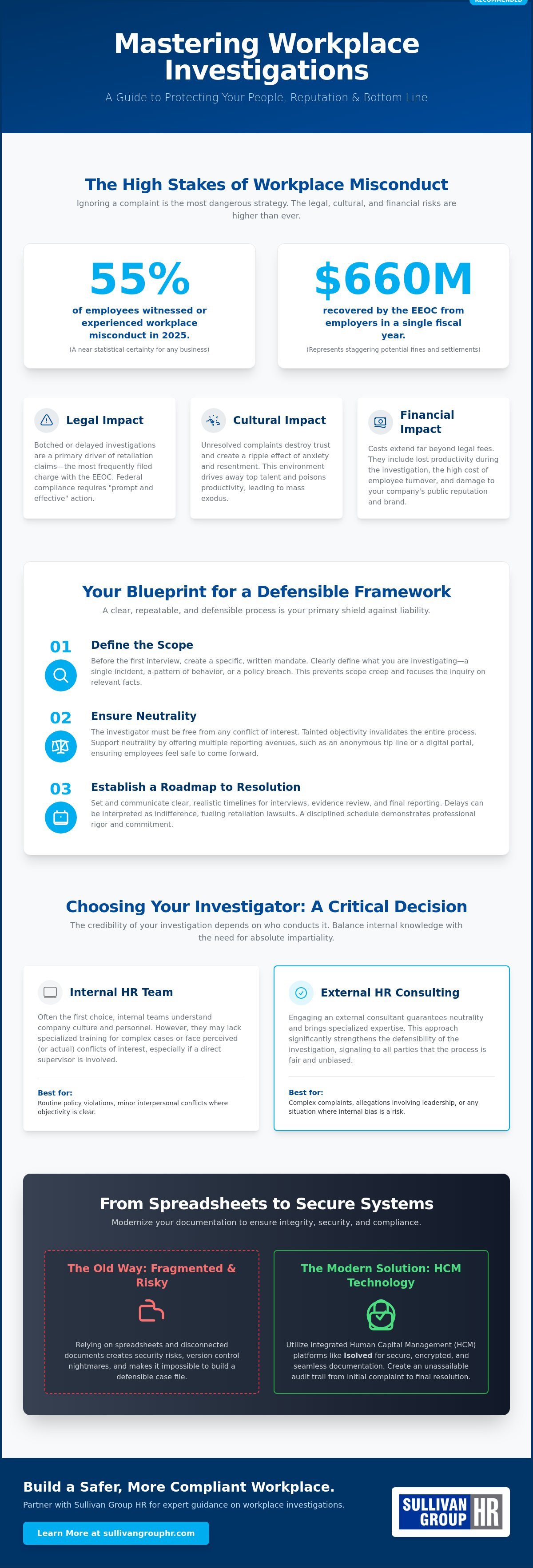
How much unresolved risk is currently sitting in your HR inbox? For many business owners, the natural instinct is to "wait and see" when a difficult complaint arises. This is the most dangerous strategy you can adopt in 2026. Ignoring a whisper today often leads to a roar in court tomorrow. With 55% of employees reporting they witnessed or experienced misconduct in 2025, the probability of an incident occurring in your workplace is a statistical certainty. Moving from a reactive "firefighting" mindset to a proactive, protective HR posture is no longer optional; it's a requirement for survival.
A botched or delayed investigation creates a three-part impact that can cripple a growing company. First, the legal impact includes staggering fines and settlements. The EEOC recovered $660 million from employers in fiscal year 2025 alone. Second, the cultural impact destroys trust and drives away your top talent. Third, the financial impact extends beyond legal fees to include lost productivity and the high cost of turnover. Implementing workplace investigation best practices ensures you address these risks before they become catastrophic.
The regulatory shifts of 2026 have increased the necessity for standardized protocols. On January 22, 2026, the EEOC rescinded its 2024 Enforcement Guidance on Harassment, removing the federal framework many employers previously relied upon. This shift, combined with state-level changes like New Jersey’s increased fines for CEPA violations and Illinois' new AI transparency laws, means your internal playbooks must be more robust than ever. You need a process that is clear, repeatable, and defensible.
Protecting Your Culture and Continuity
Transparent investigations are a powerful diagnostic tool. They allow you to identify systemic issues before they lead to a mass exodus of staff. When your team sees that complaints are handled with professional rigor, it builds a foundation of safety and advocate-level loyalty. Conversely, unresolved complaints create a ripple effect of anxiety and resentment. By prioritizing workplace investigation best practices, you signal to your workforce that their well-being is a core business value. When employees feel their voices are heard, they are less likely to seek external avenues for understanding whistleblower reports and more likely to trust your internal resolution process.
The Legal Reality of Federal Compliance
The EEOC and DOL expect "prompt and effective" action. A vague promise to "look into it" will not protect you in a deposition. A documented, standardized process serves as your primary shield against retaliation claims, which remain the most frequently filed charge with the EEOC. In the 2026 private workplace, due process is the consistent application of a fair, impartial, and documented procedure that allows all involved parties to present their perspective before any final employment decision is reached. Without this structure, you're not just managing a team; you're managing a liability.
Designing a Defensible Investigation Framework
How do you build a process that holds up under the intense scrutiny of a courtroom or a federal auditor? It starts with a clear blueprint. Before the first interview begins, you must define the scope. Are you investigating a single incident of harassment, a pattern of bullying, or a breach of data security? Without a defined boundary, investigations often drift into irrelevant territory, creating unnecessary risk. This is where workplace investigation best practices begin: with a specific, written mandate that outlines the purpose and parameters of the inquiry.
The "Neutrality Mandate" is your next essential pillar. If the person leading the inquiry has a personal relationship with the accused or a vested interest in the outcome, the entire process is tainted. You must ensure your investigator is free from conflict of interest. To support this, standardize your intake process. Don't rely on a single open-door policy. Offer multiple avenues for reporting, such as an anonymous tip line, a digital portal, or a direct HR contact. This accessibility ensures that the 78% of employees who witnessed misconduct in 2025 feel safe enough to come forward.
Finally, establish a roadmap to resolution. Set clear, realistic timelines for interviews, evidence review, and the delivery of findings. A prompt investigation isn't just a courtesy; it's a legal defense. Delays can be interpreted as indifference, which often fuels the fire of a retaliation lawsuit. By sticking to a disciplined schedule, you demonstrate professional rigor and a commitment to a safe workplace culture.
Selecting the Right Investigator
Is your internal HR team equipped to remain objective? While internal HR is often the first choice, using a direct supervisor to lead a sensitive inquiry is a recipe for a retaliation claim. You need an "arm’s length" perspective to ensure objective results. If the complaint involves senior leadership or complex legal nuances, bringing in external Human Resources Consulting provides the protective layer of neutrality your business requires. This professional distance ensures the findings are based on evidence, not office politics.
Confidentiality vs. Transparency
Managing expectations is a delicate balancing act. You should never promise absolute confidentiality to a witness; instead, promise discretion. Follow the "Need to Know" rule: only share details with those essential to the resolution. This protects the integrity of the process while fulfilling your legal obligation to act on discovered information. A transparent process doesn't mean sharing every detail. It means being clear about the steps you are taking to reach a fair conclusion and crafting persuasive recommendations that lead to meaningful change.
Internal HR vs. Professional HR Consulting: Choosing Your Path
Who should hold the clipboard? This is the central question facing employers when a complaint hits the desk. While your internal team knows your culture best, they are also part of it. This proximity is a double-edged sword. For minor infractions, in-house handling is efficient. But as complexity grows, the risk of perceived or actual bias skyrockets. Adhering to workplace investigation best practices means knowing when to step back and let a neutral party take the lead. As an established regional expert, we understand the specific nuances of our local territory and how internal politics can often cloud professional judgment.
The cost of bias is rarely a line item on a budget, but it's expensive. If an investigator has shared a lunchroom or a project deadline with the accused, their neutrality is compromised. This "proximity bias" can accidentally taint the findings, making them indefensible in court. A dedicated human resources consulting partner moves with a level of speed and clinical thoroughness that internal teams, often bogged down by daily administrative tasks, simply cannot match. They bring an external credibility that reassures employees the process is fair, which is vital for maintaining trust and restoring harmony.
When to Keep it In-House
Not every issue requires a third-party expert. Minor policy infractions, simple attendance disputes, or performance-related disagreements are usually best handled internally. You can utilize your existing human capital management data to resolve conduct issues that are clearly documented by time and attendance records. To do this well, ensure your internal team receives regular training on basic investigative interviewing techniques. This builds internal capacity for low-risk scenarios while keeping your culture intact and your overhead manageable.
The Case for Professional Outsourcing
High-stakes scenarios demand a different approach. If you're facing allegations of high-level executive misconduct or systemic harassment, an internal investigation is often viewed as the fox guarding the henhouse. The EEOC task force on harassment has long emphasized that the appearance of a fair process is just as important as the process itself. Professional HR risk management experts bridge the critical gap between standard HR practices and legal requirements. They produce third-party reports that carry significant weight in potential litigation. These reports demonstrate to judges, juries, and regulators that you took the complaint seriously and acted with professional rigor. When the future of your business is on the line, that external stamp of neutrality is your most valuable asset.
Five Essential Best Practices for Procedural Integrity
What does procedural integrity look like in practice? It's the difference between a guess and a guarantee. To shield your business from liability, you must follow a disciplined sequence that leaves no room for ambiguity. Adhering to these workplace investigation best practices ensures your process is as robust as it is fair. We believe in a three-part approach to every case: precision, empathy, and speed.
- Immediate Intake: The clock starts the moment a concern is raised. Document the initial complaint with precision and empathy, capturing the "who, what, when, and where" before memories begin to fade.
- Evidence Preservation: Secure digital and physical records immediately. This includes emails, chat logs, and security footage. In 2026, digital evidence is often the deciding factor in a defensible case.
- Structured Interviewing: Use a consistent set of questions for all parties. Focus on open-ended inquiries that allow the truth to emerge naturally rather than leading the witness.
- The Credibility Assessment: Weighing conflicting accounts is a professional skill. You aren't looking for proof "beyond a reasonable doubt" but rather a "preponderance of evidence."
- The Final Report: Craft a clinical, objective document that stands up to legal scrutiny. It must summarize the allegations, the evidence gathered, and the clear reasoning behind your conclusion.
Interviewing Techniques for HR Professionals
The "Funnel Method" is your most effective tool for uncovering the truth. Start with broad, open-ended questions to allow the witness to tell their story in their own words. Gradually narrow the focus to specific facts, dates, and potential contradictions. When dealing with reluctant or hostile participants, remain calm, neutral, and persistent. Contemporaneous notes taken during the interview serve as the gold standard for evidence, capturing the raw, unedited reality of the conversation as it happens.
Concluding and Corrective Action
Closing the loop is essential for restoring workplace harmony. Once you've reached a determination based on the preponderance of evidence, communicate the outcome clearly to both the complainant and the accused. While you can't always share specific disciplinary details, you must confirm that the investigation is complete and that appropriate action was taken. To prevent a recurrence, implement integrated workforce management solutions that track training completion and policy acknowledgments. If you need a partner to lead this process with professional rigor, reach out to the experts at Sullivan Group HR today.
Leveraging HCM Technology for Seamless Documentation
Is your evidence scattered across three different email threads, a private spreadsheet, and a handwritten notebook? This fragmentation is more than just an administrative headache; it's a major legal liability. If you can't prove exactly when you received a complaint or what steps you took in the following 48 hours, your defense is built on sand. Centralizing your "paper trail" is a core pillar of workplace investigation best practices. It moves your documentation from vulnerable, loose files into a secure, single source of truth.
Utilizing a platform like isolved provides secure, encrypted storage for sensitive investigation files. This ensures that only those with a "need to know" can access the data, protecting both the complainant and the accused. Beyond mere storage, modern HCM technology provides digital time-stamping and permanent audit trails. These tools allow you to prove the chronological sequence of your investigation, demonstrating to regulators that you acted with professional rigor and the "prompt and effective" urgency required by federal standards.
The transition from investigation to resolution must be seamless. Once a determination is reached, payroll administration outsourcing ensures that any resulting disciplinary actions are executed with total accuracy. Whether it's a multi-day unpaid suspension or a final paycheck that must comply with strict state-level timing laws, integrated technology prevents the administrative errors that often trigger secondary legal claims.
The Power of Integrated Data
Why look at a complaint in a vacuum? By connecting performance history and attendance records to your investigative findings, you gain a 360-degree view of the situation. This context is vital for identifying whether a complaint is an isolated incident or part of a larger pattern. Furthermore, using HCM analytics allows you to identify "hot spots" of conflict within your organization. If a specific department shows a spike in turnover or grievances, you can intervene with targeted training before a cultural rift becomes a lawsuit. This proactive use of data streamlines the entire lifecycle of an employee relationship, from intake to resolution.
Partnering for Protection
Sullivan Group HR combines the technical power of the isolved platform with our long-standing history of expert consulting. We don't just provide a software login; we provide a protective partnership. Our "People-First" approach ensures that while the technology handles the documentation, our human experts handle the nuances of your specific workplace culture. We understand that behind every data point is a person, and we help you navigate these complex disputes with both empathy and legal precision. Don't leave your documentation to chance. Schedule a consultation with our HR experts today to secure your process and your peace of mind.
Strengthening Your Organizational Security
Mastering workplace investigation best practices isn't just about avoiding a lawsuit; it's about building a culture where every employee feels safe and heard. You've seen how a defensible framework, neutral investigators, and integrated HCM technology create a shield for your business. By moving away from reactive firefighting and toward a proactive, documented process, you ensure that conflict becomes a tool for growth rather than a source of liability. A fair process is the foundation of long-term organizational security.
You don't have to navigate these complexities alone. With decades of regional HR expertise and a legacy of reliable advocacy, our team is ready to act as your coach and ally. We provide comprehensive support that spans from payroll administration to complex risk management. By utilizing the industry-leading isolved HCM platform, we ensure your documentation is encrypted and your audit trails are indisputable. Protect your business with expert HR consulting from Sullivan Group HR. Your success is our primary metric, and we are here to ensure your workplace remains a place of stability, respect, and professional potential.
Frequently Asked Questions
How long should a typical workplace investigation take?
Most investigations should conclude within 10 to 30 business days. While the complexity of a case dictates the specific timeline, federal guidelines require "prompt and effective" action. Delays beyond a month often signal indifference to regulators and can significantly escalate your legal risks. Maintaining a brisk rhythm demonstrates that you take employee concerns seriously and value a safe, professional workplace culture.
Can an employee refuse to participate in an internal investigation?
Employees can refuse to participate, but they should understand the potential impact on their employment. Most companies require cooperation as a condition of employment to ensure a safe environment. If someone declines to speak, you must proceed by evaluating the available evidence and digital records. Documentation is key here. Record the refusal clearly to show you made every effort to conduct a thorough and fair inquiry.
What is the "Preponderance of Evidence" standard in HR?
This standard means a claim is "more likely than not" to be true, representing a probability of over 50%. Unlike the "beyond a reasonable doubt" standard used in criminal courts, HR professionals use this lower threshold for internal decisions. You simply need enough credible evidence to conclude that the alleged incident likely occurred. This approach allows you to take necessary action while maintaining professional rigor and protecting your culture.
How do I handle an anonymous complaint effectively?
Treat anonymous reports with the same professional rigor as signed complaints. While you cannot follow up with the complainant for more details, you can still interview potential witnesses and review digital records stored in your HCM system. Only 56% of employees are currently aware of their organization's anonymous reporting options. Improving this awareness can help you catch systemic issues early and prevent them from turning into costly legal battles.
Should I suspend an employee during an ongoing investigation?
Suspension is appropriate if there is an immediate threat to physical safety or the integrity of the evidence. In most cases, this should be a paid administrative leave rather than an unpaid disciplinary action. This protective measure prevents further conflict while avoiding the appearance of pre-judging the outcome. It also shields you from retaliation claims while you work to uncover the facts through workplace investigation best practices.
What are the most common mistakes in workplace investigations?
The most frequent errors include delaying the start of the inquiry, using biased investigators, and failing to document every step. In 2026, failing to preserve digital evidence is a major liability that often leads to significant EEOC recoveries. Last year, the EEOC recovered $660 million from employers. Avoiding these common pitfalls requires a standardized framework that prioritizes neutrality, speed, and thorough documentation from the very first day.
How does an HCM platform like isolved help with compliance?
An HCM platform like isolved centralizes sensitive files in an encrypted environment with permanent, automated audit trails. It provides the time-stamped proof needed to show regulators that you followed a consistent and fair process. This technology eliminates the liability of loose emails and fragmented spreadsheets. By using integrated tools, you can easily connect performance history to investigative findings, ensuring your compliance is built on a single source of truth.
When is a workplace investigation legally required?
Investigations are legally required whenever an employer receives a complaint regarding harassment, discrimination, or retaliation based on protected characteristics. Failing to investigate these reports can lead to "strict liability" for your organization under federal and state laws. Even if a complaint seems minor, workplace investigation best practices dictate that you must take prompt action. This protects your business from being seen as indifferent to potential misconduct or legal violations.


