
With only 20% of employees worldwide truly engaged according to the 2026 Gallup report, the global economy is losing $10 trillion in productivity every year. It's a staggering figure that feels personal when you're battling high turnover costs and searching for effective employee engagement strategies to stop "quiet quitters" from draining your momentum. You know that people are your greatest asset, yet administrative burnout often keeps you from being the strategic leader your company needs. We understand that balancing compliance, payroll, and culture feels like a constant uphill climb.
This guide offers a clear roadmap to reclaim your time and revitalize your workforce. You'll discover the research-backed frameworks and technology-driven approaches that transform workplace culture from passive attendance to high-performance engagement. We'll show you how to automate administrative friction, measure the real ROI of your culture, and use HCM tools like isolved to drive sustainable growth. It's time to move past the paperwork and start leading with confidence, clarity, and purpose.
Key Takeaways
- Learn the vital distinction between simple employee satisfaction and high-performance engagement through the pillars of Connection, Growth, and Recognition.
- Discover how to deploy data-driven employee engagement strategies that address the $10 trillion global productivity gap and reduce turnover.
- Explore how a unified HCM platform like isolved removes administrative friction, allowing leaders to focus on their people rather than paperwork.
- Follow a structured 2026 roadmap to align your HR audit results with core business KPIs and sustainable organizational growth.
- Understand why outsourcing complex payroll and benefits management is a critical step in rebuilding the trust that fuels long-term employee retention.
Beyond the Survey: What is Employee Engagement in 2026?
What does it actually mean to have an engaged team in 2026? It's no longer enough to rely on an annual survey or a stocked breakroom. True engagement is the powerful intersection of commitment, contribution, and community. While the foundational definition of what employee engagement is focuses on emotional commitment, the modern reality is much more holistic. It's about aligning a person's professional purpose with your company's mission to create a sense of shared destiny. When these three elements align, you don't just have workers; you have advocates who drive your business forward.
The 2026 shift has moved us away from simple job satisfaction toward a model of total wellbeing and professional alignment. In a national labor market where talent can leave with a single click, your employee engagement strategies must offer more than just a paycheck. They must offer a sense of security, a clear path for development, and a culture that values the human behind the title. As an established regional expert, we've seen that the most successful firms are those that treat their people as partners in growth rather than units of production.
The Evolution of the Employee Experience
The old "handshake" between employer and employee has fundamentally changed. In our world of remote and hybrid work, top-down mandates have failed to inspire loyalty. Success now requires collaborative culture building. We've moved from a culture of "oversight" to a culture of "outcomes." Transparency has become your most valuable currency. If you aren't open about your goals, challenges, and compensation structures, you can't expect employees to be open with their best efforts. Authentic leadership is the only way to bridge the physical distance in modern work arrangements.
Why Passive Satisfaction Isn’t Enough
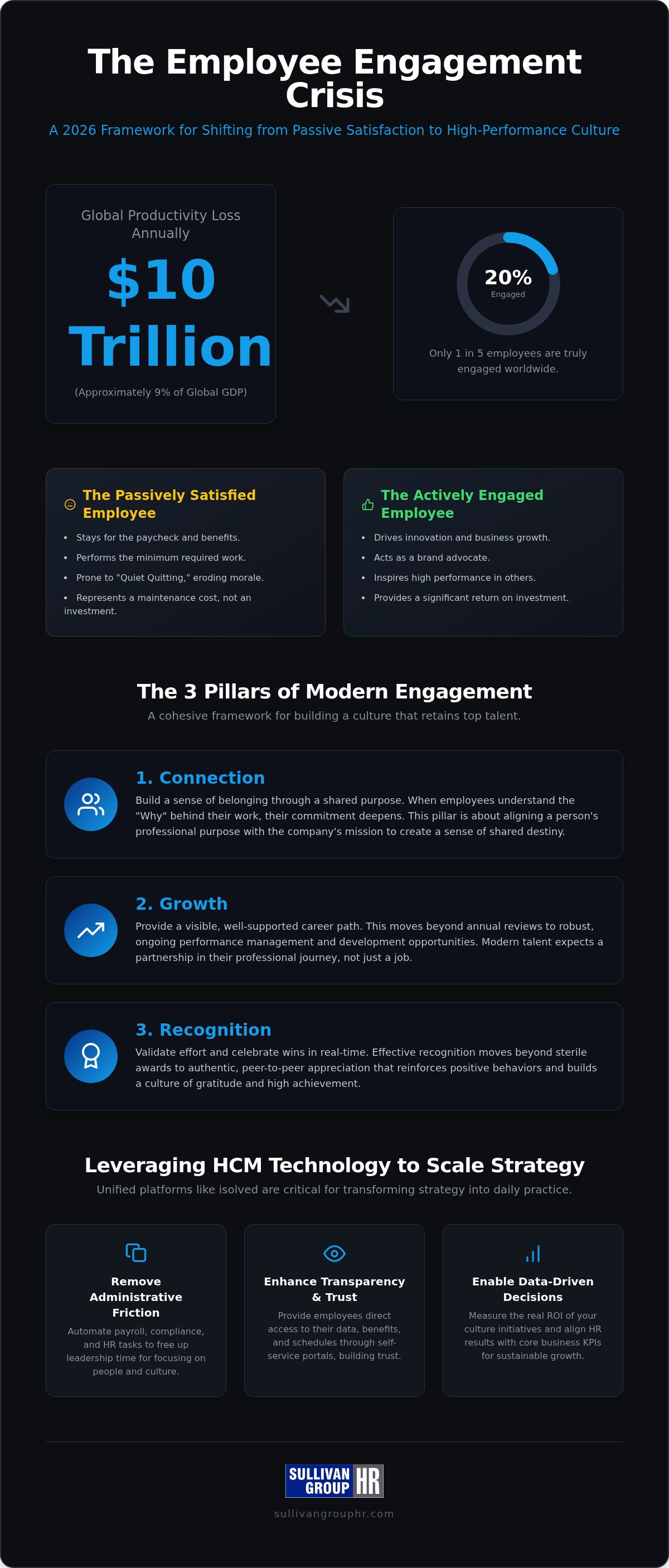
Are your employees just satisfied, or are they truly engaged? There's a dangerous difference. A satisfied employee stays for the check and the benefits. They do the minimum required to keep their seat. An engaged employee drives your growth, innovates, and protects your brand. According to the 2026 Gallup report, low engagement costs the global economy $10 trillion, or roughly 9% of global GDP. This isn't just an HR problem; it's a financial crisis for the mid-market.
Passive satisfaction often masks "quiet quitting," which silently erodes team morale and puts a heavy burden on your high performers. By identifying the "actively disengaged" and providing those who are drifting with a clearer path, you can shift your workforce from maintenance to momentum. Effective employee engagement strategies focus on this transition, turning a passive workforce into a high-performance engine. We believe that by removing administrative friction, you buy back the time needed to focus on these vital human connections.
The Three Pillars of Modern Employee Engagement Strategies
Connection is the first pillar. It's about building a sense of belonging through shared purpose. When employees understand the "Why" behind their work, their commitment deepens. Research from the U.S. Office of Personnel Management highlights specific strategies for maximizing engagement that emphasize the manager's role in fostering this connection. Growth, our second pillar, provides a visible career path supported by robust performance management. Finally, Recognition moves beyond the sterile "Employee of the Month" plaque. It focuses on real-time, peer-to-peer appreciation that validates effort when it happens.
Strategic Communication and Transparency
Transparency is the bedrock of trust. You can foster this by utilizing an employee self-service portal to give your team direct access to their own data. This isn't just about viewing paystubs; it's about removing the mystery from HR functions. When people have clear visibility into their benefits and schedules, they feel more in control of their professional lives. Frequent, low-stakes feedback loops ensure everyone understands how their individual goals align with company objectives. If you're feeling overwhelmed by these administrative hurdles, our human resources consulting can help you streamline the process.
Recognition as a Culture, Not a Milestone
Recognition should be a daily rhythm, not a quarterly event. The psychological impact of immediate rewards is far greater than a delayed bonus. By integrating appreciation into your daily workflow, you reinforce positive behaviors in real time. We recommend leveraging HCM data to identify the "unsung heroes" who may not always be in the spotlight but keep your operations running smoothly. Peer-to-peer recognition programs empower your team to celebrate each other, creating a supportive environment that larger, national firms often struggle to replicate. It's about valuing people over systems, every single day.
Leveraging HCM Technology to Scale Your Strategy
Why do we often treat technology as a barrier to human connection? In reality, the right tools act as a bridge. Effective employee engagement strategies in 2026 rely on a unified human capital management platform to provide a single source of truth. This isn't about replacing your HR team with algorithms. It's about removing the friction that prevents leaders from having meaningful conversations. When you automate the routine, you liberate the human.
Trust begins with the basics: accuracy, accessibility, and accountability. If an employee can't trust their paycheck, they won't trust your culture. Payroll errors are more than just administrative hiccups; they're emotional events that erode confidence. By ensuring every dollar and every benefit is accounted for through an integrated system, you build a foundation of security. This stability is what allows higher-level engagement to take root and flourish.
Data-Driven Insights vs. Gut Feelings
Are you leading by intuition or by insight? Stop guessing why your turnover is high and start looking at the numbers. People Analytics help you identify engagement gaps across specific departments, shifts, or locations. By tracking participation rates in voluntary benefits and professional training programs, you gain a clear view of what your team actually values. isolved data turns employee sentiment into an actionable strategy by mapping engagement trends directly to retention outcomes. These analytics allow you to predict turnover before it happens, giving you the chance to intervene with a supportive hand rather than a reactive exit interview.
Empowering Managers with Self-Service Tools
Your managers are the primary drivers of your culture, yet they're often the most overwhelmed. Why bury them in manual approvals and paper-shuffling? Self-service tools reduce the administrative weight so they can focus on coaching and mentoring. This empowerment is critical because managers account for 70% of the variance in team engagement. Consider the following benefits of a tech-enabled approach:
- Burnout Prevention: Use integrated time and attendance tracking to monitor excessive overtime and intervene before exhaustion sets in.
- Mobile Connectivity: Reach "deskless" or remote workers through mobile-first HCM tools that deliver company news and recognition directly to their pockets.
- Administrative Freedom: Automated workflows for time-off requests and benefits enrollment buy back hours of strategic time for your leadership team.
By providing these tools, you aren't just managing a workforce; you're protecting your most valuable professional asset. It's about creating a digital environment that feels supportive, organized, and deeply human.
Building Your 2026 Engagement Roadmap
How do you bridge the gap between wanting an engaged culture and actually building one? Most mid-market leaders suffer from an "execution gap" where strategic intent is buried under daily administrative fires. To overcome this, your 2026 roadmap must move from reactive fixes to proactive employee engagement strategies. It's about creating a sustainable cycle of connection, growth, and results. Are you ready to lead your team toward their full professional potential?
We recommend a five-step approach to reclaim your culture and simplify your professional functions:
- Step 1: Conduct a comprehensive HR audit. Identify exactly where administrative friction points, like manual payroll or compliance bottlenecks, are stealing your time.
- Step 2: Align engagement goals with core business KPIs. Engagement must drive productivity to be financially sustainable.
- Step 3: Centralize the experience with a unified HCM platform like isolved to ensure a single source of truth.
- Step 4: Train managers as "culture coaches." Since managers account for 70% of the variance in team engagement, their development is your highest leverage activity.
- Step 5: Measure, iterate, and communicate. Success requires a constant feedback loop that celebrates progress.
From Onboarding to Long-Term Retention
Engagement doesn't start on the first day of work; it starts with the very first interaction. Your applicant tracking and onboarding process is the "First Impression" of your entire culture. A seamless, digital-first welcome experience validates the new hire's decision and reduces early anxiety. We've seen that clear mentorship during the first 90 days significantly boosts retention. It's about moving from "hired" to "integrated" as quickly as possible to foster immediate belonging.
Measuring What Actually Matters
Stop relying solely on annual surveys that only tell half the story. To truly understand your culture, you must track internal mobility and employee referral rates. These are the real indicators of a healthy workplace. You can also use benefits management solutions to gauge how much your team actually values their total compensation package. We also recommend "Stay Interviews" over "Exit Interviews." Why wait until someone is leaving to ask what would've made them stay? If you need help designing this roadmap, our human resources consulting team is here to guide you every step of the way.
How Sullivan Group HR Transforms Engagement into Results
How much time do you spend on paperwork that could be spent on your people? At Sullivan Group HR, we believe you should focus on your vision while we handle the administrative weight. We position ourselves as your coach and ally, taking over the "Business of HR" so you can lead the "People of HR." This partnership is the secret weapon behind the most effective employee engagement strategies. By removing the burden of compliance and administration, we help you buy back the time needed to build a truly high-performance culture.
Trust is the bedrock of any professional relationship, and it starts with getting the basics right every single time. When you choose payroll administration outsourcing, you aren't just offloading a task; you're protecting your company's reputation. Errors in pay or benefits are the fastest way to erode employee confidence. We eliminate those friction points, ensuring your team feels safe, valued, and respected. It's a "no-nonsense" approach that prioritizes results over excuses.
Integrating isolved for Seamless Management
We provide access to the industry-leading isolved HCM platform to centralize your operations and simplify complex professional functions. This all-in-one solution integrates payroll, benefits, and talent management into a single source of truth. We don't just hand you the keys; we customize the experience to fit your specific regional needs and team dynamics. A unified platform reduces the "app fatigue" that often overwhelms employees and kills engagement. By streamlining the digital experience, you make it easier for your team to stay connected and productive.
Professional Consulting for a Human-Centric Culture
Our human resources consulting team acts as a direct extension of your leadership team. We bring hard-earned wisdom to every interaction, helping you navigate complex cultural shifts with confidence. We help you manage hr risk management without sacrificing the warmth and community-oriented feel of your workplace. As an established regional expert with national-scale resources, we offer the perfect blend of high-tech efficiency and high-touch advocacy. Your success is our primary metric, and we're here to ensure your employee engagement strategies translate into a lasting legacy of excellence.
Lead Your Team Toward Sustainable Growth in 2026
Are you ready to move from administrative burnout to strategic leadership? We've explored how modern employee engagement strategies are built on the functional pillars of connection, growth, and recognition. High-performance cultures don't happen by accident. They require a deliberate roadmap and the right technology to remove the daily friction that slows your momentum. By aligning your business goals with the human needs of your team, you create a foundation for a lasting professional legacy.
Sullivan Group HR is here to act as your advocate and ally. We provide access to the isolved People Cloud to streamline your operations, alongside expert HR consulting that scales with your growth. Our integrated payroll and benefits management ensures the accuracy your team deserves, building the foundational trust necessary for a thriving workplace. Ready to transform your culture? Explore Sullivan Group HR’s HCM solutions today. Your team’s potential is waiting; let's unlock it together.
Frequently Asked Questions
What are the most effective employee engagement strategies for 2026?
The most effective employee engagement strategies for 2026 focus on three core pillars: Connection, Growth, and Recognition. This means building a sense of belonging through shared purpose, providing visible career paths with performance tools, and implementing real-time peer appreciation. Organizations that prioritize these human-centric elements over surface-level perks see higher commitment and lower turnover. It's about aligning professional potential with company mission to create a culture where employees feel valued and secure.
How do you measure the ROI of employee engagement programs?
You measure the ROI of engagement by tracking concrete metrics like retention rates, productivity per employee, and internal referral numbers. When engagement increases, recruitment costs drop because your existing team stays longer and attracts new talent. You can also monitor the usage of voluntary benefits and training programs through your HCM platform. These data points provide a clear financial picture of how a thriving culture directly impacts your bottom line and organizational stability.
Can HR technology like isolved actually improve company culture?
Yes, technology like isolved improves culture by removing the administrative friction that frustrates both managers and employees. When a unified platform handles payroll, benefits, and time tracking, it eliminates the "app fatigue" that drains morale. It provides a single source of truth and self-service tools that empower your team. This efficiency buys back the time your leadership needs to focus on coaching and building genuine human connections rather than pushing paper.
What is the difference between employee satisfaction and employee engagement?
Employee satisfaction is a passive state where a worker is content with their pay and benefits but may not be committed to the company's success. In contrast, employee engagement is an active emotional commitment where people drive growth and innovate. While satisfied employees might stay for the check, engaged employees stay because they believe in the mission. Moving from satisfaction to engagement is the key to stopping "quiet quitting" and building a high-performance workforce.
How does payroll accuracy affect employee engagement levels?
Payroll accuracy is the bedrock of foundational trust between an employer and their team. If an employee can't trust that their paycheck is correct, they won't trust your culture or your leadership. Errors in pay create immediate emotional stress and erode the sense of security workers need to be fully engaged. By ensuring every dollar is accurate and on time, you prove that you value their contribution and respect their professional well-being.
What role does onboarding play in long-term employee retention?
Onboarding serves as the critical first impression of your culture and sets the tone for the entire employee lifecycle. A seamless, digital-first experience validates a new hire's decision and reduces early anxiety. Research shows that employees who experience a structured, supportive onboarding process are much more likely to stay past the 90-day mark. It's your first opportunity to foster a sense of belonging and align a new team member with your company's long-term goals.
How can small businesses compete with large corporations on engagement?
Small businesses compete by leveraging their ability to provide a personalized, human-centric touch that national firms can't easily replicate. You have the agility to build deeper community connections and offer flexible, tailored career paths. By partnering with a regional expert for HR outsourcing, you gain access to the same high-level HCM technology used by giants. This allows you to focus on your people while maintaining a stable, professional infrastructure that protects your legacy.
How often should we conduct employee engagement surveys?
We recommend moving away from the traditional annual survey in favor of more frequent, low-stakes pulse surveys. Conducting shorter surveys quarterly or even monthly allows you to identify and address issues in real time. This continuous feedback loop shows your team that their voice matters and that you're committed to making ongoing improvements. It's about creating a dialogue rather than a milestone, ensuring your strategy stays aligned with the actual sentiment of your workforce.


