
What if your payroll process was actually your strongest asset instead of your biggest liability? Most business owners view tax season with a sense of dread, fearing the complexity of multi-state filings or the sting of a surprise Department of Labor audit. It's exhausting to manage manual entries while trying to maintain employee trust. You want to focus on growth, but administrative burdens keep pulling you back into the weeds. This is why a robust payroll compliance checklist is no longer optional; it's your primary shield for 2026.
We've designed this guide to transform that administrative anxiety into absolute confidence. Our goal is to help you master modern regulations and protect your legacy from costly, avoidable mistakes. By following these steps, you can empower your workforce and reclaim your time. We'll explore how to build a 'set-it-and-forget-it' framework using the isolved platform and professional consulting. You'll learn to streamline your tax, time, and truth to ensure your business security remains bulletproof and your administrative burden disappears.
Key Takeaways
- Learn how to transform payroll compliance into a strategic shield that protects your financial assets and strengthens employee trust.
- Master the "Three Pillars of Accuracy" to ensure every tax dollar, work hour, and record is accounted for without error.
- Utilize our comprehensive payroll compliance checklist to navigate the complexities of FLSA classifications and avoid common audit triggers.
- Establish a clear, chronological framework for your daily and quarterly tasks to eliminate administrative chaos and manual entry errors.
- Discover how an integrated HCM platform like isolved can automate your compliance workflow and provide a single source of truth for your business.
Why Payroll Compliance is the Foundation of Your Business Security
Payroll is more than a transaction. It is the heartbeat of your organization and represents the ultimate intersection of legal duty and employee trust. When you get it right, it's invisible. When you get it wrong, it's catastrophic. Compliance isn't just about avoiding trouble. It's about building a foundation for growth and protecting the legacy you've worked hard to create. Are you prepared for an audit environment that now looks at your data in real-time?
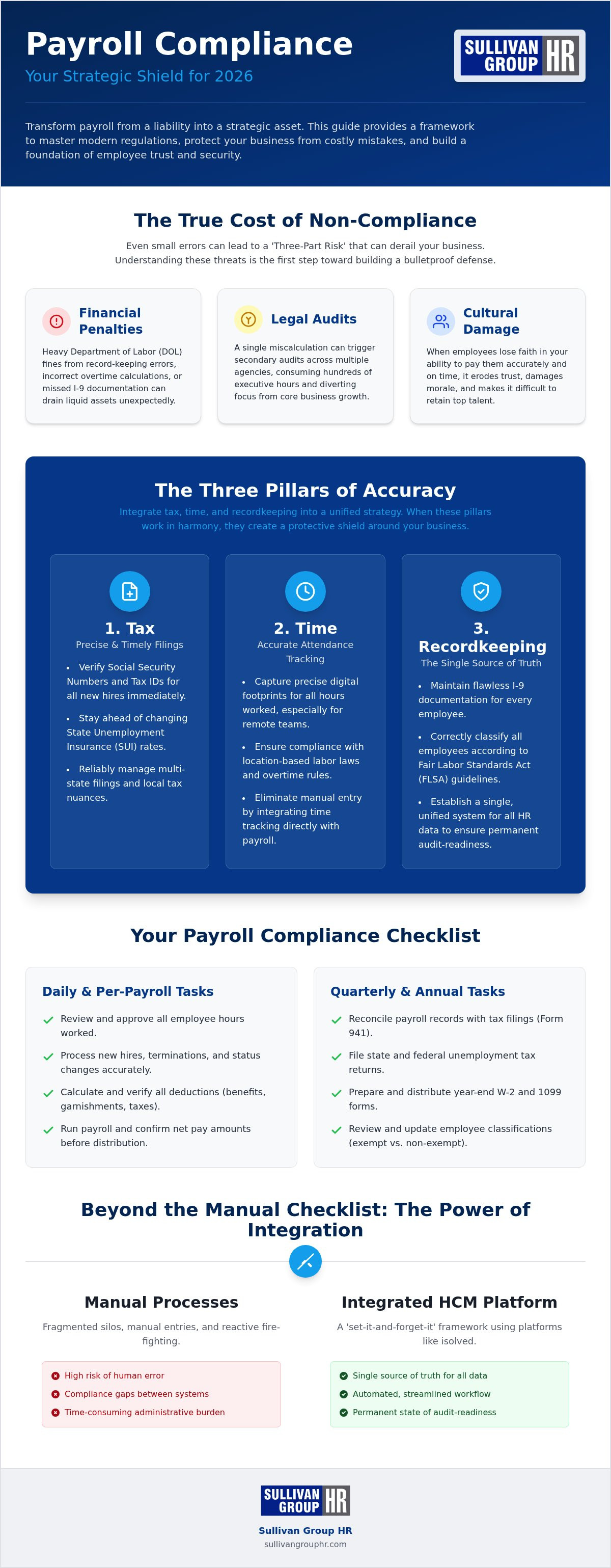
Business owners today face a 'Three-Part Risk' that can derail even the most successful venture. First, financial penalties can drain your liquid assets overnight. Second, legal audits consume hundreds of executive hours. Third, cultural damage occurs when employees lose faith in your ability to pay them accurately. While a basic payroll compliance checklist can help, manual processes often fail as you scale. The 2026 landscape is shifting toward digital-first regulations, making the audit environment more transparent and far more aggressive than in years past.
The True Cost of Non-Compliance
Small record-keeping errors often lead to heavy Department of Labor (DOL) fines. For example, missing I-9 documentation or incorrect overtime calculations can trigger immediate penalties per employee. A single miscalculated tax filing can create a dangerous snowball effect. It often signals to other agencies that your records deserve a closer look, triggering secondary audits across multiple jurisdictions. Industry experts report that the average cost of a payroll audit in 2026 represents a massive financial burden when combining back pay, interest, and statutory penalties.
Compliance as a Competitive Advantage
Accuracy is actually a retention strategy. When your pay cycles are perfect, your employees feel valued and secure. This transparency builds a 'people-first' brand that attracts the best talent in your industry. By implementing a modern payroll compliance checklist, you ensure that your focus remains on your people, not on paperwork. Ultimately, a reliable compliance framework creates the professional freedom you need to lead. You stop reacting to administrative crises and start driving results. This security allows you to act as a coach for your team, proving that you value your people over simple automated systems.
The Three Pillars of Accuracy: Tax, Time, and Recordkeeping
Are you treating your payroll as a series of isolated tasks? Many business owners make the mistake of viewing taxes, time tracking, and recordkeeping as separate silos. This fragmented approach is exactly where compliance gaps begin to form. To build a resilient organization, you must integrate these functions into a unified human capital management strategy. When these three pillars work in harmony, they create a protective shield around your business assets. Tax, time, and truth. These are your anchors.
A comprehensive payroll compliance checklist ensures that no detail falls through the cracks. It moves your business away from reactive fire-fighting and toward a state of permanent audit-readiness. This isn't just about avoiding fines; it's about establishing a professional rigor that your employees can feel. It's about safety, movement, and results.
Pillar 1: Navigating the Tax Maze
Ensuring every cent reaches the correct authority is the first step in protecting your legacy. This process begins with absolute precision in your data. You must verify Social Security Numbers and tax IDs for every new hire immediately. Inaccurate data at the start leads to massive headaches during year-end filings. Additionally, you need to stay ahead of shifting State Unemployment Insurance (SUI) rates. These numbers often change annually, and missing an update can trigger unexpected liabilities. Many growing firms find that payroll administration outsourcing is the most reliable way to manage these complexities. It allows you to leverage expert knowledge to handle multi-state filings and local tax nuances without the administrative burden.
Pillar 2: Master Your Time and Attendance
Time tracking is the critical link between hours worked and wages paid. Rough estimates are no longer acceptable; they're a legal liability. In 2026, standards for remote work time-tracking have become even more stringent. You need a system that captures precise digital footprints to prove compliance with location-based labor laws. Integrating your time-tracking directly with your payroll platform eliminates the manual entry errors that lead to employee distrust. This integration ensures that overtime is calculated correctly every single time. If you're still using spreadsheets to track hours, you're leaving your business vulnerable to wage and hour claims. You can explore integrated time and attendance solutions to automate this pillar and ensure your data is always accurate.
The final pillar is the Truth. This means maintaining audit-ready records at all times. Your recordkeeping should serve as the verifiable proof of your tax and time accuracy. Whether it's I-9 forms, payroll registers, or deduction authorizations, your documentation must be organized and accessible. A strong payroll compliance checklist keeps these pillars standing tall, ensuring your business remains secure and your workforce stays empowered.
Navigating Employee Classification and the FLSA
Does your current workforce structure leave you vulnerable to a surprise audit? Misclassifying a worker isn't just a clerical error; it's a fundamental threat to your business security. Your payroll compliance checklist must prioritize the distinction between employees and independent contractors to avoid the 'Classification Trap.' This trap often catches well-meaning owners who assume a signed 1099 agreement is enough protection. It isn't. The Department of Labor looks past the contract to the actual nature of the relationship. Missteps here directly damage your HR risk management profile, potentially leading to years of back taxes and unpaid overtime claims.
Understanding the difference between exempt and non-exempt status is equally vital. You can't simply pay a salary to avoid overtime. Under the Fair Labor Standards Act (FLSA), an employee must pass a specific duties test to be considered exempt. In a modern workplace where remote and flexible schedules are common, managing overtime eligibility becomes even more complex. You must ensure that non-exempt staff are tracked accurately, regardless of where they work. This protectiveness ensures your team stays empowered while your business remains legally sound.
The Independent Contractor Test
The Department of Labor utilizes an 'Economic Reality' test to determine if a worker is truly an independent contractor. They look for economic dependence. Are you the worker's only source of income? Do you control when and how they perform their tasks? A common misconception is that if a worker wants to be a '1099,' it's legally permissible. This is false. You must re-evaluate your current roles by examining the degree of control you exert and the permanency of the relationship. If the role is integral to your daily operations, they are likely an employee.
FLSA Recordkeeping Requirements
Precision in your documentation is your best defense. The FLSA requires you to keep specific data points, including total hours worked each day and total overtime earnings, for at least three years. You must also maintain 'Poster Compliance' by displaying current labor law information in a location accessible to all staff, including digital versions for remote teams. The 2026 exempt salary threshold remains a critical figure that business owners must verify against the latest Department of Labor triennial adjustments to ensure continued compliance. Keeping these records organized isn't just a chore; it's a strategic shield for your professional legacy.
Your 2026 Payroll Compliance Checklist: A Chronological Framework
Do you know exactly what needs to happen by next Tuesday? Most compliance failures don't happen because of a lack of knowledge. They happen because of a lack of timing. A payroll compliance checklist is only effective if it's integrated into your actual work calendar. You need a chronological framework that moves with the rhythm of your business. This ensures that every task, from the daily grind to the annual review, receives the attention it deserves. It turns a daunting legal requirement into a manageable professional habit.
Every pay cycle requires immediate precision. You must verify deductions and check for manual adjustments before any funds leave your account. This is also the time to ensure new hire data is captured perfectly. Linking these per-pay-period habits to your overall workforce management solutions creates a seamless flow between talent and compensation. It prevents the data fragmentation that leads to audit triggers.
Monthly tasks should focus on reconciling your payroll registers against your bank statements. Quarterly, your focus shifts to state tax filings and unemployment reports. Annually, you must handle W-2 distribution and a full policy review. Once a year, perform an 'Audit Drill.' Randomly select five employee files. Verify that every signature, deduction, and hour worked is documented. If you find a gap now, you can fix it before the Department of Labor finds it for you. This proactive approach is the ultimate security measure.
The Onboarding and Offboarding Checklist
Compliance starts and ends at the door. You must verify Form I-9 within three business days of a new hire's start date. There are no exceptions to this rule. When an employee leaves, your payroll compliance checklist must account for state-specific termination laws. Some jurisdictions require final paychecks on the last day of work, while others allow for the next regular pay cycle. Managing benefit deductions during these transitions prevents costly overpayments or coverage gaps that can haunt your bottom line.
The Periodic Review: Staying Ahead of Changes
Regulations are not static. You must update your State Unemployment Insurance (SUI) rates every January to avoid underpayment penalties. Review employee addresses in the fall to ensure accurate W-2 delivery in January. Finally, check for local minimum wage increases in every jurisdiction where you operate. These often change on July 1st or January 1st. Staying ahead of these shifts protects your business from unnecessary friction and legal exposure. Ready to automate this calendar? Partner with our payroll experts to build a custom compliance schedule for your team.
Beyond the Manual Checklist: Leveraging Integrated HCM
Are you still relying on paper trails and manual reminders to keep your business safe? A payroll compliance checklist is a vital foundational tool, but as your organization scales, the complexity of modern regulations can outpace even the most diligent administrator. You need a system that doesn't just list tasks but actively prevents errors. By moving beyond manual processes, you transform compliance from a recurring stressor into a silent, automated strength. This shift allows you to focus on your professional potential while a unified system handles the administrative rigor. For organizations looking to formalize their internal documentation, SOP Corp provides an AI-assisted way to build and manage the standard operating procedures that support these automated systems.
The power of a single source of truth cannot be overstated. When your payroll, employee benefits, and time and attendance data are integrated, you eliminate the data silos that often hide compliance gaps. This connectivity ensures that every deduction is accurate and every work hour is recorded in real-time. Automated reporting replaces the frantic energy of manual audits with the calm of permanent readiness. You no longer have to "get ready" for an audit because your system is always prepared.
The isolved HCM platform serves as the technological backbone of your compliance strategy. It offers automated tax filing and constant updates to reflect the latest regulatory shifts, ensuring you never miss a deadline or a rate change. With employee self-service portals, the responsibility for record accuracy is shared. Staff can update their own addresses and tax withholdings, which reduces your administrative burden and improves data integrity. Real-time reporting tools provide proactive risk management, allowing you to spot and correct potential issues before they escalate into legal liabilities.
Why Partner with Sullivan Group HR?
We are more than a transactional vendor. We are an established, "no-nonsense" authority that understands the specific nuances of your territory. By partnering with Sullivan Group HR, you combine the power of the isolved platform with our deep human expertise in HR consulting. We act as your coach and ally, helping you protect your business legacy through every stage of the employee lifecycle. Our collaborative approach ensures that your organizational security is built on a foundation of stability and hard-earned wisdom. We value your people over simple automated systems, providing the personalized touch that national firms lack.
Ready to trade your manual payroll compliance checklist for a unified, secure solution? It's time to reclaim your professional freedom and empower your workforce with a platform designed for results. Let's build a compliance framework that works as hard as you do.
Protect Your Legacy with Permanent Audit Readiness
Is your business truly prepared for the regulatory shifts of 2026? We've explored how a comprehensive payroll compliance checklist transforms administrative dread into a strategic advantage. It starts with mastering the three pillars of tax, time, and recordkeeping. It continues by addressing the classification traps that trigger federal audits. The most important step is moving from manual tracking to a unified, automated system. This is where your professional potential meets organizational security.
Success requires a blend of advanced technology and human expertise. You don't have to face the Department of Labor alone. By utilizing the industry-leading isolved HCM platform and our expert HR consulting, you gain the peace of mind needed to lead your team. We provide the comprehensive payroll and benefits administration that keeps your business moving safely forward. You've worked hard to build your company. Let's ensure it stays protected.
Secure your business with a unified payroll solution—Contact Sullivan Group HR today.
Frequently Asked Questions
What are the most common payroll compliance mistakes for small businesses?
Misclassifying employees as independent contractors and failing to calculate overtime correctly are the top errors. Many owners also struggle with tracking remote work hours or missing state-specific tax updates. These oversages often trigger Department of Labor audits and lead to heavy back-pay liabilities. Using a consistent payroll compliance checklist helps catch these errors before they result in financial penalties or damage employee trust.
How long are employers required to keep payroll records for the DOL?
The Fair Labor Standards Act (FLSA) requires you to keep payroll records for at least three years. Additionally, you must preserve records on which wage computations are based, such as timecards and piece work tickets, for two years. Keeping these documents organized ensures you remain audit-ready. Digital storage within an integrated HCM platform like isolved makes retrieving these records simple if a regulatory agency requests an inspection of your files.
What is the difference between an employee and an independent contractor in 2026?
The primary distinction lies in the "Economic Reality" test used by the Department of Labor to determine worker dependence. An employee is financially dependent on your business, while a contractor maintains an independent business venture. Factors include the degree of control you exert over their work, the permanency of the relationship, and who provides the necessary equipment. Mislabeling a worker as a contractor to avoid benefits or taxes is a major audit trigger.
Can payroll software automatically handle multi-state tax compliance?
Advanced platforms like isolved are designed to automate the complexities of multi-state tax filings. These systems track the specific tax laws, unemployment insurance rates, and local withholding requirements for every jurisdiction where your employees work. This automation is a critical component of a modern payroll compliance checklist. It reduces the risk of manual entry errors and ensures that your business remains compliant even as your remote workforce expands across state lines.
How often should a business conduct an internal payroll audit?
Missing a deadline triggers immediate failure-to-file penalties and interest charges from the IRS or state agencies. These costs accumulate quickly and can significantly impact your cash flow. Beyond the financial sting, late filings often signal to regulators that your internal controls are weak, which may lead to more frequent and deeper audits. Promptly addressing a missed deadline is essential to protect your business legacy and maintain a clean compliance record.
Does the FLSA apply to remote workers in different states?
Yes, the Fair Labor Standards Act applies to all covered employees regardless of their physical work location. You must comply with federal minimum wage and overtime rules for every remote staff member. It's also important to note that state-specific labor laws often apply based on where the employee is actually performing the work. This means you may need to manage different overtime thresholds or rest break requirements for a multi-state team.
How does integrated HCM software reduce payroll errors?
Integrated HCM software creates a single source of truth by connecting time tracking, benefits, and payroll in one platform. This connectivity eliminates the need for manual data reentry, which is where most human errors occur. When an employee tracks their time, the data flows directly into the payroll engine with pre-configured compliance rules. This seamless movement ensures that every paycheck is accurate, protected, and reflective of the actual hours worked by your workforce.


