

What if you could eliminate unearned wages and payroll errors with a single touch? For many leaders, the dream of a self-running, 100% accurate attendance system feels just out of reach. You want to trust your team, but you also know that "buddy punching" and manual data entry mistakes are quietly draining your bottom line. It's a difficult balance to strike. To make the right choice for your company's future, you need a clear-eyed look at the biometric time clock pros and cons.
We understand the pressure of protecting your profit while respecting employee privacy. This 2026 strategic guide will help you decide if biometric tracking is your next big win or a potential compliance headache. We'll explore how these tools integrate with systems like isolved to automate your payroll, secure your data, and safeguard your culture. You will learn to weigh the undeniable accuracy of fingerprints and facial recognition against the evolving landscape of privacy regulations like BIPA. Let's find the path that keeps your business compliant, efficient, and profitable.
Key Takeaways
- Stop payroll leakage by moving from "what you have" to "who you are," ensuring every minute worked is a minute paid.
- Protect your organization from costly litigation by conducting a proactive legal audit of state-specific biometric privacy laws like BIPA.
- Streamline your administrative workflow by integrating advanced hardware directly with the isolved HCM platform for seamless payroll data.
- Weigh the biometric time clock pros and cons to find a solution that balances modern security with your team's unique culture.
- Master the art of "compliance-first" implementation through transparent employee communication and secure data management strategies.
Beyond the Badge: The Evolution of Biometric Time Tracking
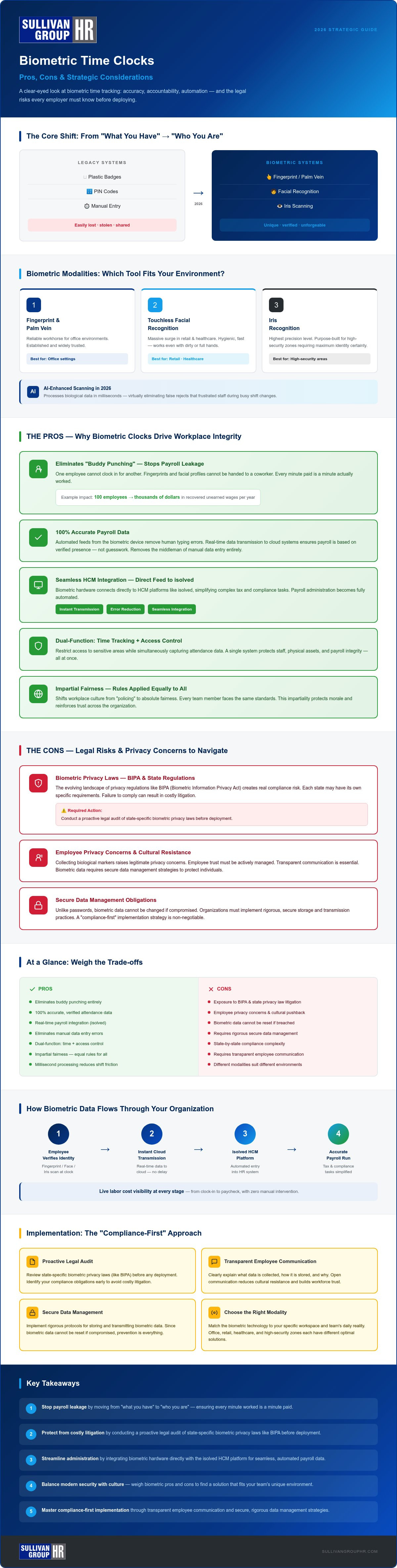
How do you prove an employee is who they say they are? For decades, businesses relied on plastic badges and PIN codes. These tools are easily lost, stolen, or shared. Today, we've moved beyond those physical props. Biometric time clocks use unique biological markers like fingerprints, facial features, or iris patterns to verify identity. It's a shift from what you have to who you are. As you weigh the biometric time clock pros and cons, it's clear that this evolution is about more than just high-tech gadgets. It's about establishing a foundation of absolute truth in your workplace.
The 2026 landscape looks significantly different than it did just a few years ago. AI-enhanced scanning now processes biological data in milliseconds. This speed has virtually eliminated the false rejects that used to frustrate staff during busy shift changes. These systems don't just track time; they serve as a strategic HR asset. They provide a protective layer for your business, ensuring that your payroll is based on verified presence rather than guesswork. This creates a loop of speed, accuracy, and security for your entire operation.
Common Biometric Modalities in the Workplace
Different environments require different tools. Fingerprint and palm vein scanning remain the reliable workhorses for many office environments. However, we've seen a massive surge in touchless facial recognition across retail and healthcare. It's hygienic, fast, and works even if an employee's hands are dirty or full. For high-security zones, iris recognition offers a level of precision that was once the stuff of science fiction. These biometric identification technologies ensure that your records are as unique as your people. Choosing the right modality depends on your specific workspace and the daily reality of your team.
How Modern Biometrics Connect to Your Payroll
The real magic happens behind the scenes. Modern biometric clocks don't just sit on a wall; they talk to your systems. Data moves from the clock to the cloud in real-time, providing a live view of your labor costs. You eliminate the manual entry errors that plague traditional systems. When biometrics feed directly into the isolved platform, payroll becomes a breeze. This connectivity is a core part of modern workforce management solutions. By removing the middleman of manual data entry, you ensure that your payroll administration is based on 100% accurate data. Truly understanding the biometric time clock pros and cons starts with recognizing how this data flows through your organization to protect your bottom line.
- Instant Transmission: Data moves from the hardware to the software without delay.
- Error Reduction: Automated feeds remove the risk of human typing mistakes.
- Seamless Integration: Direct links to HCM platforms like isolved simplify complex tax and compliance tasks.
The Pros: Why Biometric Clocks Drive Workplace Integrity
Why does payroll integrity matter so much to your bottom line? It protects your profit, ensures fairness across your team, and builds a culture of trust. When you examine the biometric time clock pros and cons, the benefits of accuracy and accountability usually lead the conversation. These systems don't just record time; they verify presence. This distinction is the foundation of a modern, secure workplace. By using biological markers, you eliminate the guesswork that often leads to expensive administrative errors.
Beyond simple time tracking, these tools offer a multi-layered approach to business security. You can restrict access to sensitive areas while simultaneously capturing attendance data. This dual function creates a safer environment for your staff and your physical assets. To further bolster your organization's digital defenses, you can discover CyberOne and their specialized cybersecurity solutions. It's an investment in three core areas: accuracy, accountability, and automation. By removing the human element from the identification process, you create a system that is both impartial and incredibly precise.
Buddy punching remains a significant driver of payroll leakage. It happens when one employee clocks in for another who is running late or absent. While five minutes here and there might seem small, the cumulative cost is staggering. For a company with 100 employees, those small leaks can result in thousands of dollars in unearned wages every year. Biometric clocks make this practice impossible. You cannot hand a fingerprint or a facial profile to a coworker. This shift moves your workplace culture from one of "policing" to one of absolute fairness. Every team member knows that the rules are applied equally to everyone, which protects morale and your budget simultaneously.
Streamlining the Payroll Lifecycle
The administrative burden of manual payroll is a constant headache for growing businesses. HR teams often spend hours deciphering handwritten notes or investigating missing punches. Biometrics solve this by generating automated, 100% accurate timesheets. This data feeds directly into your larger systems, creating a seamless bridge to payroll administration outsourcing. You get a clean digital audit trail that reduces compliance friction during tax season or internal reviews. It's about making your business faster and more profitable by letting technology handle the repetitive tasks. If you're ready to see how these tools can transform your operations, our human capital management experts can help you design a system that works for your unique team.
- Eliminate Time Theft: Stop unearned wage payments instantly.
- Boost HR Productivity: End the cycle of manual data entry and error correction.
- Ensure Data Integrity: Rely on 100% accurate, verified attendance records for every pay period.
The Cons: Navigating Legal Risks and Privacy Concerns
What happens when your high-tech solution creates a high-stakes legal problem? To make an informed decision, you must look at both sides of the biometric time clock pros and cons. While these systems offer unmatched precision, they also introduce a unique set of compliance and security risks. In 2026, the legal landscape is more complex than ever. You aren't just managing time; you're managing sensitive biological data that cannot be changed if it's compromised. Protecting your business means understanding these vulnerabilities before you install a single device.
The legal minefield is real. Regulations like the Biometric Information Privacy Act (BIPA) in Illinois and the California Consumer Privacy Act (CCPA) have set a high bar for data protection. Many other states have followed suit with their own emerging laws. Non-compliance can lead to devastating class-action lawsuits and heavy fines. Beyond the law, you must also manage employee perception. Some team members may view biometric scanning as an invasive tactic. Addressing these privacy fears is essential to maintaining a healthy, trusting workplace culture.
Finally, consider the initial investment. High-quality biometric hardware requires a larger upfront cost than traditional badge readers. When evaluating the biometric time clock pros and cons, the hardware cost is often the most visible hurdle. You must weigh this expense against the long-term ROI of eliminated time theft. While the hardware is durable, it still requires maintenance and occasional troubleshooting to remain effective over several years.
The Compliance Burden: Consent and Disclosure
Consent is your first line of defense. In 2026, written consent forms are non-negotiable for any business using biometric tracking. You must clearly disclose how data is collected, how long it is stored, and when it will be destroyed. This transparency protects you and your employees. We help our clients master HR risk management by building robust policies that meet these strict standards. A solid policy includes three key pillars: clear disclosure, verified consent, and secure destruction.
Technical Hurdles and Maintenance
Technology isn't perfect. "False negatives" occur when a scanner fails to read a legitimate user, often due to dirty fingers in industrial or construction settings. Extreme environments like intense heat, bitter cold, or heavy dust can also challenge hardware durability. To keep your operations moving, you must have a backup plan. A secondary clock-in method, such as a PIN code or a physical badge, ensures that your team can always record their time. Regular cleaning and software updates are necessary to keep your biometric system running at peak performance.
Selection Criteria: Choosing the Right Clock for Your Team
Are you outfitting a quiet medical suite or a bustling fabrication shop? The hardware you choose must survive the daily reality of your team. While we have already explored the general biometric time clock pros and cons, your final decision depends on four practical factors: environment, integration, capacity, and speed. A clock that works perfectly in a carpeted office might fail in a dusty warehouse. You need a solution that feels like a natural extension of your workplace, not a barrier to entry. If you are managing industrial settings, you may also want to check out Bio-Cognitive Solutions to ensure your broader operational technology environment is protected.
Speed is non-negotiable for large teams. If you have 50 employees arriving for a 7:00 AM shift, you cannot afford a five-second delay per person. Look for verification speeds of less than one second. This prevents bottlenecks in the lobby and ensures your staff starts their day on time. Capacity also matters. Ensure your chosen device can store the biometric profiles of your entire workforce with room to grow. It's about planning for the business you want to be, not just the one you are today.
Hygiene is a top priority in healthcare and food service. For these environments, touchless facial recognition is the superior choice. It eliminates physical contact and keeps your team safe. In contrast, manufacturing and construction sites often require ruggedized fingerprint scanners. These devices are built to handle dirt, grease, and heavy use. If you have a diverse workforce, consider "hybrid" clocks. These offer both biometric scanning and PIN options, providing a reliable backup for every situation. Matching the modality to the task is a key part of your workforce management solutions strategy.
Software Integration: The 'Brain' Behind the Clock
A standalone clock is a data silo. It forces your HR team to manually pull reports and upload files, which defeats the purpose of automation. The real power lies in a unified feed. When your hardware talks directly to the isolved People Cloud, everything changes. You get real-time alerts for overtime, late arrivals, and missing punches. This connectivity allows you to manage your labor costs proactively rather than reacting to errors after the pay period ends. Don't settle for a clock that doesn't communicate. If you want to build a truly integrated system, our human capital management experts can guide you through the selection process.
Implementation Strategy: The Sullivan Group HR Approach
How do you move from a strategic plan to a successful rollout? Implementation is where many businesses stumble, but it is also where you secure your long-term return on investment. By now, you have weighed the biometric time clock pros and cons and decided to move forward. Success now depends on a structured, people-first approach. We believe that the best technology only works when it is backed by clear policies and empathetic leadership. It's about protecting your business while supporting your team.
Our framework starts with a rigorous legal audit. You must verify your state’s specific biometric privacy requirements before collecting a single scan. Once the legal foundation is set, we move to transparent communication. Tell your team why this change is happening. Explain that it is about ensuring everyone is paid fairly for every minute they work. Finally, we recommend a pilot phase. Test the hardware with a small group to calibrate the sensors and identify any environmental hurdles before a full-company launch. This phased approach allows you to Acquisition, Compensation, and Security with confidence.
Winning Employee Buy-In
Privacy concerns are the most common source of friction during a transition to biometrics. You can overcome this by being an open book. Explain that modern systems don't store actual photos of fingerprints or faces. Instead, they create encrypted mathematical templates that cannot be used to reconstruct a biological image. This distinction is vital for peace of mind. By framing the system as a tool for fairness rather than a tool for surveillance, you build a culture of accountability. Create an open-door policy where employees can ask questions about how their data is stored, used, and eventually destroyed. Truly understanding the biometric time clock pros and cons means recognizing the human element at every step.
Leveraging isolved for Unified Workforce Success
A time clock should never be a standalone island in your office. We integrate your biometric data into a broader Human Capital Management strategy. This creates a single source of truth for your entire organization. When your attendance data flows seamlessly into the isolved platform, you eliminate the gaps where errors and compliance risks often hide. You gain a partner who understands the nuances of your industry and the complexities of payroll law. This transition allows you to move from talent acquisition to compensation and long-term organizational security with ease. Ready to secure your payroll? Speak with a Sullivan Group HR expert today to build a system that protects your people and your profits.
Future-Proof Your Payroll Strategy Today
Weighing the biometric time clock pros and cons is a vital step for any leader looking to protect their bottom line. You've seen how these tools eliminate buddy punching and streamline your payroll cycle. However, success isn't just about the hardware on the wall. It's about building a foundation of trust through transparent policies and airtight legal compliance. When you align high-tech accuracy with a people-first approach, you create a workplace that values every minute of work.
You don't have to navigate this transition alone. As an authorized isolved Elite Partner with 25+ years of human resources expertise, we're here to be your coach and ally. We provide comprehensive HR compliance audits to ensure your data practices stay ahead of evolving regulations like BIPA. By integrating advanced tracking with your broader HCM strategy, you can turn administrative burdens into a strategic advantage. It's time to move toward a more secure, efficient, and profitable future.
Secure Your Payroll Integrity with Sullivan Group HR. Your team deserves a fair, accurate system that protects their future as much as yours. Let's build it together.
Frequently Asked Questions
Is it legal to require employees to use a biometric time clock?
It's generally legal in most jurisdictions, provided you comply with specific state regulations and disclosure requirements. States like Illinois and California have strict laws regarding notice and written consent. You must provide a clear policy explaining how the data is used and stored. We recommend consulting with our human resources experts to ensure your implementation meets all current legal standards across the country.
What is 'buddy punching' and how much does it actually cost businesses?
Buddy punching occurs when one employee clocks in for another who isn't present. This practice is a major driver of payroll leakage. While individual instances seem small, the American Payroll Association has previously estimated that it can cost companies up to 2.2% of their total gross payroll. Using a biometric system eliminates this risk by ensuring the person on the clock is physically present at the terminal.
Do biometric time clocks store actual fingerprints or facial images?
Modern systems do not store actual images of your employees' faces or fingerprints. Instead, the hardware converts biological markers into a unique mathematical template or code. This code is encrypted and cannot be reversed to recreate the original image. This technical safeguard is a key factor when weighing the biometric time clock pros and cons for your team's privacy and security.
How do I handle employees who refuse to use biometric scanners for religious or privacy reasons?
You should offer a reasonable alternative to ensure compliance with Title VII of the Civil Rights Act and other labor laws. If an employee has a sincerely held religious belief or a valid privacy concern, provide a non-biometric option like a PIN code or physical badge. Having a documented exception process protects your culture and your legal standing while maintaining operational efficiency for the rest of your staff.
What happens to the biometric data if an employee leaves the company?
Your data retention policy must dictate the immediate or scheduled destruction of biometric templates once an employee is no longer with the firm. Most state laws require that data be deleted within a specific timeframe after the purpose for collection has ended. We help our clients establish secure destruction protocols that satisfy both state regulations and internal security standards to prevent any long-term liability.
Which is better: facial recognition or fingerprint scanning for a warehouse environment?
Facial recognition is often the superior choice for warehouse settings because it is touchless and hygienic. Warehouse work often involves dust, grease, or gloves, which can cause false rejects on traditional fingerprint scanners. Facial recognition terminals allow for faster throughput during shift changes. This helps you balance the biometric time clock pros and cons by choosing the modality that best fits your specific physical workspace.
Can biometric time clocks integrate with my existing payroll software?
Yes, seamless integration is a hallmark of modern Human Capital Management. Our systems feed attendance data directly into the isolved platform, eliminating the need for manual data entry or file uploads. This connection ensures that your payroll administration is based on real-time, verified data. A unified feed reduces errors and allows your HR team to focus on strategic growth rather than administrative troubleshooting.
Are biometric time clocks expensive to maintain compared to traditional badge systems?
While the initial hardware investment is typically higher, the ongoing maintenance costs are often lower than traditional badge systems. You no longer need to purchase, replace, or re-issue plastic cards that employees frequently lose or damage. The primary maintenance involves simple cleaning and software updates. Over time, the elimination of buddy punching and badge replacement costs usually results in a significant net saving for the business.


