

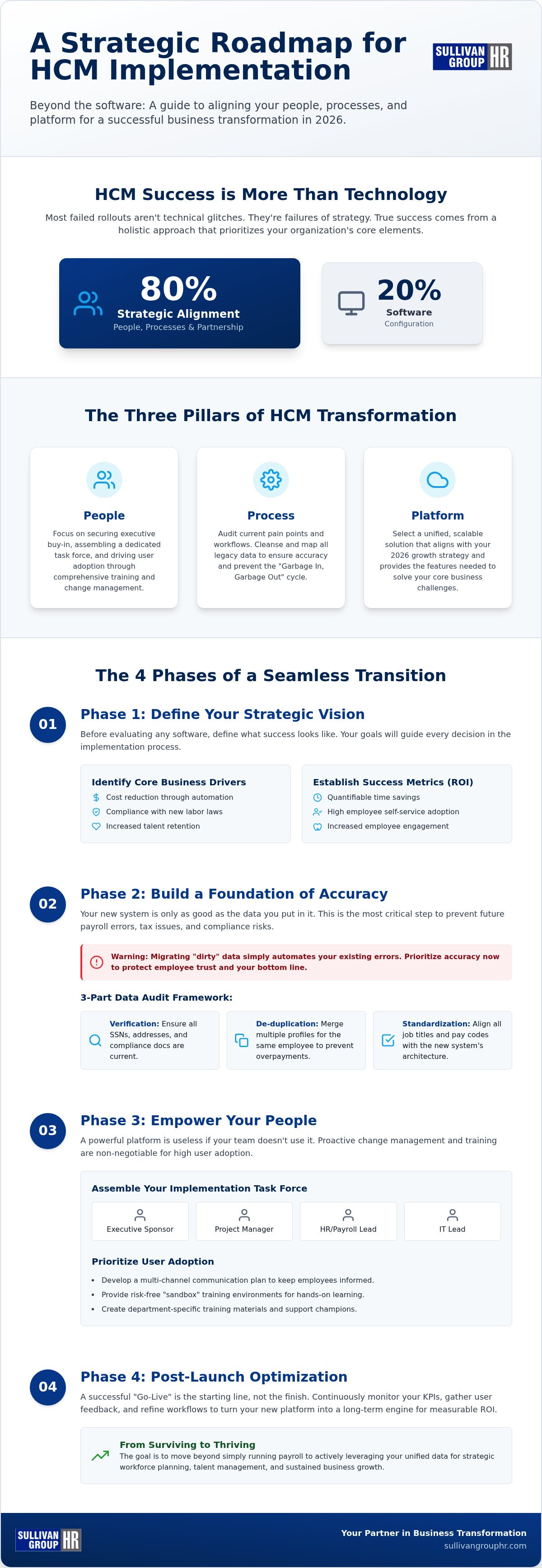
Most business owners believe a failed software rollout is simply a technical glitch. In reality, successful HCM implementation is 20 percent software configuration and 80 percent strategic alignment between your people, your processes, and your partnership. When you're researching how to choose an hcm platform, the stakes feel incredibly high. You're likely worried about payroll errors during the transition or employees who might resist the change. It's a valid concern. Moving your entire workforce data shouldn't feel like a gamble with your company's stability or your team's trust.
We believe you deserve a partner who acts as a coach and an advocate. This guide provides a battle-tested framework designed to secure your data, empower your people, and drive measurable ROI. You'll learn how to master the complexities of deployment while ensuring high user adoption across every department. We'll walk through the essential implementation steps for 2026, from staying ahead of new state regulations to automating workflows that finally give your team their time back. By the end, you'll have a clear roadmap for a seamless transition to a unified platform that works as hard as you do.
Key Takeaways
- Learn why successful HCM implementation is a business transformation that requires a three-part pillar of people, process, and platform.
- Discover how to audit and cleanse your employee data to prevent payroll errors and ensure a reliable foundation for your new system.
- Understand the specific roles needed for your implementation task force to ensure executive buy-in and project stability.
- Master the steps of how to choose an hcm platform that prioritizes user adoption through multi-channel communication and risk-free sandbox training.
- Explore the post-launch optimization strategies that turn a successful go-live into a long-term engine for measurable ROI.
Defining the Strategic Vision: How to Choose an HCM Platform for Growth
Are you looking for a simple software upgrade, or a total business evolution? Implementing a Human Capital Management (HCM) platform is rarely just an IT project. It's a fundamental shift in how your organization breathes. Many leaders treat this like a plug and play installation. That's a mistake. True success rests on a three part pillar: your people, your processes, and your platform. If one leg is weak, the whole structure topples. When you're deciding how to choose an hcm platform, you're actually deciding how your company will scale in 2026 and beyond. We act as your coach and ally to ensure this vision is clear from the start.
What's the primary goal for your rollout? You must identify the core drivers before you sign a contract. Is the goal cost reduction through automation? Is it maintaining compliance with new state labor laws? Perhaps it's increasing talent retention by improving the employee experience. Without a defined target, your implementation will lack direction. Establishing clear KPIs for your "Go-Live" date ensures everyone is moving toward the same finish line. Success isn't just about the software turning on; it's about the software turning your business into a more efficient machine.
Identifying Your Core Business Drivers
Every firm has friction. You need to audit your current pain points before you look at a single demo. Where is the administrative weight the heaviest? If your team spends twenty hours a week on manual data entry, that's a clear signal. You must differentiate between must-have features and nice-to-have bells and whistles. A flash interface won't fix a broken payroll process. Align your HCM goals with your 2026 growth strategy. Solutions like the isolved People Cloud provide a unified suite that scales with you. It simplifies complex professional functions into a single, manageable stream of data.
Establishing Success Metrics and ROI
You can't manage what you don't measure. Quantifying your goals makes the investment tangible for your executive team. Start by calculating potential time savings in payroll administration and benefits enrollment. Set firm benchmarks for employee self-service adoption rates. If your staff doesn't use the tool, the tool isn't working. HCM ROI is the intersection of reduced labor costs and increased employee engagement. By setting these benchmarks early, you transform a vague hope for improvement into a documented business win. This strategic foresight protects your data and your bottom line.
Data Readiness: Building the Infrastructure of Accuracy
How do you ensure your new system doesn't inherit your old system's mistakes? HCM Data Readiness is the rigorous process of auditing, cleansing, and validating every piece of employee information before the migration begins. It's the most critical step in learning how to choose an hcm platform. If you move "dirty" data, you're simply automating your errors. This "Garbage In, Garbage Out" cycle destroys payroll accuracy, creates tax headaches, and erodes employee trust. By prioritizing accuracy now, you align with modern payroll administration outsourcing standards that demand high-integrity data for compliance and reporting.
Auditing and Cleansing Legacy Data
Don't assume your legacy records are perfect. We recommend a three-part audit framework: Verification, De-duplication, and Standardization. Start by verifying that every social security number and home address is current. Are there multiple profiles for the same seasonal worker? De-duplicate those records to prevent overpayments. Finally, standardize your job titles and pay codes so they align with the new system's architecture. This is also the time to identify missing compliance documents like I-9s and updated tax forms. Clean data is your best defense against future DOL audits. It's about more than just software; it's about effective change management that starts with a solid foundation of truth. If you find yourself overwhelmed by the volume of records, our team can act as your expert guide through the data migration process, ensuring nothing is left to chance.
Mapping Workflows for a Unified Platform
A unified platform like isolved works best when your workflows are streamlined rather than just digitized. Take this opportunity to visualize the entire employee lifecycle, from the initial applicant tracking phase to long-term retirement planning. Are you still using manual spreadsheets to bridge the gap between payroll and benefits? Intelligent automation can eliminate those redundant steps. When data flows seamlessly between modules, your team spends less time fixing discrepancies and more time focused on growth. We focus on creating a steady, reliable beat for your administrative tasks. By mapping these workflows correctly, you ensure that every piece of information moves safely from talent acquisition to compensation without human intervention. This transition from fragmented tasks to a unified People Cloud turns your HR department into a strategic engine for the business.
Assembling Your Implementation Task Force
Who is actually steering the ship? Software alone cannot solve cultural friction or operational silos. Executive buy-in is the single greatest predictor of implementation success. If leadership isn't visible, the project feels optional to everyone else. When you research how to choose an hcm platform, you are building a coalition, not just a tech stack. You need a dedicated group focused on three core areas: vision, execution, and accuracy. For enterprise transformations, HRIS Audit provides the client-side leadership and advisory services that ensure your internal team remains aligned with your strategic goals.
A successful task force requires a specific structure to remain agile. We recommend a three-part leadership grouping:
- Executive Sponsor: The leader who provides the authority, resources, and long-term vision.
- Project Manager: The person who handles the daily execution, keeps the timeline on track, and manages the budget.
- Subject Matter Experts (SMEs): The individuals who understand the nuances of payroll, benefits, and HR workflows.
Don't overlook the role of the Super User. These are your internal champions who will drive departmental adoption. They are the first to learn the system and the first to show their peers how it actually saves time. When you analyze how to choose an hcm platform, look for a partner who understands that software is only as good as the people using it. A partner-led approach beats a vendor-only approach because it prioritizes your team's confidence over a simple software license.
Securing Executive and Stakeholder Buy-in
Leadership often views new tech through a lens of cost. You must frame the platform as an engine for human capital management growth. Address the cost vs. value objection by highlighting the risks of staying with legacy systems. Manual errors and compliance gaps aren't just annoying; they're expensive. Communicating this vision helps stakeholders see the platform as a protective shield for the company’s assets and long-term stability.
Choosing the Right Implementation Partner
There is a massive difference between a software vendor who sells and an HCM partner who implements. A vendor gives you a login and a manual. A partner stays in the foxhole with you. Evaluate your options based on their human-centric approach and industry expertise. The gold standard is a partner with national reach who still offers personalized, "no-nonsense" consulting. Sullivan Group HR provides this balance, acting as a coach and ally rather than just a service provider. We focus on your success as the primary metric of our own.
The Human Factor: Change Management and Training
Why do most software rollouts fail? It isn't usually a bug in the code. It's a lack of trust from the people using it. When you're deciding how to choose an hcm platform, you must account for the emotional weight of change. Employees often view new software as a threat to their routine or a sign of increased surveillance. We approach this as your coach and ally, helping you transition from fear to fluency through a structured, human-centric framework.
A successful launch requires a steady, purposeful beat. Follow these five steps to ensure your team feels supported:
- Step 1: Develop a multi-channel communication plan. Use email, Slack, and town halls to announce the change early.
- Step 2: Create a Sandbox environment. Give your staff a hands-on, risk-free space to explore the system before Go-Live.
- Step 3: Deploy role-based training. Managers need to understand reporting and approvals; employees just need to know how to log time.
- Step 4: Launch an internal Help Desk. Provide a dedicated FAQ portal or chat channel for the first 30 days of operation.
- Step 5: Celebrate small wins. Acknowledge the first successful payroll run or the first department to reach 100 percent adoption.
Overcoming Resistance to New Technology
Empathy is your most powerful tool. Staff members who feel overwhelmed by administrative burdens need to know this change is for them, not just for the company. Focus on the "What’s in it for me?" value. Highlight how the employee self-service portal gives them instant access to pay stubs, tax forms, and time-off requests. When employees see they can manage their own professional life from their phone, resistance turns into appreciation. We help you frame the isolved People Cloud as a tool for empowerment, not just an obligation.
Testing and User Acceptance (UAT)
Confidence is built through verification. Before the official launch, you must run parallel payroll cycles to ensure 100 percent accuracy between your old system and the new one. This is the time to test the mobile-first experience for your remote or field teams. Gather feedback from a small group of beta testers to refine workflows. If a process feels clunky to them, it will feel impossible to the rest of the firm. Testing isn't just about the software; it's about validating the user experience. If you want to ensure your team is ready for day one, reach out to our HCM consulting experts to build your custom training roadmap.
Post-Launch Optimization: From Surviving to Thriving
Did you reach the finish line on Go-Live day? Not exactly. Most leaders treat the launch date as the end of the journey. In reality, it's the starting line for your company's new operational rhythm. The Day 31 reality often brings a mix of relief and fresh questions as your team begins to live in the system. When you were researching how to choose an hcm platform, you likely focused on the immediate setup. Now, you must focus on the long term evolution of your workforce. We believe in staying by your side as a coach and ally long after the initial data migration is complete.
Conducting a post-mortem within the first month is essential. You need to identify what worked, what caused friction, and what requires immediate tuning. This isn't about finding fault; it's about refining the machine. By leveraging advanced analytics within the isolved People Cloud, you can move beyond simple record-keeping into strategic forecasting. You'll begin to see patterns in labor costs and productivity that were previously hidden in spreadsheets. Continuous human resources consulting ensures your system evolves alongside changing labor laws, keeping your business protected and compliant as you scale.
The First 90 Days: Monitoring and Refinement
The first three months are the most critical for long term success. You must track adoption metrics with a "no-nonsense" rigor. Are employees actually using the self-service tools, or are they still emailing HR for basic pay stubs? Identifying your internal power users is a game changer. These individuals often emerge naturally and can mentor others who may be struggling with the transition. Use real-world usage data to refine your automated workflows. If a specific approval chain is causing a bottleneck, fix it now. This proactive approach prevents small frustrations from turning into deep-seated resistance.
Continuous Improvement and Scaling
Your business won't look the same in two years, and your technology shouldn't either. When you evaluate how to choose an hcm platform, you're looking for a system that grows with you. Regularly review new feature releases within the isolved platform to see how they can further simplify your professional functions. As you expand into new states or markets, your HCM should handle the increased complexity without breaking a sweat. This transition from administrative efficiency to strategic workforce planning is where you find the true ROI. You move from simply managing people to empowering your greatest asset for long term stability and growth.
Securing Your Future with Strategic HCM Implementation
Are you ready to move from administrative burden to strategic growth? Mastering the complexities of deployment requires more than just a software license. It requires a battle-tested framework that prioritizes data accuracy and employee trust. By focusing on the alignment of your people, your processes, and your platform, you transform a potentially disruptive transition into a powerful engine for success. Learning how to choose an hcm platform is truly about choosing a future where your team is empowered and your data is secure.
We've seen how a partner-led approach outpaces a vendor-only model every time. We provide the industry-leading isolved People Cloud technology paired with expert HR consulting and implementation support. Our proven track record in payroll and benefits integration ensures your firm remains compliant and efficient as you scale. You don't have to navigate these regulatory shifts alone. We act as your advocate to ensure every workflow serves your long-term goals.
Your professional potential is waiting. Let's build a more secure, productive, and people-centered workplace together.
Frequently Asked Questions
What is the average timeline for a successful HCM implementation?
A successful implementation typically takes between 90 and 180 days. This duration depends on the complexity of your current data and the specific modules you choose. Small firms might finish sooner; larger organizations with complex benefits often need the full six months. We help you map out a realistic schedule that avoids timeline creep while ensuring every payroll cycle remains accurate. Speed is important, but precision is the priority for long-term stability.
How do we ensure data security and HIPAA compliance during migration?
We ensure security by utilizing end-to-end encryption and strict multi-factor authentication protocols. For businesses handling sensitive medical information, we maintain HIPAA compliance through secure data centers and Business Associate Agreements. Data is never moved without a clear audit trail. This protective approach creates a sense of security for your team. You can rest easy knowing your employee records are shielded from unauthorized access during and after migration.
What are the most common mistakes companies make during HCM rollout?
The most common mistakes include migrating "dirty" data and neglecting the human side of change. Many leaders focus only on the tech specs and forget to secure executive buy-in. When researching how to choose an hcm platform, remember that skipping the testing phase is a recipe for payroll errors. Don't let a lack of training derail your rollout. We act as your ally to identify these pitfalls before they impact your bottom line.
How does an HCM implementation partner differ from a software vendor?
A software vendor sells you a license and a login. An implementation partner stays in the foxhole with you to configure the system for your specific needs. We differentiate ourselves by offering "no-nonsense" authority and deep expertise. Instead of a transactional relationship, you get a long-term advocate who understands your business's nuances. This supportive partnership ensures your platform actually works for your people, not just the other way around.
Can we implement different HCM modules in phases instead of all at once?
Yes, you can absolutely implement modules in a phased approach. Most firms start with core payroll and time tracking before moving to benefits or applicant tracking. This strategy minimizes cognitive load for your team and allows for small wins early in the process. It's a purposeful way to build momentum. By the time you reach the final phase, your staff will already feel confident in the system's basic functions.
How do we measure the ROI of our new HCM platform after the first year?
You measure ROI by tracking time savings in administrative tasks and the reduction of manual payroll errors. Look at your employee self-service adoption rates after the first year. If your HR team spends 30 percent less time answering basic questions, that's a measurable win. When you understand how to choose an hcm platform, you see that true value comes from the intersection of lower labor costs and higher employee engagement.
What should be included in an HCM change management communication plan?
Your plan should include the "why" behind the change, a clear timeline, and specific "what's in it for me" benefits. Use a mix of emails, town halls, and internal FAQs to reach everyone. Consistency is key to building trust. You want to create a steady beat of information that reassures staff rather than overwhelming them. A well-timed message can turn potential resistance into active support for the new platform.
How do we handle legacy data that does not fit into the new system?
Legacy data that doesn't fit the new architecture should be archived in a secure, read-only format. Don't try to force incompatible historical records into your new unified platform. This only creates data clutter and potential reporting errors. We help you decide which records are essential for compliance and which can be safely stored elsewhere. This keeps your new system lean, fast, and focused on your current workforce needs.


