

Did you know that the average U.S. employee spends nearly three hours every single week navigating internal friction? This persistent tension costs domestic companies an estimated $359 billion in lost productivity annually. If you are struggling with decreased team morale or the fear of compliance risks, implementing modern workplace conflict resolution strategies is the only way to protect your bottom line. We understand that managing these interpersonal dynamics can feel like a heavy administrative burden that pulls you away from your actual mission.
You deserve a workplace where clear policies prevent disputes before they start and where you feel confident handling even the most difficult conversations. This guide will show you how to transform organizational friction into fuel by combining expert HR consulting with powerful HCM tools like isolved. We believe in protecting your assets through professional rigor and empathetic partnership. Our goal is to move you away from "office politics" and toward a culture of reliable advocacy.
We'll walk through the three pillars of a high-performing culture: proactive policy design, structured communication frameworks, and automated systems that ensure long-term security. By the end of this article, you will have a clear roadmap to reduce turnover, empower your people, and lead with absolute confidence.
Key Takeaways
- Are you losing talent to quiet quitting? Learn to quantify the hidden costs that unresolved tension places on your organization's human capital.
- Move beyond personality clashes by fixing the systemic gaps that create friction in modern hybrid and remote work environments.
- Implement effective workplace conflict resolution strategies to assess, address, and advance your team toward peak performance.
- Establish a culture of radical candor and psychological safety by treating your employee handbook as a reliable contract of conduct.
- Protect your assets and your people by using the isolved HCM platform to identify grievance patterns before they escalate.
The True Cost of Unresolved Workplace Conflict
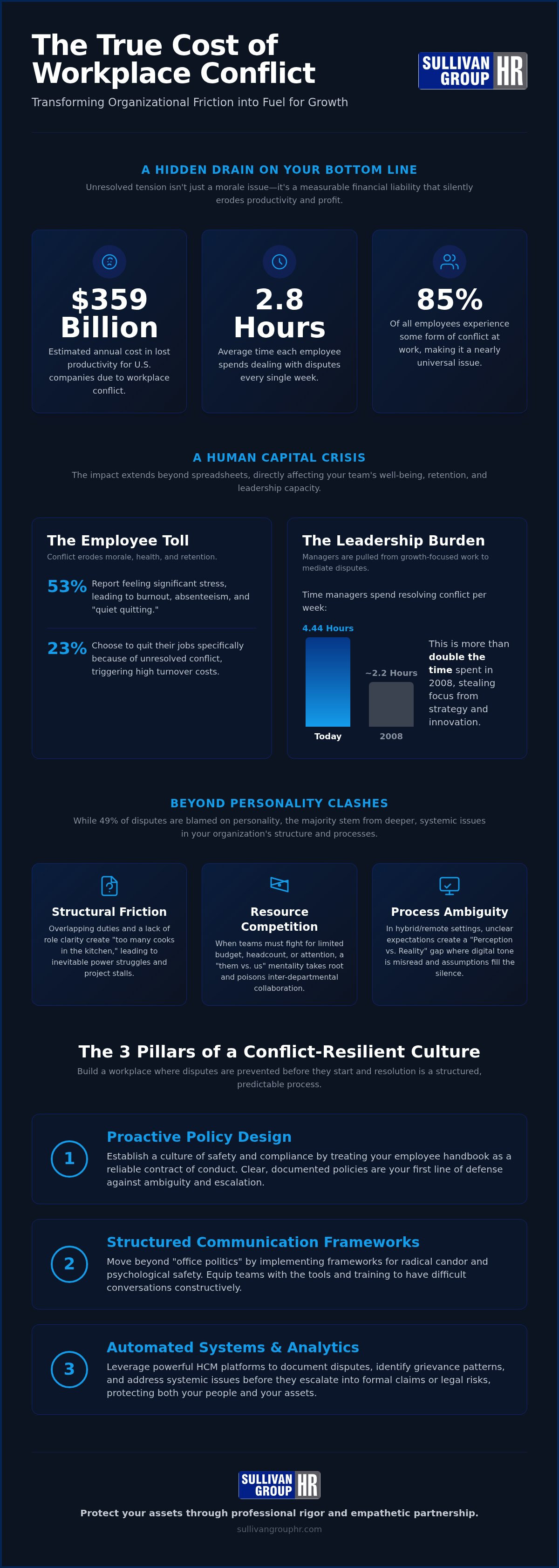
Are you treating team tension as a personality quirk or a financial liability? Conflict isn't just an emotional hurdle; it's a measurable drain on your human capital. Research indicates that 85% of employees experience conflict at work, and 53% report feeling significant stress as a result. This isn't just a morale issue. It is a human capital crisis that erodes your bottom line. When disputes go unaddressed, they manifest as "quiet quitting," increased absenteeism, and high turnover. In fact, 23% of employees choose to quit their jobs specifically because of unresolved conflict.
Recruitment, retention, and results are the three pillars of a healthy business. Unresolved Organizational conflict erodes all three simultaneously. It makes recruiting harder as your reputation suffers, forces talented people out the door, and ultimately kills the results you've worked so hard to achieve. Think of it this way: every hour your team spends in a closed-door argument is an hour stolen from your growth. U.S. workers spend an average of 2.8 hours each week dealing with these disputes, which translates to an estimated $359 billion in lost productivity annually.
Organizational Friction is the gap between a team's potential and their actual output.
Impact on Productivity and Performance
Managers now spend an average of 4.44 hours each week resolving workplace conflict. That is more than double the time they spent in 2008. When your leadership team is stuck in constant mediation, they aren't focusing on strategic growth or innovation. This creates a ripple effect where one toxic relationship can stall an entire department. These disputes lead to project delays, missed milestones, and a general breakdown in collaboration. Implementing proactive workplace conflict resolution strategies is the only way to reclaim those lost hours and refocus your team on high-value work.
The Legal and Compliance Risks
Minor disagreements don't always stay minor. Without a structured resolution process, a simple misunderstanding can quickly escalate into formal grievances or costly EEOC claims. This is where HR risk management becomes your best defense. Documenting every dispute and following a clear, consistent policy protects your assets during labor audits and potential litigation. We've seen it often: a business owner ignores a small dispute only to face a legal headache months later. A lack of a clear resolution process is a major red flag for regulators. It leaves your business vulnerable to claims of wrongful termination or a hostile work environment. By establishing formal workplace conflict resolution strategies, you create a culture of safety and compliance that protects both your people and your legacy.
Identifying the Root Causes: Beyond Personality Clashes
Why do we blame "difficult people" when the system itself might be broken? While personality clashes account for 49% of workplace disputes, focusing solely on individual tempers ignores the structural gaps that breed frustration. In 2026, the rise of hybrid and remote work has introduced new layers of complexity. When expectations aren't crystal clear, employees fill the silence with assumptions. This creates a "Perception vs. Reality" gap where colleagues misinterpret digital tone as hostility. Effective workplace conflict resolution strategies must begin by auditing your processes before you audit your people.
Resource competition is another primary driver of inter-departmental friction. When teams feel they are fighting for a limited slice of the budget, attention, or headcount, a "them vs. us" mentality takes root. This isn't a character flaw; it's a survival instinct triggered by poor organizational design. If you find your leaders constantly refereeing these battles, it's time to look at how your resources are allocated and communicated across the board.
Structural Friction and Role Confusion
Rapidly growing organizations often suffer from overlapping duties and "too many cooks" in the kitchen. When two people believe they own the same project, conflict is inevitable. This is why modern workforce management solutions are your first line of defense. They provide the clarity needed to define boundaries. If your employee handbook hasn't been updated since 2022, it's likely creating ambiguity in behavioral standards. Clear documentation provides a reliable handshake that prevents disputes before they start. If you are feeling overwhelmed by these administrative gaps, our expert HR consulting can help you build a more resilient structure.
Communication Breakdowns in a Digital World
Digital tools like Slack and email are efficient, but they are notorious for stripping away nuance. Without body language or tone of voice, a short message can feel like a sharp rebuke. These misunderstandings quickly build into information silos where departments stop sharing data out of spite. The foundation of a healthy culture starts long before the first day of work. There is a direct link between poor applicant tracking and onboarding and early-stage culture mismatch. When you hire for skills but ignore cultural alignment, you are essentially importing future conflict. By refining your workplace conflict resolution strategies to include better communication protocols, you can bridge the gap between digital convenience and human connection.
5 Strategic Workplace Conflict Resolution Strategies
How do you choose the right tool for the job? Effective leadership requires a versatile toolkit of workplace conflict resolution strategies rather than a one-size-fits-all approach. We utilize the Thomas-Kilmann Conflict Mode Instrument (TKI) to help leaders move beyond emotional reactions. This framework allows you to Assess the situation, Address the root cause, and Advance toward your organizational goals. Remember, the objective isn't always "winning." It is finding the path that yields the highest productivity and lowest risk.
The Collaborative Approach (Win-Win)
Collaboration is the gold standard for long-term team building and innovation. You should invest the time in this method when the concerns of both parties are too important to be compromised. To facilitate a session successfully, set a strict agenda focused on shared objectives. This prevents the meeting from devolving into a "gripe-fest" or a series of personal attacks. When done correctly, this strategy fosters deep trust and creative problem-solving. It is a vital investment in your most valuable asset: your people.
The Compromising and Accommodating Methods
Sometimes, speed is your primary metric. Compromising allows you to find a middle ground when deadlines are looming and a "good enough" solution keeps the project moving. It's about splitting the difference to maintain momentum. Accommodating is a strategic move where you yield to another's point of view. Leaders use this when the issue matters more to the other person or when preserving a vital professional relationship is the top priority. It isn't about weakness; it's about picking your battles to ensure long-term organizational security.
The Competitive and Avoidance Tactics
While they may sound negative, these tactics have a place in professional HR risk management. A Competitive stance is necessary when a firm, decisive "no" is required for safety, compliance, or legal reasons. There is no room for compromise on regulatory standards or core company values. Avoidance is useful as a temporary cooling-off period. If tempers are high, pushing for an immediate resolution can backfire. However, be careful not to overuse these strategies. Relying too heavily on competition or avoidance can lead to a culture of fear or resentment. Statistics show that 74% of mediation cases result in full or partial resolution when handled with professional rigor. For high-stakes disputes that threaten your culture, our Human Resources consulting team provides the expert mediation needed to protect your assets and restore peace.
Building a Conflict-Resilient Culture Through Policy
How do you build a culture that doesn't just survive conflict but grows from it? A truly resilient organization requires more than just good intentions. It needs a foundation of psychological safety where "Radical Candor" can flourish without fear of retaliation. Your employee handbook serves as the essential contract of conduct for your entire team. It sets the baseline for behavior and provides a predictable framework for resolution. When your policies are clear, your people feel secure.
Regular performance reviews and Pulse Surveys act as your early warning systems. These tools allow you to identify simmering tensions before they boil over into formal grievances. By utilizing modern HCM platforms, you can track sentiment and address friction in real-time. This proactive approach is a cornerstone of effective workplace conflict resolution strategies. We focus on three pillars to ensure long-term stability: policy, process, and protection. This framework removes the administrative burden from your shoulders while creating an atmosphere of reliable advocacy.
Fractional HR provides a distinct advantage by offering neutral, expert mediation that internal teams often struggle to maintain. It removes "office politics" from the equation and ensures that every voice is heard without bias. This external advocacy creates a sense of security for your business, knowing that complex employee relations are being handled with professional rigor and hard-earned wisdom.
Training Leaders for Difficult Conversations
Management is shifting from a "Directing" style to a "Coaching" style. Leaders must move beyond giving orders and start facilitating solutions. Training your team in active listening and the use of "I" statements during high-stress meetings is critical. We believe this training should be a mandatory component of your human capital management strategy. It empowers managers to handle disputes locally, protecting your culture and your productivity. When leaders act as allies rather than just supervisors, the entire organization thrives.
Standardizing the Resolution Process
Ambiguity is the enemy of peace. You need a clear, multi-step reporting and escalation hierarchy so every employee knows exactly where to turn. This is where understanding what is HR outsourcing provides a massive advantage. An objective third-party perspective ensures that mediation is fair and unbiased. Standardizing these workplace conflict resolution strategies through clear documentation ensures that your policies are defensible and consistent. It prevents future "he-said, she-said" scenarios and creates a historical record of compliance. If you're ready to solidify your policies and protect your team, our expert HR consulting team is here to help you build that foundation.
Turning Friction into Growth with Sullivan Group HR
What would your business look like if you could stop acting as a referee and start leading as a visionary? Managing internal friction is an administrative burden that shouldn't fall solely on your shoulders. Sullivan Group HR acts as your protective partner, handling the complex human capital management tasks that often lead to team tension. By integrating your payroll, benefits, and HR consulting into a single, cohesive system, we remove the structural friction that breeds frustration. It’s time to move from simply managing problems to truly leading people.
We believe in a three-part framework for organizational health: Recruit with clarity, Retain with culture, and Reward with precision. This approach transforms workplace conflict resolution strategies from reactive "firefighting" into a proactive risk management plan. When you have a dedicated ally handling your employee relations, you can focus on the growth and results that define your professional potential.
The isolved Advantage: Data-Driven Culture
Data is your most reliable early warning system. The isolved HCM platform provides the visibility you need to identify patterns in turnover and grievances before they reach a breaking point. By utilizing integrated time and attendance data, you can spot signs of burnout early and intervene with supportive solutions. Unified systems ensure that every team member is on the same page regarding their roles, compensation, and benefits. This transparency eliminates the "Information Frustration" that often triggers departmental disputes. An integrated employee self-service portal empowers your people, giving them direct access to their information and reducing the administrative gaps that cause friction.
Professional HR Consulting for Peace of Mind
Our professional HR consulting team provides the security of hard-earned wisdom and a "no-nonsense" approach to mediation. We've navigated every type of workplace dispute, from minor personality clashes to complex compliance issues. You gain the peace of mind that comes with knowing your workplace conflict resolution strategies are fully aligned with current labor regulations. We act as a reliable coach and advocate, ensuring that your business remains a safe, high-performing environment. Don't let "office politics" or compliance fears stall your momentum. Schedule a consultation with Sullivan Group HR today and start protecting your most valuable assets with the expertise they deserve.
Leading a Frictionless Future
Are you ready to reclaim the hours lost to internal tension? Transforming your workplace starts with a shift in perspective. We've seen that conflict is a measurable financial liability, but it's also an opportunity for growth when handled with the right tools. By implementing proactive workplace conflict resolution strategies, you move beyond temporary fixes and build a culture rooted in psychological safety. You don't have to navigate these complex employee relations alone.
We're here to act as your coach and ally. Our team combines the power of the isolved HCM platform with expert HR risk management consulting to protect your assets. We provide comprehensive integrated payroll and benefits, allowing you to focus on your professional potential rather than administrative burdens. You deserve a partner who values people over systems and results over red tape. It's time to lead with absolute confidence and security.
Protect your business and your people with Sullivan Group HR
Your journey toward a high-performing, peaceful workplace starts today. We look forward to helping you turn your vision into a reality.
Frequently Asked Questions
What are the 5 main conflict resolution strategies used in business?
The five primary workplace conflict resolution strategies are collaborating, compromising, accommodating, competing, and avoiding. Based on the Thomas-Kilmann model, these frameworks help leaders choose the right tool for any situation. Collaborating seeks a win-win outcome, while competing is necessary for safety or compliance. Accommodating preserves relationships, avoiding provides a cooling-off period, and compromising finds a quick middle ground. Using this structured framework ensures your responses are purposeful rather than emotional.
How can I resolve a conflict between two employees who refuse to work together?
Start by conducting separate interviews to understand each perspective without judgment. Once you have identified the root cause, bring both parties together for a structured mediation session focused on shared goals rather than personal grievances. If the refusal persists, refer to your employee handbook's conduct policies. Clear documentation and firm boundaries are essential to protect your team's productivity and maintain a professional environment of reliable advocacy.
When should an employer bring in a third-party HR consultant for conflict?
You should engage a professional HR consultant when a dispute involves senior leadership, potential legal claims, or specialized compliance issues. Third-party experts provide the neutral perspective and professional rigor required for high-stakes mediation. If internal efforts have stalled or if the conflict threatens your company's reputation, an outside ally can help you navigate the situation safely. This approach reduces the administrative burden on your internal team.
Can workplace conflict ever be a positive thing for a company?
Yes, healthy conflict can drive innovation and prevent groupthink when managed correctly. When team members feel safe enough to challenge ideas, it leads to better problem-solving and creative breakthroughs. The key is transforming destructive friction into constructive fuel by focusing on tasks rather than personalities. By implementing structured workplace conflict resolution strategies, you can harness diverse perspectives to achieve superior organizational results and long-term security.
What is the first step a manager should take when they notice a team dispute?
The first step is to observe the situation and gather facts before intervening. Avoid jumping to conclusions or taking sides based on initial impressions. Once you understand the dynamics, schedule private conversations with the involved parties to assess the severity of the dispute. Early intervention is critical to prevent minor misunderstandings from escalating into formal grievances. This proactive approach demonstrates your commitment to a supportive and protective culture.
How does an HCM platform like isolved help with conflict management?
An HCM platform like isolved provides data visibility into patterns like high turnover or frequent grievances in specific departments. By tracking time and attendance, you can identify signs of burnout that often lead to interpersonal tension. Unified systems also ensure everyone has access to the same information regarding roles and pay. This reduces information frustration and creates a transparent environment where disputes are less likely to arise from simple administrative gaps.
What legal risks do I face if I ignore workplace conflict?
Ignoring conflict exposes your business to significant risks, including wrongful termination claims, EEOC complaints, and hostile work environment lawsuits. Unresolved disputes can also lead to labor audits if compliance standards are neglected. Documenting your resolution process is a vital part of HR risk management. Failing to act not only hurts morale but also leaves your assets vulnerable to costly litigation and regulatory penalties that could have been avoided.
Is it better to accommodate or collaborate in a high-stakes disagreement?
It depends on whether you value the relationship or the outcome more in that specific moment. Collaboration is best for high-stakes issues where you need a sustainable win-win solution and have the time to invest. Accommodating is a strategic choice when the issue is minor to you but vital to the other person. Choosing between these workplace conflict resolution strategies requires you to assess the long-term impact on your organizational goals and team stability.


