

Is your potential for growth being held hostage by your back office? Most leaders start their journey to innovate and build, not to spend late nights wrestling with tax tables and manual data entry. You likely feel the mounting pressure of 2026 regulations, from the $184,500 Social Security wage base to new pay transparency mandates. It's a heavy burden to balance employee trust, regulatory safety, and financial accuracy without a dedicated team behind you.
When you weigh the benefits of outsourcing payroll vs in-house management, you're deciding how to best protect your culture, your compliance, and your bottom line. We're here to help you navigate these choices with the clarity and confidence you deserve. This guide reveals which path offers the most reliable security for your specific business needs this year. You'll discover how to eliminate tax penalty fears, streamline your administrative workflow, and finally reclaim your time to focus on the strategic growth that matters most.
Key Takeaways
- Understand the fundamental differences between outsourcing payroll vs in-house management to determine which model secures your business against 2026's shifting labor laws.
- Identify the "hidden labor hours" and compliance risks that often make internal processing more expensive than it appears on a standard balance sheet.
- Apply the "Rule of 25" to evaluate your current administrative pain threshold and decide exactly when your growth requires a more sophisticated payroll partner.
- Discover how a human-centric approach to Human Capital Management (HCM) provides better accuracy and scalability than automated-only software solutions.
- Learn how to reclaim your focus for strategic leadership by offloading the burden of tax filings and regulatory updates to a protective partner.
What is the Difference Between Outsourcing Payroll and In-House Management?
Is your payroll process a source of stability or a ticking clock of administrative stress? For most business leaders, this choice defines the boundary between strategic growth and operational fatigue. At its core, the debate over outsourcing payroll vs in-house management is about where you place your trust. Do you trust an internal team to keep pace with shifting 2026 tax codes, or do you trust a protective partner to handle the heavy lifting? This decision serves as the heartbeat of your business security. It impacts everything from employee morale to your standing with the IRS.
In 2026, the traditional boundaries are blurring. Advanced technology allows for a more collaborative approach than ever before. Whether you keep it in-house or partner with an expert, the fundamental payroll functions remain the same: calculating earnings, withholding taxes, and ensuring compliance. However, the method you choose determines who carries the burden of accuracy. Are you looking for a transactional software fix, or a long-term relationship built on results?
The Mechanics of In-House Payroll
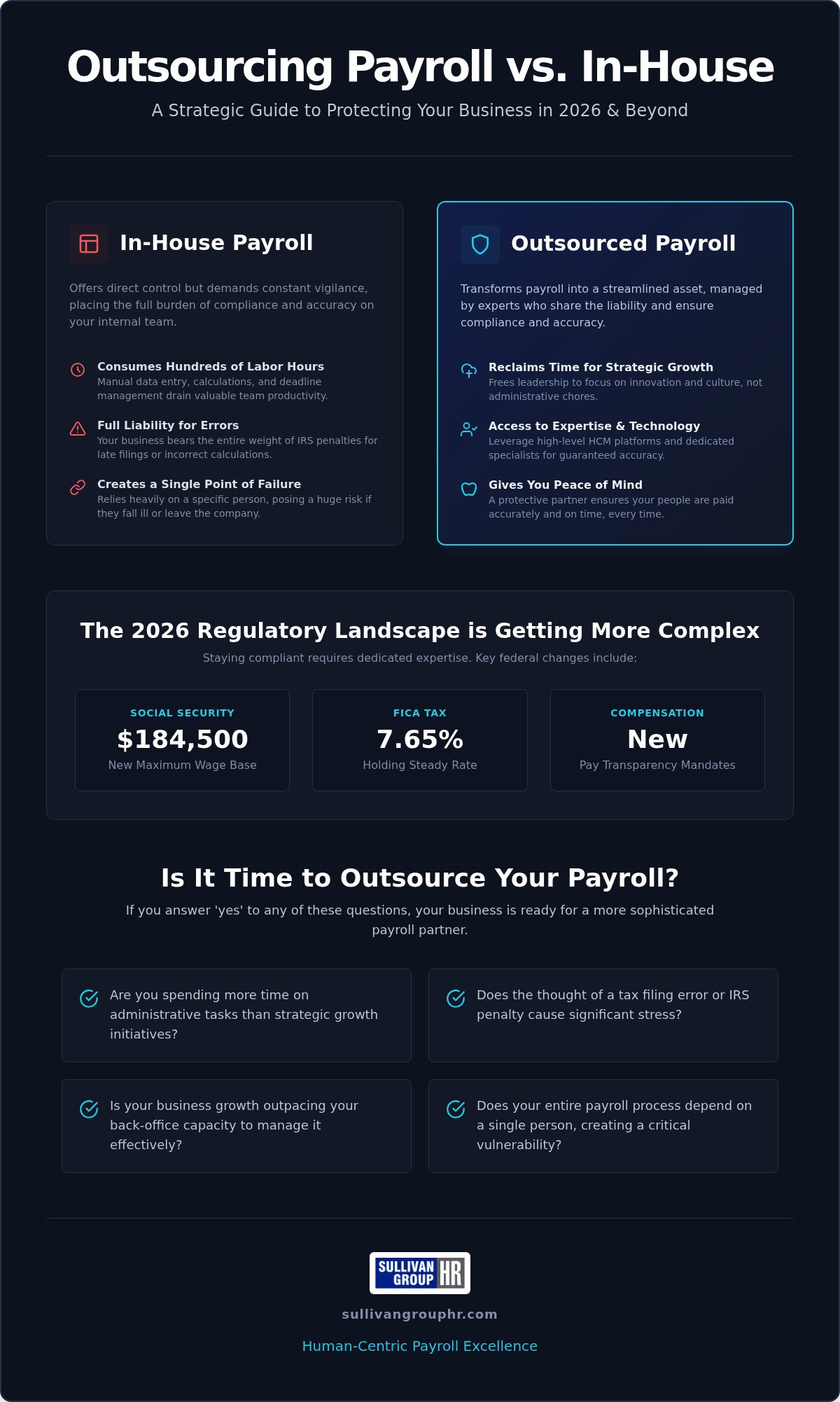
Managing payroll internally means you rely on your own staff and specific software to run the numbers. It offers a sense of immediate control, but it demands constant vigilance. Your team handles the manual data entry, the hardware maintenance, and the grueling task of deadline management. In this model, you are the final line of defense. If a filing is late or a calculation is off, the full weight of IRS penalties rests on your shoulders. It is a high-stakes game of precision that consumes hundreds of labor hours every year. For many, the "control" of in-house processing eventually feels more like a cage of administrative chores.
The Reality of Payroll Outsourcing
When you choose outsourcing payroll vs in-house systems, you shift from being a "processor" to an "overseer." This model focuses on three pillars: security, expertise, and scalability. You gain access to high-level HCM platforms like isolved without the struggle of a solo implementation. A professional firm takes over the administrative liability, managing tax filings and regulatory updates on your behalf. This partnership transforms payroll from a manual drain into a streamlined asset. It gives you the freedom to lead while a protective ally ensures your people are paid accurately and on time. You aren't just buying software; you're investing in peace of mind.
The True Cost of In-House Payroll: Hidden Risks and Resources
Do you know the real price of your internal payroll process? While many leaders focus on software subscription fees, the true cost is often buried in lost time, regulatory risk, and operational vulnerability. When you analyze outsourcing payroll vs in-house management, you must look beyond the line item on your budget. Managing this function internally requires a constant sacrifice of your most valuable asset: focus. Are you investing your team's talent in growth, or are they stuck in a cycle of administrative maintenance?
A Deloitte survey found that 60% of North American businesses still handle payroll operations in-house. However, this choice often leads to a "single point of failure." If your only payroll clerk leaves or falls ill, your entire compensation cycle could grind to a halt. This leaves your employees' trust and your company’s reputation at risk. Protecting your business requires more than just a spreadsheet; it requires a system that doesn't depend on a single person or a local server.
Quantifying the Time Drain
The minutes your staff spends on payroll add up to weeks of lost productivity every year. Your team must calculate gross-to-net figures, manage complex garnishments, and track multi-state withholdings with absolute precision. In 2026, staying current with payroll accounting best practices is a full-time job in itself. Beyond the initial math, there is the constant stream of employee questions regarding paystubs or tax changes. Opportunity cost in payroll administration is the revenue your business loses while skilled employees perform administrative data entry instead of strategic growth initiatives.
The Compliance Red Flags to Watch
The 2026 regulatory landscape is fraught with landmines that can trigger devastating audits. With the Social Security wage base rising to $184,500 and the FICA tax rate holding at 7.65%, the margin for error has never been thinner. Misclassifying an independent contractor or missing a specific state filing deadline can alert the Department of Labor (DOL) or the IRS. These agencies have increased their scrutiny of employers, and a single calculation error often leads to a broader, more invasive investigation. Shifting to professional payroll administration helps you avoid these red flags by placing your compliance in the hands of experts who monitor these changes daily. You gain security, accuracy, and the freedom to lead without the fear of a surprise audit.
Outsourcing Payroll vs In-House: A Strategic Comparison
Can you maintain total control without doing the manual labor yourself? This is the central question for leaders evaluating outsourcing payroll vs in-house models. Many fear that stepping away from the spreadsheet means losing sight of their company's finances. In reality, modern Human Capital Management (HCM) systems provide more visibility than local servers ever could. You aren't giving up control. You're gaining an expert partner who ensures your data is accurate, accessible, and actionable. We provide the movement, safety, and results your business needs to thrive.
The difference between "just software" and an integrated HCM platform like isolved is significant. Software is a tool; an HCM is an ecosystem. It links your payroll directly to benefits administration, time tracking, and workers' compensation. This unified approach eliminates the need for redundant data entry. It creates a single source of truth for your entire organization. When your systems talk to each other, you spend less time fixing errors and more time building your culture. With a legacy of stability dating back to 1998, we bring the hard-earned wisdom required to manage these complex functions safely.
Accuracy, Compliance, and Security
Accuracy isn't just about getting the math right. It's about protecting your business from the rising tide of regulatory changes. Professional providers assume the administrative burden of tax filing accuracy, moving the liability away from your desk. They utilize SOC-compliant data centers to safeguard sensitive employee information, providing a level of privacy that local hardware cannot match. This proactive approach is a cornerstone of effective HR risk management. It ensures your business remains a fortress against data breaches and audit triggers. Why risk your reputation on a system that might fail when you need it most?
Scalability for Long-Term Growth
How does your current system handle a leap from 10 to 50 or 500 employees? An in-house model often requires hiring more HR staff just to keep up with the paperwork. Choosing outsourcing payroll vs in-house management removes this hurdle. Your partner provides the infrastructure to scale instantly. Whether you're expanding across state lines or adding new departments, an expert firm handles the multi-state tax complexities for you. Unified portals maintain a consistent employee experience, regardless of how fast you grow. You focus on the talent. We'll handle the compensation lifecycle. This shift allows you to lead with confidence while we protect your bottom line.
Decision Guide: When Should You Outsource Your Payroll?
How much of your leadership energy is currently consumed by administrative friction? Every business has a specific pain threshold where the cost of internal management outweighs the benefit of perceived control. When you evaluate outsourcing payroll vs in-house systems, you aren't just looking at software costs. You're analyzing the ROI of your own focus. If you're losing sleep over the 2026 Social Security wage base or multi-state compliance, you've likely crossed that threshold. We focus on three pillars to help you scale: recruit, pay, and protect.
We often recommend the "Rule of 25" as a strategic benchmark for growing firms. Below 25 employees, a dedicated in-house clerk might manage the workload. Once you cross that line, the complexity of benefits, time tracking, and tax filings scales exponentially. It becomes a specialized function rather than a secondary task. In 2026, the complexity of labor laws means that "getting by" is no longer a viable strategy for a secure organization.
Signs Your In-House System is Failing
Is your current process protecting your culture or eroding it? According to recent QuickBooks data, nearly 78% of small business owners want to grow, but only 45% report actually doing so. Administrative hurdles are often the culprit. Look for these red flags in your office:
- Frequent errors in tax withholdings or late filings that risk IRS scrutiny.
- Employee complaints regarding pay accuracy or difficulty accessing their own digital records.
- High turnover in your administrative or HR departments due to burnout and manual data entry fatigue.
The 5-Point Evaluation Framework
To make a confident choice, you need a framework that values results over activity. Consider these five factors to determine if it's time for a change:
- Total Cost: Compare software fees and internal labor hours against a predictable service fee.
- Compliance Risk: Determine your comfort level with potential IRS penalties and 2026 tax updates.
- Operational Integration: Evaluate the need for unified workforce management solutions that sync payroll with benefits.
- Scalability: Decide if your internal team can handle a 20% increase in headcount without crashing.
- Expertise: Assess if your staff can keep up with multi-state labor laws as effectively as a protective partner.
The right choice provides more than just a check; it provides absolute peace of mind. Ready to stop processing and start leading? Partner with Sullivan Group HR to secure your business with a human-centric approach to payroll administration.
The Sullivan Group Advantage: Human-Centric Payroll Excellence
Why settle for a transactional vendor when you can have a legacy partner? The debate over outsourcing payroll vs in-house management often misses a critical middle ground: the human element. While automated, tech-only firms offer software, we offer a relationship backed by hard-earned wisdom. We've been providing stability and security since 1998. We don't just process checks; we protect your potential. Our approach transforms administrative chores into a strategic advantage, ensuring your business is ready for whatever 2026 brings.
We believe that your payroll is the lifeblood of your company culture. It represents the promise you make to your team every single day. When that promise is broken by errors or delays, trust erodes. By moving beyond simple "payroll processing" to comprehensive Human Capital Management (HCM), we help you build an organization where people feel valued and safe. We act as your coach, your ally, and your advocate. We simplify the complex, deliver the results, and protect your bottom line.
Unified Success with isolved
Our service is powered by the isolved HCM platform, the industry's leading technology for mid-market leaders. This isn't just another piece of software; it's a unified ecosystem. By combining payroll, benefits, and time tracking in one secure cloud, we eliminate the friction of fragmented systems. You gain a single source of truth for your entire workforce. Employees are empowered with intuitive self-service portals, which significantly reduces the administrative burden on your internal team. You get real-time data to make smarter business decisions, while we ensure the back-end stays perfectly synchronized.
Your Partner in Compliance and Growth
In a year defined by shifting labor laws and increased IRS scrutiny, having a protective shield is non-negotiable. We provide proactive alerts for regulatory changes and audit risks before they become crises. You gain access to expert human resources management services that go far ahead of basic tax filing. We understand the nuances of the 2026 landscape, from the $184,500 Social Security wage limit to the complexities of multi-state withholding. Is your current approach to outsourcing payroll vs in-house management holding you back or propelling you forward? It's time to choose a partner who knows your name, understands your goals, and values your people as much as you do.
Secure Your Growth and Protect Your People
Is your current administrative process a bridge to your future or a barrier to your growth? Choosing between outsourcing payroll vs in-house management is ultimately a choice about where you invest your energy. We've explored how internal systems often hide costs in lost labor hours and compliance risks. By contrast, a unified HCM platform provides the scalability you need to lead with confidence. True success in 2026 requires more than just software; it requires a protective partner who understands the high stakes of shifting regulations.
By integrating payroll, benefits, and workers' comp into a single source of truth, you reclaim your time and your peace of mind. You gain access to leading isolved HCM technology and expert-led compliance management that keeps your business safe. Are you ready to stop managing administrative burdens and start focusing on strategic results? We are here to act as your ally and your shield. Ready to protect your business? Request a Payroll Consultation with Sullivan Group HR today.
Your professional potential is too valuable to be buried in paperwork. Let's build a secure foundation for your team together.
Frequently Asked Questions
Is it cheaper to do payroll in-house or outsource?
It depends on how you value your time and risk exposure. While software fees alone might look low, the labor cost of internal processing and the risk of expensive IRS penalties often make outsourcing the more cost-effective choice. You save on hardware maintenance, staff training, and the high price of manual errors. Outsourcing provides a predictable monthly cost that scales with your headcount, allowing you to budget for growth without administrative surprises.
What are the biggest risks of managing payroll in-house?
Compliance failure and operational instability are the primary threats to your business. If your internal team misses a 2026 filing deadline or miscalculates the Social Security wage base, your firm faces immediate financial penalties. Additionally, relying on a single employee to run payroll creates a dangerous knowledge silo. If that person leaves, your entire compensation process could fail, damaging employee trust and your reputation as a reliable employer.
Can a small business outsource payroll effectively?
Yes, small businesses often benefit the most from this strategic shift. Partnering with an expert allows a lean team to access high-level tools usually reserved for large corporations. It levels the playing field. When comparing outsourcing payroll vs in-house management for small teams, the primary benefit is the peace of mind that comes from knowing tax filings are handled by professionals. This allows you to focus on your core mission. For readers who also serve on a community board, you might explore Monthly HOA Management Fees to see how professional management can provide similar administrative relief for your neighborhood.
A smooth transition typically takes between 30 and 60 days. This timeline ensures that all historical data is accurately migrated and that your team is fully trained on the new platform. We recommend starting the process at the beginning of a quarter to simplify tax reporting. This deliberate pace allows us to act as your coach, ensuring every detail of your compensation cycle is protected during the move.
Does outsourcing payroll mean I lose control over my company data?
No, it actually increases your visibility and data security. Modern HCM platforms provide 24/7 access to real-time reports and employee records from any secure device. Instead of digging through filing cabinets or local spreadsheets, you have a single source of truth at your fingertips. You retain full ownership and oversight of the data while we handle the heavy lifting of administrative processing and advanced security maintenance.
What should I look for in a payroll outsourcing partner in 2026?
Look for a partner that balances advanced technology with human-centric expertise. A reliable firm should offer a unified HCM platform, have a long history of stability, and provide a dedicated point of contact who knows your business. In 2026, it's critical that they stay proactive about labor law changes. Avoid tech-only vendors that offer automated support instead of the personalized guidance your business deserves to stay safe.
How does an HCM platform like isolved improve the payroll process?
It eliminates the friction of fragmented systems by housing everything in one cloud. When you weigh outsourcing payroll vs in-house options, the integration of isolved is a major differentiator. It syncs time tracking, benefits, and payroll instantly. This reduces manual data entry errors and ensures that your compliance is built into the workflow. It's a modern ecosystem designed to help your business move faster and stay safer in a complex market.
Will outsourcing payroll help with workers' compensation audits?
Yes, it simplifies the entire audit process by providing accurate, organized records. A professional partner can help you manage workers' compensation insurance payments through a pay-as-you-go model. This aligns your premiums with actual payroll data, which prevents large year-end audit surprises. Having an expert ally ensures your reports are ready when auditors call, protecting your bottom line from unexpected expenses and the stress of manual data gathering.


