

What if the very benefits you designed to attract talent became the single greatest threat to your organization's stability? In a world of shifting federal mandates, staying ahead requires more than just good intentions. It demands a rigorous employee benefits compliance checklist that accounts for the 2026 regulatory landscape. You likely feel the weight of overlapping mandates and the constant headache of manual paperwork. It's exhausting to balance employee care with the fear of an unexpected Department of Labor audit or a massive non-compliance penalty.
We believe compliance shouldn't be a source of stress; it should be a protective shield for your business. This guide provides the clear, stress-free roadmap you need to achieve total legal protection while reclaiming time for strategic growth. We'll walk through the updated 2026 contribution limits, new SECURE 2.0 requirements, and the "One Big Beautiful Bill Act" changes. You'll learn how to master your data, secure your workforce, and protect your legacy with confidence. Let's move past the red tape and focus on what matters most: your people.
Key Takeaways
- Learn why a proactive compliance strategy serves as your business's silent shield against rising healthcare costs and federal penalties.
- Access a comprehensive 2026 employee benefits compliance checklist to stay ahead of critical ERISA and ACA reporting deadlines.
- Identify hidden administrative red flags and learn how to eliminate the data silos that create manual paperwork burdens.
- Discover how to leverage the isolved platform as a single source of truth for all your compliance and payroll data.
- Understand how to move from a reactive compliance mindset to a strategic advantage that empowers your workforce.
Why Compliance is Your Business’s Silent Shield in 2026
Are you running your business on potential or on luck? For many leaders, the line between the two feels dangerously thin. Every year, new federal mandates arrive. Every year, the stakes for employee benefits administration grow higher. In 2026, compliance isn't just a box to check; it's a foundational shield. If you're operating without a comprehensive employee benefits compliance checklist, you aren't just risking a minor clerical error. You're risking your business legacy, your financial stability, and your peace of mind.
High stakes define the current regulatory climate. Between the evolving requirements of the SECURE 2.0 Act and the permanent shifts introduced by the "One Big Beautiful Bill Act," the margin for error has vanished. A proactive stance prevents the "compliance tax" of hefty fines, back taxes, and legal fees that drain your capital. Beyond the financial impact, compliance builds a bridge of transparency, clarity, and trust with your workforce. When people know their health coverage and retirement accounts are managed with integrity, they stay. Retention isn't just about the perks; it's about the promise of security.
The Emotional Cost of Non-Compliance
The fear of a Department of Labor audit can be paralyzing. It's a heavy, invisible weight that pulls your attention away from innovation and growth. We understand the anxiety of staring at a mountain of manual paperwork and wondering if one missed signature could trigger a catastrophe. Moving from a reactive panic to a protective mindset changes the entire energy of your leadership. Professional rigor replaces administrative dread. By treating compliance as a discipline of care, you create a culture of organizational security. You deserve to lead with confidence, knowing your house is in order.
Compliance as a Competitive Advantage
Why does top talent choose one organization over another? They look for stability, transparency, and results. They want to know their 401(k) contributions are handled correctly and their health plans meet federal affordability standards. Stable, well-managed benefits act as a signal of operational excellence. By utilizing advanced benefits management solutions, you turn a legal burden into a powerful recruitment tool. This part of your employee benefits compliance checklist isn't just about avoiding penalties; it's about building a foundation for long-term growth. When your administrative systems are tight, your focus remains entirely on scaling your vision and supporting your team.
The Three Pillars of Federal Benefits Regulation
How do you build a benefits package that stands the test of time? You start with a firm foundation. Federal regulation isn't a single wall of text; it's a structure supported by three critical pillars: ERISA, the ACA, and COBRA. Understanding these isn't just for lawyers. It's for any leader who wants to avoid the luck based strategy of hoping for the best. ERISA is the 1974 federal law that sets minimum standards for most voluntarily established retirement and health plans. It ensures that the promises you make to your team are promises you can keep. It makes your plan fair, funded, and functional.
While ERISA handles the retirement and plan standards, the ACA manages health coverage and affordability. COBRA provides the safety net during life transitions. Together, they form the core of any employee benefits compliance checklist. Neglecting even one pillar can cause the entire structure to crumble under the weight of a Department of Labor audit. You need a system that treats these regulations as a unified shield rather than separate hurdles.
ERISA and Fiduciary Duty
What does it mean to be a fiduciary in 2026? It means you are a protector. You have a legal and ethical obligation to act solely in the interest of your plan participants. This includes ensuring plan fees are reasonable and Summary Plan Descriptions (SPDs) are accurate. The Employee Benefits Security Administration (EBSA) oversees these standards with a focus on audit quality. You must stay diligent with Form 5500 filings to avoid penalties that reach thousands of dollars per day. Providing a clear, annually updated paper statement is now a mandate under SECURE 2.0 unless employees specifically opt out. If you feel overwhelmed by these administrative burdens, our human capital management experts can help you streamline the process.
ACA and COBRA Compliance
The ACA landscape remains complex regarding the Employer Mandate. For plan years beginning in 2026, coverage is considered affordable if the employee's contribution for self-only coverage doesn't exceed 9.96% of their household income. Missing this threshold triggers significant shared responsibility payments. You also need to navigate new electronic disclosure rules. Digital delivery is the standard, but you must ensure every employee has the necessary access and consent on file. COBRA compliance often trips up even seasoned HR pros. Common pitfalls include late initial notices or failing to document when a qualifying event notice was mailed. These small clerical slips are the primary drivers of benefits related litigation. Keeping your employee benefits compliance checklist updated with specific notification deadlines is the best way to safeguard your organization against these avoidable risks.
Identifying the Hidden Compliance Red Flags in Your Current Plan
Is your current benefits administration leaving you exposed? Many business owners operate under the dangerous assumption that having a plan is the same as being compliant. In reality, the cracks often hide in plain sight. One of the most common red flags is the presence of "Data Silos" between your payroll and benefits systems. When these two functions don't talk to each other in real time, errors multiply. A change in a salary or an address might update in one place but not the other, leading to inaccurate filings and frustrated employees.
Outdated employee handbooks are another primary target for auditors. If your handbook hasn't been refreshed to reflect the 2026 regulatory changes, it's a neon sign indicating a lack of oversight. Relying on manual tracking in a digital-first world is equally risky. Spreadsheets are prone to human error; federal mandates are not. An effective employee benefits compliance checklist requires a "single source of truth" to ensure that every data point is captured correctly and stored securely.
The Paperwork Trap: Missing Documentation
"We have it somewhere" is not a valid defense when an auditor knocks on your door. The Employee Benefits Security Administration (EBSA) expects immediate access to plan amendments, board resolutions, and signed Summary Plan Descriptions. If you can't produce these documents, you face the risk of fiduciary breach claims. This is where HR risk management becomes critical. You must establish a rigorous document retention policy that tracks the entire lifecycle of a plan. Every amendment should be dated, filed, and accessible in a centralized digital environment. Professional rigor today prevents a catastrophe tomorrow.
Misclassification and Eligibility Errors
Audit priorities for 2026 have shifted toward independent contractor versus employee status. Misclassifying a worker doesn't just impact your tax liability; it creates a massive benefits headache. If a contractor is later deemed an employee, they may be entitled to retroactive benefits, triggering severe ACA penalties. Missing an eligibility window is another common trap. If a new hire isn't offered coverage within the required timeframe, your organization faces significant financial exposure. Regular plan audits are the only way to catch these slips before they become systemic failures. Staying disciplined with your employee benefits compliance checklist ensures that every worker is correctly classified and every window is met.
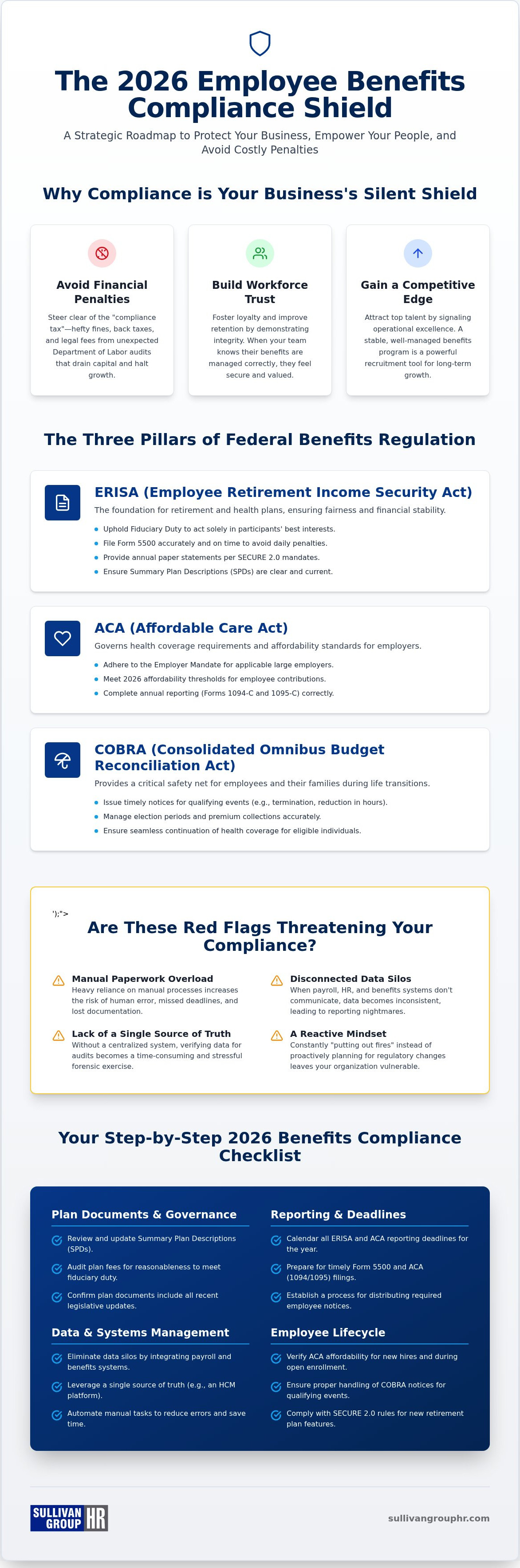
Your Step-by-Step 2026 Benefits Compliance Checklist
How do you turn a year of complex mandates into a manageable routine? You break it down. An effective employee benefits compliance checklist moves chronologically to prevent last-minute scrambles and costly oversights. In the first quarter, your focus is on foundational accuracy. You must review your plan documents and ensure every team member has received an updated Summary Plan Description (SPD). This is also the time to verify that your 2026 contribution limits, such as the $24,500 401(k) employee limit, are correctly reflected in your payroll system. Accuracy in Q1 sets the tone for the entire year.
As you move into the second quarter, the focus shifts to federal reporting. This is when you finalize and file ACA forms 1094-C and 1095-C. By the third quarter, your attention turns to the Form 5500 series and non-discrimination testing. These tests ensure your plan doesn't unfairly favor high-earners, maintaining the tax-qualified status of your benefits. Finally, the fourth quarter is dedicated to open enrollment. You'll distribute updated notices for the coming year and ensure your plan remains affordable under the 9.96% household income threshold. This cycle ensures no deadline is missed and no penalty is triggered.
Monthly and Ongoing Maintenance
Compliance isn't just a quarterly event; it's a monthly discipline. Your routine should focus on three critical areas: tracking, reconciling, and monitoring. You must track "Life Events" like marriages or births to trigger timely COBRA notifications. You also need to reconcile carrier invoices against payroll deductions every single month. This prevents you from paying for terminated employees or missing deductions for new ones. Finally, you must monitor hours for variable-hour employees to determine their eligibility for coverage under ACA rules. Consistency is the only true defense against a Department of Labor audit.
The Digital Disclosure Standard
How are you delivering your plan documents in 2026? Digital delivery is efficient, but it must meet specific legal standards. You can legally distribute notices electronically if employees have regular access to a computer as an integral part of their job. For those without such access, you must use "safe harbor" methods, which often include obtaining written consent for electronic delivery or providing physical copies. Utilizing modern workforce management solutions allows you to automate this delivery and track exactly who has opened and acknowledged each notice. This digital paper trail is your best friend during a regulatory review. If you're ready to automate these burdens and secure your organization, our payroll administration experts are here to help you build a reliable system.
Moving From Compliance Burden to Strategic Advantage
Compliance often feels like a heavy anchor. It slows your momentum and drains your energy. But what if you could turn that weight into an engine for growth? Software alone is not a compliance strategy. A digital platform can track data, but it cannot interpret the nuance of a complex federal mandate or a sudden regulatory shift. To truly protect your organization, you need the power of the isolved platform paired with Sullivan Group HR expertise. This combination transforms your employee benefits compliance checklist from a list of chores into a blueprint for excellence.
By leveraging payroll administration outsourcing, you eliminate the dangerous gaps between your financial data and your benefit plans. You stop reacting to threats and start building a fortress. This shift allows you to reclaim your time. Instead of chasing missing signatures or reconciling complex spreadsheets, you can focus on what you do best: growing your business and leading your team. You move from a state of constant defense to a position of strategic power.
The Unified HCM Advantage
The isolved platform acts as your single source of truth. When your payroll, time tracking, and benefits live in one unified system, manual entry errors disappear. Information flows seamlessly across every function. This integration ensures you are audit-ready every day of the year. You don't have to scramble when a regulator asks for documentation; you simply pull a report. As your headcount grows, your compliance scales automatically. You maintain professional rigor without adding administrative headcount. It's about working smarter, staying safe, and seeing results.
Your Partner in Protection
Sullivan Group HR brings a "no-nonsense" approach to human resources consulting. We don't just provide a service; we act as your coach, your ally, and your administrative engine. We understand the specific nuances of the 2026 regulatory landscape because we live in it every day. Our goal is to provide the reliable advocacy you need to lead with confidence. Taking the first step toward total peace of mind starts with a simple conversation. Let us handle the complexities of your employee benefits compliance checklist so you can focus on your professional potential. You deserve a partner who values people over systems and results over rhetoric. We are here to safeguard your legacy while you build your future.
Securing Your Legacy and Your People for 2026
Managing a workforce shouldn't feel like a constant battle against red tape. We've explored how a proactive employee benefits compliance checklist protects your organization from the "compliance tax" of fines and audits. By understanding the foundational pillars of ERISA, ACA, and COBRA, you move from reactive anxiety to total organizational security. You've seen that the right routine doesn't just avoid penalties; it builds trust with your team and signals operational excellence to the market. A well-managed plan is a promise kept to your employees.
Sullivan Group HR serves as your ally in this journey, providing much more than just software. You gain access to isolved, the industry's leading HCM platform, backed by decades of expertise in human resources consulting. Our comprehensive integrated payroll and benefits management eliminates the administrative burden, giving you back the hours you need to lead. Ready to secure your business? Let’s build your compliant future together. You've built something remarkable. Let's make sure it's protected for the long haul. Your growth is our primary metric of success.
Frequently Asked Questions
What are the most common employee benefits compliance mistakes?
Common errors often stem from data silos between payroll and benefits. Failing to track variable-hour employee eligibility or missing COBRA notification deadlines creates significant legal exposure. Many organizations also struggle with maintaining an updated employee benefits compliance checklist that reflects the newest 2026 federal limits. These clerical slips are often the first things auditors look for during a review. Professional rigor in daily tracking is your best defense against these avoidable mistakes.
How often should we update our Summary Plan Descriptions (SPDs)?
You must distribute an updated Summary Plan Description (SPD) every five years if you have amended the plan. If no changes occurred, you must still provide a new SPD every ten years. If you make a material change mid-cycle, you must issue a Summary of Material Modifications (SMM). This ensures your team stays informed about their coverage. Keeping these documents current is a core requirement of fiduciary responsibility under ERISA.
What are the penalties for ACA non-compliance in 2026?
For 2026, the primary trigger for ACA penalties is failing the affordability threshold. Coverage is considered affordable if the employee's contribution for self-only coverage doesn't exceed 9.96% of their household income. If you fail to offer minimum essential coverage to 95% of full-time employees, you face the "A" penalty. If the coverage is unaffordable, you face the "B" penalty. These fines are indexed annually and can reach millions for large organizations.
Do small businesses have to comply with ERISA?
Yes, ERISA applies to nearly all private-sector employers regardless of their size. If you offer a retirement plan or a group health plan, you must follow federal standards for fiduciary conduct and reporting. Small businesses often assume they are exempt, but this is a dangerous misconception. While some reporting forms like the 5500-SF are simplified for smaller plans, the legal obligation to act in the best interest of participants remains the same.
Can I distribute benefits notices via email?
You can distribute notices via email if you meet the Department of Labor's safe harbor requirements. This means employees must have access to a computer as an integral part of their daily job duties. For employees without regular computer access, you must obtain their affirmative consent before switching to digital delivery. Always ensure you have a system to track that the document was actually received and opened to maintain your audit trail.
What is the difference between a plan sponsor and a fiduciary?
A plan sponsor is the employer or organization that establishes and maintains the benefit plan. A fiduciary is any person or entity with discretionary authority over plan management or the control of plan assets. In many small and mid-sized businesses, the plan sponsor also acts as the fiduciary. This role carries a heavy legal burden to act solely in the interest of the participants and to ensure plan fees remain reasonable.
How does an HCM platform like isolved help with compliance?
An HCM platform like isolved serves as the single source of truth for your employee benefits compliance checklist. By integrating payroll and benefits into one system, it eliminates the manual entry errors that lead to data silos. The platform automates eligibility tracking, manages open enrollment, and generates necessary tax forms like the 1095-C. This technology ensures you stay audit-ready every day while reducing the administrative burden on your internal HR team.
What happens if we miss a Form 5500 filing deadline?
Missing a Form 5500 deadline can lead to massive daily penalties from both the IRS and the Department of Labor. The DOL has the authority to assess fines that can exceed $2,500 for every day the filing is late. If you discover a missed filing, you should utilize the Delinquent Filer Voluntary Compliance Program (DFVCP). This program allows you to correct the error and pay a significantly reduced penalty before an audit begins.


