

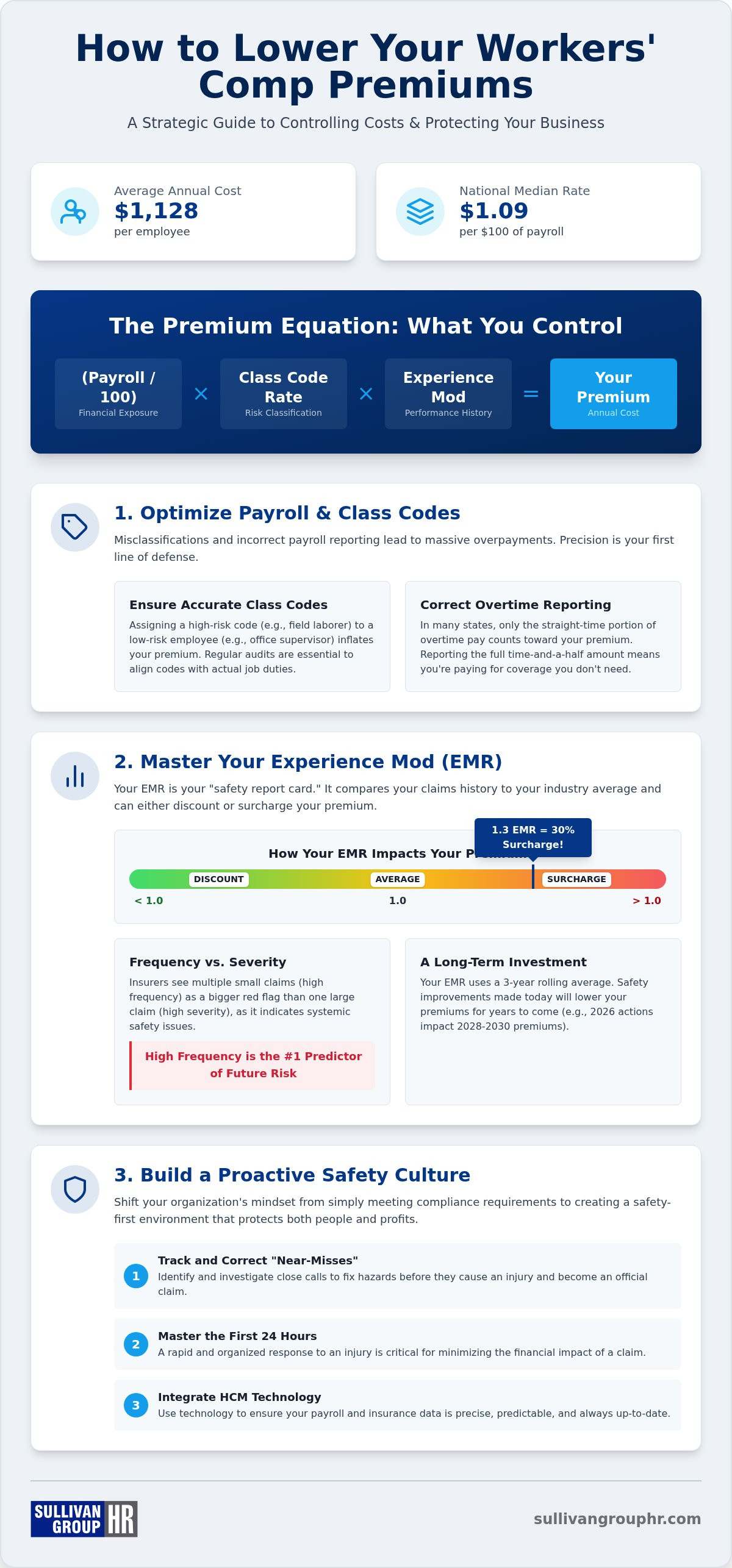
Did you know the average American business now pays approximately $1,128 per employee every year for coverage? While the national median rate sits at $1.09 per $100 of payroll, a single spike in your Experience Mod rating can send those costs soaring. You might feel like you're stuck in a cycle of unpredictable bills, administrative headaches, and rising costs. If you're wondering how to lower workers comp premiums in this shifting 2026 landscape, you're in the right place.
We understand that managing claims and deciphering complex insurance data feels like a second full-time job. It's frustrating to watch your hard-earned revenue disappear into premiums that seem disconnected from your actual safety efforts. You deserve a partner who values people over systems and results over paperwork. This guide promises to hand you the actionable strategies and data-driven insights needed to regain control of your costs and secure your financial future.
Could your payroll data be the secret to a smaller premium? We'll walk through the specifics of classification accuracy, the benefits of a "Pay-As-You-Go" model, and the power of a proactive safety culture. It's time to simplify, secure, and streamline your entire workers' compensation process.
Key Takeaways
- Break down the three core components of your premium to see exactly how payroll and class codes impact your annual costs.
- Learn how to treat your Experience Modification Rate as a safety report card that you can actively improve over time.
- Minimize the financial weight of workplace injuries by mastering the critical first 24 hours of the claims reporting process.
- Shift your organizational mindset from simple compliance to a safety-first culture that protects both your people and your profits.
- Discover how to lower workers comp premiums by using integrated HCM technology to keep your insurance data precise and predictable.
Understanding the Workers’ Comp Premium Equation
Does your workers’ comp bill feel like a fixed tax? It shouldn't. Think of your premium as a variable business expense rather than a static overhead cost. Your premium directly reflects your business’s safety performance, administrative precision, and operational risk. Most owners view these costs as inevitable, but many elements are actually within your control. By understanding the math behind the bill, you can discover how to lower workers comp premiums and protect your bottom line.
The equation is simple but powerful: (Payroll / 100) x Class Code Rate x Experience Mod = Your Premium. While the foundational Workers' compensation system provides necessary protection for employees, the specific amount you pay depends on how you manage these three variables. We categorize these into three functional pillars: risk classification, financial exposure, and performance history. Some costs, like state-mandated rates, are non-controllable. However, your payroll reporting and your safety record are entirely under your influence.
The Role of Payroll Classification Codes
What do your employees actually do every day? Class codes are four-digit numbers that represent the risk level of specific job functions. A clerical worker sitting at a desk carries far less risk than a field technician on a ladder. Misclassifying even one or two team members can lead to massive overpayments. For example, if a supervisor spends 90% of their time in an office but is classified as a field laborer, you're wasting capital. Regular payroll audits are essential to ensure every person is assigned the correct code. These checks prevent you from paying high-risk rates for low-risk roles and keep your data clean.
Annual Payroll: The Base of Your Premium
Your premium starts with your total remuneration. This includes wages, bonuses, and sometimes commissions. It's the foundation of the entire calculation. However, things get tricky when you factor in overtime. In many states, only the straight-time portion of overtime pay is used for premium calculations. If you report the full time-and-a-half amount, you're essentially paying for coverage you don't need. Accurate, real-time payroll reporting prevents year-end audit surprises and ensures you only pay for your actual exposure. When you master these variables, you've taken the first step in learning how to lower workers comp premiums for the long term.
The Power of the Experience Modification Rate (EMR)
If your premium calculation was a transcript, the Experience Modification Rate, or "Mod," would be your safety report card. This single number has the power to either discount your insurance costs or inflate them significantly. Your Mod serves three critical functions: it measures your risk, determines your cost, and signals your safety culture to the market. The math is straightforward. Rating bureaus compare your actual workers' compensation losses to the average losses expected for a business of your size in your industry. An E-Mod of 1.0 means you're exactly average. If your Mod hits 1.3, you're paying a 30% surcharge on every dollar of your base premium. This isn't just a number; it's a "tax" on your business growth that drains capital you could otherwise use for new equipment, higher wages, or geographic expansion.
Frequency vs. Severity: What Matters More?
Why do insurance carriers worry more about ten small trips than one major fall? Frequency is the ultimate red flag for underwriters. While a single large claim might be a fluke accident, multiple small incidents suggest a systemic failure in your safety protocols. The NCCI formula is specifically weighted to penalize frequency because it's a much better predictor of future risk. According to the U.S. Department of Labor, workers' compensation programs are designed to provide a safety net, but frequent claims signal that your net has too many holes. One of the most effective ways how to lower workers comp premiums is to identify, investigate, and correct "near-misses" before they become official claims. Tracking these close calls allows you to fix hazards before they ever impact your financial standing.
Lowering Your Mod Over Time
Patience is a requirement when you're looking at how to lower workers comp premiums through Mod management. Your Mod is calculated using a three-year rolling window, typically excluding the most recent year. This means the safety improvements you implement today in 2026 will directly influence your premiums in 2028, 2029, and 2030. It's a long-term investment in your company's stability. Early intervention and aggressive claim closure remain your best tools for driving that number down. By leveraging professional HR risk management, you can monitor your Mod in real-time and address trends before they become permanent fixtures of your history. As regional experts, we understand that these calculations can feel overwhelming, but a partner in payroll administration can help ensure your data is accurate and your reporting is seamless.
Proactive Claims Management and Return-to-Work
What happens in the first 24 hours after an injury determines the ultimate cost of the claim. Speed is your greatest ally. When you report an incident immediately, you ensure the injured worker receives prompt medical attention and feels supported by the organization. This immediate action prevents "litigation creep," where uncertainty leads employees to seek outside legal counsel. By establishing a relationship with preferred occupational health clinics, you ensure your team sees providers who understand the nuances of workplace recovery. These clinics focus on functional improvement rather than just symptom management, which is a core pillar of how to lower workers comp premiums effectively.
Active management isn't just about paperwork. It's about maintaining the human connection. Researching strategies for managing and lowering workers’ compensation costs reveals that early intervention is the most reliable way to keep a small injury from becoming a permanent financial burden. When you stay involved, you control the narrative and the timeline of the recovery process.
Implementing a Return-to-Work (RTW) Program
Keeping an injured employee on your payroll is often cheaper than letting them stay home. When a worker remains at home, the insurance carrier pays "indemnity" costs to cover lost wages. These indemnity payments hit your Experience Mod much harder than medical-only expenses. By creating a library of transitional, light-duty job descriptions, you can bring employees back to the office or shop in a limited capacity. This keeps them connected to the team, maintains their professional identity, and stops the clock on indemnity payments. It's a win for their mental health and a massive win for your insurance budget.
Effective Communication with Injured Workers
Your supervisors are the first line of defense against rising costs. They must be trained to handle injury reports with a balance of empathy and professionalism. If an employee feels ignored or blamed, they are far more likely to hire an attorney. A standardized reporting process reduces claim duration by ensuring that every step, from the initial report to the first clinic visit, happens without friction. Clear, consistent communication proves that you value people over systems. This approach simplifies the path to recovery and is a proven strategy for how to lower workers comp premiums while building a more resilient workforce.
Safety Culture as a Financial Strategy
Safety is often viewed as a chore. Many owners see it as a list of rules to follow just to avoid a fine. But what if you viewed it as a high-yield investment? Moving from a compliance-only mindset to a safety-first culture is one of the most effective ways how to lower workers comp premiums. When safety becomes part of your company's DNA, you stop reacting to accidents and start preventing them. This shift creates a massive return on investment. You might spend pennies on a pair of safety glasses or a training session, but you save thousands of dollars in premium surcharges and lost productivity.
Don't overlook state-specific incentives. Many territories offer mandated premium discounts for businesses that maintain certified drug-free workplace programs. These programs do more than just lower your bill. They ensure your team is alert, capable, and focused while on the clock. Regular safety audits serve a similar purpose. By identifying a loose railing or a frayed cord today, you prevent a claim that could haunt your Experience Mod for the next three years. Proactive hazard identification is the cornerstone of a healthy bottom line.
The Role of Professional HR Consulting
Building a robust safety program from scratch is a daunting task for a busy entrepreneur. This is where human resources management services become an invaluable asset. Professional consultants help you build comprehensive safety handbooks tailored to your specific industry risks. They help you standardize "toolbox talks" and safety meetings so every department stays on the same page. With expert guidance, you can stay ahead of OSHA 2026 requirements and discover new strategies for how to lower workers comp premiums through administrative excellence.
Incentivizing Safety at the Employee Level
Your employees are your eyes and ears on the ground. Empowering them to report hazards without fear of retribution is critical for a healthy workplace. Consider designing reward programs that celebrate accident-free milestones. This doesn't have to be expensive. Even small tokens of appreciation or team lunches can boost engagement and awareness. There is a direct connection between high employee engagement and lower accident rates. When people feel valued and heard, they work more carefully and look out for one another. Ready to turn your safety record into a competitive advantage? Partner with an expert in HR consulting to build a culture that protects your people and your profits.
The Sullivan Group Advantage: Integrating HCM and Risk
Are you tired of feeling like your payroll and insurance are speaking different languages? When your systems don't talk to each other, you end up with data gaps, miscalculations, and unexpected expenses. This is where a unified approach becomes your greatest asset in learning how to lower workers comp premiums. By integrating your workers' compensation coverage with the isolved HCM platform, you ensure every dollar of payroll is reported with surgical precision. This connectivity allows for a "Pay-As-You-Go" model. Instead of making massive estimated down payments and hoping for the best, you pay based on actual, real-time payroll. This protects your cash flow and keeps your capital where it belongs: in your business.
Choosing payroll administration outsourcing does more than just free up your Tuesday afternoons. It creates a seamless link between your employee data and your risk management strategy. Sullivan Group HR acts as your protective partner, standing between you and the administrative burdens that often lead to premium spikes. We don't just provide a service; we build a long-term relationship based on reliability, stability, and results. Our goal is to simplify your professional life while securing your financial future.
Eliminating Audit Surprises with isolved
Year-end audits don't have to be a source of dread. With isolved, you have access to real-time data tracking that prevents those painful year-end "catch-up" payments. If a claim ever arises, your integrated time and attendance data provides clear, undeniable proof for your defense. This level of professional human capital management gives you the peace of mind to focus on your core operations while we handle the regulatory heavy lifting. We ensure your reporting is accurate, your codes are correct, and your data is defensible.
Customized Risk Consulting
Every business faces unique challenges. We provide personalized Mod analysis to identify your specific cost drivers and create a roadmap for improvement. Whether you're a small local shop or a growing regional enterprise, our support evolves alongside your workforce. We look at the nuances of your local territory to provide advice that national firms often miss. Don't let unpredictable premiums hold you back. Protect your business and lower your premiums with Sullivan Group HR today. We are ready to help you regain control and protect your bottom line.
Take the Lead on Your Business Security
Lowering your premiums isn't just about finding a cheaper policy; it's about mastering your data and protecting your people. You've seen how accurate payroll classification, proactive return-to-work programs, and a safety-first culture can fundamentally change your financial trajectory. These aren't just theories. They are the proven steps for how to lower workers comp premiums while building a more resilient organization. By taking control of your Experience Mod today, you secure your growth for years to come.
You don't have to navigate these administrative complexities alone. Sullivan Group HR brings decades of experience in workforce risk management and a deeply supportive, protective approach to your business. We combine expert HR consulting with the industry-leading isolved HCM platform to ensure your data is precise and your risks are minimized. We value your people over automated systems and your success as the primary metric of our own.
Ready to see where you can save? Get a Comprehensive Risk Assessment from Sullivan Group HR. It's time to stop worrying about unpredictable spikes and start focusing on your professional potential. We are ready to stand by your side as your reliable, no-nonsense advocate.
Frequently Asked Questions
What is the Experience Modification Rate (EMR) and how does it affect my premium?
The Experience Modification Rate is a numerical multiplier that acts as a safety report card for your business. It compares your actual claims history to the expected losses of similar companies in your industry. If your EMR is 1.0, you pay the standard rate. A higher number increases your costs, while a lower number earns you a discount. It scales your base premium directly, making it the most significant controllable factor in your annual insurance bill.
Can I really lower my workers’ comp costs if I am in a high-risk industry?
Yes, businesses in high-risk industries have some of the greatest opportunities to save money. Since your base rates are already higher, even a small reduction in your Experience Mod leads to significant dollar savings. You can't change your industry's inherent risk, but you can change your individual performance. By implementing rigorous safety protocols and a return-to-work program, you can consistently outperform your peers and secure a lower premium than the industry average.
How often should I review my employee classification codes?
You should review your employee classification codes annually at a minimum, though quarterly checks are better for growing teams. Roles often evolve, and an employee who started in the field might now handle purely administrative tasks. If they are still classified under a high-risk code, you are overpaying. Regular reviews ensure every team member is assigned the correct four-digit code, which is a fundamental step in how to lower workers comp premiums through administrative accuracy.
What are the benefits of a Pay-As-You-Go workers’ comp plan?
A Pay-As-You-Go plan calculates your insurance costs based on actual payroll data from each pay period rather than a year-end estimate. This model eliminates the need for large upfront deposits, which helps protect your monthly cash flow. It also significantly reduces the risk of a surprise bill during your annual audit. Because the payments happen in real-time, your insurance costs scale naturally with your hiring and seasonal payroll fluctuations throughout the year.
Does having a safety manual actually lower my insurance rates?
A safety manual is more than just a document; it's a tool for securing premium credits. Many insurance carriers and state programs offer direct discounts for businesses that maintain a formal, written safety program. Beyond the immediate discount, a manual standardizes training and reduces the frequency of accidents. Underwriters view a comprehensive manual as evidence of a disciplined, low-risk culture, which can lead to more competitive pricing during your policy renewal process.
How long does a workplace injury stay on my company’s record?
A workplace injury typically impacts your Experience Modification Rate for three years. However, the calculation usually follows a rolling window that excludes the most recent year. For example, a claim filed in 2024 will likely influence your premiums in 2026, 2027, and 2028. Because of this multi-year impact, a single claim can have long-term financial consequences. This delay is why immediate safety improvements are essential for protecting your bottom line in the future.
What is the most common mistake businesses make during a workers’ comp audit?
The most common error is reporting gross payroll without excluding the overtime premium. In most states, workers' comp premiums are only calculated on straight-time wages. If an employee earns time-and-a-half, the half portion is often exempt from the calculation. Businesses that fail to separate these figures during an audit end up paying for insurance on wages that shouldn't be taxed. Keeping detailed, categorized payroll records is a simple way to prevent this unnecessary overpayment.
How does an HCM platform like isolved help with workers’ comp management?
The isolved HCM platform integrates your payroll administration directly with your workers' compensation reporting. This connection ensures that employee classification codes and wage data are always synchronized and accurate. It eliminates the manual data entry errors that often lead to audit discrepancies or premium spikes. By providing a single source of truth for your workforce data, isolved simplifies how to lower workers comp premiums and gives you the transparency needed to manage risk effectively.


