
What if your workers' compensation premium wasn't a mandatory tax, but a direct reflection of your company's operational health? Many business owners feel trapped by high Experience Modifier scores and the confusion of how to lower workers comp premiums while facing rising costs. You might feel discouraged by news like the 10.4% rate increase proposed for California in September 2026. These administrative burdens often feel like a weight on your professional potential, leaving you searching for a reliable advocate in a sea of complex regulations and audit surcharges.
The truth is that you have more control than you think. You can transform this expense from a fixed cost into a manageable strategic asset through proactive HR management. We're here to show you exactly how to protect your team while improving your bottom line. This article debunks five costly myths and provides a clear path toward lower annual premiums, fewer workplace injuries, and streamlined audit processes. Let's move beyond the paperwork and focus on a strategy that values people, safety, and results.
Key Takeaways
- Master your Experience Modifier (E-Mod) to treat workers’ compensation as a variable cost you can actively control.
- Avoid the "highest-rated classification" trap by ensuring your NCCI codes reflect your actual workplace roles with precision.
- Implement a "Return-to-Work" policy and 24-hour reporting window to lower claim costs and protect your team.
- Discover how to lower workers comp premiums by moving beyond a transactional insurance purchase toward a strategic HR partnership.
- Leverage your Human Capital Management (HCM) system to streamline audits and maintain accurate, real-time safety records.
Myth 1: Workers' Comp Premiums Are an Uncontrollable Fixed Cost
Do you view your insurance bill as an inevitable tax? Many business owners treat their annual premium as a static, immovable number. This mindset is the first hurdle to overcome when learning how to lower workers comp premiums. In reality, your premium is a variable cost. It fluctuates based on your safety protocols, your administrative accuracy, and your historical performance. It is not a fixed expense, but a direct reflection of your operational maturity. By focusing on safety, precision, and history, you can turn a daunting bill into a strategic advantage.
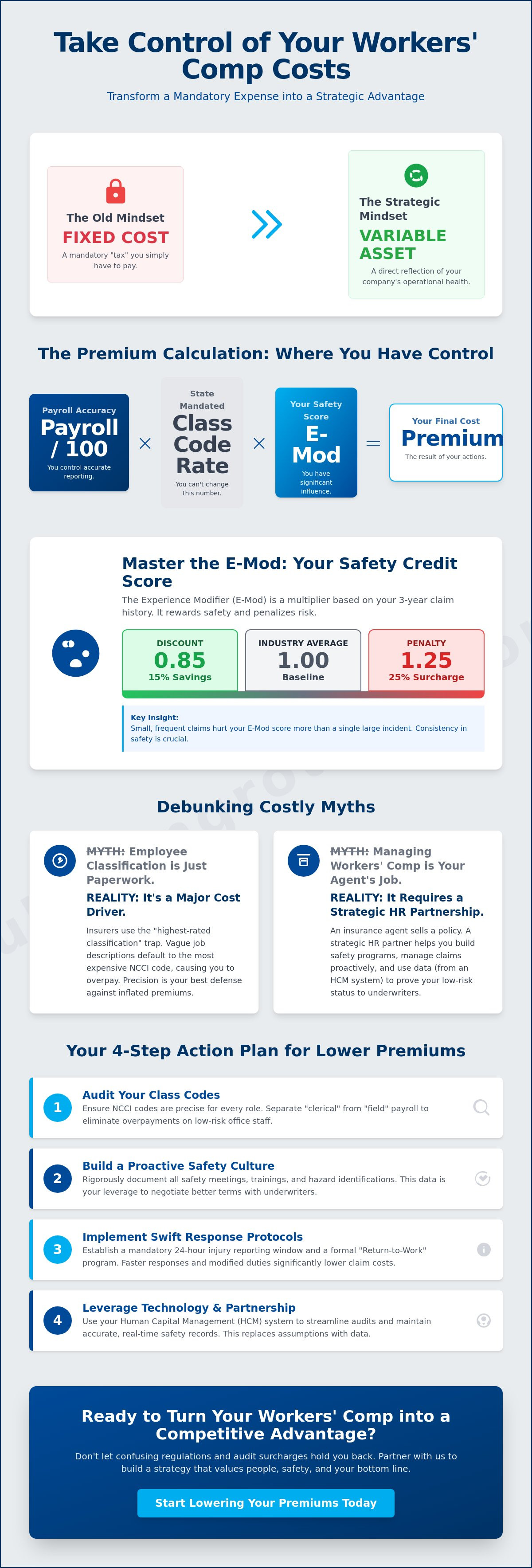
To understand the leverage you have, you must look at the math. The standard calculation follows a clear path: (Payroll / 100) x Class Code Rate x E-Mod = Your Premium. While you cannot change the industry class code rates set by the state, you have significant control over your payroll reporting and your Experience Modifier. Before diving into the numbers, it helps to understand the foundation of what is workers' compensation? and why the system rewards businesses that prioritize employee well-being. The Experience Modifier, or E-Mod, is a multiplier that rewards or punishes businesses based on their specific three-year claim history.
Understanding the Experience Modifier (E-Mod)
Think of the E-Mod as your business’s "safety credit score." The industry average is 1.0. If your score is 0.85, you receive a 15% discount. If it’s 1.25, you pay a 25% penalty. Is your score helping or hurting your cash flow? This score creates a "lag year" effect. The safety decisions you make today will dictate your 2027 premiums. It is also a common misconception that one big accident is the primary budget killer. In truth, small, frequent claims hurt your score more than a single catastrophic event. Insurance carriers view frequency as a sign of systemic failure, making how to lower workers comp premiums a matter of consistent, daily vigilance rather than just avoiding big disasters.
The Power of Proactive Risk Management
It's time to stop using the "pay and pray" model. This reactive approach assumes injuries are inevitable and simply hopes for the best. By shifting to a proactive strategy, you take the wheel. This involves rigorous HR risk management to identify hazards before they become claims. Documenting your safety meetings and training sessions isn't just busy work. It provides tangible proof of a safety culture. When your annual renewal arrives, these records give your HR partner the leverage needed to negotiate better terms with underwriters. You aren't just a policy number; you are a low-risk partner with the data to prove it.
Myth 2: Employee Classification is Just Administrative Paperwork
Is your payroll data working for you or against you? Many entrepreneurs view employee classification as a minor clerical task, but this is a dangerous oversight. NCCI class codes are the engine behind your insurance rates. If you want to know how to lower workers comp premiums, start by auditing your codes. Insurers often employ the "highest-rated classification" trap. If a job description is vague or ambiguous, they default to the most expensive code available for your industry. This simple administrative slip can lead to thousands in overpayments that never get recovered.
Precision is the best antidote to high costs. You must separate "clerical" payroll from "field" payroll, especially for hybrid roles. Why pay a high-risk rate for an employee who spends ninety percent of their time in the office? By using a human capital management system like isolved, you can ensure your payroll data matches these class codes automatically. This removes the guesswork. It creates a transparent, defensible record for your carrier. It positions you as a business that values accuracy over assumptions.
Common Classification Errors That Drain Cash
Mislabeling staff is one of the fastest ways to drain your cash reserves. Consider a receptionist working at a construction firm. If they are lumped in with the site crew, you are paying a massive premium for a low-risk role. Roles change, but job descriptions often stay static. You should update these descriptions whenever a role shifts significantly. Utilizing a workers compensation audit can help you identify and correct these past mistakes. This process often reveals hidden savings that have been sitting on your books for years.
The Role of Data Integrity in Payroll Reporting
Manual data entry is the enemy of financial accuracy. Relying on spreadsheets often leads to "audit shock" when the carrier discovers discrepancies at the end of the year. Automated reporting helps you track overtime, which many states exclude from premium calculations. This level of data integrity is a core part of a robust safety and health program, as it allows for accurate premium forecasting. Real-time visibility into your payroll means no surprises. It allows you to manage, monitor, and master your insurance costs with total confidence.
Myth 3: Claims Management Only Starts After an Injury Occurs
Are you waiting for an accident to happen before you think about claims management? This reactive approach is one of the most expensive mistakes a business owner can make. True claims management begins long before the first bandage is applied. It starts with a documented Return-to-Work (RTW) policy that is ready to deploy at a moment's notice. If you are searching for how to lower workers comp premiums, you must master the "Golden Hour." Reporting an injury within 24 hours can reduce total claim costs by up to 40%. This speed allows for immediate medical intervention and prevents minor "medical-only" incidents from spiraling into complex "lost-time" claims.
Keeping an injured employee connected to the workplace is vital for their recovery and your bottom line. Transitional duties allow workers to stay on your payroll in a modified capacity rather than drawing disability benefits from your insurance carrier. This strategy is a cornerstone of proven strategies to reduce costs because it keeps the indemnity portion of a claim low. When you prevent an injury from becoming a lost-time event, you protect your Experience Modifier from the heavy penalties associated with long-term disability payments.
Building a Robust Return-to-Work Program
A successful RTW program requires a library of light-duty tasks prepared in advance. You might include safety audits, filing, light assembly, or even specialized training. Don't wait for an injury to define these roles. Communicate your RTW policy to every employee during the onboarding process. This sets clear expectations that you value their contribution and want them back on the team as soon as medically possible. By documenting these options early, you demonstrate a culture of safety and support that underwriters find highly attractive during renewal negotiations.
Improving Cash Flow with Modern Billing
How you pay for your coverage is just as important as how you manage claims. Traditional models rely on estimated premiums and large down payments, often leading to painful adjustments during the year-end audit. You can avoid this stress by switching to pay-as-you-go workers compensation. This modern billing model uses real-time payroll data to calculate premiums with total precision. It eliminates the need for massive upfront deposits and ensures your cash flow remains steady. When your billing matches your actual payroll, the annual audit becomes a simple verification rather than a financial surprise.
Myth 4: Safety Programs Are Only for High-Risk Industries
Do you believe your office environment is inherently safe? It's a common trap for white-collar business owners to assume safety programs are strictly for high-risk industries like construction or manufacturing. This myth ignores the "invisible" costs that quietly erode your bottom line. Carpal tunnel syndrome, chronic back strain, and mental health-related absenteeism are persistent risks in any professional setting. If you want to master how to lower workers comp premiums, you must recognize that an injury at a desk is just as impactful to your E-Mod as an injury on a job site. Protecting every desk, cubicle, and retail counter is the first step toward long-term savings.
Investing in safety is not a sunk cost; it is a high-yield investment. Industry data from sources like OSHA consistently shows that for every $1 spent on safety initiatives, businesses see a return of $3 to $6. This ROI comes from reduced claim frequency, lower administrative overhead, and improved employee retention. Many states even reward proactive behavior by offering direct "safety credits." By establishing a formal safety committee, you can earn these credits and lower your base premium immediately. This turns safety from a regulatory burden into a competitive financial advantage that rewards your commitment to your team.
Implementing a Drug-Free Workplace Program
One of the most direct ways to secure a discount is through a certified drug-free workplace program. In many jurisdictions, this certification provides an automatic premium reduction ranging from 5% to 7.5%. Maintaining this status requires more than just a one-time test. You need a compliant HR policy that covers pre-employment, post-accident, and reasonable suspicion testing. This structured approach reduces the frequency of preventable accidents and ensures your team remains sharp, focused, and safe. It is a clear signal to your insurance carrier that you are a low-risk partner who values a stable work environment.
The Psychology of Safety Culture
A true safety culture is built on leadership behavior, near-miss reporting, and continuous education. It is not enough to hang a sign in the breakroom. Leaders must model the behavior they expect to see every day. Encourage your employees to report "near-miss" events without fear of reprimand. These reports are the early warning signs that allow you to fix a hazard before it becomes a claim. You can easily manage this process by using your HCM system to track safety training completion and distribute updated protocols. This ensures that safety remains a top-of-mind priority for every member of your organization.
Ready to build a safer, more profitable workplace? Contact our expert HR consultants today to start your safety transformation.
Myth 5: Managing Workers Comp is Your Insurance Agent’s Job
Do you assume your insurance agent has your workers' compensation costs fully under control? While an agent is a vital buyer of your policy, they are rarely the daily manager of your risk. This distinction is critical for anyone learning how to lower workers comp premiums effectively. An agent shops for the best rate based on your current data, but an HR partner works to improve that data. Sullivan Group HR acts as a bridge between your daily operations and your insurance carrier. This ensures that your safety efforts are recognized and your premium reflects your actual risk profile rather than an industry average.
As we look toward the remainder of 2026, the landscape is shifting. Medical costs in claims are rising across the country. In states like California, where a 10.4% rate increase was proposed for September 2026, a passive approach is no longer sustainable. Data-driven HR management is the only reliable way to combat these inflationary pressures. By focusing on the details of your workplace safety and administrative accuracy, you protect your company from external market volatility. You need a partner who understands the nuances of your territory and the specific needs of your workforce.
The Advantage of Unified HCM and Risk Management
Fragmented systems create blind spots. When your payroll, time tracking, and risk management live in separate silos, errors are inevitable. By integrating these functions into a single platform like isolved, you eliminate data gaps. This unified approach to what is human capital management ensures that every hour worked and every safety training completed is documented in real time. Automated data sharing reduces your audit preparation time from days to minutes. It transforms a stressful annual event into a simple confirmation of your operational excellence. You gain clarity, speed, and total control over your administrative destiny.
Partnering for Long-Term Premium Reduction
Many businesses make the mistake of "shopping" their insurance every single year. While it's tempting to chase a lower quote, this rarely addresses the root cause of high costs. Your primary goal should be improving your Experience Modifier (E-Mod) over time through consistent safety and claim management. Professional HR consulting provides the hard-earned wisdom needed to navigate complex, state-specific regulations that an automated system might miss. We help you build a legacy of safety that carriers want to reward with lower rates. Are you ready to stop reacting and start managing? Schedule a risk assessment with Sullivan Group HR to secure your business's financial future today.
Secure Your Business with Strategic HR Management
Are you ready to stop overpaying for "uncontrollable" costs? You now have the roadmap for how to lower workers comp premiums by mastering your E-Mod, refining employee classifications, and implementing a 24-hour reporting culture. These aren't just administrative tasks; they are the building blocks of a resilient organization that values its people as much as its profits. By shifting your focus from a reactive purchase to proactive management, you gain total control over your financial destiny.
Since 1998, we've helped regional businesses navigate these complexities with specialized HR consulting and the power of the isolved HCM platform. You don't have to face audit stress or rising medical costs alone. Our team provides proactive claims management and dedicated audit support to ensure your data remains accurate and your business stays protected. We act as your coach and advocate, turning administrative burdens into streamlined assets.
Get a Comprehensive Risk Management Review from Sullivan Group HR. Your potential is limitless when your risks are managed. We're ready to help you build a safer, more profitable legacy today.
Frequently Asked Questions
How long does it take for safety improvements to lower my premiums?
Safety improvements typically take three years to fully impact your premium through the Experience Modifier calculation. This delay occurs because the rating bureau looks at a rolling three-year window of your claims history. While you won't see an immediate drop on day one, consistent safety habits prevent future surcharges and secure your long-term financial health. It is a marathon, not a sprint, toward operational excellence.
What is an Experience Modifier (E-Mod) and why does it matter?
Your E-Mod is a numerical multiplier that acts as a safety performance rating compared to other businesses in your industry. It matters because it directly scales your premium up or down based on your historical risk. A score below 1.0 serves as a discount, while anything above 1.0 is a penalty. Managing this score is the most effective way to understand how to lower workers comp premiums over time.
Can I challenge a classification code assigned by my insurance company?
Yes, you can challenge a classification code if it does not accurately reflect the actual duties performed by your employees. You should start by reviewing your job descriptions and comparing them against NCCI guidelines. Providing detailed evidence of daily tasks often leads to a reclassification. This correction can result in significant annual savings and even retroactive credits. Don't accept a default code without verification.
Does pay-as-you-go workers comp actually lower the total cost?
Pay-as-you-go billing does not necessarily lower the base rate, but it significantly reduces the hidden costs of cash flow management and audit penalties. By paying based on real-time payroll, you avoid large upfront deposits and the risk of massive year-end audit bills. It ensures your premium is always accurate and aligned with your current workforce size. It is a smarter way to manage your monthly capital.
What are the most common mistakes found during a workers comp audit?
The most frequent audit errors include misclassifying administrative staff, failing to exclude overtime pay correctly, and lacking certificates of insurance for subcontractors. Many business owners lose money by lumping all payroll into the most expensive class code. Keeping organized records through a unified HCM platform helps you identify these mistakes before the auditor arrives. Preparation is the key to a stress-free audit experience.
How much can a drug-free workplace program save me on premiums?
A certified drug-free workplace program can save you between 5% and 7.5% on your base premium in many states. Beyond the direct discount, these programs reduce the frequency of accidents and improve overall workplace morale. It is a proven strategy for how to lower workers comp premiums while building a more reliable and productive team. This small policy change delivers a significant return on investment.
What should I do if an injured employee refuses to return to light-duty work?
If an employee refuses a medically cleared light-duty offer, you should immediately document the refusal and notify your insurance carrier. Refusing a valid Return-to-Work offer can lead to the suspension of their indemnity benefits. Having a written policy in your employee handbook ensures everyone understands their responsibilities and protects your business from unnecessary lost-time costs. Clear communication prevents confusion during the recovery process.
Is workers comp insurance required for remote employees in different states?
Yes, you generally must provide workers' compensation coverage in the state where the employee is physically performing the work. Remote work creates a multi-state compliance obligation that requires careful payroll tracking. Failing to register in the correct state can lead to severe fines and uncovered claims. Professional HR consulting is essential for distributed teams to ensure you remain protected regardless of where your talent resides.


