

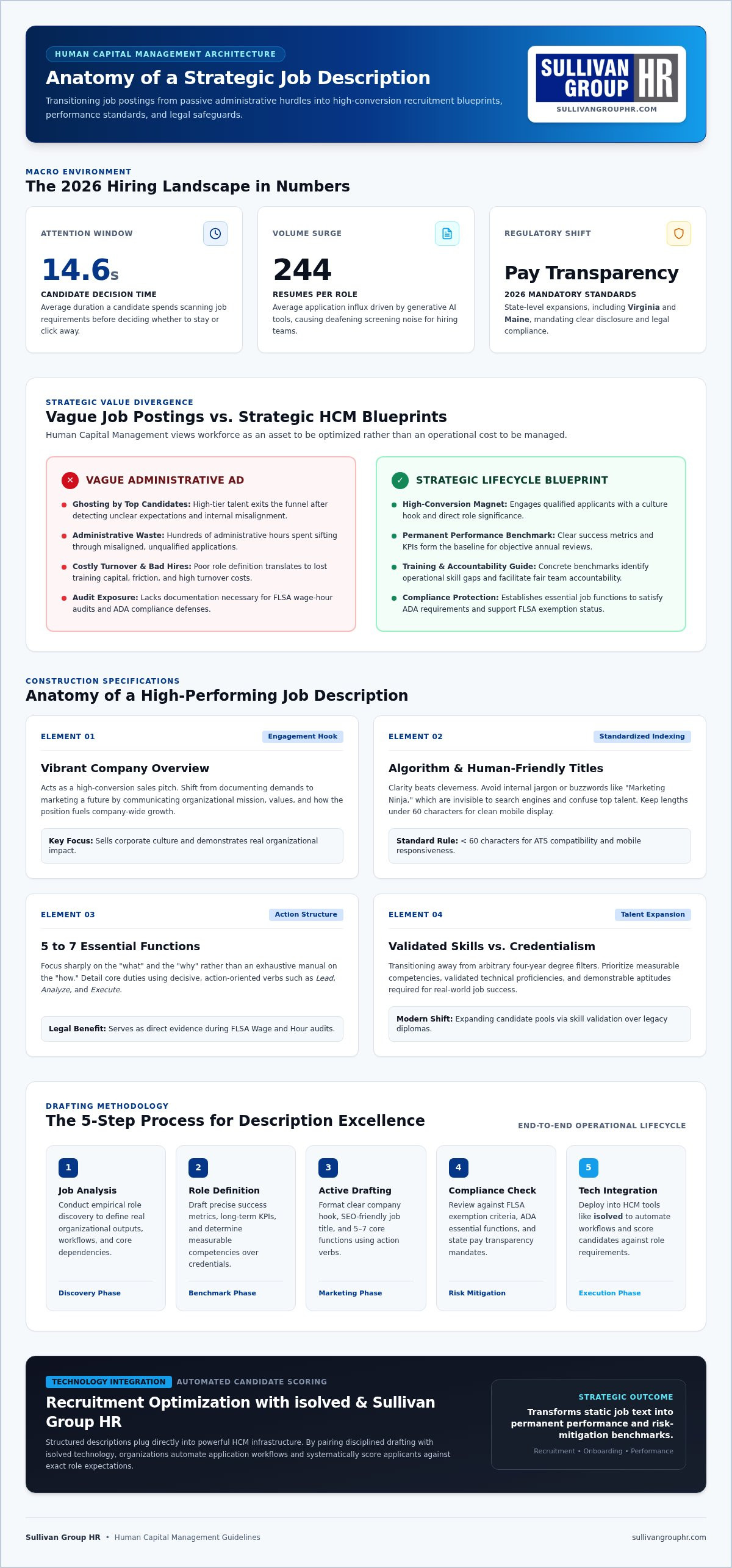
Did you know the average job seeker spends only 14.6 seconds reviewing your requirements before deciding to click away? With generative AI tools driving application volume to an average of 244 resumes per role, the noise can be deafening. If you feel overwhelmed by unqualified candidates or the complex web of 2026 pay transparency laws in states like Virginia and Maine, you aren't alone. You need a hiring process that offers security, clarity, and results.
Learning how to write effective job descriptions is the first step in a unified strategy to protect your business and empower your people. We'll help you master the art of crafting postings that attract top talent, ensure legal compliance, and streamline your entire hiring lifecycle. This guide provides a repeatable template for success, ensuring your team stays aligned and your candidate pool remains high-quality. We will explore how to balance marketing, compliance, and technology to build a stronger, more resilient workforce.
Key Takeaways
- Transform your job descriptions from simple hiring ads into strategic blueprints that guide the entire employee lifecycle.
- Balance internal culture with external searchability by mastering the anatomy of high-performing titles and engaging company hooks.
- Protect your organization by learning how to write effective job descriptions that satisfy ADA requirements and mitigate compliance risks.
- Adopt a proven 5-step drafting process that uses real-world job analysis to define clear success metrics for every new hire.
- Leverage powerful HCM technology like isolved to automate your recruitment workflow and score candidates against your specific role expectations.
Why Job Descriptions are the Foundation of Human Capital Management
Is your hiring process a source of organizational strength or a point of friction? Many business owners view job postings as a simple administrative hurdle. In reality, a well-crafted job description is the DNA of your company. It serves as a strategic blueprint for the entire employee lifecycle. It defines how you recruit, how you manage, and how you protect your business. When you master how to write effective job descriptions, you move beyond filling seats. You begin making growth investments that pay dividends in productivity and peace of mind.
This approach sits at the heart of Human Capital Management (HCM). HCM is a framework that views your workforce as a valuable asset to be optimized rather than a cost to be managed. A clear description ensures that every person you hire is aligned with your vision from day one. It creates a culture of transparency, reliability, and professional rigor.
The Cost of a Poorly Written Description
Vague descriptions create a ripple effect of inefficiency that drains your bottom line. When expectations are blurry, high-quality candidates often "ghost" the process because they sense a lack of internal alignment. This leaves you with a sea of unqualified applicants. According to the 2026 Greenhouse Benchmark Report, the average job now receives 244 applications. Without a precise description, your team wastes hundreds of administrative hours filtering through resumes that never should have been submitted. Poorly defined roles also lead to "bad hires" and high turnover, which can cost your business thousands in lost training time and recruitment fees. A weak description doesn't just attract the wrong people; it actively repels the right ones.
Descriptions as Performance Benchmarks
Clarity drives results and builds trust. A clear description serves as a performance roadmap that guides an employee's journey long after the initial offer letter. By mastering how to write effective job descriptions, you establish measurable KPIs and success metrics from the start. This creates a foundation for annual reviews that are objective rather than emotional. When expectations are documented, you can identify training needs, reward excellence, and hold team members accountable with confidence. This alignment ensures that every individual understands their specific contribution to your company's long-term security and success. It transforms a simple job post into a permanent tool for organizational excellence.
Anatomy of a High-Performing Job Description
Is your job posting a static list of demands or a compelling invitation? In a market where candidates spend less than 15 seconds reviewing a post, your description must act as a high-conversion sales pitch. Mastering how to write effective job descriptions requires a shift in perspective. You are no longer just documenting a role; you are marketing a future. This starts with a "Hook"—a vibrant company overview that sells your culture, mission, and the specific impact this role will have on the organization's growth.
Writing Titles for Humans and Algorithms
Clarity beats cleverness every time. While "Marketing Ninja" might sound fun in a staff meeting, it's invisible to search engines and confusing to top-tier talent. Use industry-standard titles to ensure your post is easily indexed by your Applicant Tracking System. Keep titles under 60 characters to ensure they display correctly on mobile devices. This simple adjustment ensures your role reaches the right eyes quickly and professionally. If you need help refining your recruitment strategy, our team at Sullivan Group HR can provide the expert consulting you need to stand out.
Defining Essential Functions
Precision protects your business. When listing core responsibilities, focus on the "what" and "why" rather than a step-by-step manual on "how." Limit this section to 5; 7 core functions to avoid overwhelming the reader. Use action-oriented verbs like "Lead," "Analyze," and "Execute" to convey movement and results. This clarity is vital for meeting FLSA exemption requirements, as the written description serves as primary evidence during a Wage and Hour audit. It ensures the role is correctly classified while setting clear expectations for the candidate.
The 2026 hiring landscape has moved away from "credentialism." Instead of requiring arbitrary four-year degrees, focus on measurable competencies and validated skills. Ask yourself: what must this person actually do to succeed? By prioritizing demonstrable aptitudes over traditional diplomas, you expand your candidate pool and mitigate disparate impact liability. This approach treats how to write effective job descriptions as a tool for inclusivity and organizational safety. It builds a workforce based on what people can achieve, not just what they've done in the past.
Navigating Compliance: Protecting Your Business
Are your current job postings creating a legal shield or a liability? In the modern regulatory environment, a job description is far more than a recruitment tool. It is your first line of defense against discrimination claims and wage disputes. Understanding how to write effective job descriptions ensures your business remains compliant, protected, and prepared for scrutiny. This proactive approach is a cornerstone of a robust HR Risk Management strategy.
The ADA and 'Essential Functions'
Precision in your documentation is non-negotiable. You must clearly distinguish between essential functions, the core duties that define why the role exists, and marginal tasks. This distinction is the primary factor in determining reasonable accommodations under the Americans with Disabilities Act. According to the EEOC essential job functions guidance, employers must accurately document physical demands like lifting, standing, or travel. By being specific now, you protect your organization from future accommodation disputes. It's also vital to note that under the Pregnant Workers Fairness Act (PWFA) regulations in effect since June 2024, an applicant remains qualified even if they temporarily cannot perform an essential function. Your descriptions must reflect these nuances to ensure full organizational safety.
Avoiding Unconscious Bias in Language
Does your language accidentally narrow your talent pool? Words like "energetic" or "digital native" can be interpreted as age-coded, while terms like "competitive" or "dominant" often lean toward gendered bias. To build an equitable process, focus on "minimum" qualifications rather than "preferred" ones. This shift invites a broader range of qualified applicants who might otherwise opt out. Inclusive language creates a workplace where every individual feels valued and secure, which significantly improves long-term retention rates. By removing these hidden barriers, you foster a culture of belonging and stability.
Finally, consider the growing patchwork of state laws. As of July 1, 2026, Virginia joined states like California and New York in requiring good-faith salary ranges in all job postings. Maine followed with similar requirements on July 29, 2026. Learning how to write effective job descriptions now includes mastering pay transparency. This transparency builds trust with candidates and ensures your internal compensation structures remain fair and consistent. Protecting your business means staying ahead of these shifts with clarity and professional rigor.
The 5-Step Process for Drafting Effective Descriptions
How do you move from a blank page to a high-performing job post without losing hours of your day? Many leaders make the mistake of recycling old, dusty templates that no longer reflect the reality of the role. Instead, follow a structured process that ensures every word serves a purpose. Mastering how to write effective job descriptions is about combining real-world feedback with strategic clarity. Use this five-step framework to build a repeatable engine for your recruitment success.
- Step 1: Conduct a Brief Job Analysis. Don't guess what the role requires. Interview your current high performers to understand the daily reality of the position.
- Step 2: Define Success Metrics. Determine exactly what a "win" looks like for the first 90 days. Clear goals attract candidates who are ready to deliver results.
- Step 3: Draft Technical and Soft Skill Requirements. Separate the "must-haves" from the "nice-to-haves" to ensure your pool remains diverse and qualified.
- Step 4: Review for Compliance and Searchability. Run a final check for inclusive language and ensure your title matches what candidates actually search for.
- Step 5: Finalize and Distribute. Upload your polished description to your HCM platform for automated distribution across thousands of job boards.
Gathering Intel from the Front Lines
The best descriptions aren't written in a vacuum. To get the details right, ask the direct manager and the current team member three critical questions. What does a typical Tuesday look like? What is the one "hidden" task that takes up the most time? What soft skills actually lead to success in our culture? These answers reveal the nuances that a standard template will always miss. Identifying these traits helps you find a person who won't just do the job, but will thrive in your specific environment. If you need a reliable partner to handle the complexities of recruitment, Sullivan Group HR offers the professional consulting you need to scale with confidence.
Refining for Impact
Once your draft is ready, put it through the "Read Aloud" test. If a sentence feels clunky or sounds like a legal manual, change it. Your brand voice should be supportive, professional, and inviting. Trim the fat by removing corporate jargon and repetitive bullet points. Every line should either sell the role or define an essential function. Finally, ensure your call to action is low-friction. A complicated application process causes 49% of workers to abandon their submission. Keep it simple, keep it clear, and keep it focused on the candidate's potential. To see how candidates prepare for these specific company processes, you can learn more about Job Hunt Mode Blog, which offers detailed guides for applicants navigating the hiring workflows of major employers. This final polish ensures your how to write effective job descriptions strategy yields the highest possible return on your investment.
Why let a brilliant job description sit idle on your hard drive? Even the most well-crafted post fails if it doesn't reach the right audience or if your team is buried under manual data entry. Mastering how to write effective job descriptions is only half the battle. The other half is leveraging technology and expertise to turn those words into a high-performing workforce. For those hiring in specialized fields, you can discover Esquire Talent Consultants to ensure your roles reach the most qualified legal professionals. By integrating your descriptions into a unified HCM platform, you transform recruitment from a reactive chore into a proactive strategy. It's about creating a system that works for you, not against you.
Speed and precision are your greatest allies in the 2026 talent market. An integrated Applicant Tracking System (ATS), like the one powered by isolved, eliminates the friction of manual posting. With one click, your description is pushed to over 5,500 job boards and social media channels instantly. This automation ensures your role gets maximum visibility while you focus on high-level strategy. You can also set up "knock-out" questions based on your essential requirements to filter out unqualified candidates before they reach your desk. Tracking the ROI of different job boards through your HCM dashboard allows you to invest your recruitment budget where it delivers the best results. It's about working smarter, moving faster, and hiring better.
Why Partner with Sullivan Group HR?
Technology is powerful, but it's most effective when paired with human wisdom. At Sullivan Group HR, we provide a supportive, expert approach that goes beyond simple software. We help you audit your current job library to ensure every post reflects your culture and meets shifting legal standards. Are your descriptions ready for the latest pay transparency mandates? Do they accurately reflect the physical demands required by the ADA? Our team provides the protective oversight you need to grow safely. We customize the isolved People Cloud to fit your unique hiring workflow, ensuring a seamless transition from a candidate's first click to a welcoming onboarding experience. We don't just sell systems; we build long-term relationships centered on your success.
The journey of how to write effective job descriptions ends where your new hire's journey begins. By combining strategic writing, enterprise-grade technology, and professional consulting, you create a foundation for organizational security. You protect your business, support your managers, and empower your people. Let's move away from transactional hiring and toward a unified strategy that values people over systems. Your growth depends on the quality of your talent, and your talent depends on the clarity of your vision.
Secure Your Future Through Strategic Hiring
Are you ready to transform your recruitment from a burden into a competitive advantage? Mastering how to write effective job descriptions is more than just a writing exercise. It's a commitment to organizational safety, clarity, and growth. By treating every posting as a strategic blueprint, you protect your business from compliance risks and attract the talent that drives results. You've learned how to define essential functions, navigate complex transparency laws, and leverage front-line intel to find the perfect fit. Now, it's time to put these tools into motion.
Success in the 2026 market requires the right balance of technology and wisdom. Ready to streamline your hiring? Explore our isolved HCM solutions today. Our team provides the national HR compliance expertise and integrated Applicant Tracking Systems you need to scale with confidence. With access to the isolved People Cloud, you can automate your recruitment workflows while maintaining a human-centric approach. Your next great hire is waiting. Let's build a workforce that is secure, aligned, and ready for what's next.
Frequently Asked Questions
What is the difference between a job description and a job posting?
A job description is a formal, internal document that details the role's duties, requirements, and legal classifications. In contrast, a job posting is a marketing tool designed to attract candidates. While the description provides the foundation, the posting focuses on the culture and "the hook." Understanding how to write effective job descriptions involves knowing when to use each. One protects your business, while the other sells your brand to the talent market.
How long should an effective job description be?
An effective job description typically ranges between 400 and 700 words. It needs to be long enough to cover essential functions and physical requirements but short enough to keep a candidate's attention. Remember that job seekers spend less than 15 seconds on the first pass. Use bulleted lists for duties and qualifications to improve readability. This structure ensures you deliver high-impact information quickly without overwhelming the reader or burying critical role expectations.
Should I include salary ranges in the job description?
Yes, including a good-faith salary range is now the industry standard for 2026. States like Virginia, Maine, and Illinois have enacted laws requiring this transparency. Beyond compliance, listings with pay ranges receive significantly more engagement from high-quality candidates. Providing this data upfront builds immediate trust and prevents wasted time for both your hiring team and the applicant. It ensures your recruitment process remains efficient, fair, and aligned with modern workforce expectations across the country.
What are 'essential functions' under the ADA?
Essential functions are the fundamental job duties that an employee must be able to perform, with or without reasonable accommodation. These are the core reasons why the position exists. If a task is only performed occasionally or could be easily reassigned, it is a marginal function. Distinguishing between these two is critical for ADA compliance. It protects your company during accommodation requests by clearly documenting the non-negotiable physical and mental requirements of the role.
How often should I update my company's job descriptions?
You should review and update your job descriptions at least once a year or whenever a significant change occurs in the role's responsibilities. Business growth often causes positions to evolve naturally over time. Regular audits ensure your documentation remains accurate for performance reviews and legal safety. Keeping these files current prevents misalignment between management and staff. It also ensures your Applicant Tracking System continues to score candidates against the most relevant and up-to-date criteria.
Can a job description be used as a legal document?
While not a contract, a job description is a vital piece of evidence in legal and regulatory proceedings. It is the primary document scrutinized during Department of Labor audits to verify FLSA exemption status. It also serves as a defense against discrimination or wrongful termination claims. Learning how to write effective job descriptions that are accurate and compliant provides a layer of organizational security. This documentation proves that your hiring and management decisions are based on objective, non-discriminatory criteria.
How do I make my job description stand out on LinkedIn or Indeed?
To stand out, lead with a compelling company overview that highlights your unique culture and mission. Use industry-standard job titles to ensure your post is easily searchable by algorithms. Avoid corporate jargon and focus on the impact the new hire will make. Since many candidates use mobile devices, keep your paragraphs short and your call to action clear. A low-friction application process combined with a transparent salary range will significantly increase your candidate conversion rates on major job boards.


