

Could your business growth be your greatest liability? While expanding across state lines marks a major milestone, it also introduces a tangled web of overlapping regulations. As of April 2026, fourteen states and the District of Columbia have enacted mandatory paid family leave systems. Addressing multi-state employer compliance challenges isn't just about filing paperwork. It's about safeguarding your legacy, protecting your people, and securing your future against a shifting regulatory landscape of tax nexus thresholds and AI disclosure requirements.
We know that tracking 50 different sets of labor laws while calculating precise payroll taxes feels like a full-time job in itself. You deserve the peace of mind that comes from predictable labor costs and audit-ready records. This article will help you master the complexities of multi-jurisdictional HR with a strategic framework designed to protect your growing organization. We'll explore the 2026 regulatory maze, highlight the power of the isolved People Cloud as your single source of truth, and show you how to integrate payroll, benefits, and compliance into one seamless operation.
Key Takeaways
- Understand how the shift toward remote work has transformed small businesses into national entities with complex regulatory obligations.
- Identify and mitigate multi-state employer compliance challenges using a three-pillar framework of financial, operational, and relational risk.
- Uncover the hidden administrative hurdles and paper trails that often lead to costly penalties during multi-jurisdictional audits.
- Master a proactive five-step strategy to maintain consistent employee handbooks while adhering to diverse local labor laws.
- Leverage the isolved People Cloud to create a single source of truth for your payroll and benefits data across all 50 states.
The Evolution of Multi-State Employment: Why Compliance Is Harder in 2026
What does it mean to be a multi-state employer? Simply put, any business with employees performing work in more than one jurisdiction falls into this category. In the past, this was a challenge reserved for large corporations with massive footprints. Today, the "work from anywhere" culture has transformed even the smallest startups into national entities. Every home office, kitchen table, and co-working space is now a satellite branch that carries its own unique set of rules.
The 2026 landscape is markedly different from years past. We are seeing a surge in state-level legislative activity and much stricter enforcement across the country. As of April 2026, fourteen states and the District of Columbia have enacted mandatory paid family leave systems. Relying on federal law is no longer enough to protect your business. You're now managing a complex patchwork of local rules that can change overnight. This reality creates significant multi-state employer compliance challenges for even the most organized HR teams.
The Remote Work Trigger: When Does a State Gain Jurisdiction?
Is your team truly where you think they are? An employee’s physical location usually dictates which labor laws apply, not where your company headquarters is located. This physical presence creates a "nexus," which is the legal connection that triggers your tax and regulatory obligations. The risk often lies in unmonitored travel. A staff member taking a "working vacation" in another state for several weeks can accidentally create a new tax jurisdiction for your business. You must track location, verify residency, and monitor movement to stay safe.
The High Cost of Non-Compliance: Penalties and Audits
The price of a mistake is rarely just a slap on the wrist. Non-compliance leads to a painful list of consequences that can threaten your bottom line:
- Unpaid back taxes and mounting interest.
- Liquidated damages and heavy legal fees.
- Stiff penalties for missed pay data reporting.
The Three Pillars of Multi-State Risk: Tax, Wages, and Benefits
How do you maintain a unified company culture when your regulatory obligations change every time you cross a state line? Managing national expansion requires a strategic framework that moves beyond basic record-keeping. We view multi-state employer compliance challenges through three critical lenses: Financial (Tax), Operational (Wage/Hour), and Relational (Benefits). These areas frequently conflict with federal standards, creating a compliance gap where many businesses stumble. Expert payroll administration outsourcing serves as your first line of defense, ensuring that local nuances don't derail your growth.
Certain "red flag" states like California, New York, and Illinois demand extra vigilance. These regions often lead the way with highly specific regulations that exceed federal standards. Staying ahead of these shifts isn't just about avoiding fines; it's about building a resilient foundation for your team. If you're feeling the weight of these administrative burdens, our human resources consulting team is here to help you navigate the path forward.
Payroll and Tax Nexus: The "Where" of Compliance
Compliance begins with geography. You must distinguish between state income tax withholding and State Unemployment Tax Acts (SUTA). While some neighboring states have reciprocal agreements that simplify withholding, others require precise tracking from day one. Accurate time and attendance data is essential here. Without it, you risk misallocating tax dollars and inviting unwanted scrutiny from state agencies that are increasingly aggressive in 2026.
Wage and Hour Variations: Minimums and Overtime
Federal FLSA standards are often just the floor. Many states have implemented aggressive minimum wage increases for 2026. For instance, California’s minimum wage rose to $16.90 per hour on January 1, 2026. Beyond the hourly rate, you must account for "daily overtime" rules and specialized pay stub requirements. A "one size fits all" payroll process will eventually lead to costly errors when facing multi-state employer compliance challenges in these high-regulation zones.
Benefits and Leave: Navigating the Statutory Maze
The relational pillar is where compliance meets employee care. The rise of state-mandated Paid Family and Medical Leave (PFML) programs is a defining trend of 2026. Delaware, Maine, and Minnesota all launched or expanded benefits earlier this year. You also need to manage varying rules for vacation payouts and "use it or lose it" policies that differ by jurisdiction. For a deeper look at these requirements, explore our guide on benefits management solutions.
Beyond the Basics: Hidden Compliance Hurdles for Expanding Teams
Is your business growing faster than your documentation? Rapid expansion often leaves a messy paper trail of half-finished registrations and outdated policies in its wake. Many entrepreneurs rely on "template-based" HR to save time, but these generic forms fail the moment you cross a state line. Effective HR risk management is about more than just checking boxes; it's about building a fortress around your company assets. You need a partner who understands the specific nuances of every territory you enter. Having an expert ally who watches the regulatory horizon allows you to scale with confidence rather than fear.
Employee Handbooks: One Version Is Not Enough
A single handbook cannot cover 50 different sets of rules. We recommend a "Hub and Spoke" model for your documentation. This keeps your core values and mission central while using state-specific addendums to handle local requirements. These addendums address critical differences such as:
- At-will employment disclaimers and local termination rules.
- Jury duty pay requirements and protected time off.
- Voting leave windows and mandatory notification periods.
Workers’ Compensation Insurance: A State-by-State Puzzle
Don't assume your current policy is a national blanket. Workers’ compensation is almost always state-specific, not a national blanket policy. You must navigate the sharp differences between competitive markets and "monopolistic" states where you must purchase coverage directly from a state-run fund. Properly covering remote workers in their home jurisdictions is a frequent pitfall in multi-state employer compliance challenges. If an injury occurs in a state where you aren't registered, you could face massive out-of-pocket costs and legal penalties. We help you verify that your coverage moves as fast as your people do.
The Visibility Challenge: Labor Law Posters and Notices
How do you hang a labor law poster in a remote employee's living room? This logistical nightmare is a real compliance risk for modern teams. In 2026, digital notice requirements are the standard for hybrid and remote workforces. You must verify that every team member has received and acknowledged the required disclosures. Centralizing these documents within the isolved People Cloud provides a secure, digital paper trail. This system ensures that whether your employee is in a corporate office or a home study, they have the information they need and you have the proof you require during an audit.
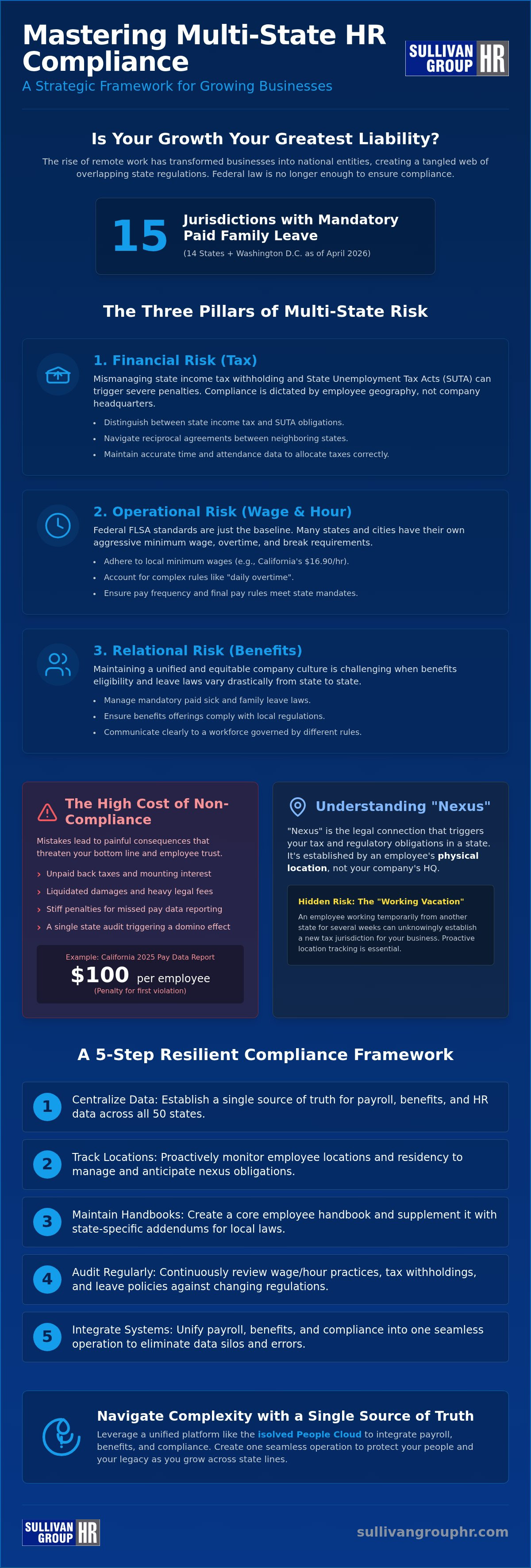
Building a Resilient Compliance Framework: A Strategic 5-Step Approach
Is your compliance strategy a one-time project or a living process? To survive the 2026 regulatory maze, you must move beyond reactive fixes. A proactive stance turns multi-state employer compliance challenges into a competitive advantage rather than a source of anxiety. It's time to retire the manual spreadsheets and embrace a unified workforce management solution. This transition is the hallmark of Professional Human Resources Consulting excellence, allowing you to focus on growth while we focus on the rules.
Step 1: Audit Your Current Footprint
You cannot manage what you haven't mapped. Start by identifying exactly where every employee is physically working today. This sounds simple, but the rise of hybrid models makes it a moving target. Review your existing registrations for state taxes and workers’ comp in every jurisdiction where your team resides. For the 2026 tax year, physical presence is established the moment an employee performs work within a state's borders, often triggering withholding requirements once they cross specific day-count thresholds. If a team member moved to a new state without notifying HR, you might already have an unregistered nexus.
Step 2: Centralize Data with Unified HCM
Siloed data is the enemy of accuracy. When your payroll software doesn't talk to your HR records, critical details like the 2026 Social Security wage base of $184,500 can be misapplied across different regions. Using a platform like isolved provides a single source of truth for all employee records. This integration is vital when handling applicant tracking and onboarding for out-of-state hires. When data flows seamlessly from the first application to the first paycheck, you eliminate the manual entry errors that lead to audit red flags. Digital centralization ensures that every state-specific form is signed, stored, and searchable.
Step 3: Establish a Monitoring Rhythm
Regulations don't sleep, and neither should your oversight. You need a set calendar for legislative updates, focusing heavily on January 1 and July 1 as key effective dates for new labor laws. Don't just process data; leverage a partner who provides proactive alerts about upcoming changes in tax rates or leave requirements. This is where "Fractional HR" support becomes a game changer. Having an expert to interpret new laws ensures you aren't just reading the rules, but applying them correctly to your specific business model. A steady monitoring rhythm prevents the "compliance panic" that usually follows a surprise legislative shift.
Ready to build a framework that protects your business? Consult with Sullivan Group HR to secure your national expansion and gain the peace of mind you deserve.
Navigating Complexity with Ease: The Sullivan Group HR Advantage
How do you move from surviving to thriving in a multi-state environment? The answer isn't just better software; it's a better partnership. Sullivan Group HR acts as the bridge between daunting regulations and your business growth. We help you overcome multi-state employer compliance challenges by combining industry-leading technology with hard-earned wisdom. Our philosophy is simple: we value people over systems. This means we provide security, stability, and results for your team. While our tech handles the complex math, our human experts handle your high-level strategy. This approach allows you to reclaim your time and focus on your core mission while we watch your back.
Expanding across state lines should be a celebration of your success, not a source of administrative anxiety. By positioning ourselves as your coach and ally, we transform the way you manage your workforce. We don't just provide a service; we foster a long-term relationship built on advocacy and reliable expertise. You deserve to lead your company with the confidence that every tax filing is accurate and every employee handbook is compliant.
Isolved People Cloud: Built for the Multi-State Reality
The isolved People Cloud is more than just a payroll tool; it's a single source of truth for your national workforce. The platform automates tax calculations and filings across all 50 states, ensuring accuracy regardless of where your team logs in. Through the Employee Self-Service portal, your staff can update their own addresses and tax forms. These updates trigger automatic adjustments in your payroll and tax withholding, eliminating the manual entry errors that often plague expanding teams. When audit season arrives, our built-in reporting tools provide the precise documentation you need to prove compliance in an instant. This digital centralization keeps your data safe, organized, and ready for any regulatory inquiry.
Your Protective Partner: Beyond the Software
Software can process data, but it cannot advocate for your professional potential. That's where our expert human resources consulting comes in. Having a dedicated HR consultant on call provides a level of reassurance that an automated help desk simply can't match. We act as your administrative shield, absorbing the burden of regulatory research and legislative interpretation. Whether you are navigating new leave laws in Minnesota or pay reporting in California, we provide the specific guidance you need to stay safe. We are here to ensure your growth remains sustainable and your legacy remains protected. Protect your business today with Sullivan Group HR.
Scale with Confidence: Your Future Beyond the Regulatory Maze
Are you ready to stop managing paperwork and start leading your expansion? The 2026 regulatory landscape is complex, but it doesn't have to be a barrier to your success. By centralizing your data and adopting a proactive monitoring rhythm, you transform multi-state employer compliance challenges into a streamlined part of your operations. You've worked hard to grow your business; now it's time to ensure that growth is built on a foundation of total security and professional rigor.
Sullivan Group HR provides the protective shield you need to navigate this journey. Through our industry-leading isolved HCM platform, expert human resources consulting, and integrated payroll and benefits administration, we offer a single source of truth for your national team. We focus on the math and the rules so you can focus on your mission and your people. It's time to reclaim your peace of mind and focus on what you do best.
Simplify your multi-state compliance with Sullivan Group HR. You have the vision to lead a national team, and we have the expertise to help you protect it. Let's build your legacy together.
Frequently Asked Questions
How do I know which state’s labor laws apply to a remote employee?
An employee’s physical work location generally determines which state labor laws apply to their employment. This includes rules regarding minimum wage, meal breaks, and overtime. If your staff member works from their home in Colorado, you must follow Colorado's specific regulations, even if your headquarters is in another state. We help you track these physical footprints to ensure you never miss a local requirement as your team expands across state lines.
Do I need to register my business in every state where I have a remote worker?
Yes, you typically need to register with the Secretary of State and tax authorities in every state where you have employees. This process establishes your presence for payroll tax withholding and state unemployment insurance (SUTA). Failing to register can lead to significant penalties and back taxes. Our team simplifies this process by handling the administrative registrations required to keep your national expansion fully compliant and audit-ready from day one.
What is tax nexus, and how does payroll trigger it?
Tax nexus is the legal connection between your business and a state that gives that state the authority to tax your activities. Having a single employee performing work in a state usually creates a physical presence nexus. This triggers obligations for income tax withholding and potentially sales or corporate taxes. Managing multi-state employer compliance challenges requires a deep understanding of these triggers to avoid accidental nexus through unmonitored remote work.
Do I need multiple versions of my employee handbook for different states?
You don't necessarily need separate handbooks, but you must include state-specific addendums. These addendums cover unique requirements for jury duty pay, voting leave, and local pregnancy accommodations. Since labor laws vary wildly between states like California and Texas, a single template won't protect you. We provide the expert human resources consulting needed to build and maintain these dynamic documents as state legislative sessions introduce new rules every year.
How does an HCM platform like isolved simplify multi-state compliance?
The isolved platform acts as a single source of truth by centralizing all employee data in one secure location. It automatically calculates and files taxes based on the employee’s verified work address, which is vital for overcoming multi-state employer compliance challenges. With built-in reporting tools and automated alerts for legislative changes, the system ensures your payroll and benefits administration remain accurate across all 50 states without the need for manual spreadsheets.
What are the penalties for failing to withhold out-of-state payroll taxes?
Penalties for failing to withhold taxes include back taxes, interest, and liquidated damages. State agencies are increasingly aggressive with enforcement in 2026. Beyond the immediate financial hit, failing to withhold correctly can trigger a domino effect of audits across multiple jurisdictions. These errors also damage employee trust, which can hurt your retention efforts. We act as your shield, ensuring every cent is reported correctly to protect your business and your reputation.
Can I use one workers’ compensation policy for all my employees nationwide?
No, workers’ compensation is almost always state-specific rather than a national blanket policy. You must ensure your coverage is active in every state where your employees perform work. Some jurisdictions, known as monopolistic states, even require you to purchase coverage through a specific state-run fund. We help you navigate these puzzles, ensuring your remote workers are properly protected and your business avoids the high cost of being uninsured in a new jurisdiction.
How often should I review my multi-state compliance policies?
You should review your policies at least once a year, though we recommend a quarterly check-in for high-growth teams. Key dates like January 1 and July 1 are critical, as most new state labor laws take effect then. Legislative sessions can move quickly, and what was compliant in December might be outdated by February. Our proactive monitoring rhythm ensures you stay ahead of the curve, providing peace of mind as your organization scales.


