

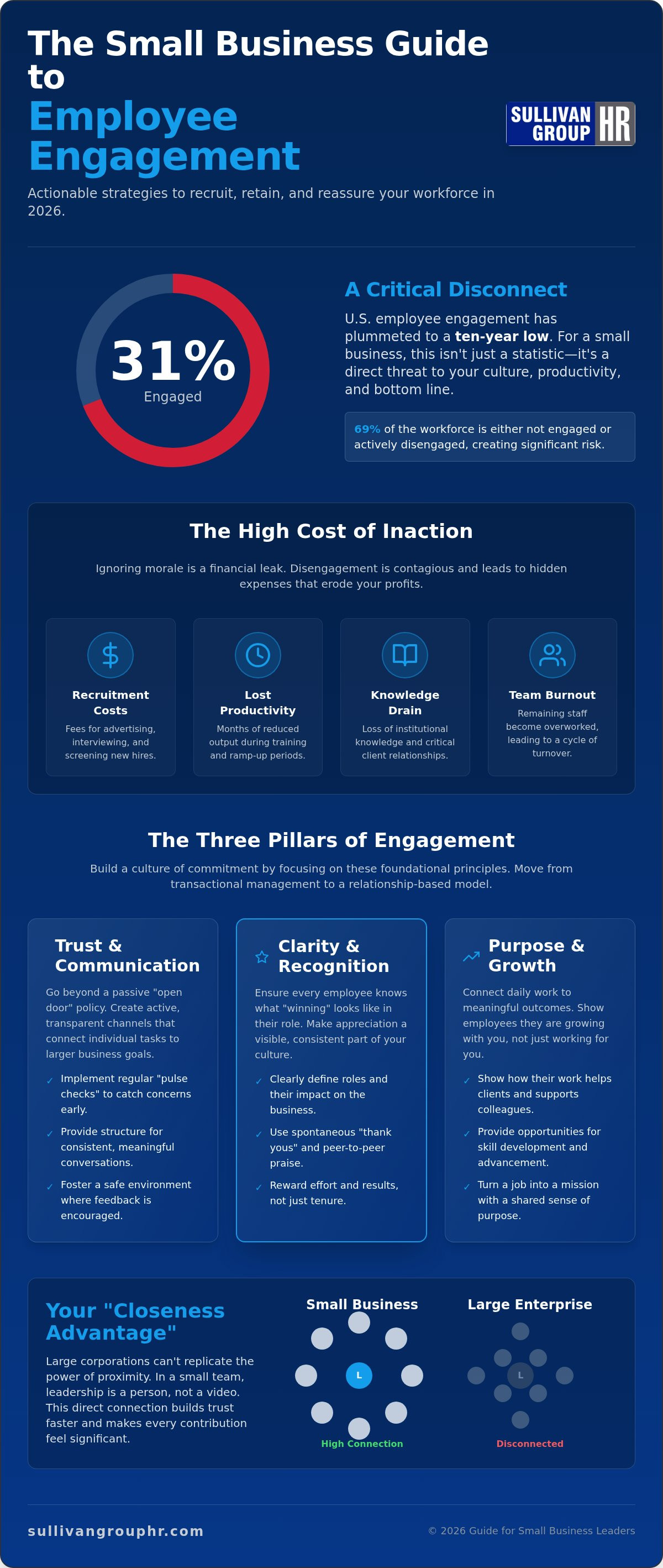
Did you know that U.S. employee engagement has plummeted to a ten-year low of just 31%? For a small business owner, that isn't just a data point; it's a direct threat to your bottom line. You're likely balancing high turnover costs with the challenge of keeping a hybrid team connected, all while your own schedule is packed. Finding effective employee engagement strategies for small business shouldn't require a corporate-sized budget or a dedicated department. It requires a partner who understands that your time is your most precious resource.
We believe that when you simplify your administrative tasks, you gain the freedom to lead with purpose. This 2026 guide offers actionable, cost-effective ways to boost morale and retention using modern human capital management insights. You'll discover how to lower turnover, motivate your team, and use tools like the isolved platform to streamline your daily operations. We'll show you how to move from being overwhelmed by paperwork to being an advocate for your people. Let's explore how to recruit, retain, and reassure your workforce for a more profitable future.
Key Takeaways
- Leverage your "closeness advantage" to build deeper emotional commitment and reduce turnover costs in a way that large enterprises cannot replicate.
- Discover how to implement effective employee engagement strategies for small business by focusing on the three pillars of trust, clarity, and purpose.
- Humanize your workplace using the isolved People Cloud, transforming HR software from a cold administrative tool into a vibrant hub for team connection.
- Implement five low-cost, high-impact tactical strategies that integrate seamlessly with your current workflows to boost morale without a corporate-sized budget.
- Free up your time for cultural leadership by partnering with experts who handle the administrative mechanics, allowing you to focus on your team's potential.
Why Employee Engagement Strategies for Small Business Matter in 2026
Are your employees just showing up, or are they truly "in it" with you? To understand What is Employee Engagement?, we must look beyond basic job satisfaction. It's the emotional commitment an employee has to your organization and its goals. In 2026, this commitment is harder to earn. AI tools have automated many routine tasks, but they've also left many workers feeling disconnected or anxious about their future. Meanwhile, hybrid work models have made culture feel like a digital ghost for some. This is why modern employee engagement strategies for small business must prioritize human connection over process alone. You need a strategy that recruits, retains, and reassures your workforce.
The Small Business Advantage
You have something a corporate giant can't buy: proximity. In a small team, trust builds faster because leadership isn't a face on a pre-recorded video; it's a person across the desk or a direct message away. When an employee sees how their daily work keeps the lights on, their morale spikes. They aren't just a cog. They're a contributor. This visibility creates a sense of belonging that enterprises struggle to replicate. Engagement is the intersection of purpose, clarity, and safety. By focusing on these three elements, you turn a job into a mission. Your team doesn't just work for you; they grow with you.
The High Cost of Doing Nothing
Ignoring morale isn't just a culture problem; it's a financial leak. When a key team member leaves, the cost isn't just their salary. It's the recruitment fees, the months of lost productivity during training, and the strain on the remaining team. In a small business, disengagement is contagious. It spreads through a tight-knit team faster than a large department. Developing effective employee engagement strategies for small business isn't a luxury; it's a survival tactic. Disengagement is estimated to cost the global economy nearly 9% of its GDP. For your business, the hidden expenses of turnover include:
- Recruitment and advertising costs for new hires.
- Time spent by leadership on interviewing and onboarding.
- Loss of institutional knowledge and client relationships.
- A "burnout loop" where remaining staff are overworked.
Think of engagement as a risk management strategy for long-term growth. Without it, you're constantly starting from zero. Protecting your culture is the most effective way to protect your profit.
The Three Pillars of Small Business Engagement: Trust, Clarity, and Purpose
Are your employees working for a paycheck or a partnership? This question often determines the long-term survival of a growing company. True engagement isn't a happy accident. It's a deliberate outcome of a culture built on three specific pillars: Communication, Recognition, and Growth. When these pillars are strong, you create a workforce that doesn't just show up but actually leans in. Implementing effective employee engagement strategies for small business starts with moving away from transactional management and toward a relationship-based model.
Clarity in roles is perhaps the most underrated engagement tool in your arsenal. If an employee doesn't know what "winning" looks like in their specific position, they cannot be fully engaged. They need to understand their exact impact on the business. Similarly, purpose doesn't require a "save the world" mission statement. It simply requires work that feels meaningful. When a team member sees how their effort helps a client or supports a colleague, they find the "why" behind their "what."
Communication: Beyond the Open Door Policy
A passive "open door" policy is rarely enough. You need active, transparent channels that connect individual tasks to larger business goals. Instead of relying on high-pressure annual reviews, try implementing regular "pulse" checks. These are short, frequent conversations that allow you to catch concerns before they turn into turnover. Many business owners find that human resources management services provide the essential framework to keep these conversations consistent. This structure ensures that communication remains a priority even when the workday gets chaotic.
Recognition: Making Appreciation Visible
Recognition should be more than a formal year-end bonus. While financial rewards matter, spontaneous "thank yous" often carry more emotional weight. In small teams, peer-to-peer recognition is particularly powerful because it builds a culture of mutual respect and safety. You can use HCM tools like isolved to track and celebrate milestones automatically. Whether it's a work anniversary or a project win, making that success visible to the whole team reinforces their value. Companies with top-quartile engagement see 23% higher profitability, proving that appreciation is a sound investment. If you feel overwhelmed by these administrative details, our human capital management solutions can handle the mechanics so you can focus on the mission.
Leveraging Technology to Humanize the Workplace
Does your HR software feel like a digital wall or a bridge? Many small business owners fear that adding more technology will make their culture feel sterile or bureaucratic. In reality, the right tools do the opposite. They remove the administrative clutter that keeps you from actually talking to your team. Modern employee engagement strategies for small business rely on technology to handle the "boring" mechanics so leaders can focus on the human mission. When your team isn't frustrated by broken portals or payroll errors, they have more energy to invest in their work and each other.
The Power of the isolved Platform
Tech should simplify, not complicate. Using comprehensive workforce management solutions like the isolved People Cloud turns a fragmented mess into a unified hub for connection. Think about the employee journey: it starts with an integrated applicant tracking system and a smooth onboarding experience that makes a new hire feel welcome from day one. Self-service portals empower your staff to manage their own benefits, view paystubs, and request time off without waiting for an email reply. This autonomy builds trust. Additionally, automated payroll reduces the administrative friction that causes employee stress, ensuring your team feels safe and valued through consistent, accurate compensation.
Data-Driven Culture
How do you spot a problem before it becomes a resignation letter? Data provides the early warning signs. By analyzing time and attendance patterns, you can identify signs of burnout, such as excessive overtime or unusual absenteeism. You aren't just tracking hours; you're protecting your people's well-being. By offering proactive tools like SRC4everyone LLC for remote stress-relief, you demonstrate a tangible commitment to their overall wellness. A unified system ensures that every interaction is smooth, professional, and reliable. This consistency fosters a sense of organizational security, making technology the foundation of a healthy, human-centric culture. An integrated HCM system allows you to:
By using these tools, you move from reactive fire-fighting to proactive leadership. You gain the insights needed to keep your team motivated and secure, even in a fast-paced hybrid environment. Technology doesn't replace the human touch; it creates the space for it to thrive.
5 Tactical Engagement Strategies for Small Teams
You don't need a corporate treasury to build a world-class culture. In fact, small teams have an advantage because they can be more agile and personal. As a business owner, your role is shifting from a task-master to a supportive coach. By implementing low-cost, high-impact employee engagement strategies for small business, you can create a workplace where people feel seen and valued. These tactics integrate directly into your existing workflows. This ensures that culture-building doesn't become a secondary job. It's about making small, intentional shifts in how you lead and support your team every day.
Flexible Benefits and Work-Life Integration
Flexibility is the most requested "perk" in 2026. It isn't just about remote work; it's about life integration. Employees want to know they can attend a school play or a doctor's appointment without fear. You can leverage tailored benefits management solutions to offer voluntary benefits that add massive value without high employer costs. Think about options like identity theft protection, pet insurance, or flexible spending accounts. These choices show you care about their life outside the office. When you protect their personal peace, they bring their best selves to their professional roles.
Professional Development on a Small Scale
How do you offer growth when there isn't a traditional corporate ladder? You create career paths through "stretch projects" and cross-training. Engagement thrives when employees feel they're gaining new skills, even if their job title stays the same. Use your HR consulting partner to design a growth-oriented culture where learning is celebrated. Assign a team member to lead a new initiative or learn a different part of the business. This variety prevents burnout and keeps their work feeling fresh. If you're ready to build a more resilient team, our human capital management experts can help you draft a roadmap for success.
Beyond these pillars, consider these three additional tactical wins to round out your strategy:
- The Friday Win: Spend five minutes at the end of the week highlighting one specific contribution from a team member.
- Pulse Surveys: Use your HCM to send monthly, one-question surveys to catch morale shifts early.
- Social Collisions: Schedule 15 minutes of non-work "coffee talk" for remote or hybrid teams to maintain human connection.
These strategies don't just improve morale. They're protective measures for your business's future. By focusing on the person behind the position, you build a loyalty that money can't buy. You move from being a boss to being a partner in their success.
Partnering for Success: How Sullivan Group HR Scales Your Culture
How much time did you spend on paperwork this week? For many owners, the mechanics of running a business eat the time meant for the mission of leading people. Effective employee engagement strategies for small business are only sustainable when you aren't buried under administrative tasks. By outsourcing the heavy lifting, you gain the clarity and energy needed to focus on your team's potential. We act as your advocate, ensuring your culture stays protected while your operations stay compliant. When you lift the administrative burden, you create space for the human connections that drive growth.
The Sullivan Group HR Difference
Since 1998, we've provided the no-nonsense authority that small businesses need to thrive. Our legacy is built on a stable foundation of hard-earned wisdom and reliable advocacy. We utilize a specific three-part model: Payroll, Benefits, and HCM. This "Integrated Success" framework is designed to simplify complex professional functions so they feel manageable and organized. While we offer a national reach, our approach remains deeply personal and supportive. We don't just provide a service; we offer a long-term partnership that values people over automated systems. With our expert HR consulting, you get more than just a vendor. You get a coach who understands the specific nuances of workforce management and the lifecycle of your professional relationships.
Next Steps for Your Business
Scaling your culture starts with an honest look at your current landscape. We encourage every owner to conduct a culture audit to identify engagement gaps before they lead to turnover. Is your communication truly transparent? Are your recognition efforts making a visible impact? Once you identify the friction points, you can leverage the isolved platform to implement effective employee engagement strategies for small business that actually stick. This technology serves as the hub that connects your tactical strategies to your daily operations. We invite you to explore a demo and see how human capital management becomes a bridge to a better workplace.
Don't let administrative burdens stifle your growth. You've seen how technology and tactical planning can transform a team. Now, it's time to put those insights into action with a partner who understands the stakes. Protect your business and empower your team with Sullivan Group HR. We handle the mechanics. You handle the mission. Together, we build a more productive, motivated, and secure workforce that is ready for the future.
Securing Your Business Future Through Your People
Building a resilient team in 2026 doesn't happen by chance. It's the result of intentional trust, clear communication, and the right tools. You've seen how effective employee engagement strategies for small business can transform your culture from a source of stress into a competitive advantage. By leveraging modern insights and tactical shifts, you protect your bottom line while empowering your most valuable asset: your people. This journey moves you from a transactional manager to a supportive advocate for your team's success.
You don't have to navigate these administrative complexities alone. Since 1998, we've helped owners scale their culture by handling the mechanics so they can lead the mission. With access to the industry-leading isolved HCM platform and our comprehensive HR consulting, you can move away from sterile systems and back toward meaningful human connection. It's time to reclaim your schedule and reinvest in your team's potential. Empower your team with Sullivan Group HR’s expert solutions. Your growth is within reach, and we're ready to help you secure it.
Frequently Asked Questions
What is the most effective employee engagement strategy for a small business?
The most effective approach is building a culture of radical clarity and trust. When employees understand exactly how their work contributes to the company's success, their commitment grows. You don't need a massive budget to be transparent about goals or to offer direct access to leadership. This proximity is your greatest asset. By focusing on the person behind the position, you create a sense of belonging that larger firms simply cannot replicate.
How do you measure employee engagement without a large HR department?
You can measure engagement by using automated pulse surveys and tracking key behavioral data within your HCM platform. You don't need a dedicated department to gather these insights. Look for trends in time and attendance, such as unusual absenteeism or excessive overtime, which often signal burnout. Frequent, one-question surveys provide a steady stream of honest feedback. This allows you to address morale shifts before they lead to costly resignations.
Can employee engagement strategies work for remote or hybrid teams?
Yes, employee engagement strategies for small business are highly effective for remote and hybrid teams when supported by the right technology. A digital hub like the isolved People Cloud ensures that every team member feels connected regardless of their physical location. You can maintain culture through virtual recognition, shared milestones, and transparent communication channels. The goal is to replace physical proximity with digital visibility, ensuring no one feels like a ghost in the system.
Are employee engagement programs expensive to implement?
Implementing engagement programs is remarkably cost-effective when you focus on tactical, high-impact changes. Many of the best strategies, such as peer-to-peer recognition or flexible work schedules, require zero capital investment. You can also offer voluntary benefits that add value to an employee's life without increasing your overhead. The true cost lies in doing nothing. Replacing a single key employee often costs significantly more than a year of proactive culture-building initiatives.
What role does payroll play in employee engagement?
Payroll is the foundational layer of the employee experience and a primary driver of organizational trust. Accuracy and consistency in compensation provide the financial safety that employees need to stay focused and engaged. When payroll errors occur, it creates immediate friction and erodes the relationship between the worker and the business. By using professional payroll administration, you ensure that this critical function remains a silent, reliable proof point of your commitment to your team.
How often should a small business conduct employee engagement surveys?
We recommend conducting short pulse surveys at least once a month rather than relying on a single annual review. Annual surveys often capture a single moment in time and fail to reflect the evolving needs of your team. Monthly checks allow you to gather actionable data in real time. This frequent rhythm keeps the dialogue open and demonstrates to your employees that their feedback is a consistent priority for leadership.
What is the difference between employee satisfaction and employee engagement?
Employee satisfaction measures how content a worker is with their current situation, while engagement measures their emotional commitment to the organization's mission. A satisfied employee might show up and do the bare minimum for a paycheck. An engaged employee leans in, contributes ideas, and stays resilient during challenges. Understanding this difference is key to developing employee engagement strategies for small business that drive long-term productivity and actual business growth.
How can an HCM platform like isolved improve employee retention?
An HCM platform like isolved improves retention by streamlining the entire employee journey and reducing administrative friction. From a smooth onboarding experience to empowering self-service portals, it makes the workplace feel professional and organized. When employees can easily manage their benefits or view paystubs without waiting for an email, their trust in the company grows. This reliability creates a sense of security that encourages long-term loyalty and reduces the urge to look elsewhere.


