

What if a single transposed digit on a WH-347 form cost your company its next three years of government contracts? It's a sobering thought for any contractor balancing the demands of the job site with the rigid requirements of federal and state labor laws. You know that manual data entry is a recipe for disaster, and the fear of a surprise audit can keep even the most seasoned business owner awake at night. That's why professional certified payroll reporting services have become a vital shield for growth-oriented firms. We understand that your expertise lies in building infrastructure, not in decoding complex wage determinations or tracking the latest 2026 electronic filing mandates.
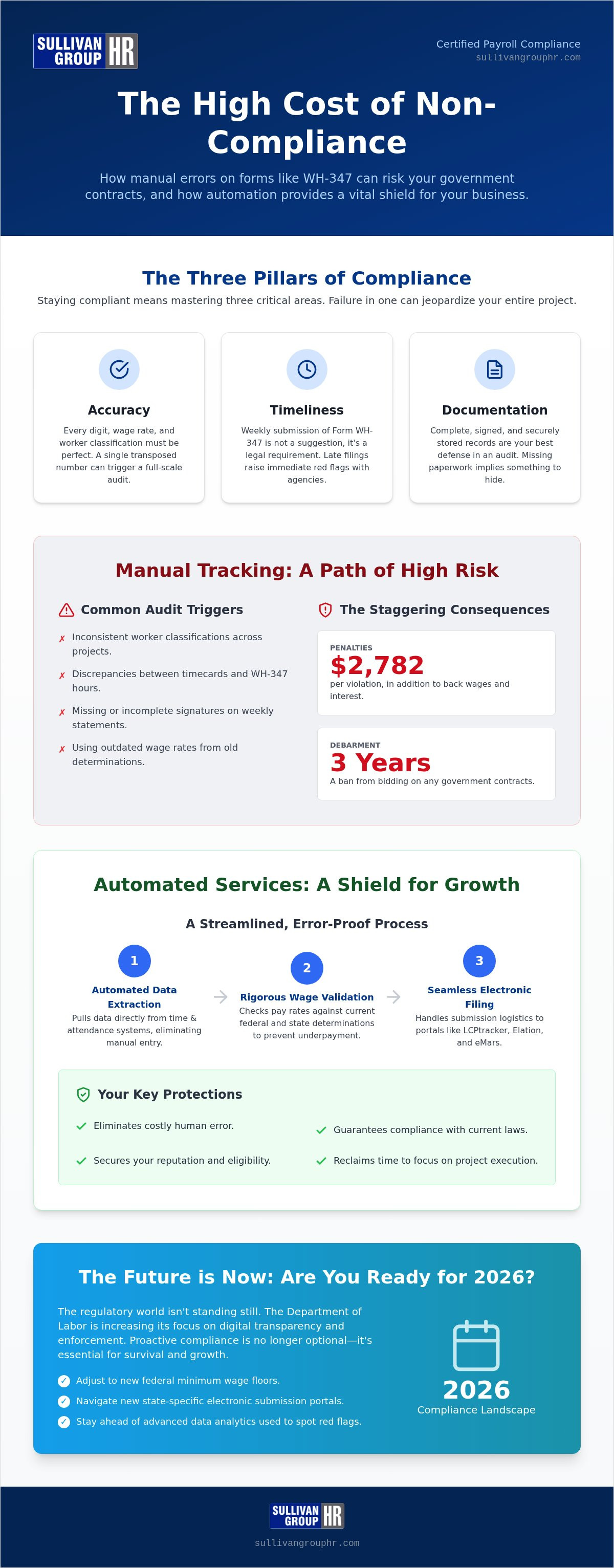
Staying compliant means managing three critical pillars: accuracy, timeliness, and documentation. Whether you are navigating New York's new electronic submission portal or adjusting to the 2026 federal minimum wage increases for specific contracts, the margin for error is zero. This guide will help you master prevailing wage complexities and show you how to leverage automated technology to protect your business from costly debarment. We'll explore how to transition from manual spreadsheets to a streamlined system that offers peace of mind during audits and gives you more time to focus on project execution.
Key Takeaways
- Are you prepared for 2026? Identify the shifts in federal reporting and new state-specific electronic portals to ensure your business remains audit-ready and contract-eligible.
- Why risk manual entry errors? Discover how professional certified payroll reporting services eliminate mistakes on Form WH-347 by automating data extraction from your time systems.
- What is the true cost of manual tracking? Evaluate the hidden risks of spreadsheets compared to automated solutions that validate wage rates against current determinations.
- Can technology simplify compliance? Learn how the isolved HCM platform creates a unified experience by integrating time tracking directly with complex payroll requirements.
- Ready to focus on the job site? Reclaim your time for project execution by partnering with a protective ally who manages the heavy lifting of prevailing wage documentation.
Navigating the Complexities of Prevailing Wage and Davis-Bacon Compliance
Do you feel confident that your weekly payroll records could withstand a federal audit tomorrow? For contractors working on public works projects, the administrative burden is often heavier than the physical labor. At its core, certified payroll is the weekly submission of Form WH-347 to your contracting agency. This document isn't just a record; it's a legal certification that you've paid your workers according to federal or state mandates. The foundation for these requirements is the Davis-Bacon Act, which applies to every federal construction contract exceeding $2,000. In 2026, the stakes for accuracy are higher than ever as the Department of Labor increases its focus on digital transparency and enforcement.
In this environment, "close enough" is a dangerous philosophy. A minor clerical error or an outdated wage rate can trigger a cascade of financial and legal consequences. We view compliance as more than a hurdle; we see it as a growth strategy. By utilizing professional certified payroll reporting services, you transition from a reactive posture to one of protective compliance. This approach secures your current projects and builds the stable reputation needed to win future government contracts.
Why Prevailing Wage Laws Exist
Prevailing wage laws are designed to level the playing field. They prevent outside contractors from undercutting local businesses by importing lower-paid labor from other regions. These laws ensure that government funding supports fair community standards for every worker on the job site. It's helpful to remember that a prevailing wage is defined as the specific combination of a basic hourly rate and required fringe benefits. When you understand this balance, you can better manage your labor costs while remaining fully compliant with local wage determinations.
The 2026 Compliance Landscape
The regulatory world isn't standing still. As of May 11, 2026, many federal contractors must adjust to new minimum wage floors, such as the increase to $13.65 per hour under Executive Order 13658 for certain existing contracts. Enforcement agencies are now using advanced data analytics to spot red flags instantly. Common triggers for a full-scale audit include:
- Inconsistent worker classifications across different project phases.
- Missing or incomplete signatures on weekly compliance statements.
- Discrepancies between timecards and the reported hours on Form WH-347.
The cost of ignoring these details is staggering. Beyond back wages and interest, federal penalties can reach up to $2,782 per violation. Perhaps most damaging is the risk of debarment, which can ban your company from bidding on government work for up to three years. Investing in certified payroll reporting services helps you avoid these pitfalls, providing a clear path to project success and organizational security.
What are Certified Payroll Reporting Services? (A Comprehensive Breakdown)
Have you ever spent your entire Sunday afternoon cross-referencing paper timecards with a federal wage determination table? Professional certified payroll reporting services exist to eliminate that administrative exhaustion. These services act as a bridge between your daily job site operations and the rigid demands of government agencies. They don't just store data; they actively protect your business by ensuring every hour worked is billed at the correct rate. By moving beyond manual entry, you gain a partner that prioritizes your compliance and your peace of mind.
The process begins with automated data extraction. By pulling directly from your time and attendance systems, these services remove the human error inherent in manual entry. Once the data is in the system, it undergoes a rigorous validation process. The software checks your internal pay rates against current federal and state determinations to catch underpayments before they become legal liabilities. Finally, the service handles the logistics of electronic filing. Whether your contract requires submissions to LCPtracker, Elation, or eMars, the reporting service formats and transmits the data securely to the appropriate portal.
Key Components of a Reporting Service
Accuracy is non-negotiable. A comprehensive service provides weekly WH-347 generation with full support for digital signatures, which is increasingly mandatory for 2026 projects. If your crew crosses state lines, the system handles multi-state compliance by applying the specific rules of each jurisdiction automatically. It also manages the complex math of fringe benefit tracking. It ensures every penny of health insurance or pension contributions is properly allocated to meet the total prevailing wage requirement. Most importantly, it provides audit-ready record keeping. Federal law requires you to retain these records for at least three years; a professional service keeps them organized and accessible.
The Role of Integrated HCM Technology
Why do so many contractors struggle with reporting? The problem is usually siloed data. When your time-tracking hardware doesn't talk to your payroll software, errors are inevitable. By linking workforce management solutions directly to compliance engines, you create a single source of truth. This integration prevents the 'Friday afternoon' panic that occurs when you realize your payroll data doesn't match your contract requirements. Real-time data flow ensures that your reports are ready when you are. If you're ready to stop worrying about paperwork and start focusing on growth, Sullivan Group HR can help you build a more secure foundation.
Evaluating Your Options: Manual Tracking vs. Automated Reporting Software
Is your current payroll process a bridge to your next project or a ticking time bomb? Choosing between manual tracking and automated software isn't just about efficiency; it's about survival. While manual entry might feel familiar, it leaves you vulnerable to the human element that federal auditors often target. Professional certified payroll reporting services provide the structure you need to move from a state of constant worry to one of total control. You deserve a system that works as hard as your crew on the job site.
Every business owner must eventually conduct a serious risk assessment. How much liability are you willing to shoulder? Software-only solutions are great for organizing data, but they often leave the heavy lifting of error correction to you. If the system flags an issue, you're still the one searching for the answer. We believe in a managed approach that combines high-tech automation with high-touch expertise, ensuring that you aren't just filing reports, but filing them correctly.
The Spreadsheet Trap
Excel is often the first tool contractors reach for, yet it remains a leading cause of certified payroll audit failures. Spreadsheets simply aren't built to track complex fringe benefit allocations or strict apprentice-to-journeyman ratios across multiple projects. An audit trail is the chronological set of digital records that provides evidence of your payroll calculations, and manual systems almost always lack a robust one. Without this digital footprint, proving your compliance to a Department of Labor investigator becomes an uphill battle.
The Hybrid Advantage
The most successful contractors in 2026 are moving toward a hybrid model. This involves combining the industry-leading power of isolved with professional payroll administration outsourcing. This combination offers the best of both worlds: the speed of automation and the security of human oversight. When a wage determination is ambiguous or a state portal rejects a filing, you have an expert ally to call for immediate resolution.
This approach also offers unparalleled scalability. You can move from a single local contract to large-scale federal projects without hiring a single new administrative staff member. By utilizing certified payroll reporting services that grow with you, you ensure that your back-office operations never slow down your field production. It's about building a foundation that supports your vision for the future.
Key Features to Look for in a Certified Payroll Partner
Are you settling for a software vendor when you actually need a protective ally? Selecting the right partner for your certified payroll reporting services isn't just about checking a box; it's about securing your company's future. You need a solution that anticipates problems before they reach an auditor's desk. In 2026, the best partners offer a blend of technological precision and human hard-earned wisdom. They don't just provide a platform; they provide a safety net for your growing business, allowing you to bid on larger projects with total confidence.
Technical Integration Capabilities
Does your current service play well with your existing ERP or accounting software? True efficiency happens when data flows seamlessly from the job site to the final report without manual intervention. Mobile time tracking for field crews is no longer a luxury; it's a requirement for real-time accuracy. By automating the flow from the initial punch-in to the generated WH-347, you eliminate the manual touchpoints where errors usually hide. This connectivity ensures that your project managers can focus on building rather than data entry, keeping your jobs on schedule and under budget.
Compliance Support and Expertise
Look for partners who offer more than just a software login. You need comprehensive human capital management solutions that include actual compliance consulting. Can your partner explain a complex fringe benefit credit calculation? Do they understand the specific nuances of agency-specific report formats that differ from the standard federal forms? Having a dedicated expert on call transforms your administrative burden into a predictable, manageable process. This expert oversight is vital when managing apprentice-to-journeyman ratios or multi-state wage determinations.
Proactive alerts are your final line of defense against costly mistakes. A superior system flags rate discrepancies before you finalize payroll, not after the checks are cut and the reports are filed. This level of oversight is a cornerstone of effective HR risk management. It ensures that every worker classification and wage rate aligns perfectly with the latest 2026 determinations. Don't wait for an audit to find out your system is failing you. If you're ready to upgrade your protection and streamline your operations, talk to our payroll administration experts to see how we can help.
Sullivan Group HR: Simplifying Compliance with isolved HCM
What could your business achieve if administrative burdens didn't dictate your daily schedule? For many contractors, the weight of regulatory paperwork acts as an invisible ceiling on growth. At Sullivan Group HR, we believe your primary focus should be on the job site, not the filing cabinet. We've built our certified payroll reporting services around a no-nonsense philosophy: we handle the complex administrative heavy lifting so you can focus on building the future. By combining the industry-leading isolved platform with our hard-earned expertise, we provide a protective shield that secures your business and your reputation.
Our approach goes beyond simple data entry. We integrate your payroll functions with comprehensive benefits management solutions and proactive risk mitigation. This unified strategy ensures that every aspect of your employee compensation, from health credits to prevailing wage rates, is perfectly aligned. It's a holistic way of doing business that replaces fragmented systems with a single, reliable partnership. You aren't just buying a service; you're gaining a coach and an ally dedicated to your long-term organizational security.
The Power of the isolved Platform
Success in 2026 requires a single source of truth for your data. Through the isolved HCM platform, we offer a unified experience where time tracking, payroll, and reporting live in one ecosystem. This eliminates the need for redundant data entry and slashes the risk of the clerical errors that trigger audits. The interface is designed to be user-friendly for your office administrators and your field employees alike. Whether you need to generate a standard WH-347 or a highly specific state agency report, our system handles the formatting automatically. This technical precision ensures your certified payroll reporting services are always audit-ready and accurate.
Why Partnership Beats Software Alone
Why do we emphasize the "Sullivan Handshake" in a digital world? Because software alone can't navigate the nuances of a complex labor dispute or an ambiguous wage determination. While tech-only competitors offer a portal and a help desk, we offer a relationship. You have access to professional HR consulting when you face difficult personnel issues or shifting federal mandates. We treat your compliance as our own, providing the stability and wisdom that only decades of experience can offer. This human-centric oversight is the differentiator that turns a vendor into a long-term advocate for your success.
Don't let the fear of a surprise audit or a missed deadline slow your momentum. It's time to trade your administrative stress for the peace of mind that comes with professional oversight. If you're ready to streamline your operations and protect your bottom line, contact Sullivan Group HR for a compliance review today. Let's build a foundation that supports your professional potential and your company's growth.
Securing Your Growth in a Regulated Landscape
Do you feel prepared to scale your business without the constant fear of a federal audit? Mastering the nuances of prevailing wage requirements is a strategic move that separates successful contractors from those who struggle with compliance. We've seen that the right combination of automated technology and expert oversight is the only way to ensure accuracy in your weekly filings. By choosing professional certified payroll reporting services, you reclaim your time and secure your eligibility for future government projects.
Sullivan Group HR stands ready to be your protective ally. We offer access to the industry-leading isolved HCM platform alongside decades of professional HR and payroll experience. Our integrated risk management and compliance support provide the safety net you need to focus on what you do best: building infrastructure. You've worked hard to establish your legacy, and we're here to help you protect it with rigor and reliability. You don't have to navigate these complex federal labor standards alone.
Ready to offload your compliance burden? Talk to a Sullivan Group HR expert today.
Your professional potential is limitless when you have the right partner in your corner. Let's build a more secure future for your company together.
Frequently Asked Questions
What exactly is a certified payroll report?
A certified payroll report is a weekly document submitted to a contracting agency that verifies workers on a government-funded project received the correct wages and benefits. It consists of a detailed payroll record and a signed Statement of Compliance. This process ensures transparency and accountability for any construction project subject to federal or state labor standards. By utilizing certified payroll reporting services, you ensure these records are generated accurately from your time-tracking data every week.
Is certified payroll the same as prevailing wage?
No, these are two distinct but related concepts. Prevailing wage refers to the specific hourly rate and fringe benefits required for a specific job classification in a specific geographic area. Certified payroll is the administrative process of reporting that you have actually paid those mandated rates. While the prevailing wage is the standard you must meet, certified payroll is the evidence you provide to the government to prove your compliance.
What is Form WH-347 and when is it required?
Form WH-347 is the official Department of Labor form used for federal certified payroll reporting. It is required for all federal construction projects exceeding $2,000 under the Davis-Bacon Act. The form tracks worker names, classifications, hours worked, and deductions. It also includes a mandatory Statement of Compliance that must be signed by the employer or an authorized agent to certify the information's accuracy under penalty of law.
Can I use standard payroll software for certified reporting?
Standard payroll software usually lacks the specialized logic required to handle prevailing wage rates, fringe benefit allocations, and the specific formatting of Form WH-347. While some general systems allow for basic data entry, they often fail to catch classification errors or rate discrepancies. Integrating your payroll with an advanced platform like isolved through certified payroll reporting services provides the necessary automation to handle these complex requirements without manual intervention.
How long must I keep certified payroll records for federal projects?
Federal law requires you to retain all certified payroll records, including timecards and benefit documentation, for at least three years after the project is completed. Some state agencies or specific contracts may require even longer retention periods. Maintaining these records in a secure, digital format is essential for protecting your business during potential audits that may occur years after you have left the job site.
What happens if I make a mistake on a certified payroll report?
Errors on a report can lead to severe consequences, ranging from withheld contract payments to significant civil penalties. In New York, for example, late filings can trigger a fine of $100 per day. For federal projects, willful falsification can result in criminal prosecution or debarment from bidding on government work for up to three years. These risks highlight why professional oversight is a critical component of your risk management strategy.
Do I need to report fringe benefits on certified payroll?
Yes, reporting fringe benefits is a mandatory part of the process. The total prevailing wage is the sum of the basic hourly rate and the fringe benefit amount. You must document whether these benefits were paid directly into a bona fide plan, such as health insurance or a 401(k), or paid to the employee as cash in lieu of benefits. Accurate tracking ensures you meet the full compensation requirement for every hour worked.
How much do certified payroll reporting services typically cost?
The cost of these services depends on several factors, including your total employee count, the number of active projects, and the complexity of your state and federal reporting requirements. Most professional providers use a scalable pricing model that grows with your business needs. While prices vary across the industry, the investment is generally much lower than the cost of a single compliance fine or the loss of a major government contract.


