

Your business may be exempt from routine OSHA recordkeeping and still have to report a serious workplace incident within hours. The OSHA reporting requirements for small business can be confusing because notifying OSHA, maintaining injury logs, and submitting data electronically are separate responsibilities.
It’s understandable to wonder which rules apply and when a deadline begins. Employers must report a work-related fatality within 8 hours, and a work-related in-patient hospitalization, amputation, or loss of an eye within 24 hours. An exemption from routine recordkeeping does not remove those immediate reporting duties.
This guide explains which incidents require an immediate report, which cases belong on OSHA injury and illness records, and how business size and industry affect routine recordkeeping and electronic submissions. It also covers key deadlines and practical steps for assigning responsibility, documenting incidents, and preserving records. With a clear process in place, your team can respond without having to sort out the rules under pressure.
Key Takeaways
- Understand how OSHA jurisdiction and industry rules can affect your obligations, beyond business size alone.
- Use a clear response sequence to protect people, establish incident facts, determine whether a report is required, and document each step.
- Learn how OSHA reporting requirements for small business differ across immediate incident reports, injury logs, and electronic submissions.
- Set up a repeatable checklist with assigned responsibilities and a secure place to store incident records and report receipts.
- See how consistent HR guidance, compliance support, and workers’ compensation assistance can help organize workforce responsibilities.
OSHA Reporting Requirements for Small Business: Which Incidents Trigger a Report?
OSHA incident reporting means notifying the Occupational Safety and Health Administration about certain severe, work-related events within specific deadlines. It is separate from routine recordkeeping. Depending on the incident and the rules that apply, an employer may need to contact OSHA promptly, maintain an injury log, do both, or meet neither obligation. The Occupational Safety and Health Act of 1970 established the federal framework, but the employer, workplace, and applicable OSHA jurisdiction affect which rules apply.
That distinction matters: a case can be recordable without requiring an immediate report, and a recordkeeping exemption does not automatically remove the duty to report a severe event. The OSHA reporting requirements for small business are not determined by headcount alone.
Which severe workplace events generally require prompt OSHA reporting?
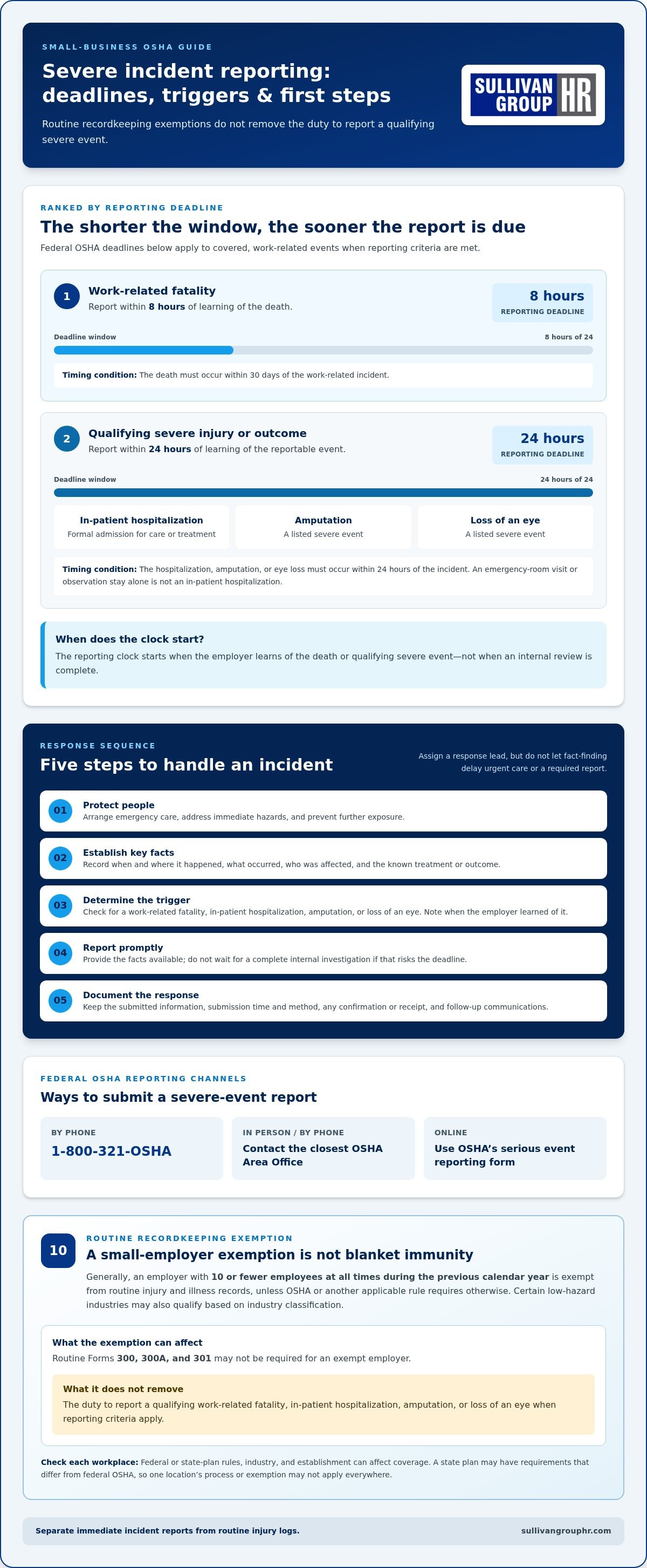
Under federal OSHA rules, covered employers generally must report a work-related fatality within 8 hours. A work-related in-patient hospitalization, amputation, or loss of an eye generally must be reported within 24 hours. The event must meet OSHA’s timing and work-relatedness criteria. For example, the fatality must occur within 30 days of the incident, while the listed severe injuries must occur within 24 hours of the incident.
“In-patient hospitalization” means formal admission to a hospital or clinic for care or treatment. An emergency-room visit or observation stay alone does not meet that definition. A serious-looking injury, medical visit, or incident at work does not automatically trigger an immediate OSHA report. Assess the event details and the rules for the applicable jurisdiction before deciding.
Does being a small business exempt an employer from OSHA rules?
Some employers may qualify for an exemption from routinely keeping OSHA injury and illness records. Generally, an employer that had 10 or fewer employees at all times during the previous calendar year is exempt from routine recordkeeping, unless OSHA or another applicable rule requires otherwise. Certain low-hazard industries may also qualify for an exemption based on industry classification.
A size-based or industry-based exemption can remove the routine duty to maintain Forms 300, 300A, and 301, but it does not exempt an employer from reporting a work-related fatality, in-patient hospitalization, amputation, or loss of an eye when OSHA’s reporting criteria apply. An exemption from routine records is not blanket immunity from OSHA requirements.
Why can’t you use one rule for every location?
OSHA coverage depends on the applicable federal or state-plan rules, the industry, and the establishment. A state plan may have requirements that differ from federal OSHA’s, so a company with multiple locations should not assume one location’s exemption or process applies everywhere. Confirm which rules govern each workplace, and keep immediate incident reporting separate from routine logs. This distinction helps prevent a small-employer exemption from being mistaken for permission to skip a required report.
OSHA Reporting Deadlines and Channels: What Small Employers Do First
A clear response sequence helps protect employees and meet an OSHA reporting deadline. Assign someone to lead the response, but do not let fact-finding delay urgent care or a required report. The OSHA Recordkeeping Requirements page explains the federal framework; state-plan requirements may also apply.
- Protect people. Arrange emergency care, address immediate hazards, and prevent further exposure.
- Establish key facts. Record when and where the event occurred, what happened, who was affected, and what treatment or outcome is known.
- Determine the trigger. Check whether the event involved a work-related fatality, in-patient hospitalization, amputation, or loss of an eye. Note when the employer learned of it.
- Report promptly. Use an OSHA reporting channel and provide the facts available. Do not wait for a complete internal investigation if doing so could put the deadline at risk.
- Document the response. Keep a copy of the information submitted, the submission time and method, any confirmation or report receipt, and follow-up communications.
How quickly must an employer report a fatality or severe injury?
Report a work-related fatality within 8 hours of learning of the death; report a work-related in-patient hospitalization, amputation, or loss of an eye within 24 hours of learning of the reportable event. Under federal OSHA rules, the fatality must occur within 30 days of the work-related incident, and the hospitalization, amputation, or eye loss must occur within 24 hours of the incident. The clock starts when the employer learns of the death or qualifying severe event, not when an internal review is complete.
In-patient hospitalization means formal admission for care or treatment, not emergency-room treatment or observation alone. If the event’s timing or circumstances are unclear, assess the known facts promptly against the applicable rule and jurisdiction.
How can a small business submit an OSHA incident report?
Federal OSHA accepts reports by calling 1-800-321-OSHA, contacting the closest OSHA Area Office, or using its online serious event reporting form. Be ready to provide basic details such as the employer and workplace, when the event occurred, what happened, the affected employee or employees, and a contact person. Share accurate information you have, note what remains unknown, and follow up as needed.
An internal incident form helps preserve facts, but it does not notify OSHA. Record who made the external report, when and how it was submitted, and any confirmation or follow-up. Clear internal ownership, supported by consistent HR compliance guidance, can help keep these steps organized.
OSHA Reports, Injury Logs, and Electronic Submissions: What Is Different?
Think of OSHA obligations as three separate tasks: notify OSHA about a severe event, record qualifying cases, and submit required information electronically. One incident may trigger more than one task, but completing one does not automatically complete the others. The OSHA Small Business Resources page offers official guidance. The distinctions below help you identify the different duties and deadlines.
| Obligation | Purpose and trigger | Timing | Who and where |
|---|---|---|---|
| Severe-event report | Notify OSHA of a work-related fatality, inpatient hospitalization, amputation, or loss of an eye. | Within 8 hours of learning of a fatality; within 24 hours of learning of a qualifying hospitalization, amputation, or eye loss. | All employers subject to the applicable OSHA reporting rule; report to OSHA through an accepted reporting channel. |
| Forms 300, 301, and 300A | Maintain a record of qualifying work-related injuries and illnesses, their case details, and the annual summary. | Enter a recordable case within 7 calendar days of learning of it; post the certified 300A summary from February 1 through April 30. | Covered employers maintain records at the establishment; post the summary in a visible workplace location. |
| Electronic submission | Send required injury and illness data through OSHA’s Injury Tracking Application (ITA). | For 2025 data, the 2026 submission deadline was March 2, 2026. | Establishments meeting OSHA’s employee-size and industry criteria submit to the ITA. |
When do OSHA Forms 300, 301, and 300A apply?
Form 300 is the log of recordable work-related injuries and illnesses. Form 301 captures details about an individual case, while Form 300A summarizes the establishment’s cases and days away, restricted, or transferred for the year. A case generally belongs on the log if it results in death, days away from work, restricted work or job transfer, medical treatment beyond first aid, or loss of consciousness. These recordability criteria differ from the severe-event triggers for immediate reporting.
Employers with 10 or fewer employees at all times during the previous calendar year are generally exempt from routine OSHA injury and illness recordkeeping. Some low-hazard industries are also exempt. Covered employers must retain Forms 300, 301, and 300A for five years after the year they cover. The annual summary must be posted even if no recordable cases occurred.
Which establishments may need to submit records electronically?
Electronic submission depends on establishment size and industry, not just total company headcount. Establishments with 250 or more employees generally submit Form 300A data annually. Those with 20 to 249 employees submit 300A data if their industry is on OSHA’s designated high-hazard list. Establishments with 100 or more employees in specified higher-risk industries must also submit data from Forms 300 and 301. Check the applicable OSHA lists and state-plan rules for each establishment. These distinctions are central to the OSHA reporting requirements for small business: an exemption from recordkeeping does not remove a separate duty to report a severe event.
A Small-Business OSHA Reporting Checklist for Preventing Missed Steps
A useful process starts before an incident, not while someone is searching for a form or deciding who can call OSHA. Turn the OSHA reporting requirements for small business into assigned tasks your team can follow under pressure.
- Name a primary response lead and a backup. Give both the responsibility and authority to recognize a potential reporting trigger, gather initial facts, and reach the person who can submit a report.
- Set a clear notification path. Tell supervisors who to contact and how to reach the lead. Include HR, safety staff, and decision-makers who may need to coordinate next steps.
- Choose a secure record location. Keep incident notes, witness details, relevant records, and OSHA report confirmations in a restricted-access location. Make sure the backup can find the process if the lead is unavailable.
- Separate the different workflows. An OSHA notification, an OSHA injury log entry, a workers’ compensation claim, and an internal incident notice serve different purposes. Assign each task, and do not treat one as a substitute for another.
- Review the process periodically. Revisit OSHA instructions, applicable state-plan requirements, contact details, and employee responsibilities. Update the written steps when your operations or coverage change.
What information should the incident response lead capture?
Use a consistent incident record to capture the event date and time, workplace location, work activity, affected worker, and known circumstances. Note when the employer first learned of the event, since that can matter when assessing reporting deadlines. If an OSHA report is submitted, document the time, method, contact, information provided, confirmation, and any follow-up.
Keep observations separate from conclusions. Mark what is verified and what remains unknown, then update the record as facts are established. Store employee and witness information securely, and limit access to people who need it for the response.
How should employers assign reporting and recordkeeping responsibilities?
Write down who identifies possible report triggers, who contacts OSHA, who maintains any required injury records, and who handles workers’ compensation paperwork. One person may hold several roles, but naming a backup helps prevent confusion during an absence. Supervisors should know how to escalate an event promptly rather than deciding alone that it does not need review.
OSHA reporting and workers’ compensation processes may involve overlapping incident facts, but completing a claim or notifying a manager does not itself satisfy an OSHA reporting duty. An internal report likewise does not replace a required external notification. Confirm which federal or state-plan rules apply to each establishment. State requirements may differ, so do not assume federal deadlines cover every workplace.
Sullivan Group HR provides support with employment compliance responsibilities and HR processes through HR guidance and compliance services.
How Sullivan Group HR Can Support a More Organized Compliance Process
A written checklist gives your team a starting point. Keeping responsibilities clear as workforce needs and requirements change takes steady follow-through. Sullivan Group HR provides compliance support covering federal, state, and local employment regulations, along with HR guidance and workers’ compensation assistance. This support can help organize who handles workforce records, how concerns are escalated, and where incident documentation fits into broader HR processes. It does not guarantee compliance or replace an employer’s responsibility to follow the OSHA rules that apply.
How can an HR partner help organize workforce compliance?
HR guidance can help make recurring responsibilities easier to manage. For example, an employer can clarify who receives a supervisor’s incident notice, who maintains relevant employee records, and how workforce information is preserved for follow-up. Accurate time and attendance records can also support an orderly documentation process, but a system does not automatically determine whether an OSHA report is required or submit one.
OSHA reporting is one part of employment compliance. Sullivan Group HR provides compliance support for federal, state, and local employment regulations, helping employers organize responsibilities across their workforce. General HR and compliance support is distinct from formal legal interpretation. For related perspective on identifying and organizing workplace risks, explore this HR risk management guide.
What does an integrated workforce management relationship look like?
Sullivan Group HR combines enterprise-grade isolved HCM technology with a dedicated Sullivan Group HR specialist for each client. The technology and personal support are part of the service model, giving employers tools to manage workforce processes alongside a consistent HR point of contact. This does not mean isolved automatically files OSHA reports. Employers still need a clear internal response process and must meet applicable reporting obligations.
Workers’ compensation assistance can sit alongside HR guidance when an incident requires attention to both workplace documentation and a compensation-related process. Keeping those responsibilities distinct helps prevent an internal notice or compensation paperwork from being mistaken for an OSHA report. Sullivan Group HR brings 40 years of experience in payroll, HR, and employee-benefits management to its work with employers.
For more on how an ongoing HR relationship can support workforce responsibilities, read the HR outsourcing guide. If you’re ready to bring more structure to your HR and compliance processes, Sullivan Group HR can support your organization.
Build a Reporting Process Your Team Can Use
A written procedure is useful only if people can follow it under pressure. Walk through a realistic incident scenario with the employees who may receive the first notification. Identify where information could stall, who needs to make the next decision, and whether the backup contact can step in. A practice run can reveal gaps before they matter.
Make the process part of your regular workforce planning. Review it when responsibilities change, preserve a clear record of updates, and give supervisors an easy way to find the current instructions. Consistent preparation can make the OSHA reporting requirements for small business more manageable and help your organization respond with care and clarity.
To bring more structure to your workforce compliance responsibilities, connect with Sullivan Group HR about HR guidance, compliance support, and workers’ compensation assistance.
Frequently Asked Questions
Is a workplace near miss reportable to OSHA?
A near miss without a death or qualifying injury generally does not trigger OSHA’s severe-event reporting rule, but the circumstances and any later-discovered injury matter. For example, a falling object that narrowly misses a worker may not require an immediate OSHA report, yet recording it internally can help identify a hazard and prevent harm. Internal safety tracking is separate from OSHA reporting. Assess the specific facts against current OSHA guidance and applicable state-plan rules.
Does filing a workers’ compensation claim satisfy OSHA reporting requirements?
No. Workers’ compensation paperwork and OSHA reporting serve different purposes, so filing a claim does not replace a required OSHA report. If an employee’s injury later meets a severe-event reporting trigger, the employer may have a separate notification duty even if a claim is underway. Assess the event against current OSHA reporting criteria, and keep records of the claim process and any OSHA notification separately.
Are injuries to temporary workers reported by the staffing agency or the host employer?
Responsibility should not automatically be assigned to only one employer. OSHA recordkeeping responsibility can depend on which employer supervises the temporary worker’s day-to-day activities, while reporting duties depend on the applicable rule and incident facts. If an injury occurs, the staffing agency and host employer should promptly share relevant information, including the worker’s duties and treatment. Use current OSHA temporary-worker guidance to determine the obligations for the specific arrangement.
Does OSHA reporting apply to an injury that happens while an employee works from home?
It can, depending on whether the injury is work-related and on the event’s circumstances. Working from home alone does not decide the question. Consider whether the employee was performing work duties when the injury occurred rather than assuming every injury at home is work-related. Also distinguish whether the case is recordable from whether it meets a severe-event reporting trigger. Apply current OSHA home-work guidance and any relevant state-plan requirements.
Can an employer report a workplace incident anonymously to OSHA?
An employer’s required severe-event report is different from a worker’s safety complaint. Employer reports generally include identifying details about the employer and incident, while OSHA complaint processes may have separate confidentiality provisions. Do not assume a particular submission is anonymous or that confidentiality works the same way across channels. Review OSHA’s current instructions for the specific reporting or complaint process and provide the information that process requests.
What should a small business do if it discovers an incident after the reporting deadline?
Act promptly: review the event, when the employer learned of it, and the reporting rule that applies. Discovering a missed deadline does not by itself remove a reporting obligation. Preserve the available records, note when the incident came to light, and submit any required report as OSHA directs. If the facts are complex or the timeline is disputed, seek appropriate HR or legal guidance while documenting the steps taken.
Does OSHA cover an employee injured while travelling for work?
Work travel alone does not determine whether an injury is work-related. Consider what the employee was doing and the circumstances at the time, then assess recordkeeping separately from any severe-event reporting trigger. For example, an injury during a work assignment may require a different analysis than one during personal activity. Apply current OSHA guidance to the facts and account for any state-plan requirements. Do not assume every travel injury is covered or excluded.


