

What if a safe return to work starts with planning the work, not just setting a start date? Employers know recovery takes time, but identifying suitable duties, coordinating communication, and balancing employee wellbeing with operational needs can be challenging. These return-to-work program best practices can help turn uncertainty into a clear, supportive process.
A consistent plan gives everyone a shared understanding of what happens next. It should reflect the employee’s current work-related restrictions, identify who is responsible for communication, and set points to review how the return is going. That structure can support recovery while helping managers plan meaningful work and address concerns early.
This guide covers key steps, from preparing before an employee returns to selecting appropriate duties and reviewing the plan over time. It also explains how to organize documentation and consider leave, accommodation, and workers’ compensation factors alongside applicable requirements. The goal is practical: a process employees and managers can understand, with clear responsibilities and room to adjust as circumstances change.
Key Takeaways
- Learn why a written program is more reliable than handling each return through informal, case-by-case conversations.
- Use return-to-work program best practices to set clear responsibilities while keeping general policy separate from individual decisions.
- Build an employee-specific plan by comparing current work restrictions with essential job duties and possible adjustments.
- Protect employee wellbeing by avoiding pressure to return before the timing and duties are appropriate.
- See how consistent HR guidance, compliance support, and workers’ compensation assistance can help organize return-to-work administration.
What Is a Return-to-Work Program, and Why Does It Matter?
A return-to-work program is a planned process for supporting an employee’s return after an absence. It explains how the employer and employee will communicate, how current work-related restrictions will be considered, and how suitable duties will be identified. The aim isn’t to rush a return or promise a particular result. It’s to replace uncertainty with clear, respectful next steps.
That structure distinguishes a program from an informal, case-by-case conversation. Without a shared process, a manager might make decisions on the fly, leaving the employee unsure who to speak with or what work to expect. A documented process gives the organization a consistent starting point while preserving flexibility for individual circumstances. The term can also appear in a labor-dispute context, as in a Return to work order, which is distinct from an employer’s supportive workplace process.
What should a return-to-work program accomplish?
A useful program gives employees and managers a shared understanding of responsibilities and next steps. It should support recovery, protect dignity, encourage appropriate communication, and help identify work that fits the employee’s current abilities. Returning to work doesn’t automatically mean resuming every usual task or schedule. Duties may need to be discussed and adjusted based on current restrictions and the work involved.
In practice, the process should answer straightforward questions: Who will coordinate updates? Which tasks are currently suitable? When will the arrangement be reviewed? Clear answers help employees know what to expect and help managers plan work without making assumptions about a medical condition. A consistent framework is one of the return-to-work program best practices, but the right plan still depends on the person’s circumstances, job duties, and applicable requirements.
Who participates in the return-to-work process?
Clear roles prevent responsibilities from getting blurred. Each person contributes information or decisions within their role, while access to sensitive details should be limited to what’s appropriate for that role.
- The employee shares relevant work-related information and communicates concerns about assigned duties or changes in ability.
- The manager describes job responsibilities, coordinates practical work arrangements, and checks in about how those arrangements are working.
- The HR contact coordinates the process, supports consistent documentation, and helps the organization consider applicable workplace requirements.
- Benefits or workers’ compensation contacts may help coordinate administrative details related to leave or a work-related claim, as relevant.
- Healthcare providers can inform work-related restrictions within their role. Managers should use that information to plan work, not attempt to diagnose a condition.
For example, a provider may communicate a restriction that affects lifting. The manager can identify which regular tasks involve lifting, while HR coordinates the discussion. The team can then consider suitable work without asking the employee to disclose unnecessary personal medical details. This separation supports respectful communication and practical planning. A program can clarify the process, but it can’t guarantee a specific recovery timeline or outcome.
Build a Return-to-Work Policy with Clear Roles and Communication
A written policy turns good intentions into a repeatable workflow. It should explain the program’s purpose and scope, who coordinates each step, how information is shared, and when the plan is reviewed. Make clear that the policy sets a consistent process, not a fixed return date or a preset list of duties for every employee.
That distinction matters. A general policy can establish who receives notice and how to raise questions. Individual decisions about timing, duties, and adjustments must reflect the employee’s circumstances and current information. The goal is consistency in how decisions are handled, not identical decisions for everyone. That’s one of the return-to-work program best practices that helps managers act with care while keeping responsibilities clear.
Which responsibilities belong in the written policy?
Make ownership explicit so an employee doesn’t have to guess who to contact. The policy can identify the person or role responsible for receiving notice, coordinating discussions, recording work-related decisions, and scheduling follow-up. It should also explain how employees can report a concern or a change in their work capacity.
- Set communication expectations. Identify the appropriate contact and explain how updates will be shared. Encourage respectful, timely conversations without requesting unnecessary medical details.
- Define decision boundaries. Managers can describe job tasks and operational needs. They should route medical, accommodation, leave, or compliance questions to HR rather than making medical judgments themselves.
- Document the process. Record relevant work restrictions, agreed duties or adjustments, responsible contacts, and review points. Keep sensitive information within appropriate channels.
- Plan for questions and changes. Tell employees how to raise concerns about an assignment and whom to notify if their ability to perform work changes.
Clear documentation gives the employee and manager a shared reference point. It also helps HR identify discussions that need follow-up instead of relying on memory or scattered messages.
How can employers prepare managers before an absence occurs?
Train managers on the workflow before they need to use it. A short practical guide or scenario-based discussion can show whom to notify, what information to record, and how to respond when an employee mentions a restriction. Keep the message simple: listen, avoid assumptions, and refer questions about accommodations or compliance to HR.
Give managers consistent language for check-ins, along with a clear internal contact list for HR, benefits, and workers’ compensation matters. Broader workforce-risk planning can also inform policy development; Sullivan Group HR’s HR risk management guide offers related context.
ADA, FMLA, and workers’ compensation considerations may affect how a particular situation is handled. Their application depends on the circumstances and applicable federal, state, and local requirements. Build in a step for HR to review relevant issues rather than asking managers to interpret them alone. Sullivan Group HR provides HR guidance and compliance support covering federal, state, and local employment regulations as part of its workforce management services.
Create an Individual Return-to-Work Plan That Fits the Employee
A general policy sets the process. The individual plan turns it into practical arrangements for one employee, one role, and one set of current work-related restrictions. Focus on what the work requires and what the employee is currently able to do. Managers shouldn’t diagnose a condition or infer limits from an employee’s appearance or absence.
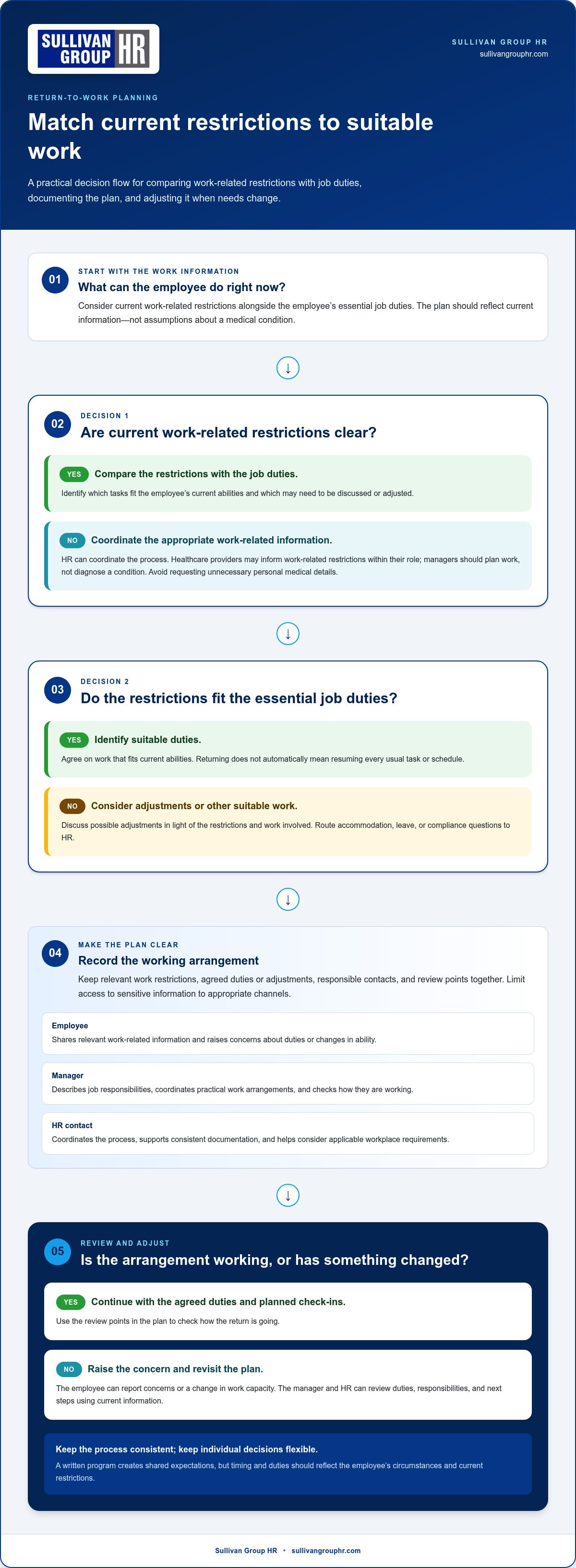
An individualized return-to-work plan is a documented match between an employee’s current work capacity and suitable duties. Build that match step by step, using information shared through appropriate channels and the actual demands of the role.
How should employers match duties to current restrictions?
Start with the restrictions available to the employer, then compare them with the position’s essential duties. Be specific about tasks, not assumptions. For example, if a restriction affects lifting, identify which essential tasks involve lifting and consider whether other suitable tasks are available. A possible adjustment for one position may not work for another, so assess each role individually.
Use a sequence that keeps decisions grounded in the work:
- Understand the restrictions. Review current work-related limits communicated through appropriate channels. Don’t ask a manager to interpret medical information or determine a diagnosis.
- Review essential duties. Identify the tasks, schedule, and work conditions the role requires, distinguishing essential responsibilities from other tasks where possible.
- Consider suitable adjustments. Depending on the restrictions and job, options may include adjusted duties, a modified schedule, or a different work arrangement. These are possibilities to assess, not automatic solutions. Consider whether each option is appropriate and feasible in the circumstances.
- Agree and document. Record the duties, expectations, responsible contacts, and a date or trigger for review so everyone understands the arrangement.
- Revisit the plan. Check whether the arrangement remains appropriate as restrictions, job demands, or other relevant circumstances change.
What belongs in a practical return-to-work plan?
Write the plan in plain language. The employee and manager should be able to tell what work is expected, what has changed, who to contact with questions, and how the arrangement will be reviewed. Avoid vague directions such as “light duties” without describing which tasks are included and which are not.
- Work arrangement: Note agreed duties, schedule, and relevant adjustments.
- Expectations: Clarify priorities, limits, and how the employee should raise a concern about assigned work.
- Communication: Name the contacts for routine updates and questions about a change in work capacity.
- Review: Set a follow-up date or define what change should prompt a review.
Keep the plan current rather than treating it as a permanent decision. If restrictions change or a task proves unsuitable, pause and reassess through the established process. This practical, individualized approach is central to return-to-work program best practices: it gives the employee and manager a shared working reference while leaving room to adapt as circumstances evolve.
Keep the Return Safe: Address Pressure, Privacy, and Changing Needs
A return-to-work program should never pressure someone to come back before they’re ready. A staffing gap, target date, or program goal isn’t evidence that an employee can safely perform particular duties. Timing and work arrangements should reflect current restrictions, the demands of the role, and applicable requirements for the situation.
Trust depends on how the process feels as well as how it’s documented. Invite the employee to share work-related concerns without suggesting they need to prove their commitment or disclose more medical information than the process requires. If the employee raises a concern about a task or schedule, respond by reviewing the plan, not by treating the concern as a lack of cooperation.
How can employers avoid making an employee feel rushed?
Use supportive, non-coercive language. A manager might say, “Let’s talk about which parts of the work feel manageable and what questions we should bring to HR,” rather than implying that the employee must accept a proposed arrangement. One approach opens a conversation; the other can make a plan feel like a demand.
Keep these safeguards in mind:
- Separate operational needs from readiness. Staffing pressure can prompt planning, but it can’t determine whether an employee is ready to return or what duties fit.
- Invite specific feedback. Ask whether the assigned tasks match the current work restrictions and whether any work-related concerns need review.
- Route complex questions appropriately. Bring questions about restrictions, accommodation, or leave to HR rather than asking a manager to interpret medical information or make compliance decisions.
These return-to-work program best practices help keep the conversation focused on safe, appropriate work and the employee’s ability to raise concerns without fear of blame.
How should employers handle privacy and changing circumstances?
Share only the information each person needs to coordinate work and follow the process. A manager may need to understand a work-related restriction and the tasks it affects, but that doesn’t automatically mean the manager needs details about the employee’s diagnosis or treatment. Store and share records according to the privacy and employment requirements that apply to the situation. Because requirements can vary, HR should guide decisions about access, documentation, and communication.
Changing needs call for a review, not guesswork. Revisit the plan if restrictions change, a task proves unsuitable, job demands shift, or the employee reports a relevant change in circumstances. A brief, documented check-in can clarify what still works, what needs adjustment, and who will follow up.
Employers can also evaluate the process itself. Ask whether employees felt heard, whether managers followed the same communication steps, whether plans were reviewed when circumstances changed, and what lessons should inform future practice. Document process improvements without turning an individual’s private medical details into general workplace discussion.
For help coordinating HR guidance and workforce processes with care, connect with Sullivan Group HR.
Support Return-to-Work Administration with Consistent HR Partnership
A written policy and an individualized plan need steady ownership behind them. An HR partner can help connect the administrative pieces: maintaining a consistent process, coordinating communication, organizing documentation, and setting review points. That continuity is useful when managers have questions or responsibilities shift during an employee’s return.
HR guidance can also help employers consider relevant federal, state, and local employment requirements without asking managers to make legal or medical judgments. Requirements vary with the situation, so questions involving leave, accommodations, or workers’ compensation should be routed for appropriate review. Clear ownership helps the organization handle these matters through a defined process rather than relying on informal handoffs.
Where can an HR partner support a consistent process?
Support may include clarifying who coordinates updates, helping keep records organized, and guiding managers on when to bring questions to HR. If a return involves a work-related claim, workers’ compensation assistance can be part of the broader support relationship. These resources can help employers coordinate responsibilities, but they don’t replace individualized decisions or guarantee a particular result.
Sullivan Group HR supports employers with HR guidance, compliance support covering federal, state, and local employment regulations, and workers’ compensation assistance. Each client has a dedicated Sullivan Group HR specialist, and the company uses isolved HCM technology as part of its broader workforce management approach. For more context on how workforce processes can fit together, explore this human capital management guide.
Consistent partnership doesn’t mean every return follows the same path. It means employees and managers have a clear place to bring questions, understand who owns the next step, and keep relevant documentation connected to the process. That steady coordination can make return-to-work program best practices easier to apply across an organization while leaving room for each employee’s circumstances.
What are practical next steps for employers?
Start with a focused review of the current process. Look for unclear handoffs, missing review points, or instructions that leave managers guessing. A short checklist can help identify where HR coordination would make the workflow more consistent.
- Review the policy: Confirm that its purpose, scope, roles, and communication steps are understandable.
- Check plan documentation: Make sure work arrangements and follow-up responsibilities are recorded clearly.
- Identify manager support needs: Note where managers need guidance on routing questions or coordinating internally.
- Set a review routine: Decide how the organization will revisit the process and capture lessons for future updates.
With 40 years of experience in payroll, HR, and employee-benefits management, Sullivan Group HR helps employers organize workforce responsibilities and access relevant HR guidance. Discuss your workforce management needs with Sullivan Group HR.
Turn Your Return-to-Work Process into a Practical Next Step
A stronger process doesn’t require a sweeping overhaul. Start with one useful question: where does uncertainty still slow a return or leave an employee unsure what to expect? Choose one gap, assign someone to address it, and set a time to review whether the change made the process clearer.
That small improvement can help turn return-to-work program best practices into everyday habits, not just policy language. Keep listening as the process is used. A manager may need clearer guidance, an employee may need a better way to raise concerns, or a handoff may need an identified owner. Treat those signals as opportunities to strengthen how your organization supports people through a return.
Building a thoughtful process takes coordination, but you don’t have to organize every workforce responsibility alone. Explore how Sullivan Group HR can support your workforce management and take a confident next step toward a process that works for your organization and its employees.
Frequently Asked Questions
What is a return-to-work program?
A return-to-work program is an organized way to coordinate an employee’s transition back after an absence. It helps the employer move from general policy to practical decisions about communication, work expectations, and follow-up. For example, a program can clarify who receives an employee’s update and who coordinates next steps. It doesn’t automatically determine a return date or mean the employee resumes every prior task immediately.
When should an employer start return-to-work communication?
Employers can establish respectful communication early in an absence, with the timing and content guided by the situation and applicable requirements. A brief check-in can confirm the employee knows whom to contact and how work-related updates will be handled. Keep the conversation supportive, not focused on securing a return date. Managers should follow the organization’s process and avoid requesting personal medical details that aren’t needed to coordinate work.
Can an employee return to work with restrictions?
Yes, a return may be possible if the employee’s current restrictions can be considered alongside suitable work duties. For instance, an employer may review whether tasks can be adjusted while keeping the role’s essential responsibilities in view. Managers shouldn’t decide what restrictions mean medically. They can describe the job’s demands and coordinate with HR, then document the agreed arrangement and revisit it if circumstances change.
What should a return-to-work plan include?
A practical plan should state the agreed work arrangement, relevant expectations, who the employee can contact, and how the plan will be reviewed. Use concrete descriptions, such as naming which assignments are included, rather than relying on unclear labels like “modified work.” The return-to-work program best practices outlined here also support keeping plans focused on coordinating work, with records stored and shared according to applicable privacy and employment requirements.
Does a return-to-work program apply to non-work-related absences?
Employers may use return-to-work planning after work-related and non-work-related absences, but the appropriate process can differ by circumstance. A workers’ compensation claim may involve considerations distinct from other leave or accommodation matters, such as when an employee returns after treatment for substance dependency. While employers focus on practical workplace adjustments, external recovery specialists such as sobercoach.com.au can provide personalized coaching to help individuals maintain their sobriety and wellbeing. Avoid assuming one workflow fits every absence. Instead, use a consistent starting process, identify which issues need individual review, and route questions through HR so decisions reflect the relevant facts and requirements.
How can employers tell whether a return-to-work program is working?
Look at whether the process is clear and consistently followed, not just how quickly someone returns. Employers can review whether communication happened as planned, responsibilities were understood, documentation was completed, and scheduled check-ins took place. Invite appropriate feedback from employees and managers to spot confusing handoffs or unclear instructions. These indicators can help refine return-to-work program best practices without assuming the program guarantees savings or a particular outcome.
What if an employee’s work restrictions change after returning?
Revisit the arrangement promptly rather than relying on an outdated plan. The employee can share the relevant work-related change through the established communication channel, and the manager can identify which duties may be affected. HR can help coordinate a review of the work arrangement and applicable considerations. Record any agreed updates, make sure the employee and manager understand them, and set a new review point if needed.


